2 In 2 Out Muffler vs 2 Mufflers: Expert Review [2026]

Choosing a 2-in/2-out muffler provides an integrated scavenging effect that balances exhaust pulses similar to an X-pipe, often resulting in a smoother, more refined tone. In contrast, two separate mufflers offer a traditional ‘true dual’ sound with isolated bank notes but may require more under-chassis space and external crossovers.
🎯 Key Takeaways
Recommended Best Deal Products


- 2-in/2-out units often feature an internal X-pipe for better exhaust gas scavenging.
- Two separate mufflers provide a distinct, raw ‘true dual’ muscle car sound profile.
- Single 2-in/2-out units are ideal for tight spaces near the rear axle or fuel tank.
- Internal mixing in dual-in/dual-out mufflers significantly reduces highway cabin drone.
- Two separate mufflers require an external H or X-pipe to match single-unit performance.
Choosing between a single 2-in/2-out muffler and two separate mufflers comes down to how you want your exhaust pulses to interact. A 2-in/2-out muffler typically acts as an integrated X-pipe, merging exhaust banks to improve scavenging and smooth out the exhaust note. In contrast, running two separate mufflers keeps the pulses isolated, providing that traditional, rhythmic rumble that many classic car enthusiasts crave.

Prime for Young Adults — 6 Months Free
Students and 18–24s get six months of Prime free, then half price.
Start 6 Months Free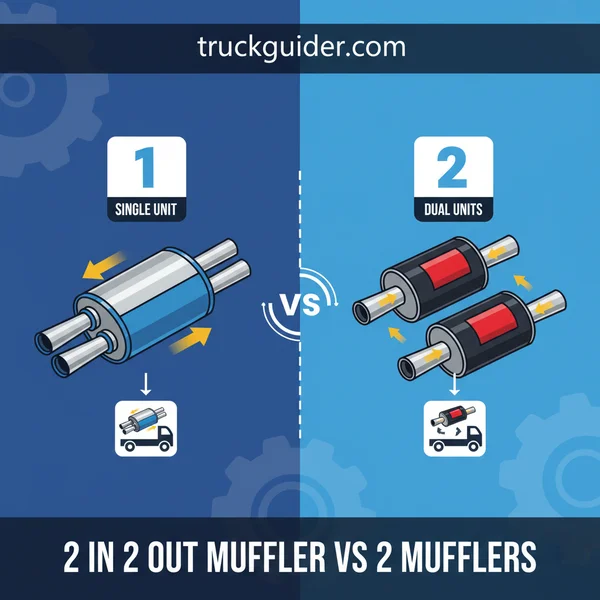
Practicality is the other major factor. While a single large muffler can save space in tight central tunnels, two smaller mufflers are often easier to tuck away near the rear axle or in narrow frame rails. Understanding these trade-offs is the difference between an exhaust system that drones miserably on the highway and one that delivers a crisp, performance-oriented snap every time you hit the throttle. If you are looking for the most efficient way to balance backpressure while refining your engine’s voice, the internal geometry of your muffler setup is the most important variable.
Scavenging and Performance: The Internal Crossover Advantage
The primary performance benefit of a 2-in/2-out muffler is the “X-pipe effect” occurring inside the casing. In a standard dual exhaust system with two separate mufflers, each bank of the engine operates in a vacuum, relatively speaking. The pulses from the left bank never “see” the pulses from the right bank. When you use a dual-in/dual-out unit, the internal chamber allows these pulses to merge and equalize. This creates a scavenging effect where the high-velocity exit of one exhaust pulse helps pull the next pulse from the opposing bank out of the cylinder head.
How Internal Merging Enhances Flow
Most high-quality 2-in/2-out mufflers, such as those from Magnaflow or Flowmaster, feature either an open middle chamber or a perforated X-junction. As exhaust gases enter the muffler, they aren’t just passing through a tube; they are expanding into a shared space. This expansion slows the gas slightly to reduce noise but allows the pressure to stabilize across both pipes. This results in:
- Reduced Backpressure: By giving the gas two exit paths regardless of which bank the pulse originated from, the effective flow area is doubled.
- Improved Volumetric Efficiency: Better scavenging means your engine spends less energy pushing out spent exhaust and more energy pulling in a fresh air-fuel charge.
- Torque Consistency: Internal crossovers help eliminate the “flat spots” in the powerband often found in completely isolated dual systems.
Eliminating the Need for a Separate X-Pipe
If you are building a custom exhaust and space is at a premium, a 2-in/2-out muffler can save you the hassle of fabricating a dedicated X-pipe or H-pipe upstream. Because the mixing happens inside the muffler body, you get the performance benefits of a crossover without the extra welds and tubing. This is particularly useful in mid-engine layouts or short-wheelbase trucks where there simply isn’t enough straight pipe before the mufflers to install a traditional crossover. You essentially get a two-for-one component that handles both sound suppression and pulse balancing.
Sound Profiles: Comparing Pulse Mixing vs. Bank Isolation
Recommended Best Deal Products


The sound of your vehicle is dictated by the frequency and timing of exhaust pulses hitting your eardrums. When you run two separate mufflers, you are hearing the distinct “thump” of each cylinder bank. This is what creates the classic “glub-glub” idle associated with American V8s. However, when you move to a 2-in/2-out system, those pulses are interleaved. The result is a much smoother, higher-pitched, and more modern exhaust note that sounds more like a precision-tuned racing engine than a tractor.
The Smoother, Higher Pitch of Merged Systems
When pulses from both banks merge inside a single muffler, the frequency of the exhaust note effectively doubles. Instead of hearing four distinct pulses per revolution on a V8 from one tailpipe, you are hearing eight merged pulses. This creates a “tenor” rather than a “bass” tone. It tends to be less “boomy” at low RPMs and more “screaming” at high RPMs. For drivers who want to avoid the “truck-like” drone of isolated duals, the 2-in/2-out configuration is often the preferred choice because it cancels out many of the harsh, low-frequency vibrations that cause cabin resonance.
Achieving the “Old School” Thump with Dual Units
If your goal is a deep, rhythmic lope that shakes the ground, two separate mufflers are the only way to go. By keeping the banks isolated, you prevent the pulses from smoothing each other out. This isolation highlights the firing order of the engine. Key characteristics of the two-muffler setup include:
- Distinct Pulse Definition: You can hear every individual combustion event, especially if you have a cam with significant overlap.
- Increased Low-End “Gutteral” Sound: The lack of mixing preserves the low-frequency energy of the exhaust.
- Stereo Effect: When standing behind the car, the left and right tailpipes will have slightly different acoustic signatures, providing a “stereo” experience that a merged system cannot replicate.
The Impact of Internal Packing
It is also worth noting that 2-in/2-out mufflers usually have more internal volume than a single small muffler, but less total volume than two separate units. This means that a single dual-path muffler might be slightly louder than two large individual mufflers, simply because there is less total sound-absorbing material (fiberglass or stainless mesh) surrounding the gas flow. If you choose a 2-in/2-out unit, look for “straight-through” perforated cores if you want maximum flow, or “chambered” internals if you want to retain some of that aggressive, metallic “cackle” during deceleration.
Packaging and Fitment: Managing Space and Chassis Constraints
When you are modifying an exhaust system, the physical footprint of your components often dictates your choices. While a dual-muffler setup is the traditional choice for muscle cars and trucks, it requires significantly more real estate under the chassis. You have to account for two separate canisters, two sets of hangers, and enough clearance to keep heat away from fuel lines and brake cables.

Audible — Listen Free for 30 Days
One free credit a month and thousands of titles included.
Listen Free for 30 DaysSolving the Tight Clearance Puzzle
A 2-in-2-out muffler is often a lifesaver for vehicles with limited underbody space. Because the internal crossover is built into a single case, you don’t need to find room for a separate X-pipe or H-pipe upstream. This “all-in-one” design is incredibly popular for mid-engine sports cars or vehicles with narrow driveshaft tunnels where running two parallel pipes and mufflers is physically impossible.
- Ground Clearance: Single units can often be tucked higher into the chassis, which is a major advantage for lowered cars.
- Transverse Mounting: Many modern hatchbacks and sports cars use a transverse (side-to-side) layout where one large 2-in-2-out muffler sits behind the rear axle.
- Driveshaft Constraints: On many rear-wheel-drive platforms, a single dual-path muffler prevents the need to crowd the differential area with bulky hardware.
Weight Distribution and Aesthetics
Don’t overlook the impact on weight. A single 2-in-2-out unit generally weighs less than two separate mufflers plus the additional piping and heavy-duty hangers required to support them. From an aesthetic standpoint, the dual-muffler look is iconic for “true dual” systems, but the single-unit approach provides a much cleaner, more streamlined appearance under the car.
Cost and Complexity: Maintenance of Single vs. Dual Units
Recommended Best Deal Products


Budget is always a factor, and the complexity of your exhaust architecture directly impacts both your initial investment and long-term maintenance. While performance is the primary driver, understanding the financial trade-offs will help you make a more sustainable choice for your build.
Initial Investment vs. Fabricator Labor
Generally speaking, purchasing one high-quality 2-in-2-out muffler is more affordable than buying two separate premium mufflers. However, the cost of the unit is only half the story. If you are doing a custom build, a dual-muffler setup is often easier for a local muffler shop to weld because the paths are straightforward. A 2-in-2-out setup requires more precise plumbing to align the dual inlets and outlets perfectly.
- Hardware Savings: With a single unit, you spend less on clamps, gaskets, and universal hangers.
- Reduced Welding Points: Fewer joints mean fewer opportunities for exhaust leaks to develop over time.
- Integrated X-Pipe: You save the cost of buying a standalone crossover pipe, as the mixing happens inside the muffler body.
Long-Term Durability and Replacement
Maintenance is where the “keep it simple” rule really shines. A single muffler has fewer mounting points that can fail due to rust or vibration. In a dual-muffler system, if one side gets damaged or develops a baffle rattle, you are often faced with a dilemma: replace just one side and risk a sound imbalance, or replace both to keep the system symmetrical. With a 2-in-2-out unit, any failure is centralized, making the diagnostic and replacement process much more straightforward.
Final Verdict: Which Setup Wins?
The choice between a 2-in-2-out muffler and a dual-muffler setup ultimately comes down to your vehicle’s layout and your sound preferences. If you want that classic, raw “true dual” separation and have plenty of room under the frame, two mufflers are hard to beat. However, if you are working with a modern performance car, a 2-in-2-out muffler provides a more sophisticated sound profile, better packaging, and often a more cost-effective way to achieve an integrated crossover effect.
Next Steps:
1. Measure your available width and height under the chassis to see if a large single unit or two slim units fit better.
2. Decide if you prefer a high-pitched, exotic “mix” (2-in-2-out) or a rhythmic, deep thumping (dual mufflers).
Whatever path you choose, upgrading your exhaust is the best way to unlock your engine’s true personality. Get under there, take some measurements, and start building the sound you’ve always wanted!
Audible Premium Plus — Annual Membership
12 audiobook credits up front, plus the full Audible catalogue.
See Annual Plans💬 Quick Questions & Answers
Does a 2-in 2-out muffler sound different than two mufflers?
Yes, it creates a smoother, more blended tone compared to the distinct, rhythmic pulses of two separate mufflers.
Which setup is better for performance?
A 2-in 2-out muffler is often superior due to internal pulse balancing, unless the two-muffler setup includes an X-pipe.
Can a 2-in 2-out muffler save weight?
Usually, yes, as one large unit typically weighs less than two mufflers and their associated mounting hardware.
Does a 2-in 2-out muffler help with drone?
Yes, the mixing of exhaust pulses helps cancel out resonant frequencies that cause interior drone.
Is it harder to install a 2-in 2-out muffler?
It can be more complex to route both pipes to one central location depending on your vehicle’s frame design.
❓ Frequently Asked Questions
How does a 2-in 2-out muffler act as a crossover?
Many dual-in/dual-out mufflers are designed with an internal ‘open’ chamber or an X-junction. This allows exhaust gases from both cylinder banks to mix, equalizing pressure and creating a scavenging effect that pulls gases out faster.
Why do some enthusiasts prefer two separate mufflers?
Two separate mufflers are chosen for a ‘true dual’ exhaust setup, which provides a classic, aggressive sound where each engine bank’s pulse is heard clearly. It is also the traditional choice for vehicles with plenty of space on either side of the driveshaft.
Will a 2-in 2-out muffler fit my truck or car?
It depends on your clearance; these units are often quite wide. They are popular on modern muscle cars and trucks where space is limited near the rear axle, as they can be tucked into a single cavity better than two separate units.
Does one setup offer better horsepower gains?
If the 2-in 2-out muffler has an internal X-pipe, it will usually outperform two separate mufflers that lack a crossover. However, a system with two mufflers and a separate X-pipe will offer nearly identical performance gains.
What is the sound difference at idle?
At idle, two separate mufflers often produce a ‘choppier’ and deeper sound. A 2-in 2-out muffler tends to sound more ‘exotic’ or high-pitched because the pulses from both sides of the engine are merged together.
Is a 2-in 2-out muffler more expensive?
While the single unit might cost more than a single standard muffler, it is often cheaper than buying two high-quality mufflers plus the extra piping and hangers required for a dual-muffler system.
![2019 Ram 2500 Oil Capacity And Lubricant: Full Specs & Data [2026]](https://truckguider.com/wp-content/uploads/2026/03/featured-1657b7c0-768x768.webp)
![Dodge Ram Tail Light Wiring Color Code: Year-by-Year Guide [2026]](https://truckguider.com/wp-content/uploads/2026/03/dodge-ram-tail-light-wiring-color-code-featured.webp)
![2019 Ram 2500 Tradesman: Full Specs & Data [2026]](https://truckguider.com/wp-content/uploads/2026/03/2019-ram-2500-tradesman-featured.webp)
![AMP Research PowerStep Warranty: Coverage & Claim Guide [2026]](https://truckguider.com/wp-content/uploads/2026/03/amp-research-power-step-warranty-featured.webp)
![PWQ Paint Code: Diagnosis & Repair [2026]](https://truckguider.com/wp-content/uploads/2026/03/pwq-paint-code-featured.webp)