Lifted 3rd Gen Cummins [2026]

Finding the perfect lift and tire combination for a 3rd Gen Cummins requires balancing visual stance with critical steering upgrades to maintain drivability. While 3-inch lifts are the gold standard for 35-inch tires, larger 6-inch setups demand adjustable track bars and steering stabilizers to prevent the notorious ‘death wobble’ common on this platform.
🎯 Key Takeaways
Recommended Best Deal Products


- 3-inch lifts comfortably clear 35-inch tires with minimal trimming on most setups.
- Always upgrade to an adjustable track bar to re-center the front axle.
- Negative wheel offsets (-12 to -44) provide that sought-after aggressive wide stance.
- Steering box braces are essential for maintaining 3rd Gen front-end stability and longevity.
- 6-inch lifts typically require 37-inch tires to avoid looking ‘under-tired’ in the wheel wells.
Achieving the perfect stance on your 3rd Gen Cummins requires more than just raw height; it’s about balancing tire clearance with the notorious front-end geometry of the 2003–2009 Ram heavy-duty platform. For most owners, the “gold standard” setup involves a 3-inch or 6-inch lift paired with 35-inch or 37-inch tires, but getting there without ruining your ride quality or inducing death wobble takes a specific recipe of components. This guide cuts through the noise to show you exactly which lift heights accommodate specific wheel offsets and tire diameters.

Prime for Young Adults — 6 Months Free
Students and 18–24s get six months of Prime free, then half price.
Start 6 Months Free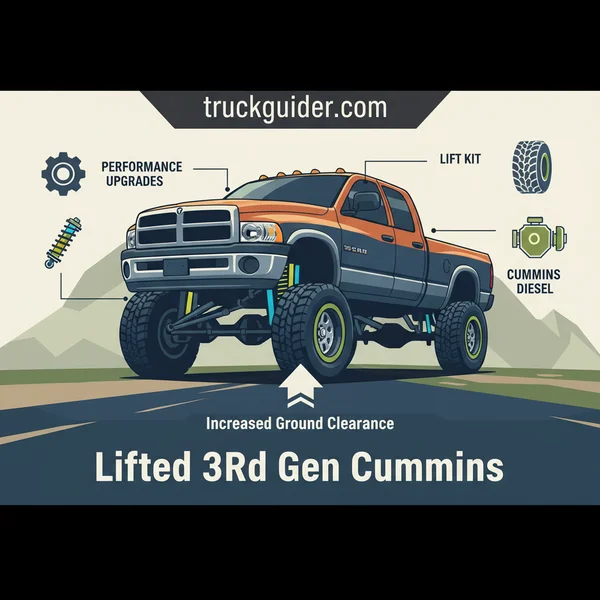
Practically speaking, your lift choice dictates your truck’s utility. A 3-inch setup maintains towing stability and daily driveability, while a 6-inch kit transforms your Ram into a dedicated show or off-road machine. Understanding how backspacing and offset interact with these heights is the difference between a truck that turns lock-to-lock and one that requires you to trim your fenders and firewall just to pull into a parking spot.
Popular 3rd Gen Lift Recipes: From 3-Inch Levels to 6-Inch Kits
The 3rd Gen Ram 2500 and 3500 respond differently to lift heights than modern trucks. Because of the solid front axle and radius arm or four-link design, every inch of lift shifts your axle center. Choosing the right height depends on whether you value high-speed dirt performance or a towering street presence.

The 3-Inch and 4-Inch “Utility” Lifts
The 3-inch lift is the most common setup for 3rd Gen owners who want to run 35-inch tires while actually improving ride quality. At this height, you aren’t just leveling the truck; you are gaining enough travel to utilize high-end shocks like Fox or King. The 4-inch lift serves as the perfect middle ground. It provides enough gap to fit 37-inch tires on narrow wheels without the massive step-up height of a 6-inch kit.
- 3-Inch Ideal Tire: 35×12.50R17 or 35×12.50R20
- 4-Inch Ideal Tire: 37×12.50R17 (on factory wheels) or 35×12.50R20 (aggressive offset)
- Wheel Setup: 17×9 or 20×9 with +12mm to +18mm offset
- Key Components: Linear or multi-rate coil springs, extended sway bar links, and an adjustable track bar.
The 6-Inch “Big Rig” Stance
If your goal is to clear 37-inch or 38-inch tires with a wide, aggressive stance, a 6-inch lift is the industry standard. This height requires significant geometry corrections, including drop brackets for the control arms or a full long-arm conversion. Long arms are highly recommended at 6 inches to prevent the harsh, “choppy” ride associated with steep short-arm angles. This height also requires a dropped pitman arm to keep your drag link and track bar parallel.
- Ideal Tire: 37×13.50R20 or 38×13.50R22
- Wheel Setup: 20×10 or 22×12 with -12mm to -44mm offset
- Key Components: Long arm kit, dropped pitman arm, extended brake lines, and rear lift blocks or full leaf packs.
The Ultimate Tire and Wheel Fitment Guide for Ram 2500/3500
Recommended Best Deal Products

Fitment on a 3rd Gen is a game of millimeters. The narrow wheel wells of the 2003–2009 body style are less forgiving than the 4th Gen or 5th Gen models. To avoid the “pizza cutter” look or the “rubbing at half-turn” nightmare, you must match your wheel width and offset to your lift height perfectly.
Running 35s: The Sweet Spot
A 35-inch tire is the natural partner for the 3rd Gen Cummins. On a 3-inch lift, a 35×12.50 will fit perfectly if you stay near a factory-style offset. If you choose a wheel with a deep lip (negative offset), you will likely rub the back of the fender well and the plastic liner. For a flush look that doesn’t rub, stick to a 9-inch wide wheel with positive offset.
- 35s on 17-inch wheels: Provides more sidewall for a softer ride and better off-road traction.
- 35s on 20-inch wheels: Offers a modern, crisp look but feels firmer over potholes and expansion joints.
- Trimming: Usually none required with +18mm wheels; minor plastic liner trimming needed for 0mm wheels.
Running 37s: The High-Clearance Challenge
Fitting 37s on a 3rd Gen requires at least 4 inches of lift, but 6 inches is safer for full articulation. The biggest hurdle is the “pinch weld” at the rear of the front fender. When you turn the wheel, the outer edge of the 37-inch tire will swing close to this metal edge. To run 37s successfully on lower lifts, many owners use “high clearance” control arms that are slightly longer than stock to push the axle forward by about half an inch.
- Best Offset for 37s: +12mm or +18mm keeps the tire tucked to avoid the fender; -24mm or -44mm pushes the tire out for a wide stance but requires heavy trimming of the metal fender.
- Wobble Prevention: 37-inch tires add massive reciprocating mass. Dual steering stabilizers and a steering box brace are mandatory at this size to keep the front end tight.
- Wheel Width: Stick to a 9-inch or 10-inch wide wheel. Going to a 12-inch wide wheel with 37s on a 3rd Gen almost guarantees significant rubbing issues unless you are at 6+ inches of lift.
Solving the Death Wobble: Critical Supporting Mods for Lifted Trucks
The 3rd Gen Cummins is notorious for the “Death Wobble”—that terrifying, violent shaking of the front end after hitting a bump at highway speeds. When you lift these trucks, you change the suspension geometry, which often amplifies any existing play in the front end. To keep your lifted 2500 or 3500 tracking straight and safe, you cannot ignore the supporting components.
The Role of the Heavy-Duty Adjustable Track Bar
The factory track bar is a common failure point. It uses a ball-joint style end that wears out quickly under the weight of the heavy 5.9L or 6.7L Cummins engine. When you lift the truck, the axle is pulled toward the driver’s side. An adjustable track bar allows you to re-center the axle and replaces the weak factory joint with a much stronger spherical bearing or high-durometer bushing.

Audible — Listen Free for 30 Days
One free credit a month and thousands of titles included.
Listen Free for 30 Days- Better Handling: Eliminates side-to-side axle shift during suspension travel.
- Durability: Brands like Thuren Fabrication or Carli Suspension offer bars that outlast factory units by years.
- Precision: High-quality bars use 1.5-inch or larger steel tubing to prevent flexing under load.
Steering Box Braces and T-Style Upgrades
Because of the massive torque and heavy tires, the steering box sector shaft can flex, leading to a “dead spot” in your steering wheel. A steering box brace ties the sector shaft to the frame on both sides, significantly reducing wear. Additionally, many owners swap the 2003-2008 “Y-style” steering linkage for the 2008.5+ “T-style” linkage. This creates a direct connection between the knuckles, preventing the “toe-change” common when the suspension cycles on earlier models.
Evaluating Suspension Types: Radius Arms vs. 4-Link Conversions
Once you move past a basic 3-inch leveling kit and head toward a 4-inch to 6-inch lift, you have to decide how to locate the front axle. The factory short-arm setup becomes very steep at higher lift heights, leading to a harsh ride because every bump sends force directly into the frame rather than into the springs.
Radius Arms: Simplicity and Strength
Radius arms use a single large arm on each side to locate the axle. Many premium lift kits, such as those from BDS Suspension, utilize this design for its simplicity and improved ground clearance. Because the arm is much longer than the factory control arms, it moves in a much larger arc, which flattens out the suspension cycle and improves ride quality significantly over stock-length arms.
- Pros: Fewer moving parts, excellent ground clearance, and easier installation.
- Cons: Can cause a slight “caster change” as the suspension moves through its full range of travel.
4-Link Conversions: The Ultimate in Geometry
If you are building a high-end 3rd Gen for technical off-road use or the absolute best highway ride, a 4-link conversion is the gold standard. This setup uses four independent arms to hold the axle. By separating the upper and lower attachment points, the axle stays at a constant caster angle regardless of how much the suspension compresses or rebounds. This results in a truck that feels more planted and predictable at high speeds.
- Best For: Trucks running 6-inch lifts or larger where geometry correction is vital.
- Performance: Offers the most “bind-free” movement for maximum articulation during off-roading.
- Example: A 4-link kit paired with 2.5-inch diameter reservoir shocks will transform a heavy 3rd Gen into a surprisingly nimble machine.
Conclusion: Building Your Perfect 3rd Gen
Building a lifted 3rd Gen Cummins is about more than just fitting bigger tires; it is about balancing height with high-quality components that can handle the weight of the legendary 24-valve engine. Whether you choose a simple leveling kit with 35s or a full 4-link conversion on 37s, focusing on steering geometry and track bar strength will ensure your truck drives as good as it looks. Remember that cutting corners on a heavy-duty truck often leads to costly repairs down the road.
Your next steps: Inspect your front-end bushings for wear before ordering a lift, and always prioritize an adjustable track bar as your first supporting mod. Get out there, choose the right kit for your driving style, and enjoy the view from the driver’s seat of your built Cummins!
💬 Quick Questions & Answers
What size tires fit a leveled 3rd Gen Cummins?
Most 3rd Gens can fit 35×12.50 tires on stock or high-offset wheels with minor plastic trimming.
Will a 6-inch lift cause death wobble?
A lift itself doesn’t cause it, but it exacerbates worn components like ball joints and track bars.
Audible Premium Plus — Annual Membership
12 audiobook credits up front, plus the full Audible catalogue.
See Annual PlansWhat wheel offset is best for a wide stance?
A -12mm to -24mm offset provides a noticeable ‘poke’ without excessive rubbing issues.
Do I need a new driveshaft for a 4-inch lift?
Usually not, but a transfer case clocking ring helps improve driveline angles on some 3rd Gens.
Can I run 37s on a 4-inch lift?
Yes, but you will likely need significant trimming or high-clearance fenders to prevent rubbing at full lock.
❓ Frequently Asked Questions
What are the most common steering upgrades for a lifted 3rd Gen?
To maintain control, you should install a steering box brace, a heavy-duty adjustable track bar, and an upgraded steering stabilizer. Many owners also convert to the ‘T-style’ steering linkage found on 2008.5+ models for superior geometry.
How does lift height affect the towing capacity of a Ram 2500?
While the engine remains capable, a lift can increase sway and change the hitch height. High-quality kits with full rear leaf packs or supplementary airbags help maintain stability while towing heavy loads.
Is a 3-inch or 4-inch lift better for a daily driver?
A 3-inch lift is often preferred for daily driving as it maintains better road manners and ease of entry while allowing for 35-inch tires. 4-inch kits often require more suspension tuning to ride as smoothly.
Why is an adjustable track bar necessary for 3rd Gen Rams?
Because the 3rd Gen uses a solid front axle, lifting the truck pulls the axle toward the driver’s side. An adjustable track bar allows you to re-center the axle perfectly under the frame.
What is the difference between a spacer lift and a full suspension kit?
Spacers are budget-friendly but retain factory ride quality and travel, whereas full kits include new coils and shocks designed for the increased height. Full kits provide superior performance off-road and better longevity.
Will 20×12 wheels rub on a 6-inch lift?
With 37-inch tires, 20×12 wheels with deep negative offsets will often rub the back of the fender well and bumper during tight turns. Trimming the plastic liners and metal pinch welds is usually required.