2018 Ram 3500 Towing Capacity Chart: Configuration And Engine Weight Ratings

For professional haulers and RV enthusiasts alike, the 2018 Ram 3500 remains a benchmark of heavy-duty capability, offering some of the highest towing figures in its class. In an era where “towing capacity” is often used as a marketing buzzword, the Ram 3500 delivers tangible mechanical strength that translates to real-world productivity. However, navigating the complex 2018 Ram 3500 towing capacity chart can be confusing, as ratings vary by tens of thousands of pounds based on engine choice, axle ratios, and cab configurations. This expert guide provides a detailed breakdown of every configuration, helping you identify the exact towing and payload limits of your truck to ensure safe and reliable operations.


Factors That Determine the 2018 Ram 3500 Towing Capacity Chart
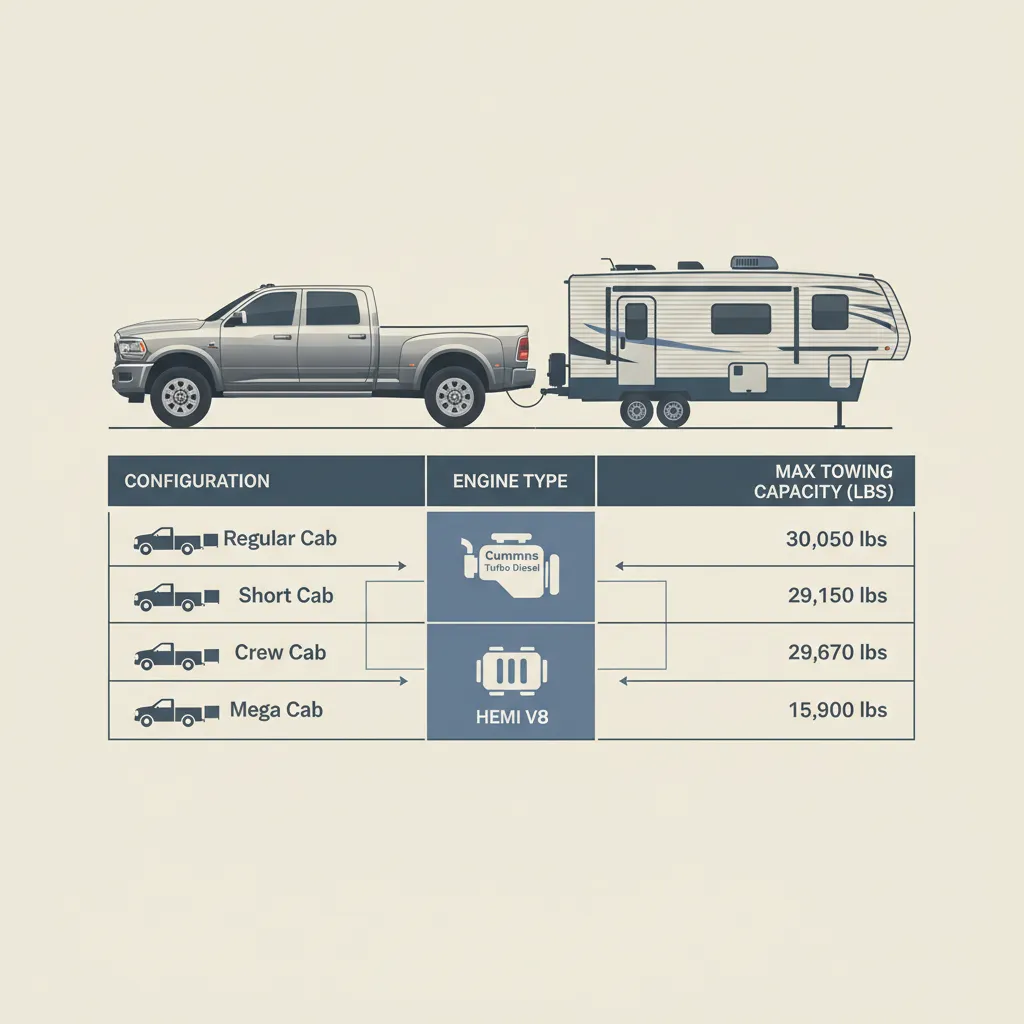
Understanding the 2018 Ram 3500 towing capacity chart requires more than just looking at the top-line number. In my 15 years of heavy-duty truck evaluation, I’ve seen many owners overlook how configuration affects the “net” towing capacity. The Gross Combined Weight Rating (GCWR) is a fixed number determined by the manufacturer; any weight you add to the truck itself—be it a heavier cab or a 4WD system—must be subtracted from that GCWR, leaving you with a lower trailer capacity.
Influence of Cab Configuration and Drivetrain
The Regular Cab 4×2 models are the champions of the complete towing chart. Why? Because a Regular Cab is lighter than a Crew Cab or the massive Mega Cab. Similarly, the 4×4 system adds approximately 400 to 600 lbs of mechanical components (transfer case, front differential, drive shafts). Research indicates that a 2018 Ram 3500 Regular Cab Long Box 4×2 Diesel can tow significantly more than a Mega Cab 4×4 Diesel simply because the truck itself weighs less, allowing more of the GCWR to be allocated to the trailer.
The Role of Rear Axle Ratios
The axle ratio is the mathematical relationship between the revolutions of the driveshaft and the revolutions of the rear wheels. For the 2018 model year, Ram offered three primary ratios: 3.42, 3.73, and 4.10. A higher numerical ratio (4.10) provides more torque multiplication at the wheels. This is critical for “launching” a heavy load from a standstill. While a 3.42 ratio is excellent for fuel economy when cruising empty, it lacks the mechanical advantage needed for the 30,000-lb threshold. Professional haulers almost exclusively opt for the 4.10 ratio for maximum performance.
If you are towing a 5th wheel or gooseneck trailer, always opt for the Dual Rear Wheel (DRW) setup. The “Dually” provides lateral stability that Single Rear Wheel (SRW) trucks cannot match, preventing the “tail wagging the dog” sensation at highway speeds.
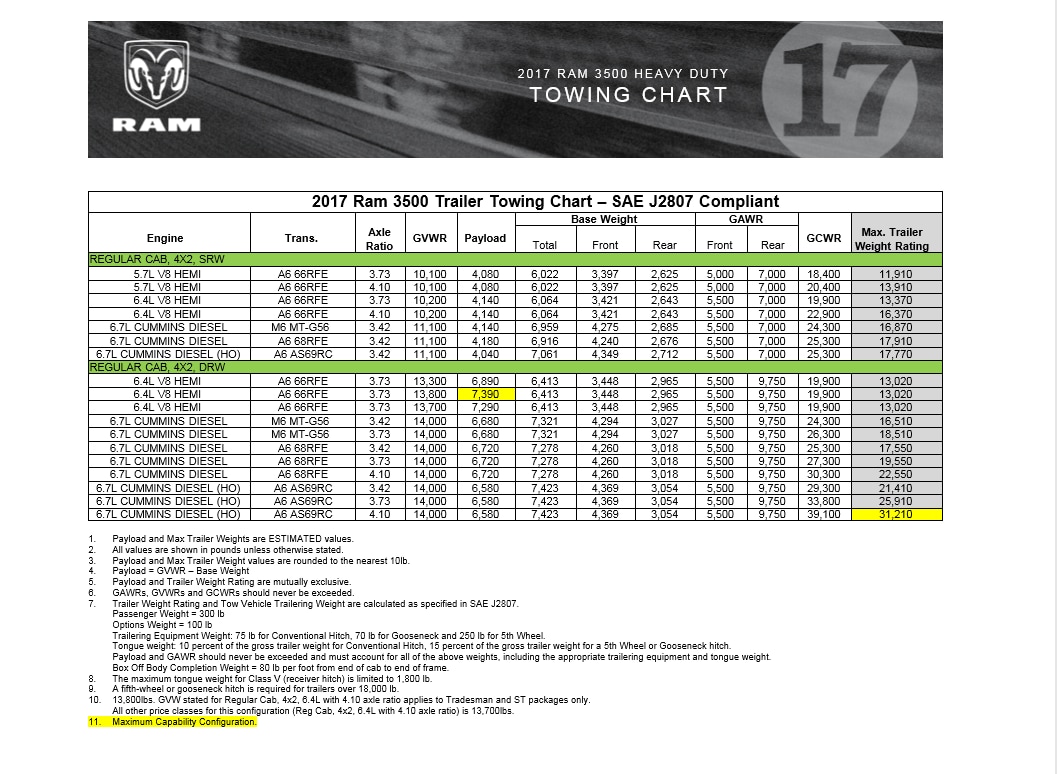
2018 Ram 3500 Towing Capacity Chart by Engine and Transmission
The heart of the 2018 Ram 3500 is its powertrain. For this model year, the choices were distinct, catering to different levels of duty. Whether you are moving a horse trailer or a multi-car wedge, selecting the right engine and transmission pairing is the most trusted way to ensure your truck isn’t overworked.
By The Numbers
Max Towing (Lbs)
Max Torque (Lb-Ft)
Max Payload (Lbs)
Max Gas Towing (Lbs)
6.7L Cummins Turbo Diesel Performance
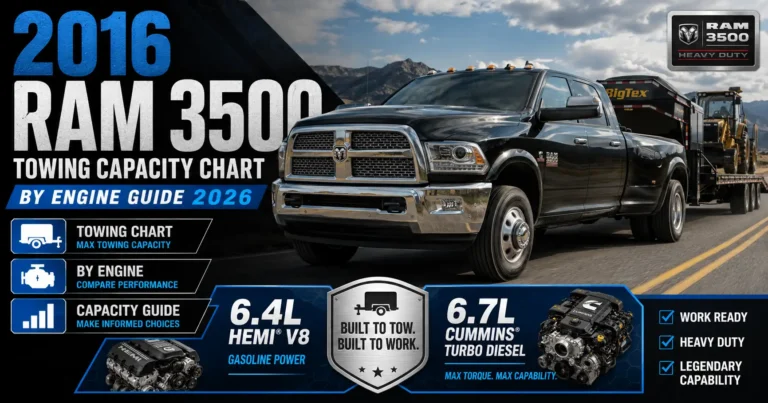
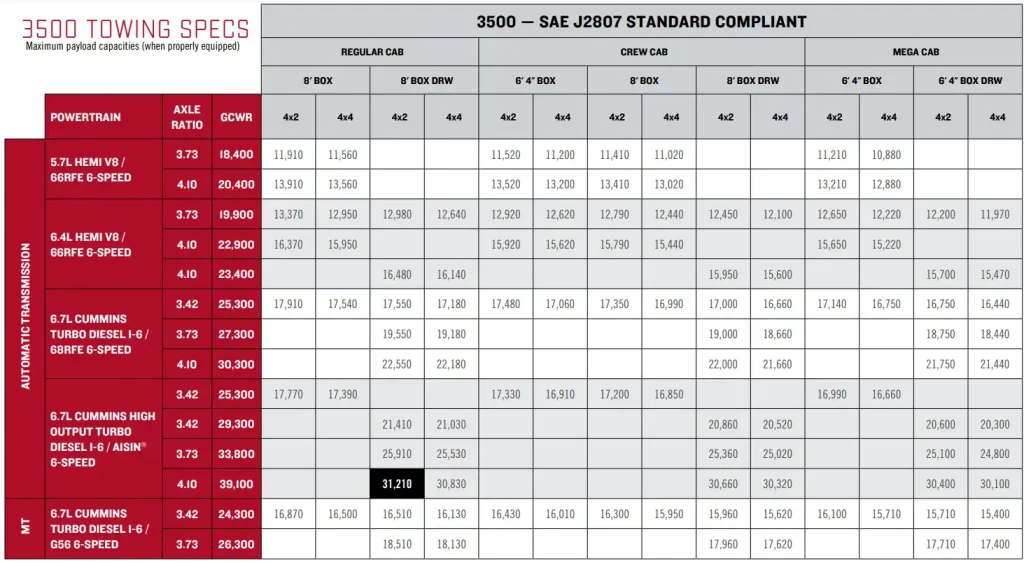
The 6.7L Cummins is the gold standard for heavy-duty towing. In 2018, there were two distinct versions of the diesel engine. The High Output (HO) variant produced 385 horsepower and a staggering 930 lb-ft of torque. To handle this massive output, Ram utilized the Aisin AS69RC six-speed automatic transmission. This combination allowed for the peak towing capacity exceeding 31,000 lbs. The standard output diesel (370 hp / 800 lb-ft) was paired with the 68RFE transmission, which is a quality unit but is generally rated for lighter loads compared to the Aisin.
6.4L HEMI V8 Gasoline Ratings
For those who don’t require the extreme torque of a diesel or wish to avoid the higher maintenance costs associated with DEF and diesel particulate filters, the 6.4L HEMI V8 is a formidable alternative. Offering 410 horsepower and 429 lb-ft of torque, it provides a towing capacity typically ranging from 12,000 to 16,480 lbs. To reach the upper end of that range, a 4.10 axle ratio is mandatory. If you have a 3.73 ratio with the gas engine, expect your capacity to hover closer to the 13,000-lb mark.
Understanding Essential Towing Metrics: GCWR, Payload, and GAWR
As a professional in the industry, I cannot stress enough that “Towing Capacity” is only one part of the equation. Safe hauling requires a comprehensive understanding of your truck’s weight ratings. Overloading a truck isn’t just a safety hazard; it’s a legal liability and a recipe for catastrophic mechanical failure.
![VIPCAR 01108 Professional Water Pump for Dodge [5.7L V8 HEMI] Engine, 2009-2018…](https://m.media-amazon.com/images/I/312eBpGsdNL._SS500_.jpg)


Gross Combined Weight Rating (GCWR)
The GCWR is the absolute maximum permissible weight of the truck, the trailer, all passengers, fuel, and cargo. For the 2018 Ram 3500, the GCWR can reach as high as 39,100 lbs in the maximum diesel configuration. If your truck weighs 8,000 lbs loaded with your family and gear, your maximum trailer weight is mathematically capped at 31,100 lbs, regardless of what the brochure says.
Payload vs. Pin Weight
Payload capacity is the amount of weight the truck can carry in its bed and cabin. While the 2018 Ram 3500 has a max payload of 7,350 lbs, this is for the regular cab gas dually. When you move to a high-trim diesel Mega Cab, payload drops significantly. This is critical for 5th wheel towing, where the “pin weight” (the weight the trailer exerts downward on the hitch) typically accounts for 15% to 25% of the total trailer weight. A 15,000-lb trailer could have a 3,000-lb pin weight, which may exceed the payload capacity of some SRW configurations.
Never rely solely on generic online charts. Always check the tire and loading information sticker located on the driver-side door jamb. This provides the reliable data specific to your truck’s VIN, accounting for all factory-installed options.
Expert Recommendations for 5th Wheel and Gooseneck Towing
When you start pushing into the upper echelons of the 2018 Ram 3500 towing capacity chart, you are no longer in the realm of bumper-pull towing. Standard hitches are generally capped at 20,000 lbs. To access the 30,000-lb+ ratings, you must utilize a gooseneck or 5th wheel setup. This requires expert equipment and setup.
Factory Tow Prep
The available 5th Wheel/Gooseneck Prep Group includes integrated mounting holes and a 7-pin bed connector for a clean, structural fit.
Exhaust Braking
The Cummins Smart Diesel Exhaust Brake provides world-class descent control, essential for preserving service brakes on steep grades.
Auto-Level Rear Air Suspension
One of the best features for heavy hauling is the available Auto-Level Rear Air Suspension. Unlike traditional leaf springs that sag under load, this system uses air bags to maintain a level vehicle rake. This ensures that your headlight aim remains correct and that your front tires maintain the necessary contact with the road for trusted steering and braking response. In my experience, this feature is a “must-have” for anyone towing over 15,000 lbs frequently.


Selecting a Professional-Grade Hitch
Don’t bottleneck your truck’s capability with an inferior hitch. If your truck is rated for 30,000 lbs, ensure your hitch is rated for 30,000 lbs. Many standard 5th wheel hitches are only rated for 16,000 or 20,000 lbs. Always check the ratings on the hitch itself and ensure your safety chains and breakaway switches are in expert working condition. You can find high-quality replacement parts and accessories via Mopar to ensure compatibility.
Safety Best Practices for Reliable Heavy-Duty Hauling
Owning a truck with a massive towing capacity is a responsibility. Utilizing that capacity safely requires a disciplined approach to maintenance and operation. Overheating is the number one cause of transmission failure when towing at more than 80% of the max rated capacity, so monitoring your vitals is a complete necessity.
📋
Safety Checklist
Adjust the integrated trailer brake controller gain so the trailer brakes engage smoothly without locking up or pushing the truck.
Verify that truck and trailer tires are at the maximum cold pressure indicated on the sidewall for heavy loads.
Keep the digital cluster set to monitor transmission and oil temperatures during long climbs to avoid thermal stress.
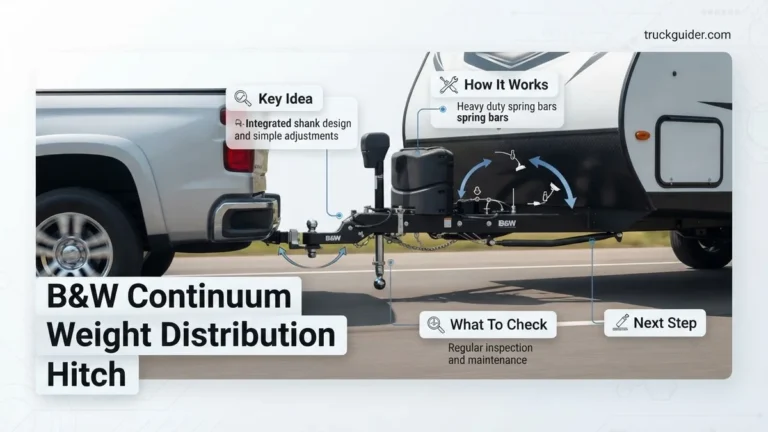
Finally, always ensure your weight distribution is correct. For conventional bumper-pull towing, use a weight distribution hitch to prevent front-end lift. For all towing types, ensure the trailer is loaded with a slightly “front-heavy” bias to prevent swaying. For detailed mechanical specs, you can consult the Ram specs provided in the Body Builder’s Guide.
Towing capacity is heavily dependent on the Cummins vs. Hemi engine choice and the specific rear axle ratio. The 2018 Ram 3500 reaches its 30,000+ lb max only in specific Regular Cab 4×2 Dually configurations with the Aisin transmission. Safety should always come first by respecting the GCWR and GAWR limits listed on your specific vehicle’s door jamb. Before hitching up your next load, verify your specific VIN data and ensure your hitch equipment is rated for the job. For more heavy-duty maintenance tips, explore our comprehensive expert tips on diesel care.
Frequently Asked Questions
What is the maximum towing capacity of a 2018 Ram 3500 Diesel?
The maximum towing capacity for the 2018 Ram 3500 equipped with the 6.7L Cummins Turbo Diesel (High Output) is approximately 31,210 lbs. This requires the Regular Cab 4×2 configuration, Dual Rear Wheels (DRW), and the 4.10 axle ratio. Other diesel configurations typically range between 17,000 and 25,000 lbs depending on the cab and drivetrain.


How does the 6.4L HEMI compare to the Cummins for towing?
The 6.4L HEMI V8 is a reliable gasoline option with a max towing capacity of roughly 16,480 lbs. While it offers lower overall towing compared to the Cummins’ 30k+ limit, it provides a higher payload capacity due to the lighter engine weight. It is ideal for those who prioritize payload or tow lighter trailers less frequently.
Does the 4×4 system reduce my towing capacity?
Yes, choosing a 4×4 drivetrain typically reduces the towing capacity by several hundred pounds. This is because the 4×4 components (transfer case, front drive axle) increase the truck’s curb weight, which subtracts from the Gross Combined Weight Rating (GCWR). For the absolute highest towing numbers, a 4×2 model is required.
What axle ratio is best for heavy towing in a Ram 3500?
For maximum towing performance, the 4.10 axle ratio is superior as it provides more torque multiplication at the wheels. If you are towing moderate loads or prioritize highway fuel economy, the 3.42 or 3.73 ratios are professional choices that balance capability with efficiency.
Where can I find my truck’s exact towing capacity?
The most reliable way to find your specific truck’s capacity is to check the Tire and Loading Information sticker on the driver’s side door jamb. For a professional-grade assessment, you can enter your VIN into the Ram Trucks ‘Towing & Payload’ online tool to see the exact ratings for your unique build configuration.