2017 Ram 1500 Towing Capacity: Full Chart & Specs [2026 Guide]

The 2017 Ram 1500 is one of the most capable and well-engineered half-ton pickups ever built. But knowing your truck’s exact towing capacity requires more than a quick Google search — it depends on your engine, axle ratio, cab size, and drivetrain.
This guide breaks down every configuration using official, SAE J2807-compliant data. Whether you’re towing a travel trailer, a boat, or heavy equipment, this is your complete reference for the 2017 Ram 1500 towing capacity.


2017 Ram 1500 towing capacity comparison by engine and cab size
Max towing capacity (lbs) — 3.92 axle ratio, optimal configuration
Max tow penalty by cab upgrade — 5.7L HEMI, 8-spd, 3.92 axle, 4×2
Max tow (any config)
10,640
lbs — HEMI / 3.92 / 6-spd
Max GCWR
15,950
lbs — HEMI V8
Max payload
1,880
lbs — V6 / Reg Cab
What Makes the 2017 Ram 1500 Different?
By 2017, Ram had established a unique engineering philosophy that prioritized ride quality, aerodynamic efficiency, and advanced powertrain technology. This wasn’t just about raw numbers — it was about how the truck handled real-world towing conditions.
The fourth-generation Ram platform introduced features rarely seen in half-ton trucks at the time: coil-spring rear suspension, available air leveling, and a class-exclusive diesel option. These innovations directly affect towing performance in ways the raw capacity numbers don’t always reveal.
If you want to understand what your 2017 Ram 1500 is truly capable of, you need to look at the full mechanical picture — not just the advertised maximum number.
Foundational Engineering: How the Ram 1500 Tows
High-Strength Steel Frame
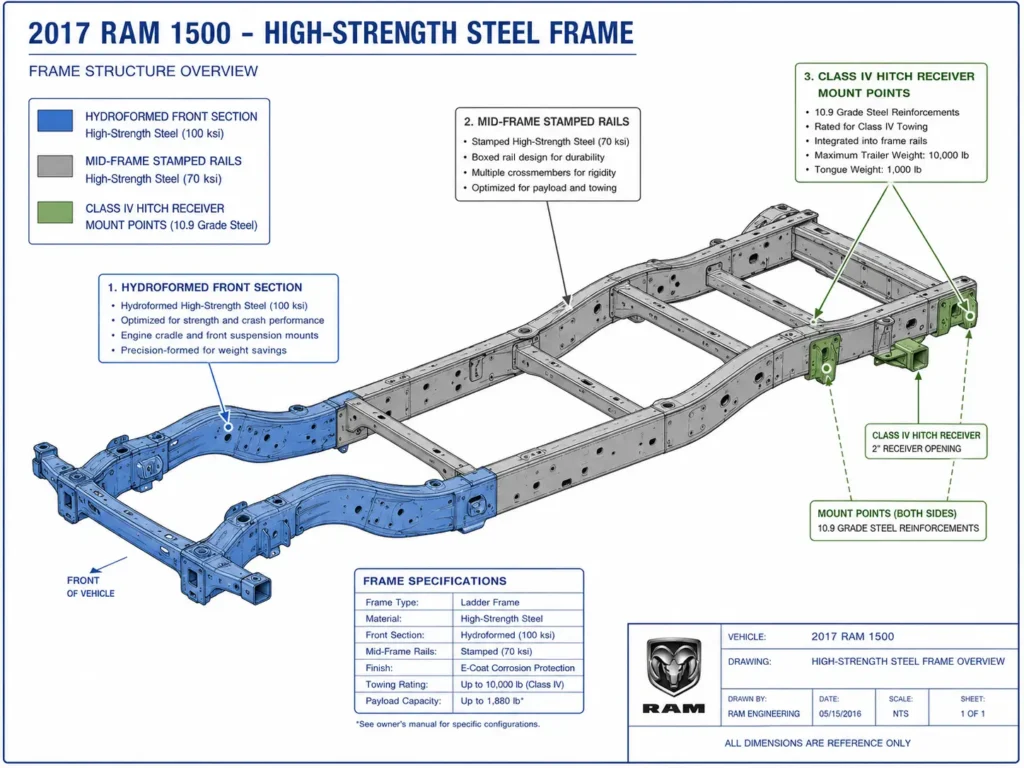
The foundation of every 2017 Ram 1500 is a high-strength steel frame built to handle dynamic towing stresses up to 10,640 lbs. Unlike older designs, this chassis uses a hydroformed tubular front section integrated with stamped steel mid- and rear rails.
This architecture distributes kinetic energy evenly across the full length of the frame. When the Class IV receiver hitch — bolted directly to the rear frame rails — faces a tongue weight of up to 1,100 lbs, the frame maintains structural integrity without deflecting or compromising steering geometry.
Five-Link Coil-Spring Rear Suspension
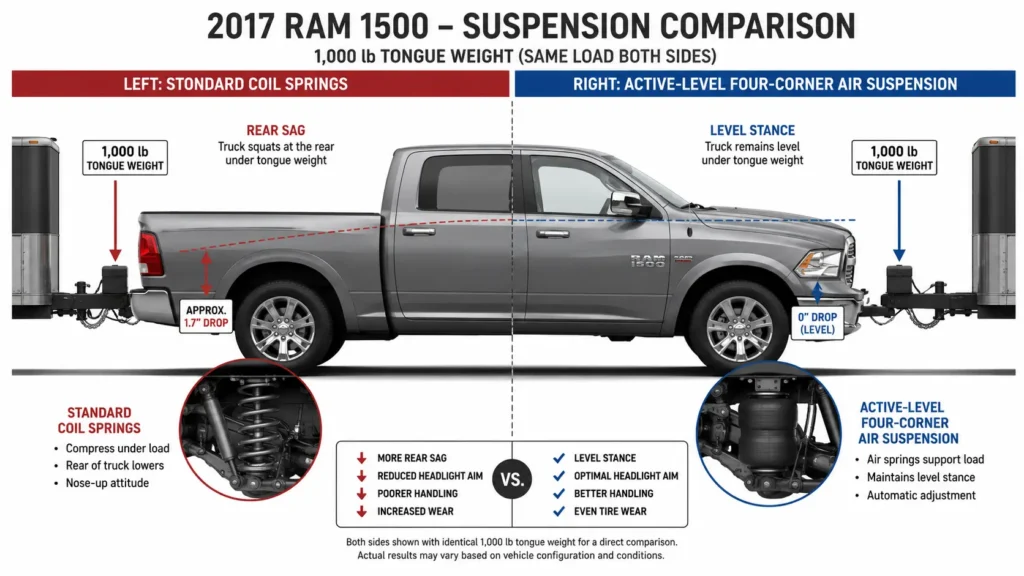
The 2017 Ram 1500 ditches the traditional leaf-spring rear suspension used by most competitors. Instead, it uses a proprietary five-link independent rear setup with coil springs, twin-tube shocks, a solid rear axle, and a Panhard track bar.
This setup reduces parasitic friction and dramatically improves ride quality — even under load. The track bar actively limits lateral axle movement, eliminating the “axle wrap” and wheel hop common to leaf-sprung trucks during heavy acceleration while towing.
Thinking about upgrading your suspension for heavier towing? See our guide on the best suspension upgrades for Ram 1500 for bolt-on options.
Active-Level Four-Corner Air Suspension (Available)
For maximum towing performance, the available Active-Level air suspension is a game-changer. It replaces the coil springs and shocks with pneumatic air bags connected to an onboard compressor.
When you hook up a heavy trailer, the system detects rear-end squat and automatically inflates the rear bags to keep the chassis level. A perfectly horizontal chassis means proper front tire contact, correct headlight aim, and maximum braking efficiency.
The system also includes an “Aero Mode” that lowers the front suspension by 0.6 inches and the rear by 1.7 inches at highway speeds, reducing aerodynamic drag and improving fuel economy while towing.
Braking: Stopping a 16,000-lb Combined Mass
Stopping the maximum combined weight of a loaded Ram 1500 and trailer — up to 15,950 lbs — requires serious braking hardware. The 2017 Ram 1500 uses four-wheel vented disc brakes with ABS across all trim levels.
Front rotors measure 336 × 28 mm (13.2 × 1.1 in) with twin-piston calipers. Rear rotors are 352 × 22 mm (13.8 × 0.87 in) with single-piston calipers. When paired with the optional factory-integrated electronic trailer brake controller, braking forces are coordinated between the truck and trailer to prevent jackknifing.


![[2026 Upgraded] DooGooCoo Windshield Sun Shade for RAM 1500 2500 3500 2009-2017…](https://m.media-amazon.com/images/I/51wc2YRpoAL._SS500_.jpg)
2017 Ram 1500 Engine Options and Maximum Towing Capacity
The 2017 Ram 1500 came with three engine choices. Each has a different towing ceiling, torque curve, and ideal use case. Your engine is the single biggest factor in your maximum tow rating.
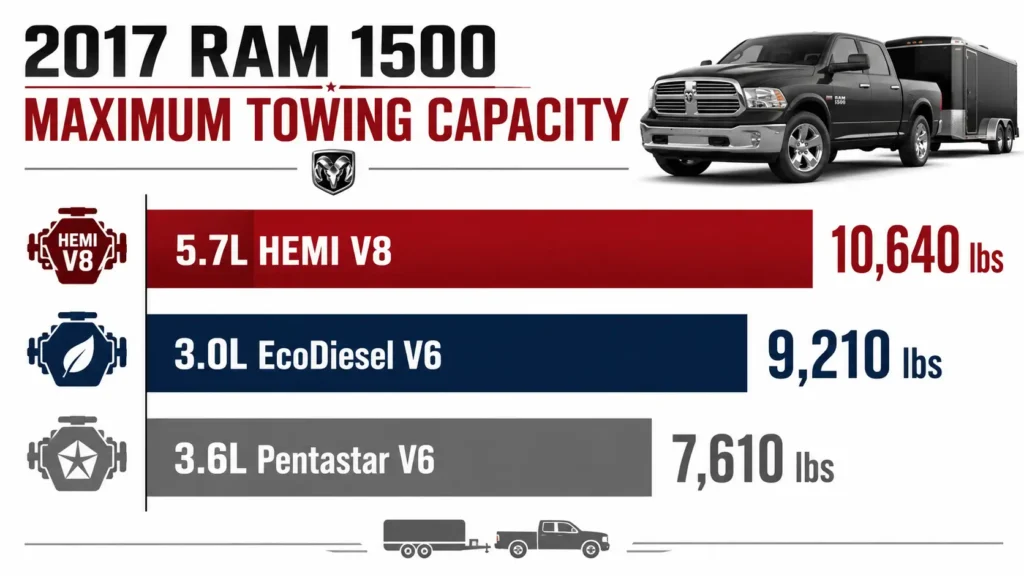
3.6L Pentastar VVT V6 — Up to 7,610 lbs
The base engine is the naturally aspirated 3.6-liter Pentastar V6 with Dual Overhead Cams (DOHC) and Variable Valve Timing. It produces 305 hp and 269 lb-ft of torque.
Paired with the TorqueFlite 845RE 8-speed automatic, the Pentastar V6 can tow up to 7,610 lbs and carry a payload up to 1,880 lbs. The 8-speed’s aggressive 4.71:1 first gear ratio multiplies torque well for a V6, making it surprisingly capable off the line.
This engine is best for: light-duty utility, small fiberglass boats, single-axle utility trailers, and pop-up campers under 6,500 lbs.
3.0L EcoDiesel V6 — Up to 9,210 lbs
The 3.0-liter EcoDiesel, built by VM Motori with a compacted graphite iron (CGI) block, is the fuel-efficiency champion of the Ram 1500 lineup. It makes 240 hp @ 3,600 RPM and an impressive 420 lb-ft of torque @ 2,000 RPM.
That low-RPM torque is the key to its towing ability. At just 2,000 RPM — barely off idle — it delivers maximum pulling force, reducing the need for constant transmission downshifting under load. Maximum towing reaches 9,210 lbs with the ZF 8HP70 8-speed automatic and a 3.92 axle ratio.
Maximum GCWR is 14,750 lbs. Payload is 1,600–1,610 lbs, slightly lower due to the heavier diesel block. This is the ideal engine for long-distance towing with fuel economy as a priority.
5.7L HEMI V8 with MDS — Up to 10,640 lbs
The 5.7L HEMI V8 is the top towing engine in the 2017 Ram 1500 lineup. This pushrod OHV engine features hemispherical combustion chambers, dual spark plugs per cylinder, and Multi-Displacement System (MDS) technology that shuts off four cylinders under light loads.
Output: 395 hp @ 5,600 RPM and 410 lb-ft of torque @ 3,950 RPM. With the 6-speed 65RFE automatic and a 3.92 axle ratio, maximum towing reaches 10,640 lbs and GCWR hits 15,950 lbs.
The 8-speed variant reaches 10,620 lbs — nearly identical, but with better fuel economy and finer gear spacing on grades. For maintenance specs on this engine, see our 2017 Ram 1500 5.7 oil capacity guide and our picks for the best oil for the 2017 Ram 1500 5.7 HEMI.
| Engine | HP / Torque | Max Towing | Max GCWR | Max Payload |
|---|---|---|---|---|
| 3.6L Pentastar V6 | 305 hp / 269 lb-ft | 7,610 lbs | 12,900 lbs | 1,880 lbs |
| 3.0L EcoDiesel V6 | 240 hp / 420 lb-ft | 9,210 lbs | 14,750 lbs | 1,610 lbs |
| 5.7L HEMI V8 | 395 hp / 410 lb-ft | 10,640 lbs | 15,950 lbs | 1,800 lbs |
Axle Ratios: The Multiplier That Changes Everything
Your axle ratio is the most overlooked variable in towing capacity math. It can swing your max tow rating by over 2,000 lbs on the same truck with the same engine.
The ratio describes how many times the driveshaft rotates per one full wheel revolution. A higher ratio means more torque multiplication at the wheels — but higher engine RPMs at cruise.
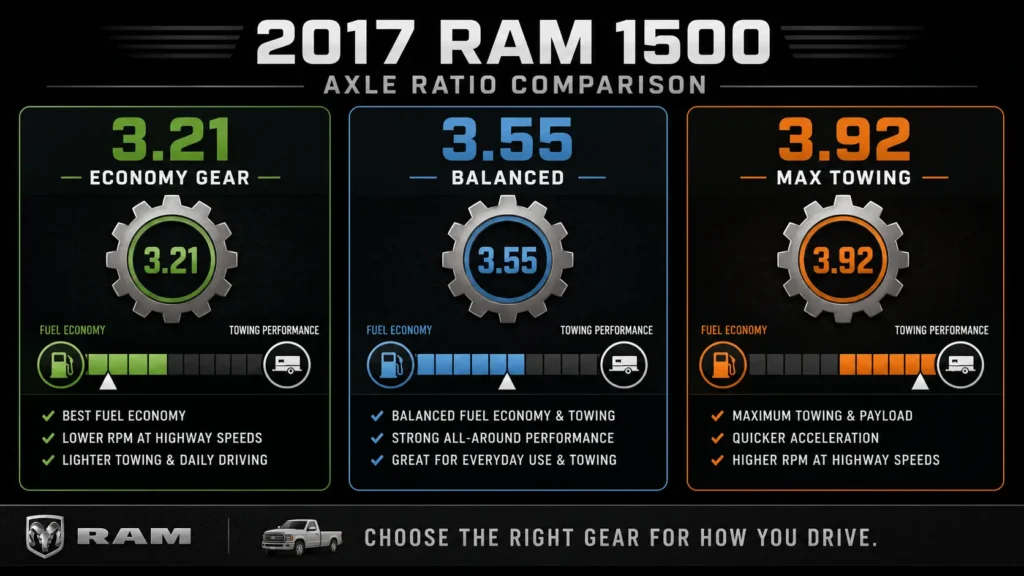
3.21 Axle Ratio — Economy Mode
The 3.21 is designed purely for highway fuel economy. The engine runs at lower RPMs, but torque multiplication at the wheels is minimized. For towing, this is the weakest option.
A 5.7L HEMI with a 3.21 axle is GCWR-capped at 13,800 lbs, limiting max towing to approximately 8,470 lbs — nearly 2,200 lbs less than the same engine with a 3.92 ratio.
3.55 Axle Ratio — Balanced Performance
The 3.55 is the best all-rounder. It provides strong off-the-line torque without sacrificing too much highway efficiency. With the 5.7L HEMI, GCWR rises to 14,400 lbs, unlocking a significantly higher tow rating.
Most buyers choosing this truck for occasional towing will find the 3.55 to be the best balance of capability and everyday drivability.
3.92 Axle Ratio — Max Tow Gear
The 3.92 is the mandatory option to reach the maximum 10,640-lb tow rating and 15,950-lb GCWR. It allows the engine to rev harder at lower speeds, multiplying available torque aggressively.
The trade-off is higher RPMs and increased fuel consumption at highway speeds when driving unloaded. If you tow frequently and heavily, the 3.92 is worth it. If not, the 3.55 is the smarter daily-driver choice.
SAE J2807 Compliance: What These Numbers Actually Mean
Every towing number in this guide is SAE J2807-compliant — the industry standard that ended the era of inflated, unverified tow ratings.
To earn a J2807 rating, a truck must:
- Accelerate to 30 mph and 60 mph within set time limits while fully loaded
- Maintain a minimum speed climbing the Davis Dam grade — an 11.4-mile, 5% average incline — in ambient temperatures above 100°F
- Complete this without engine coolant or transmission fluid overheating
The rating also deducts 300 lbs for driver + passenger weight, 100 lbs for optional equipment, and up to 65 lbs for hitch hardware before stating max trailer weight. So a J2807 rating of 10,640 lbs is a real-world number, not a best-case-scenario lab result.
2017 Ram 1500 Towing Capacity Charts by Cab Size
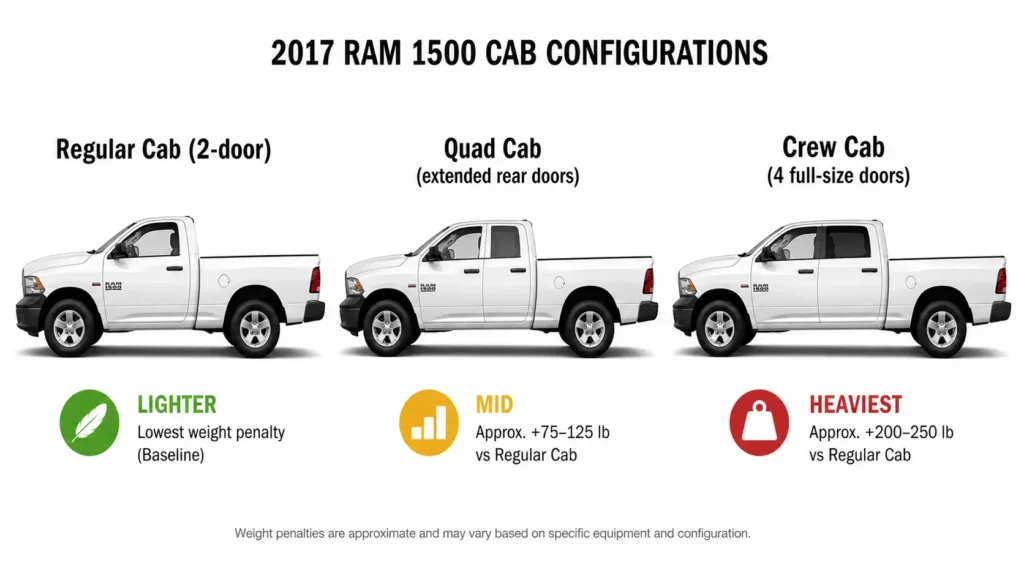
Every pound added to the truck’s curb weight — from a larger cab, 4×4 hardware, or a bigger engine — directly reduces available towing capacity. The data below is the full SAE J2807-compliant matrix for every major configuration.
Regular Cab Towing Chart
The lightest configuration yields the highest payload and tow ratings. The Regular Cab is available with either a 6’4″ or 8’0″ bed.
| Engine | Trans. | Axle | Drive | Box | GVWR | Payload | GCWR | Max Tow |
|---|---|---|---|---|---|---|---|---|
| 3.6L V6 | 8-Spd | 3.21 | 4×2 | 6’4″ | 6,025 | 1,500 | 9,850 | 4,970 |
| 3.6L V6 | 8-Spd | 3.55 | 4×2 | 6’4″ | 6,025 | 1,500 | 12,200 | 7,260 |
| 3.6L V6 | 8-Spd | 3.55 | 4×2 | 8’0″ | 6,600 | 1,880 | 12,400 | 7,270 |
| 3.0L EcoDiesel | 8-Spd | 3.55 | 4×2 | 8’0″ | 6,600 | 1,510 | 13,750 | 8,240 |
| 3.0L EcoDiesel | 8-Spd | 3.92 | 4×2 | 8’0″ | 6,600 | 1,510 | 14,750 | 9,210 |
| 5.7L HEMI | 6-Spd | 3.55 | 4×2 | 8’0″ | 6,600 | 1,700 | 14,400 | 9,090 |
| 5.7L HEMI | 6-Spd | 3.92 | 4×2 | 8’0″ | 6,600 | 1,700 | 15,950 | 10,640 |
| 5.7L HEMI | 8-Spd | 3.21 | 4×2 | 8’0″ | 6,600 | 1,690 | 13,800 | 8,470 |
| 5.7L HEMI | 8-Spd | 3.92 | 4×2 | 8’0″ | 6,600 | 1,690 | 15,950 | 10,620 |
| 5.7L HEMI | 8-Spd | 3.92 | 4×4 | 6’4″ | 6,350 | 1,390 | 14,350 | 8,930 |
Key takeaway: Adding 4×4 hardware (transfer case, front differential, front driveshafts) to a Regular Cab HEMI with a 3.92 axle drops max towing from 10,620 lbs to 8,930 lbs — a nearly 1,700-lb penalty for the added curb weight.



Quad Cab Towing Chart
The Quad Cab features extended rear seating with forward-hinged half-doors and comes exclusively with a 6’4″ bed. It’s the middle ground between cargo utility and passenger capacity.
| Engine | Trans. | Axle | Drive | GVWR | Payload | GCWR | Max Tow |
|---|---|---|---|---|---|---|---|
| 3.6L V6 | 8-Spd | 3.21 | 4×2 | 6,800 | 1,880 | 9,850 | 4,610 |
| 3.6L V6 | 8-Spd | 3.55 | 4×2 | 6,800 | 1,880 | 12,900 | 7,600 |
| 3.0L EcoDiesel | 8-Spd | 3.55 | 4×2 | 6,950 | 1,590 | 13,750 | 7,960 |
| 3.0L EcoDiesel | 8-Spd | 3.92 | 4×2 | 6,950 | 1,590 | 14,750 | 8,960 |
| 5.7L HEMI | 6-Spd | 3.55 | 4×2 | 6,900 | 1,790 | 14,400 | 8,870 |
| 5.7L HEMI | 6-Spd | 3.92 | 4×2 | 6,900 | 1,790 | 15,950 | 10,420 |
| 5.7L HEMI | 8-Spd | 3.21 | 4×2 | 6,900 | 1,760 | 13,800 | 8,190 |
| 5.7L HEMI | 8-Spd | 3.92 | 4×2 | 6,900 | 1,760 | 15,950 | 10,340 |
| 5.7L HEMI | 8-Spd | 3.92 | 4×4 | 6,900 | 1,570 | 15,950 | 10,140 |
Crew Cab Towing Chart
The Crew Cab is the heaviest and most popular configuration, with four full-size doors and maximum rear legroom. It comes with a 5’7″ or 6’4″ bed. The added body weight reduces towing capacity across all powertrains.
| Engine | Trans. | Axle | Drive | Box | GVWR | Payload | GCWR | Max Tow |
|---|---|---|---|---|---|---|---|---|
| 3.6L V6 | 8-Spd | 3.21 | 4×2 | 5’7″ | 6,800 | 1,820 | 9,850 | 4,510 |
| 3.6L V6 | 8-Spd | 3.55 | 4×2 | 5’7″ | 6,800 | 1,820 | 12,900 | 7,510 |
| 3.0L EcoDiesel | 8-Spd | 3.55 | 4×4 | 5’7″ | 6,950 | 1,320 | 13,750 | 7,690 |
| 3.0L EcoDiesel | 8-Spd | 3.92 | 4×4 | 5’7″ | 6,950 | 1,320 | 14,750 | 8,690 |
| 5.7L HEMI | 6-Spd | 3.92 | 4×2 | 5’7″ | 6,900 | 1,680 | 15,950 | 10,310 |
| 5.7L HEMI | 8-Spd | 3.21 | 4×2 | 5’7″ | 6,900 | 1,640 | 13,800 | 8,070 |
| 5.7L HEMI | 8-Spd | 3.92 | 4×2 | 5’7″ | 6,900 | 1,640 | 15,950 | 10,220 |
| 5.7L HEMI | 8-Spd | 3.92 | 4×4 | 5’7″ | 6,900 | 1,530 | 15,950 | 10,140 |
| 5.7L HEMI | 6-Spd | 3.92 | 4×2 | 6’4″ | 6,900 | 1,640 | 15,950 | 10,240 |
| 5.7L HEMI | 8-Spd | 3.92 | 4×2 | 6’4″ | 6,900 | 1,590 | 15,950 | 10,200 |
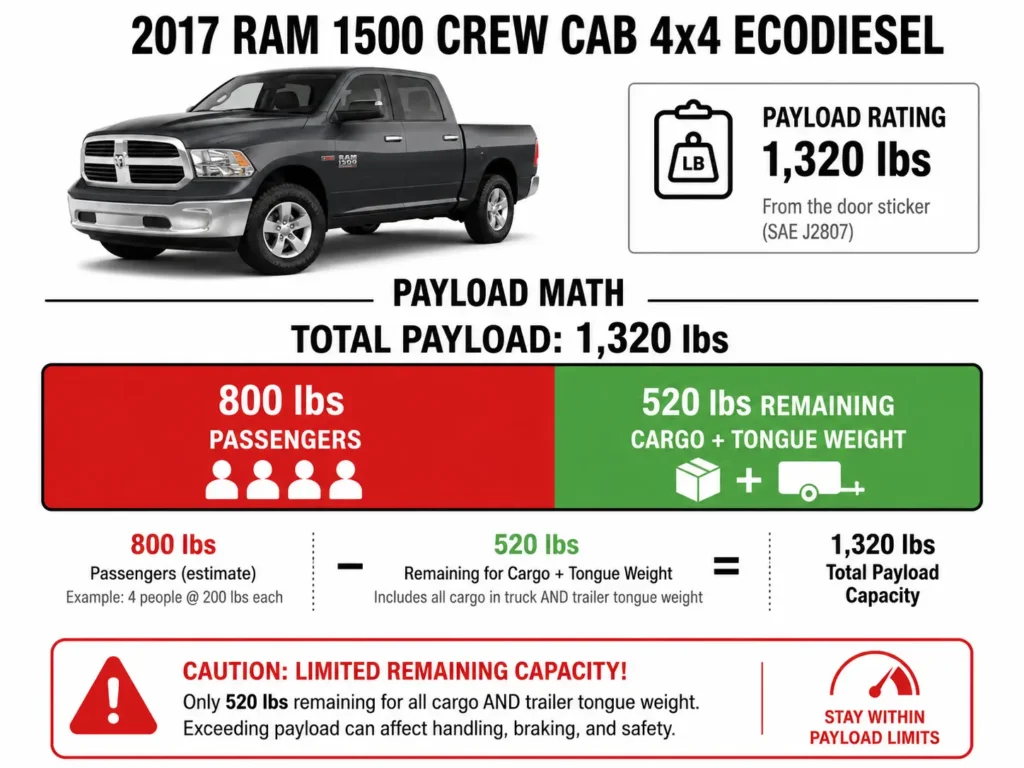
Critical point: A Crew Cab 4×4 EcoDiesel has only 1,320 lbs of payload. If four adults weigh 800 lbs combined, only 520 lbs remains for cargo and tongue weight. At a standard 10% tongue weight, that effectively caps your safe tow at just 5,200 lbs — well below the engine’s theoretical 8,690-lb ceiling.
Payload vs. Towing Capacity: The Most Misunderstood Rule in Trucking
Ram’s official documentation explicitly states: “Payload and Trailer Weight Rating are mutually exclusive.” This is the number one cause of accidental overloading.
Payload capacity is calculated as GVWR minus curb weight. Everything inside or on the truck counts toward payload — driver, passengers, cargo in the bed, AND the downward tongue weight of the trailer pressing on the hitch.
When towing a conventional bumper-pull trailer, physics demands that 10–15% of gross trailer weight rests on the hitch. Hook up a 10,000-lb trailer and you’re automatically consuming 1,000 lbs of your payload budget just from tongue weight.
Exceeding payload limits dramatically increases stopping distances, alters headlight aim upward into oncoming traffic, and risks heat-induced rear tire blowouts. Know your numbers before you hitch up.
How to Find Your Exact Axle Ratio
Because axle ratio changes your tow rating by thousands of pounds, verifying your specific ratio is essential before relying on any chart.
The easiest source is your original window sticker (Monroney label), which lists all factory options. If unavailable, crawl under the rear of the truck and look for a metal stamp or tag on the differential cover — it will show the exact ratio (3.21, 3.55, or 3.92).
You can also enter your VIN at the official Ram Trucks owner portal or at any FCA dealership to generate your full factory build sheet. This is the definitive source for all towing-relevant specs on your specific truck.
Towing-Related Diagnostic Trouble Codes (DTCs)
Heavy hauling puts extreme thermal and mechanical stress on the powertrain. Some DTCs appear specifically under towing conditions that would never trigger during normal driving. Here are the most common ones:
P0113 — Intake Air Temperature Sensor High
Towing in high ambient heat forces the engine to ingest large volumes of hot air. If the IAT sensor fails from heat soak, the PCM miscalculates the air-fuel mix, causing a loss of power. Upgrading to a cold air intake for the Ram 1500 can reduce intake temperatures and help prevent this issue.
P0128 — Coolant Thermostat Malfunction
Prolonged uphill towing followed by rapid coasting on a downgrade can confuse the ECU about coolant temperature gradients. A P0128 generally means the thermostat is stuck open or failing, preventing the engine from reaching optimal operating temperature.
P0300 — Random Cylinder Misfire (HEMI-specific)
Extreme towing loads can expose weak ignition coils or fouled spark plugs on the 5.7L HEMI that perform fine under light loads. If the truck shudders under heavy acceleration while towing, expect a P0300. Upgrading to iridium spark plugs and inspecting coil packs is the standard fix. For more HEMI maintenance context, see our 5.7 HEMI maintenance cost guide.
P0456 — Small EVAP Leak
The vibrations of a fully loaded chassis on rough campground roads can loosen aging EVAP hoses or the fuel cap seal. Not a towing emergency, but it will trigger the check engine light and may fail an emissions test.
Service Trailer Brake System Warning
This warning usually points to a poor ground connection on the trailer or a short in the 7-pin connector — not a truck fault. Spray the receptacle with dielectric contact cleaner and inspect the trailer’s ground strap. If you’re seeing other DTC codes alongside it, see our P018C Ram 1500 diagnostic guide for troubleshooting methodology.
Transmission Heat Management While Towing
The 8HP70 and 845RE transmissions depend on low-viscosity synthetic fluid to manage heat during heavy-load towing. On steep grades, fluid temperatures can spike to dangerous levels quickly.
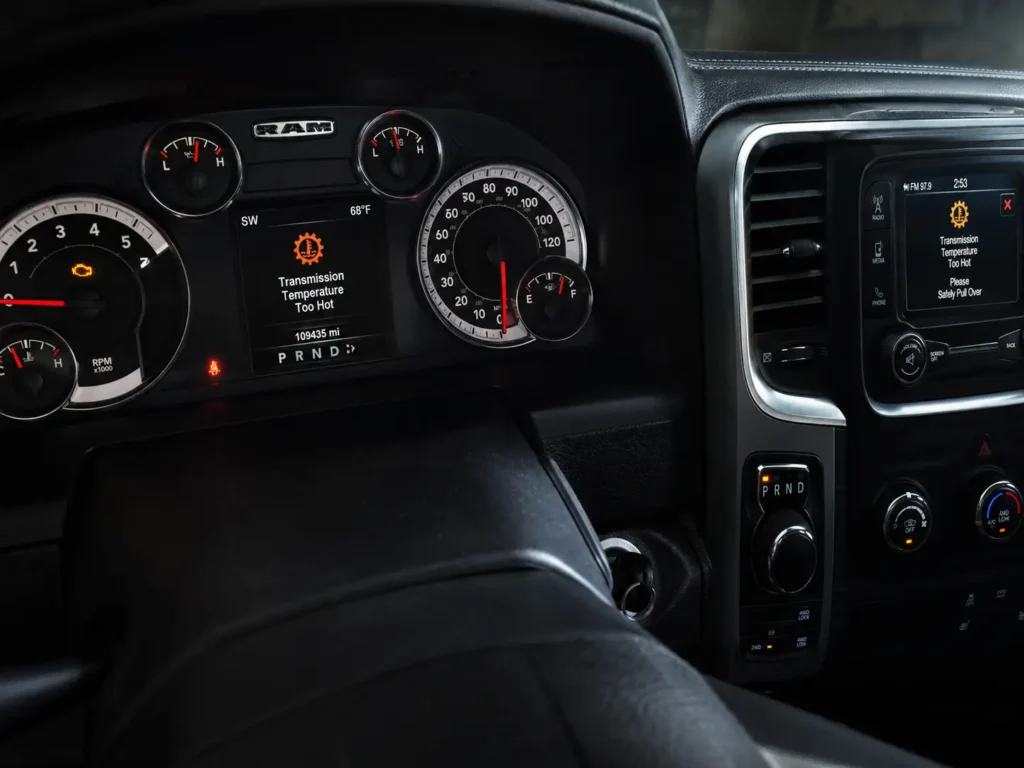
If the EVIC displays a transmission temperature warning, downshift manually to increase engine RPMs. Higher RPMs spin the mechanical fluid pump faster, pushing more hot oil through the transmission cooler lines at the front grille.
For trucks with high mileage that regularly tow, drain and replace the “lifetime” transmission fluid every 60,000 miles. Inspect the cooler line assembly for kinks or leaks — a clogged line is the leading cause of persistent overheating under load.
Do You Need a Weight-Distributing Hitch?
For any trailer exceeding 5,000 lbs of gross weight, a weight-distributing hitch is strongly recommended — and often legally required by state towing regulations.
A standard Class IV receiver places all tongue weight directly on the rear suspension, unloading the front axle like a lever. A weight-distributing hitch uses spring bars to transfer that weight forward onto the steering axle and back onto the trailer axles, restoring proper brake bias and steering response.
Without one, headlights aim skyward and trailer sway becomes a serious highway safety risk at speeds above 55 mph.
What Does the Tow/Haul Button Actually Do?
Engaging Tow/Haul mode reprograms the Transmission Control Module (TCM) shift logic. It delays upshifts, holds gears longer, and commands earlier downshifts during braking to use engine compression for slowing the combined mass.
On HEMI-equipped trucks, Tow/Haul also disables the Multi-Displacement System (MDS), ensuring all eight cylinders stay active and full torque remains instantly available throughout the tow.


Always use Tow/Haul mode when hauling anything above the truck’s unloaded curb weight. The thermal and mechanical benefits to the transmission and brakes are significant on any grade.
How Does the 2017 Ram 1500 Compare to Competitors?
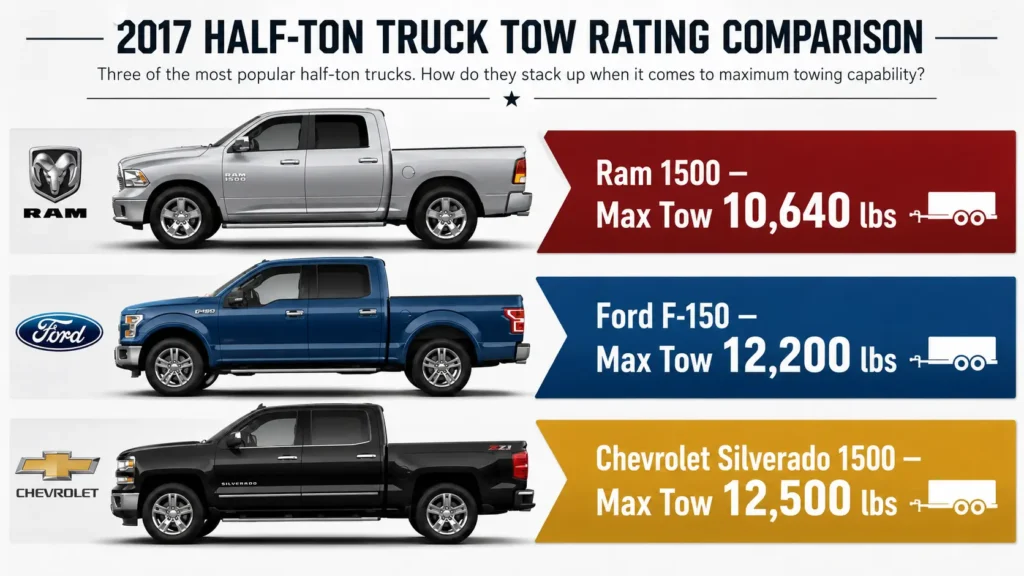
In the 2017 model year, the Ram 1500’s 10,640-lb maximum towing ceiling sat below its direct Detroit rivals. The Ford F-150 with the 3.5L EcoBoost topped out at 12,200 lbs. The Chevrolet Silverado 1500 with the 6.2L V8 reached 12,500 lbs.
On paper, Ram trails. In practice, the picture is more nuanced.
Automotive analysts and fleet operators consistently report that the Ram’s coil-spring and air-suspension ride quality while loaded is dramatically superior to the leaf-spring setups in the F-150 and Silverado. The Ram is simply more comfortable to drive with a heavy trailer on long interstate routes.
Additionally, the 3.0L EcoDiesel V6 had no direct competitor in the half-ton class for 2017. Its combination of 9,210-lb towing and 29 MPG highway was unmatched — a compelling advantage for long-haul operators. Compare this to similar models by looking at our 2014 Ram 1500 towing capacity guide to see how the platform evolved year over year.
Frequently Asked Questions
Can I re-gear my 3.21 axle to a 3.92?
Mechanically, yes. A driveline specialist can swap the ring and pinion gears. On a 4×4, both front and rear differentials must be re-geared simultaneously to prevent drivetrain binding — making it an expensive procedure.
However, re-gearing does not legally change your GVWR or GCWR as certified on the door-jamb sticker. In the event of an accident while overloaded, civil liability and insurance disputes could arise from operating outside factory certification.
Is the 3.6L V6 enough for a camper?
Yes, for the right camper. The Pentastar V6 can tow up to 7,610 lbs in optimal trim, which covers most lightweight aluminum trailers, pop-up campers, and teardrop trailers. However, towing an 8-foot-wide flat-front travel trailer introduces massive aerodynamic drag that keeps the transmission hunting through gears on the highway.
For frequent, long-distance camper towing, upgrading to the EcoDiesel or HEMI V8 is strongly advisable to prevent premature transmission wear. See our list of the best upgrades for the Ram 1500 for options that improve towing performance without swapping engines.
Where is the tongue weight rating listed?
The factory tongue weight limit for the Class IV hitch on the 2017 Ram 1500 is 1,100 lbs. This is printed in the Ram truck owner’s manual and on the hitch receiver assembly. Never exceed this figure, even if your payload math technically allows it — the rear frame and hitch mounting points have a finite stress tolerance.
Conclusion
The 2017 Ram 1500 towing capacity ranges from 4,510 lbs to 10,640 lbs depending on your specific configuration. The single most impactful variables are your engine choice, axle ratio, and cab size — in that order.
To hit the maximum 10,640-lb ceiling, you need the 5.7L HEMI V8 with either the 6-speed 65RFE or 8-speed 8HP70, paired with a 3.92 axle ratio, in a Regular Cab or Quad Cab 4×2 configuration. Any deviation from that spec reduces your ceiling.
For long-haul efficiency, the 3.0L EcoDiesel with a 3.92 axle is the smarter pick — 9,210 lbs of towing capacity and exceptional fuel economy in a truck that rides better than most half-tons on the market today.
Know your payload math, use a weight-distributing hitch on loads above 5,000 lbs, maintain your transmission fluid, and use Tow/Haul mode consistently. Do all that, and this truck will reward you with decades of reliable service.
![2008 Dodge Ram 1500 Towing Capacity: Complete Specs Guide [2026]](https://truckguider.com/wp-content/uploads/2026/03/featured-4b2248df-768x768.webp)