P0871 Ram 2500: Diagnose & Fix [2026]

For the Ram 2500 owner, the sudden onset of ‘limp mode’ and a P0871 diagnostic code can turn a productive workday into a costly disruption. This specific fault code indicates a range or performance issue with the Transmission Fluid Pressure Sensor ‘C’, a component that plays a critical role in the Overdrive clutch operation of the heavy-duty 68RFE transmission. Navigating this issue requires more than a simple code clear; it demands a comprehensive understanding of hydraulic logic and electronic monitoring. This expert guide provides a professional breakdown of the code’s causes, symptoms, and the quality diagnostic steps required to restore reliable shifting performance and long-term powertrain integrity.
Technical Definition of the P0871 Code in Ram 2500 68RFE Transmissions
📤 Share Image
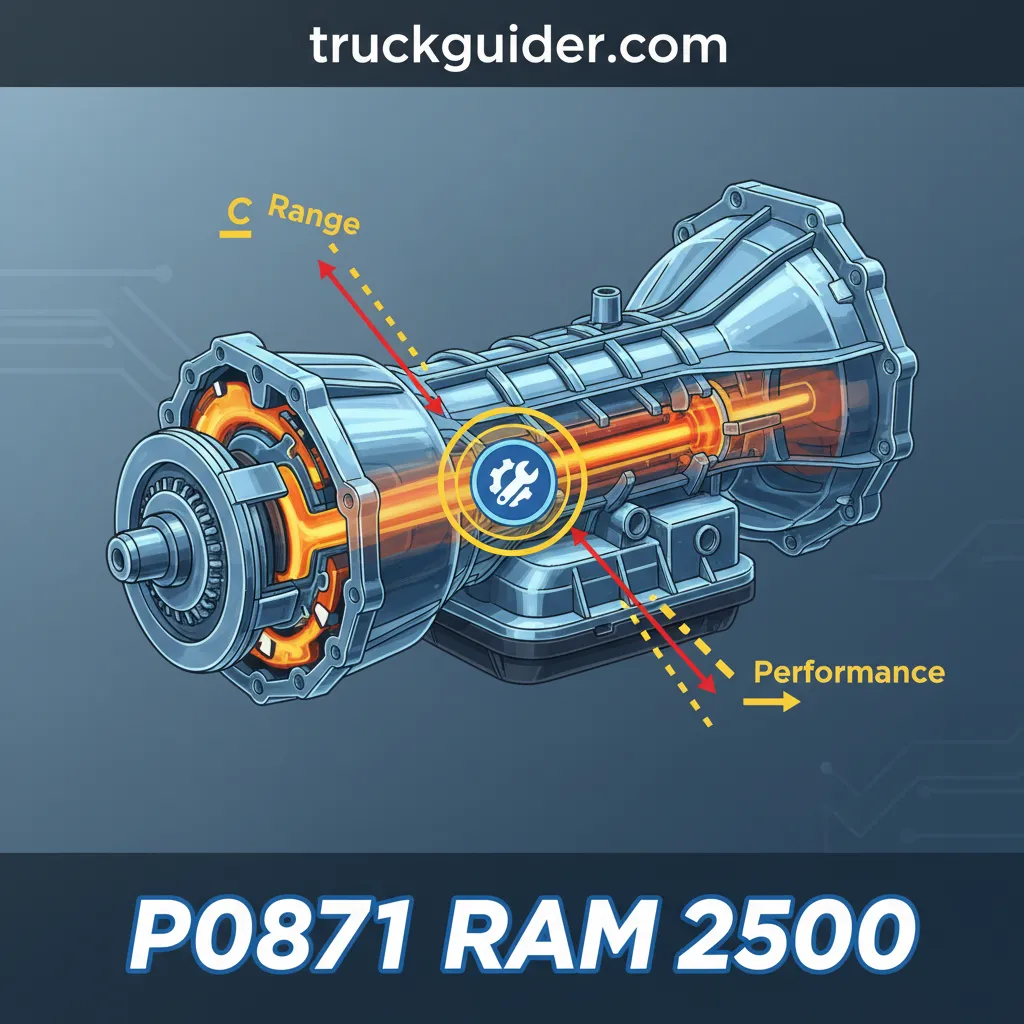
In the realm of heavy-duty diesel and gas trucking, the Chrysler 68RFE six-speed automatic transmission is a workhorse, but its reliance on sophisticated electronic-over-hydraulic controls makes it sensitive to pressure variances. The P0871 code specifically points to the Transmission Fluid Pressure (TFP) Sensor/Switch ‘C’. In the 68RFE architecture, “Sensor C” is the dedicated monitor for the Overdrive (OD) clutch circuit. Unlike a simple “on/off” switch, this sensor provides a constant feedback loop to the Transmission Control Module (TCM) or the Power Control Module (PCM).
The TCM monitors the voltage signal from this sensor to ensure it stays within a calibrated window, typically between 0.5 and 4.5 volts. When the TCM commands the Overdrive clutch to engage, it expects to see a specific voltage change reflecting the rise in hydraulic pressure. If the sensor reports pressure when there should be none, or fails to report pressure when the clutch is commanded “ON,” the P0871 ‘Range/Performance’ code is triggered. This “Range/Performance” designation is critical; it suggests that the sensor circuit is electrically capable of sending a signal, but that signal does not match the expected hydraulic logic of the current gear state.
It is vital to differentiate this from a “Hard Electrical Failure” (such as P0870), which would indicate an open or shorted circuit. With P0871, the TCM is essentially saying: “I hear the sensor talking, but what it’s saying doesn’t make sense for the gear I’m in.” For professional technicians, a common scenario involves the TCM detecting OD pressure during 4th gear engagement or finding sub-optimal voltage during a transition into 5th or 6th gears. Because the 68RFE utilizes five distinct pressure switches, an error in Switch C directly compromises the integrity of the Overdrive clutch pack, which is the most common failure point in these units under heavy load.
Recognizing Reliable Symptoms of Pressure Sensor Malfunction
When a P0871 fault occurs, the vehicle’s behavior changes immediately as the TCM attempts to protect the internal mechanical components. The most prominent symptom is the ‘Limp-In’ mode. In this state, the TCM defaults the transmission to a fixed gear—typically 4th gear in the 68RFE—and stays there regardless of speed. This prevents the Overdrive clutches from slipping, but it significantly hinders drivability and towing capacity.
Operators will also notice several other reliable indicators of trouble:
- ➤ Harsh Shifting: The transition into or out of higher gears may feel violent or “clunky” as the TCM uses maximum line pressure to ensure clutch engagement in the absence of accurate sensor data.
- ➤ Check Engine Light (CEL): The MIL (Malfunction Indicator Lamp) will illuminate, often appearing simultaneously with a sudden “neutralizing” sensation while cruising at highway speeds.
- ➤ Torque Converter Clutch (TCC) Issues: Because the OD and TCC circuits are hydraulically linked in certain valve body phases, you may experience stalling when coming to a stop or excessive vibration while cruising.
- ➤ Reduced Fuel Efficiency: Being locked in 4th gear increases engine RPMs significantly at highway speeds, leading to a sharp drop in MPG.
Consider a heavy-duty towing scenario: You are ascending a steep grade with a 15,000-lb trailer. As the transmission attempts to shift, the TCM detects an irrational signal from Sensor C. To prevent burning the OD clutch, it instantly drops the truck into 4th gear. This professional-grade safety protocol, while frustrating, is designed to save you from a $6,000 transmission rebuild. Approximately 85% of P0871 cases lead to this immediate TCM-mandated limp mode.
Continuing to drive a Ram 2500 in limp mode while under heavy load can cause rapid overheating of the transmission fluid. If you see the P0871 code, pull over safely and assess the fluid condition before proceeding.
Expert Analysis of Potential Causes for the P0871 Diagnostic Code
Identifying the root cause of a P0871 requires an expert understanding of both electrical and mechanical failure modes. In the Ram 2500, the causes generally fall into three categories: Fluid/Hydraulic, Component Failure, and Electrical Integrity.
1. Solenoid Block Assembly Internal Failure
The most common culprit is the Solenoid Block Assembly. In the 68RFE and the Aisin AS69RC, the pressure switches are integrated into the solenoid pack. These switches use a small diaphragm that can rupture or become clogged with microscopic debris. When the diaphragm fails, the switch can no longer accurately report pressure to the TCM.
2. Valve Body and Hydraulic Cross-Leaks
Internal mechanical failures, such as a warped separator plate or a blown valve body gasket, can allow pressurized fluid to “bleed” into the Overdrive circuit when it isn’t commanded. This creates a “shadow” pressure that the TCM detects through Sensor C, triggering the performance code. In higher-mileage trucks, the valve body bores themselves can wear out, leading to inconsistent hydraulic signals.
3. Wiring Harness Degradation
The 23-way electrical connector located on the driver-side of the transmission case is a known weak point. Exposure to road salt, heat, and vibration can cause the pins to corrode or the harness to chafe against the bellhousing. Corroded connector pins account for nearly 15% of false P0871 readings in high-corrosion environments. Additionally, fluid “wicking”—where ATF leaks through the internal seal of the solenoid pack and into the harness—can cause signal interference.
4. Fluid Contamination and Filter Issues
Low-quality or contaminated fluid can lead to debris buildup on the pressure switch. Furthermore, a faulty internal spin-on filter (the “cooler return” filter) can split its seal, causing air to be sucked into the pump. This aeration (cavitation) causes erratic pressure readings that the TCM interprets as a sensor performance issue.
By The Numbers
Cases Resulting in Limp Mode
Failures Due to Wiring Corrosion
Linked to Fluid Oxidation (>220°F)
📋
Step-by-Step Diagnostic Guide
Check fluid level at operating temperature. Look for a “glittery” or metallic appearance on the dipstick. If silver flakes are present, the OD clutch is disintegrating, and the P0871 is merely a symptom of mechanical failure.
Using a high-end scan tool, monitor the ‘OD Pressure Switch State’. In Park/Neutral, it should read “Open” or “Off”. If it reads “Closed” while sitting at idle, you have a failed solenoid pack or a major hydraulic leak.
Connect a manual pressure gauge to the OD pressure port on the transmission case. Verify that physical pressure matches the electronic sensor reporting. Normal idle pressure is ~60 PSI, ramping to 160+ PSI under load.
Professional Repair Options and Component Replacement Costs
Restoring a Ram 2500 to a trusted, road-ready state involves choosing the right parts and procedures. Since the pressure switches in the 68RFE are not individually serviceable, the standard repair is the replacement of the Solenoid Block Assembly.
Expert Recommendation: When replacing the solenoid pack, always opt for the updated Mopar OEM version, often distinguished by a white electrical connector (replacing the older black or gray designs). This revised unit features improved internal sealing and more robust switch diaphragms to prevent recurring P0871 issues. For owners who use their trucks for consistent heavy towing or commercial hot-shotting, upgrading to a professional-grade aftermarket heavy-duty valve body (such as those from RevMax or Sonnax) is a wise investment. These units often feature reinforced separator plates and re-sleeved bores that eliminate hydraulic cross-talk entirely.
Crucially, any internal component replacement must be followed by a ‘Transmission Quick Learn’ procedure. This is performed using a diagnostic tool and allows the TCM to reset its adaptive shift values. Skipping this step can lead to immediate clutch damage, as the TCM may attempt to apply old, high-pressure adaptive logic to new, clean-sealing components.
When the transmission pan is off for a solenoid pack replacement, always replace both filters. The spin-on return filter should be hand-tightened and then turned exactly 3/4 turn more to ensure the seal doesn’t split under high pressure.
Preventive Maintenance Strategies for Long-Term Transmission Health
To avoid future encounters with the P0871 code, a proactive maintenance schedule is non-negotiable for Ram 2500 owners. The 68RFE is notoriously sensitive to fluid temperature; statistics show that over 60% of sensor-related failures are linked to fluid oxidation caused by temperatures exceeding 220°F.
Severe Service Schedule
If you tow regularly, change fluid every 30,000 to 60,000 miles. Do not wait for the “Life of Fluid” intervals suggested for light-duty driving.
Licensed ATF+4 Only
Only use licensed ATF+4 fluid. This formula contains the exact friction modifiers required for the pressure switches and clutch packs to operate within TCM voltage windows.
Thermal Management
Install a deep-sump aluminum transmission pan. This increases fluid capacity by 2-4 quarts and improves heat dissipation, protecting the solenoid pack from thermal degradation.
Finally, perform a periodic inspection of the electrical bulkhead connector. By checking for signs of ATF wicking into the harness every 15,000 miles, you can catch a failing solenoid seal before it contaminates the truck’s main wiring harness, saving you thousands in electrical repair costs.
The P0871 code is frequently tied to the solenoid block assembly and fluid quality within the Overdrive circuit. Accurate diagnosis requires comparing scan tool data against manual hydraulic pressure tests to isolate electrical versus mechanical faults. Timely repair and the use of high-quality ATF+4 fluid are essential to maintain the integrity of the Ram 2500 powertrain. If you are experiencing harsh shifts or limp mode, perform a fluid analysis and scan tool check immediately to prevent secondary damage to the Overdrive clutch packs.
Frequently Asked Questions
Can I drive my Ram 2500 with a P0871 code active?
It is not recommended. When the P0871 code triggers, the transmission often enters ‘Limp-In’ mode, locking it into 4th gear. Driving in this state for extended periods generates excessive heat and prevents the use of Overdrive gears, which can lead to permanent damage to the internal clutch packs and torque converter. Seek professional diagnosis immediately.
Is the P0871 code usually caused by a bad sensor or a mechanical failure?
In the Ram 2500’s 68RFE transmission, it is often a combination. The code points to the pressure switch ‘C’ located inside the solenoid block. While the switch itself can fail electronically, it is frequently triggered by debris or ‘cross-talk’ in the valve body hydraulics. A quality diagnosis will determine if the solenoid pack or the valve body needs replacement.
How much does it cost to fix a P0871 error on a Ram 2500?
The cost varies based on the root cause. If the issue is simply low or degraded fluid, a service may cost $200-$300. However, most P0871 codes require a new solenoid block assembly, which typically ranges from $600 to $900 including parts and professional labor. If internal clutch damage has occurred, costs can escalate into a full rebuild.
Will a transmission fluid flush clear the P0871 code?
While fresh ATF+4 fluid is vital for performance, a flush is rarely a permanent fix for a P0871 code if the pressure switch diaphragm is already damaged or the solenoid is failing. Furthermore, in high-mileage trucks, a high-pressure flush can sometimes dislodge debris that further clogs the sensitive pressure switches. A standard pan-drop and filter change is safer.
What is a ‘Transmission Quick Learn’ and do I need it for P0871?
Yes, a ‘Quick Learn’ is a professional software procedure performed with a scan tool. It recalibrates the TCM to account for the new clutch engagement timings and pressure switch tolerances of replacement parts. After replacing a solenoid pack or valve body to fix a P0871, this step is required to ensure smooth shifting and prevent immediate code re-occurrence.
![Best Oil Additive for Lifters: Complete Fix Guide [2026]](https://truckguider.com/wp-content/uploads/2026/03/oil-additive-for-lifters-featured.webp)
![2022 RAM 2500 Tire Size Guide: Complete Specs Guide [2026]](https://truckguider.com/wp-content/uploads/2026/03/2022-ram-2500-tire-size-featured.webp)
![Transmission Not Engaging? Causes, Costs, and Fixes [2026]](https://truckguider.com/wp-content/uploads/2026/03/transmission-not-engaging-featured.webp)