2006 Dodge Ram 1500 Towing Capacity 2026 Factory Data

Quick Answer
The 2006 Dodge Ram 1500 towing capacity ranges from 3,000 lbs to 9,100 lbs depending on the engine, axle ratio, and configuration. The absolute maximum requires the 5.7L HEMI V8 with a 3.92 axle ratio and a proper tow package. Always verify your specific truck’s rating using the Gross Combined Weight Rating (GCWR) found on your driver-side door jamb sticker.
Towing with a 2006 Dodge Ram 1500 is a frequent task for owners, but safely managing heavy loads requires understanding more than just the engine size under your hood. Many owners mistakenly assume that all 2006 Ram 1500 models share the same towing capacity, a misconception that leads to dangerous overloads, accelerated transmission wear, and compromised braking performance. This guide provides the factory-verified data you need to identify your specific capacity range and the critical steps required to verify your truck’s unique limits before you hook up to a trailer.

Prime for Young Adults — 6 Months Free
Students and 18–24s get six months of Prime free, then half price.
Start 6 Months Free
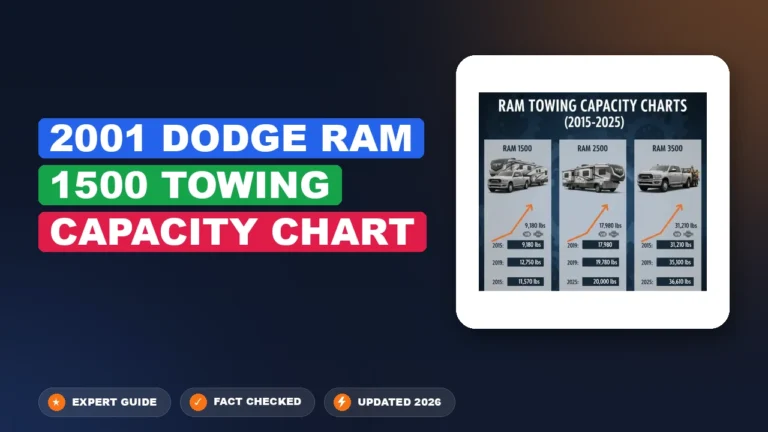
2006 Dodge Ram 1500 Towing Capacity: Official Factory Data Chart
Recommended Best Deal Products


This data reflects 2006 factory specifications. Ratings are based on properly equipped vehicles including the optional factory tow package. Values may be lower for base models without auxiliary transmission cooling or specific gear ratios. Last reviewed: August 2026.
| Engine | Drivetrain / Cab | Max Towing | Notes |
|---|---|---|---|
| 3.7L V6 | 4×2 Regular Cab | 3,800 lbs | Requires 3.55 ratio |
| 4.7L V8 | 4×2 Regular/Quad | 7,650 lbs | Requires 3.92 ratio |
| 5.7L HEMI | 4×2 Regular Cab | 9,100 lbs | Requires 3.92 ratio |
| 5.7L HEMI | 4×4 Quad Cab | 8,600 lbs | Varies by wheelbase |
Technical Scope and Data Accuracy
The capacity figures listed above are “Maximum Towing Capacity” ratings, which assume the vehicle is empty except for the driver. When you add passengers, cargo in the bed, or aftermarket accessories, the actual amount you can tow decreases proportionally. You must ensure your total loaded trailer weight does not exceed the GCWR (Gross Combined Weight Rating) specific to your truck.
Why Configuration Matters for Your Truck
A standard 2006 Ram 1500 with a 3.55 rear axle ratio will have a significantly lower tow rating than an identical truck equipped with the 3.92 performance axle ratio. The engine’s ability to maintain power in the appropriate torque band is directly tied to the differential gearing. If you are unsure which gear ratio is installed in your truck, you can find this information by decoding the VIN or checking the build sheet located in the glove box.
3,000 lbs
7,500 lbs
Understanding Your 2006 Ram 1500 Towing Ratings and GCWR
Safety while towing relies on the relationship between three critical weight metrics: GVWR, curb weight, and GCWR. The Gross Combined Weight Rating (GCWR) is the absolute maximum weight that your truck and trailer can weigh together when fully loaded. This includes the truck, the trailer, all passengers, fuel, and any gear stowed in the truck bed.
Calculating Your Gross Combined Weight Rating
To find your available towing capacity, start with your vehicle’s GCWR (available in the owner’s manual). Subtract your truck’s actual weight (weighed on a scale with passengers and fuel) from the GCWR. The remaining number is the maximum weight your trailer can legally and safely possess. Many owners fail to account for the weight of hitch equipment, which can easily add 100+ lbs to the vehicle load.
The Impact of Payload on Towing Limits
Payload is the capacity of your truck to carry weight within the cabin and bed. Crucially, the tongue weight of your trailer acts as payload. If your trailer has a tongue weight of 800 lbs, that 800 lbs is deducted from your truck’s total payload capacity. If you have four adults in the cab and 200 lbs of gear in the bed, you may already be nearing your maximum payload, leaving little room for the trailer’s tongue weight.
What Affects 2006 Dodge Ram 1500 Towing Capacity?
Recommended Best Deal Products


Several mechanical factors contribute to the 2006 Dodge Ram 1500 towing capacity. Understanding these allows you to gauge how your specific vehicle will perform under load.
- Engine Performance: The 5.7L HEMI V8 provides significantly more torque at lower RPMs compared to the 4.7L V8 or the 3.7L V6, making it far superior for pulling weight up inclines.
- Axle Ratio: Higher gear ratios (like 3.92) provide more mechanical advantage for pulling heavy loads, whereas lower ratios (like 3.55) are geared for fuel economy and light loads.
- Cooling Systems: The factory tow package usually includes heavy-duty engine cooling and an auxiliary transmission oil cooler. Without these, continuous towing risks overheating the transmission fluid, leading to catastrophic failure.
- Trailer Brake Integration: For any trailer over 2,000 lbs, electronic trailer brakes are not just recommended; they are a critical safety requirement. Your truck must be equipped with a functional brake controller to manage the inertia of the trailer.
How to Safely Calculate Your Truck’s Specific Tow Limit
Locate the white and yellow sticker inside the driver-side door jamb. This lists the GVWR and payload capacity for your specific VIN.

Audible — Listen Free for 30 Days
One free credit a month and thousands of titles included.
Listen Free for 30 DaysUse an online VIN decoder or look at your original window sticker to confirm if your truck has the 3.55 or 3.92 rear axle ratio.
Common 2006 Dodge Ram 1500 Towing Pitfalls and Safety
Recommended Best Deal Products


Never confuse the truck’s absolute maximum towing rating with a “safe operating weight.” Always aim to stay at least 10-15% below your maximum capacity for safer mountain driving and emergency stopping.
Many drivers overload the bed of the truck while simultaneously pulling a heavy trailer. This often pushes the truck over its rear axle weight rating, even if the trailer itself is technically within limits. Additionally, for long trailers or heavy cargo, a Weight Distribution Hitch is mandatory. It redistributes the trailer tongue weight across all truck and trailer axles, preventing the front end of the truck from “lifting” and maintaining steering authority.
2006 Dodge Ram 1500 Towing Capacity Questions Answered
Q: Can I exceed my towing capacity if I only go a short distance?
A: No. Mechanical stress, particularly on the transmission and brakes, occurs instantly. Exceeding your rating for even a few miles can cause internal damage or brake fade.
Q: How do I know if I have the factory tow package?
A: Look for an auxiliary transmission oil cooler mounted in front of the radiator, a 7-pin trailer plug at the rear, and an upgraded alternator. Your build sheet will explicitly list “Trailer Tow Group” as an option.
Conclusion
The 2006 Dodge Ram 1500 is a capable workhorse, with capacities ranging from 3,000 to 9,100 lbs depending on how it was configured from the factory. Remember that these are not universal numbers—they are specific to your truck’s axle ratio, drivetrain, and cab style. Exceeding your GCWR compromises the safety of everyone on the road and risks costly damage to your drivetrain. Always consult your driver-side door jamb sticker and owner’s manual to verify your exact capacity, and ensure you use a weight distribution hitch for heavier loads to maintain full control of your vehicle.
Audible Premium Plus — Annual Membership
12 audiobook credits up front, plus the full Audible catalogue.
See Annual Plans