Ram 3500 Generations Chart (1st to 5th Gen Explained)

The Ram 3500 stands as an undisputed titan in the heavy-duty pickup truck segment. It boasts a legacy built on relentless power, commercial-grade durability, and constant innovation.
For decades, this vehicle has served as the backbone for commercial fleets, agricultural operations, and heavy recreational hauling. Understanding its lineage requires a deep dive into its generational shifts, engineering milestones, and powertrain upgrades. For the broader family timeline across every Ram truck, see the Dodge Ram generations chart.
The evolution of the Ram 3500 is fundamentally tied to the escalation of the American towing arms race. Manufacturers have constantly battled to offer the highest torque ratings and the most robust chassis designs.
This comprehensive research report details every generation of the one-ton Ram truck. It explores the transition from the early Dodge D/W series to the modern, standalone Ram Heavy Duty brand.
THE RAM 3500 LEGACY
Recommended Best Deal Products


From spartan workhorse to the 1,075 lb-ft towing titan. Explore four decades of heavy-duty dominance.
The Evolution of Heavy-Duty Dominance
The Ram 3500 has transitioned from a spartan utility tool in the 1980s to a luxury-refined hauling machine. This evolution is defined by five distinct generations, each pushing the boundaries of what a one-ton pickup can achieve.
1st Gen
D/W Series: The Cummins Revolution begins.
2nd Gen
The “Big Rig” styling that changed trucks forever.
3rd Gen
Modernization and the arrival of the Mega Cab.
4th Gen
Standalone RAM brand and the 30k lb barrier.
5th Gen
The 1,000 lb-ft era with ZF 8-speed technology.
The Towing Arms Race
Recommended Best Deal Products


For decades, the Ram 3500 has been at the center of a capability war. Engineering leaps in high-strength steel frames and diesel thermal management have allowed capacities to more than triple since 1981.
KEY INSIGHT
The 4th Generation saw the largest single jump in capability, nearly doubling the peak towing of the 3rd Gen thanks to reinforced chassis architecture.
Max Towing Capacity (lbs) by Generation
The Torque Explosion
The introduction of the 5.9L Cummins in 1989 changed the trajectory of the heavy-duty market. Today, the 6.7L High Output Cummins delivers torque figures previously reserved for commercial semi-trucks.
Diesel Torque Evolution (lb-ft) 1989–2026
Payload Dynamics: Gas vs Diesel
Recommended Best Deal Products


Max Payload Capacity (lbs) – 2026 Model
Understanding the Weight Gap
A common misconception is that the most powerful engine offers the most payload. In reality, the heavy cast-iron Cummins engine weighs significantly more than the 6.4L HEMI V8.
- ✔
Gas Advantage: The 6.4L HEMI provides the highest raw payload (7,590 lbs) because the engine itself is lighter, leaving more room for cargo within the GVWR.
- ✔
Dually Benefit: Dual Rear Wheel (DRW) models are essential for high-pin weight trailers, distributing loads across four rear tires for superior stability.
Decoding Ram Platform Codes
Understanding internal chassis designations is critical for maintenance, parts, and enthusiast research.
D2
CURRENTRam 3500 Pickup
The 5th Gen heavy-duty standard. Features leaf-spring rear suspension and 98.5% high-strength steel frame.
DJ
CURRENTRam 2500 Pickup
The 3/4-ton sibling to the D2. Defined by its unique five-link coil-spring rear suspension for ride comfort.
DT
CURRENTRam 1500 Pickup
The light-duty platform. Totally distinct from HD models with independent front suspension and lighter chassis.
DD
COMMERCIAL3500 Cab & Chassis
Incomplete vehicles designed for aftermarket beds, service bodies, and flatbed upfitting.
DS
CLASSIC4th Gen 1500
The legacy 1500 platform retained for fleet sales and value-oriented “Classic” trims.
DP
MEDIUM DUTYRam 4500/5500
The heaviest commercial variants, utilizing a medium-duty chassis for extreme vocational use.
The Evolution of Heavy-Duty Dominance
The one-ton pickup truck market has changed dramatically over the past forty years. Early models were spartan, uncomfortable workhorses designed purely for utility.
Modern iterations combine luxury-sedan refinement with the pulling power of a commercial semi-truck. The Ram 3500 has consistently been at the forefront of this transformation.
The introduction of the Cummins turbo-diesel engine forever altered the trajectory of the Ram brand. It created a loyal following that persists to this day.
To navigate this history, one must map the distinct generational boundaries of the truck. These boundaries are defined by major platform redesigns, sheet metal changes, and powertrain overhauls.
Ram 3500 Generations Chart: Quick Reference Guide
The table below serves as a quick reference chart for the five primary generations of the one-ton truck. It outlines the chassis codes, production years, and the peak towing capacities achieved during each era.
| Generation | Production Years | Platform Code | Key Engine Introductions | Max Towing Capacity (Peak) |
|---|---|---|---|---|
| First Generation | 1981–1993 | D/W Series | 5.9L Cummins 12-Valve (1989) | ~11,500 lbs |
| Second Generation | 1994–2002 | BR/BE | 8.0L V10, 24-Valve Cummins | 15,100 lbs |
| Third Generation | 2003–2009 | DR/DH/D1 | 5.7L HEMI, 6.7L Cummins | 16,850 lbs |
| Fourth Generation | 2010–2018 | DS/DJ/D2 | 6.4L HEMI, High-Output Cummins | 31,210 lbs |
| Fifth Generation | 2019–Present (2026) | D2/DD/DF | Redesigned HO Cummins, ZF 8-Speed | 36,610 lbs |
First Generation Dodge Ram (1981–1993): The D/W Series Foundation
The story of the modern one-ton Ram begins in October 1980 for the 1981 model year. Chrysler rebranded its existing Dodge D series and W series pickup trucks under the “Ram” moniker.
The nomenclature was straightforward during this era. The “D” designated two-wheel-drive models, while the “W” stood for four-wheel-drive variations.
Dodge utilized numerical identifiers to classify payload capacities, mirroring the strategies of its Detroit rivals. The 150 designated a half-ton, the 250 represented a three-quarter-ton, and the 350 marked the ultimate one-ton heavy-duty truck.
Styling and Early Powertrains
These early first-generation trucks were essentially facelifted versions of the 1972 Dodge D-Series. They featured squared-off body lines, dual rectangular headlamps, and the revival of the classic Ram hood ornament.
The hood ornament had not been seen on Dodge vehicles since the 1950s. Its return signaled a new era of aggressive marketing for the truck division.
Initially, the D350 and W350 models relied on a lineup of aging gasoline engines. These included the venerable 225 cubic-inch slant-six, alongside the 318 and 360 cubic-inch V8s.
Gasoline engines of this era struggled to provide the low-end torque required for serious commercial hauling. Fuel economy was also exceptionally poor when towing heavy loads.
The 1989 Cummins Revolution
The true turning point for the Ram 3500 lineage occurred in 1989. Dodge integrated the 5.9-liter Cummins 12-valve inline-six turbo-diesel into the heavy-duty Ram lineup.
This engine was originally designed for commercial agricultural and industrial applications. It featured direct injection and a cast-iron block of immense strength.
The 1989 Cummins transformed the one-ton pickup market. It delivered 400 lb-ft of torque at an incredibly low 1,700 rpm, vastly outperforming rival diesel offerings from Ford and General Motors.
It was paired with robust manual and automatic transmissions, including the 4-speed TorqueFlite. This engine cemented Dodge’s reputation in the heavy-duty sector almost overnight.
Towing and Payload in the Early Years
By modern standards, the towing capacities of the first-generation Ram 3500 seem modest. However, in the late 1980s and early 1990s, these figures were highly competitive.
A properly equipped 1993 Dodge D350 Club Cab could manage a maximum towing capacity of 11,500 pounds. It also provided a gross vehicle weight rating (GVWR) of 10,100 pounds.
Payload capacities for these dual-rear-wheel (DRW) models frequently exceeded 4,000 pounds. For instance, the 1993 D350 boasted a payload rating of 4,563 pounds in specific configurations.
| 1st Generation (1993) Specs | D350 Club Cab Configuration |
|---|---|
| Wheelbase | 149.0 inches |
| Base Engine | 5.9L Cummins Turbo Diesel |
| Horsepower | 160 hp @ 2,500 RPM |
| Torque | 400 lb-ft @ 1,700 RPM |
| Max Payload | 4,563 lbs |
| Max Towing | 11,500 lbs |
This era proved that consumers desperately wanted heavy-duty chassis designs paired with commercial-grade diesel engines. The runaway success of the 12-valve Cummins set the stage for the dramatic redesign that would soon follow.
Second Generation (1994–2002): The Big Rig Revolution
The introduction of the second-generation Dodge Ram 3500 in 1994 sent shockwaves through the automotive industry. Chrysler completely abandoned the boxy styling of the D/W series.
In its place arrived a bold, aerodynamic “big rig” aesthetic that changed truck design forever. This design featured a massive crosshair grille, dropped front fenders, and a commanding hood profile.
It looked less like a traditional passenger pickup and more like a scaled-down Class 8 tractor-trailer. Consumer response was overwhelmingly positive, and sales skyrocketed.
The one-ton Dodge Ram 3500 was available in single rear wheel (SRW) and dual rear wheel (DRW) configurations. It primarily featured an eight-foot long bed box to cater to commercial demands.
Upgraded Cabins and V10 Power
The interior saw significant upgrades as well, with increased cabin space and improved ergonomics. Buyers could choose between the standard Regular Cab and the extended Club Cab.
In 1998, Dodge introduced the Quad Cab, which featured rear-hinged half-doors for easier access to the back seat. This became the standard configuration for families and work crews alike.
To back up its aggressive styling, Dodge completely revamped the Ram 3500’s powertrain lineup. The base engine was a 5.9-liter Magnum V8, generating 250 horsepower in later models.
However, the real headline grabber for gasoline buyers was the introduction of the 8.0-liter Magnum V10. This massive engine produced 300 horsepower and 450 lb-ft of torque, serving as a viable alternative to diesel power.
The 12-Valve to 24-Valve Cummins Transition
On the diesel front, the 5.9-liter 12-valve Cummins continued to receive iterative updates. Horsepower slowly climbed from 160 to 215 hp by 1998, depending on the transmission pairing.
In midway through 1998 (often referred to as the 1998.5 model year), Cummins introduced a massive technological shift. The new 24-valve ISB Cummins engine replaced the old mechanical P7100 injection system with the electronic VP44 injection pump.
This transition allowed for more precise fueling and improved emissions control. It bumped output to 235 horsepower and 460 lb-ft of torque by the early 2000s.
By 2001, a High Output (H.O.) version of the 24-valve Cummins became available. When mated to a new six-speed manual transmission, this setup produced a formidable 505 lb-ft of torque.
Towing Milestones of the Late 90s
The structural rigidity of the second-generation BR/BE platform allowed for significantly higher towing metrics. Engineers utilized thicker frame rails and improved suspension geometries to handle the twisting forces of heavy trailers.
In 1994, the Ram 3500 offered a conventional towing capacity of roughly 9,600 pounds. With a fifth-wheel hitch, early second-gen models could achieve up to 13,200 pounds.
By 2001, the H.O. Cummins engine pushed these boundaries further. A properly equipped dual-rear-wheel Ram 3500 could pull up to 15,100 pounds using a 4.10 rear axle ratio.
Gross Combined Weight Ratings (GCWR) for these top-tier configurations swelled to 21,500 pounds. Rear disc brakes finally became standard equipment in 2002, significantly improving stopping power under heavy loads.
| 2nd Gen High-Output Specs | 2002 Dodge Ram 3500 DRW |
|---|---|
| Engine | 5.9L 24-Valve Cummins ISB H.O. |
| Horsepower | 245 hp |
| Torque | 505 lb-ft |
| Transmission | 6-Speed Manual (NV5600) |
| Max Payload | 4,558 lbs |
| Max Towing | 15,100 lbs |
Third Generation (2003–2009): Modernization and the Mega Cab
The third-generation Ram 3500 debuted for the 2003 model year, bringing a more refined approach to heavy hauling. The prominent crosshair grille grew even larger, but the overall body lines were smoothed out for better aerodynamics.
Dodge offered this generation in Regular Cab and standard four-door Quad Cab configurations initially. The interior quality saw a marked improvement, with better noise insulation and more comfortable seating designed for long cross-country hauls.
The suspension architecture remained highly robust. It utilized a solid front axle for 4×4 models and heavy-duty rear leaf springs to manage extreme payload stress.
Perhaps the most significant structural addition came in the 2006 model year. Dodge introduced the gargantuan Mega Cab configuration.
The Mega Cab offered class-leading rear passenger legroom. It even featured reclining rear seats, a rarity in the pickup truck market at the time.
The HEMI Era Begins
The third generation marked the return of a legendary nameplate to the Dodge truck lineup: the HEMI. In 2003, the 5.7-liter HEMI V8 became the standard gasoline engine.
This early truck HEMI produced 345 horsepower, providing a significant performance boost for non-diesel buyers. It effectively rendered older gasoline V8 options obsolete.
The massive 8.0-liter V10 was offered for one final year in 2003. After that, it was retired permanently from the heavy-duty truck lineup.
By 2009, the 5.7-liter HEMI received structural updates. It was retuned to generate 383 horsepower and 400 lb-ft of torque, further cementing its value as a heavy-duty gas engine.
The Transition to the 6.7L Cummins
The diesel narrative experienced a monumental shift during this generation. Stricter federal emissions standards necessitated a replacement for the beloved 5.9-liter Cummins.
In midway through 2007, Dodge and Cummins unveiled the all-new 6.7-liter turbocharged inline-six diesel. This engine was a technological marvel designed to run significantly cleaner.
It featured a variable geometry turbocharger (VGT) to reduce turbo lag. It also incorporated a diesel particulate filter (DPF) to capture soot emissions.
The 6.7L Cummins debuted with 350 horsepower and an astonishing 650 lb-ft of torque. By 2009, this engine became standard across all Ram 3500 models, signaling the market’s heavy preference for diesel in one-ton applications.
Breaking the 16,000-Pound Towing Barrier
With the introduction of the 6.7L Cummins, towing capacities saw another distinct upward trend. The increased torque output required upgraded transmissions to handle the massive load.
Dodge introduced a new six-speed automatic transmission (the 68RFE) to pair specifically with the 6.7L diesel. This transmission provided much better gear spacing for towing heavy loads up steep grades than the outgoing 48RE four-speed.
The third-generation 3500 was also the first heavy-duty truck to offer a factory-integrated exhaust brake with the Cummins engine. This feature vastly improved downhill braking control while towing.
By the end of the third generation, a properly equipped 2009 Ram 3500 dual rear wheel model could tow up to 16,850 pounds. Payload capacities for regular cab dually models easily exceeded 5,070 pounds.
Fourth Generation (2010–2018): The Standalone Ram Brand
The 2010 model year represented a massive turning point in Chrysler’s corporate structure. The company officially spun off its truck division.
It dropped the “Dodge” name completely from the truck line. “Ram” was established as a standalone brand dedicated purely to commercial and consumer trucks.
The fourth-generation Ram 3500 received a comprehensive exterior and interior redesign. The Quad Cab was replaced by a full-size Crew Cab, offering traditional four-door entry without the extreme length of the Mega Cab.
Ram engineers focused heavily on the truck’s frame architecture. They utilized advanced high-strength steel to dramatically increase torsional rigidity.
The 2010 model featured a reinforced chassis specifically engineered to handle heavier fifth-wheel trailers. In 2013, Ram introduced another significant structural update, adding an even stronger frame and enhanced suspension components.
Suspension Innovations and the 6.4L HEMI
One of the most defining characteristics of the fourth-generation Ram 3500 was its approach to suspension. While the Ram 2500 switched to rear coil springs, the 3500 retained heavy-duty rear leaf springs to maximize load-carrying capability.
However, in 2014, Ram introduced an industry-exclusive rear air suspension system for the 3500. This supplemental air bag system improved ride quality when unladen.
More importantly, it provided automatic load leveling when towing heavy fifth-wheel trailers. This kept the truck’s headlights aimed properly and improved steering geometry under load.
The gasoline powertrain was significantly upgraded in 2014. Ram introduced the massive 6.4-liter HEMI V8.
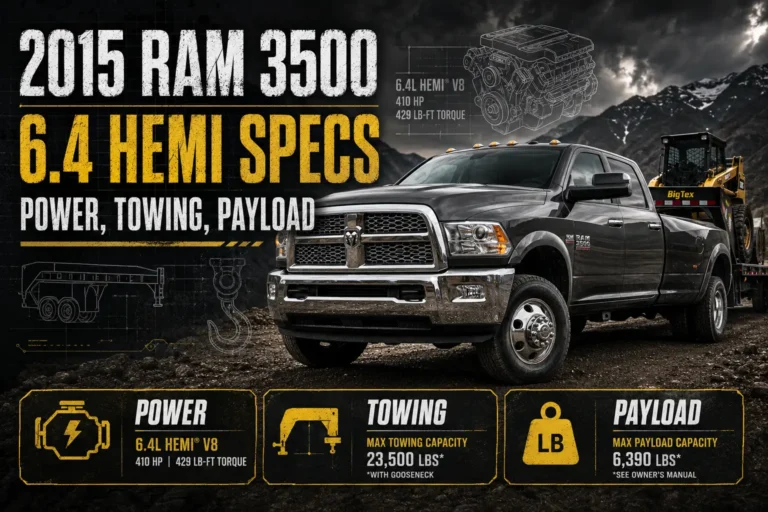
Designed specifically for heavy-duty trucks, this engine provided 410 horsepower and 429 lb-ft of torque. It remains the standard gas engine offering today.
The Towing Arms Race Accelerates
The fourth generation is where the heavy-duty towing arms race truly escalated. The competition between Ram, Ford Super Duty, and Chevrolet Silverado HD became fierce.
Towing capacities began to double what they were just a decade prior. In 2010, the Ram 3500 offered an integrated factory trailer brake controller, enhancing safety when hauling massive weights.
The 6.7L Cummins diesel saw constant output increases throughout this generation. By 2018, a High Output version of the Cummins was producing 930 lb-ft of torque.
By 2016, Ram had reclaimed the best-in-class towing title. A properly equipped regular cab Ram 3500 with the High Output Cummins and Aisin AS69RC transmission achieved a staggering 31,210-pound tow rating.
Payload capacities also soared to new heights. A gasoline-powered 2016 Ram 3500 regular cab could carry up to 7,390 pounds in its bed.
| 4th Gen Capabilities (2016) | 6.4L HEMI V8 (Gas) | 6.7L Cummins H.O. (Diesel) |
|---|---|---|
| Max Horsepower | 410 hp | 385 hp |
| Max Torque | 429 lb-ft | 900 lb-ft |
| Max Payload | 7,390 lbs | ~6,000 lbs |
| Max Towing | ~16,000 lbs | 31,210 lbs |
Fifth Generation (2019–2026): The Ultimate Towing Machine
The current fifth generation of the Ram 3500 debuted in 2019. It represents the pinnacle of heavy-duty truck engineering in the modern era.
This generation seamlessly blends ultra-luxurious interiors with unprecedented mechanical capability. The platform architecture was heavily revised from the ground up.
Engineers utilized 98.5% high-strength steel in the frame. This reduced the truck’s overall weight while maximizing its structural rigidity.
This new Heavy Duty platform is designated by the internal code D2. This distinguishes it from the DT code used for the lighter Ram 1500.
Ram focused extensively on ride quality for this generation. They utilized advanced frequency response damping shocks to mitigate the harsh ride typically associated with one-ton leaf springs.
The cabin is renowned for its absolute quietness. It utilizes active noise cancellation and acoustic glass to block out diesel clatter and road noise.
Breaking the 1,000 lb-ft Torque Barrier
The 2019 redesign brought a totally revamped 6.7-liter Cummins High Output engine. For the first time in a factory consumer pickup, a diesel engine crossed the four-figure torque threshold.
The 2019 High Output Cummins delivered 400 horsepower and an even 1,000 lb-ft of torque. This allowed the truck to tow loads previously reserved for medium-duty commercial rigs.
By 2025, and carrying over into 2026, Ram squeezed even more power from the High Output Cummins. Output currently sits at an astonishing 430 horsepower and a class-leading 1,075 lb-ft of torque.
A Standard Output Cummins also remains available. It produces a highly capable 370 horsepower and 850 lb-ft of torque.
The venerable 6.4-liter HEMI V8 continues as the standard gasoline option. It delivers 405 horsepower and 429 lb-ft of torque.
The ZF 8-Speed Transmission Upgrade
For years, Ram relied on the heavy-duty six-speed Aisin AS69RC automatic transmission to handle the massive torque of the High Output Cummins. However, a major paradigm shift occurred for the 2025 and 2026 model years.
Ram introduced the ZF PowerLine 8AP eight-speed automatic transmission for its heavy-duty diesel lineup. This commercial-grade transmission was specifically designed to optimize the Cummins’ narrow powerband.
The eight-speed transmission provides much closer gear ratios than the old six-speed. This results in seamless shifts, reduced engine noise, and improved highway fuel efficiency.
Gasoline models continue to utilize the proven TorqueFlite 8HP75 eight-speed automatic. This transmission has been thoroughly optimized with revised shift mapping for rigorous hauling environments.
Deep Dive: Year-by-Year Ram 3500 Evolution (2010–2026)
To fully grasp the rapid pace of heavy-duty truck development, it is helpful to look at granular, year-over-year updates. Ram has continuously refined the 3500 to maintain its competitive edge.
2010: The 3500 receives a total exterior and interior redesign. A reinforced chassis vastly improves fifth-wheel towing capabilities.
2011: Minor trim updates and exterior colors are introduced. The electronic trailer brake controller becomes widely adopted across trims.
2012: Ram focuses on technology upgrades. The interior receives early iterations of the Uconnect infotainment system.
2013: A massive mid-cycle refresh introduces a significantly stronger frame. The 5.7L HEMI is offered as a base V8, and interior materials are vastly improved.
2014: The 6.4L HEMI V8 debuts to replace the 5.7L in heavy-duty applications. Ram introduces the class-exclusive rear air suspension system.
2015: Ram expands luxury offerings with the Laramie Limited trim. Towing capacities are incrementally increased via minor suspension tweaks.
2016: Engine calibration updates increase performance and efficiency. Ram reclaims the towing crown with a 31,210-pound capacity.
2017: Ram introduces the 4×4 Off-Road Package for heavy-duty models. Minor updates are made to in-cabin safety technology.
2018: The Limited Tungsten edition debuts as the highest-tier luxury option. This marks the final year of the fourth-generation DS/D2 platform.
2019: The completely redesigned fifth-generation D2 platform launches. The High Output Cummins breaks the 1,000 lb-ft torque barrier.
2020: Adaptive cruise control and blind-spot monitoring become available. The Night Edition offers a blacked-out aesthetic package.
2021: Ram introduces advanced towing tech, including a digital rearview mirror. The trailer reverse guidance view simplifies hitching.
2022: The Uconnect 5 infotainment system is introduced. Subtle exterior design tweaks keep the truck looking fresh.
2023: A new digital instrument cluster is added behind the steering wheel. Minor software updates improve the towing experience.
2024: Ram prepares for a massive powertrain overhaul. The final year of the Aisin six-speed transmission for consumer High Output models.
2025: The ZF PowerLine 8-speed transmission replaces the 6-speed Aisin. A massive 14.5-inch infotainment screen becomes available.
2026: The Warlock and Black Express trims debut for heavy-duty models. Ram introduces an industry-leading 10-year/100,000-mile powertrain warranty.
Decoding Ram Heavy Duty Platform Codes
Automotive engineers, mechanics, and hardcore truck enthusiasts often refer to vehicles by their internal platform codes. Understanding these codes is crucial when researching specific parts or technical service bulletins.
When Ram separated the light-duty 1500 from the heavy-duty 2500/3500 development cycles, the platform codes diverged completely.
The current fifth-generation Ram 1500 is known internally as the DT platform. It utilizes an entirely different frame, suspension setup, and cab mounting structure than its heavier siblings.
The heavy-duty trucks are categorized under several specific codes based on their chassis type and gross vehicle weight rating:
| Internal Platform Code | Vehicle Description | Notes |
|---|---|---|
| DS | 4th Gen Ram 1500 (Classic) | Retained for fleet sales |
| DT | 5th Gen Ram 1500 | Independent front suspension |
| DJ | Ram 2500 Pickup | Coil-spring rear suspension |
| D2 | Ram 3500 Pickup | Leaf-spring rear suspension |
| DD / DF | Ram 3500 Cab & Chassis | Incomplete vehicle for upfitters |
| DP | Ram 4500 / 5500 | Commercial medium-duty chassis |
These designations are vital for distinguishing between the previous generation and the current generation when ordering aftermarket accessories. A suspension lift kit designed for a DJ (2500) will not properly fit a D2 (3500) due to the rear axle differences.
Ram 3500 Towing Capacity History & Engineering
The escalation of towing capacities over the last three decades is a testament to automotive engineering. Analyzing the historical data reveals how completely the market has transformed to support massive recreational and commercial loads.
The table below tracks the maximum towing capabilities of the Ram 3500 from the introduction of the second generation through the current model year.
| Model Year | Base Engine Towing (Gas) | Max Towing (HO Diesel DRW) | Key Technical Enabler |
|---|---|---|---|
| 1994 | 9,600 lbs | 13,200 lbs | BR/BE Frame, 12-Valve Cummins |
| 2002 | 10,150 lbs | 15,100 lbs | High Output 24-Valve Cummins |
| 2009 | 11,200 lbs | 16,850 lbs | 6.7L Cummins Introduction |
| 2014 | 16,100 lbs | 30,000 lbs | Revised Frame, Dual Cooling Radiators |
| 2018 | 16,480 lbs | 31,210 lbs | 930 lb-ft Torque Output |
| 2021 | 18,210 lbs | 37,100 lbs | Upgraded Aisin Transmission |
| 2026 | 18,150 lbs | 36,610 lbs | ZF 8-Speed, 1,075 lb-ft Torque |
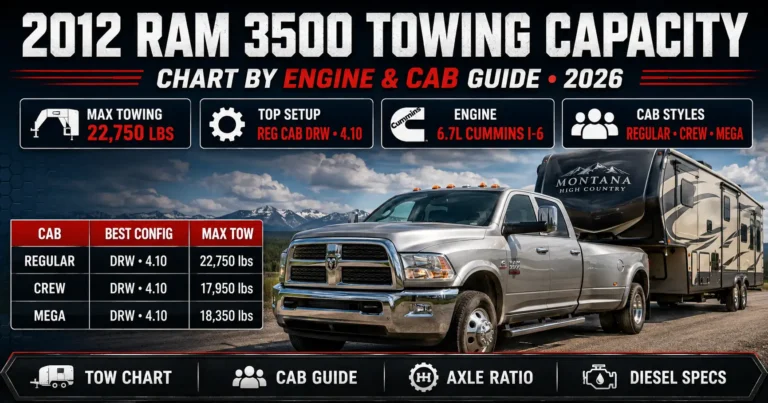
To achieve the maximum 36,610-pound rating on a 2026 model, highly specific configurations are required. A buyer must specify a Regular Cab, Dual Rear Wheel chassis with the 4×2 drivetrain and the High Output Cummins engine.
Towing physics dictates that pulling loads of this magnitude requires a fifth-wheel or gooseneck hitch setup. Conventional bumper-pull towing is generally limited to around 23,000 pounds due to weight distribution constraints and hitch receiver limitations.
Towing calculations rely heavily on mathematical ratios involving the engine, transmission, and rear differential. The fundamental formula for tractive effort utilizes the axle gear ratio to multiply engine torque before it reaches the wheels.
For example, selecting a 4.10 rear axle ratio provides significantly more mechanical advantage for getting heavy loads moving than a 3.42 ratio. The trade-off is higher engine RPMs at highway speeds, which can negatively impact fuel economy.
Payload Capacity: Single Rear Wheel (SRW) vs. Dual Rear Wheel (DRW)
While diesel engines dominate the towing conversation, payload capacity tells a very different story. Payload refers to the total weight a truck can carry in its cabin and cargo bed, including passengers and equipment. For year-by-year figures, see the Ram 3500 payload capacity chart.
Because the massive cast-iron Cummins diesel engine is substantially heavier than the gasoline HEMI V8, it subtracts from the truck’s overall gross vehicle weight rating (GVWR). Therefore, the highest payload capacities are always found on gasoline-powered models.
A 2026 Ram 3500 equipped with the 6.4L HEMI V8 boasts a maximum payload capacity of 7,590 pounds. Conversely, the exact same truck equipped with the heavy High Output Cummins diesel tops out at 6,050 pounds of payload.
The choice between a Single Rear Wheel (SRW) and Dual Rear Wheel (DRW) configuration also drastically affects payload. DRW models—commonly known as “duallies”—distribute weight across four rear tires instead of two.
An SRW Ram 3500 generally offers a GVWR between 11,040 and 12,300 pounds. Stepping up to a DRW model pushes the GVWR to a massive 14,000 pounds, unlocking thousands of additional pounds of payload capacity.
| Configuration (2026 Model) | Max Payload (Gasoline V8) | Max Payload (HO Diesel) |
|---|---|---|
| Crew Cab 8′ Box SRW (4×4) | 4,250 lbs | 3,970 lbs |
| Crew Cab 8′ Box DRW (4×4) | 7,200 lbs | 5,380 lbs |
| Regular Cab 8′ Box DRW (4×2) | 7,590 lbs | 6,050 lbs |
For agricultural workers loading heavy round bales, the DRW configuration is virtually mandatory. The dually setup also provides superior stability in high crosswinds when towing large profile RVs.
2026 Ram 3500 Updates: Warlock, Black Express, and Warranty
As the fifth generation matures, Ram continues to refine the 3500 lineup. This ensures it maintains a competitive edge against updated Chevrolet Silverado HD models.
For 2026, Ram introduced the Black Express trim, offering a value-oriented package with aggressive, blacked-out exterior styling. This trim provides 20-inch black wheels and body-color bumpers without forcing buyers into the highest luxury price brackets.
Additionally, the legendary Warlock trim makes its way to the heavy-duty lineup. Aimed at off-road enthusiasts, the Warlock features a 1-inch raised ride height, Bilstein gas-charged shocks, and aggressive all-terrain tires.
Perhaps the most significant update for 2026 is the implementation of an industry-leading powertrain warranty. Ram now covers the heavy-duty powertrain for an unprecedented 10 years or 100,000 miles.
This extended warranty covers critical components like the engine, transmission, transfer case, and drive axles. This strategic move is a direct appeal to commercial fleet managers looking to minimize long-term maintenance liabilities.
Frequently Asked Questions: Ram 3500 Capabilities & History
What is the best year for a used Ram 3500 diesel?
Many diesel purists consider the 2006 to 2007.5 model years to be the “holy grail” of the Ram 3500. These trucks feature the legendary 5.9L 24-valve Cummins engine just before the implementation of complex DPF and EGR emissions systems. They offer exceptional reliability and fuel economy, though they lack the towing capacities of modern fifth-generation trucks.
Did Ram stop using the Aisin transmission?
Yes, for the 2025 and 2026 model years, Ram phased out the heavy-duty six-speed Aisin AS69RC transmission in its consumer pickups. It was replaced by the advanced ZF PowerLine 8AP eight-speed automatic. This new transmission provides smoother shifting, better fuel economy, and superior integration with the High Output Cummins’ torque curve.
What is the difference between the Ram 2500 and Ram 3500?
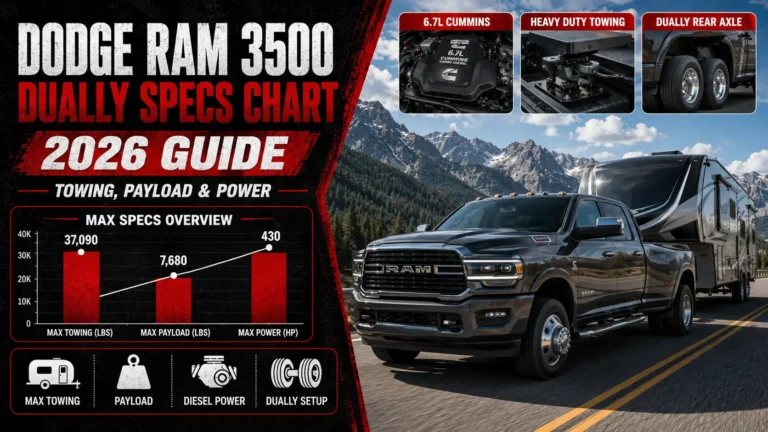
While they share identical cab structures and engine options, the Ram 3500 is built on a significantly stiffer frame with a different rear suspension setup. The Ram 2500 utilizes a five-link coil rear suspension for a smoother unladen ride, while the 3500 relies on heavy-duty leaf springs to support massive payload and towing weights. Furthermore, only the 3500 is available with a Dual Rear Wheel (DRW) dually option. See full figures in our Ram 3500 dually specs chart.
Can you get a manual transmission in a new Ram 3500?
No, Ram officially discontinued the six-speed manual transmission (the G56) after the 2018 model year. The fifth-generation trucks (2019–Present) are exclusively offered with automatic transmissions. The sheer volume of torque produced by modern Cummins diesel engines simply exceeds the holding capacity of traditional consumer manual clutches.
Does the Mega Cab reduce towing capacity?
Yes, selecting the Mega Cab configuration slightly reduces both towing and payload capacities compared to a standard Crew Cab. The extended cab structure adds several hundred pounds of curb weight to the vehicle. Because the Gross Vehicle Weight Rating (GVWR) remains static, this extra body weight subtracts directly from the available payload and tow ratings.