Truck Payload Capacity Chart By Year (2026 Full Reference)

Quick Answer
Truck payload capacities generally range from 1,000 lbs in compact pickups to over 7,500 lbs in heavy-duty commercial configurations. Calculated as Gross Vehicle Weight Rating (GVWR) minus curb weight, maximum ratings vary significantly by powertrain and chassis. Critically, factory brochure numbers show best-case scenarios; your vehicle’s actual certified payload capacity is strictly dictated by the driver’s door jamb Tire and Loading Information placard.
A truck’s payload capacity defines the true functional limit of what the vehicle can carry and tow, ranging anywhere from 1,000 pounds in compact and midsize pickups to well over 7,500 pounds in commercial-grade dual-rear-wheel workhorses. Online manufacturer charts and glossy sales brochures routinely advertise best-case payload numbers based on stripped-down, base-trim regular cabs. This practice leads owners to dangerously overload their pickups when towing bumper-pull trailers, mounting fifth wheels, or packing cargo. This comprehensive 2026 reference guide provides verified payload capacity charts by class, powertrain, and model year, along with the engineering formula required to calculate your vehicle’s legally binding rating directly from your driver-side door placard.

Prime for Young Adults — 6 Months Free
Students and 18–24s get six months of Prime free, then half price.
Start 6 Months Free1,000 – 1,800 lbs
1,300 – 2,300 lbs
2,500 – 4,200 lbs
5,500 – 7,800+ lbs
Truck Payload Capacity Chart by Class and Year (2020–2026)
Recommended Best Deal Products


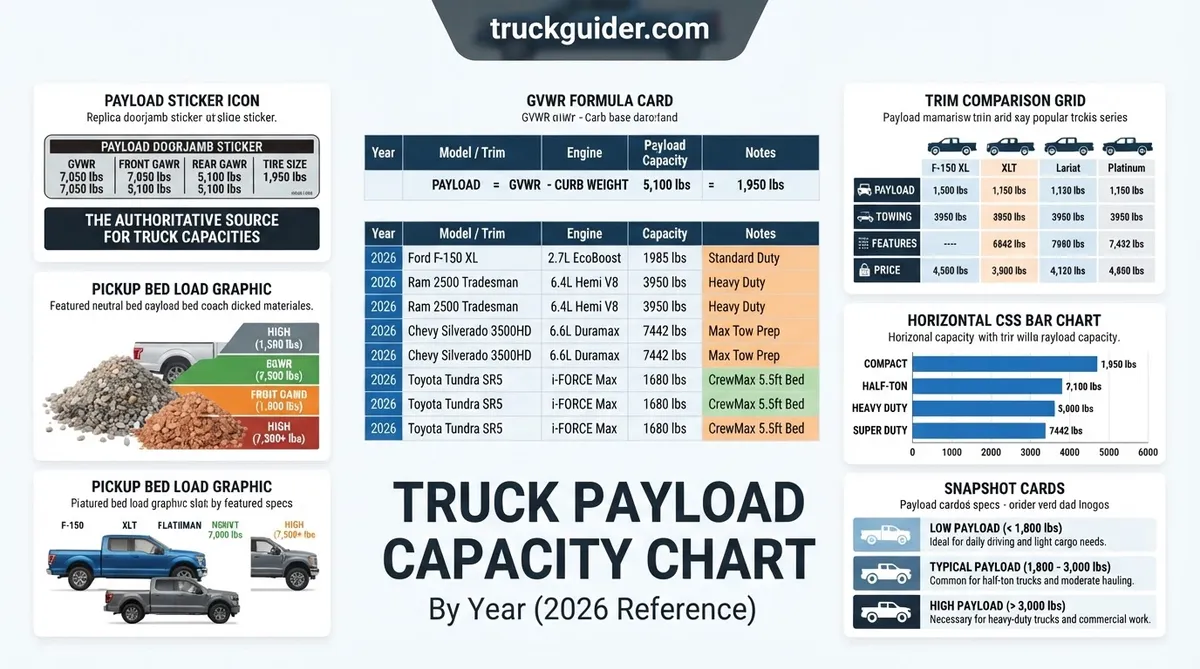
This reference chart establishes the factory specification ranges across primary pickup categories covering model years 2020 through 2026. Understanding these numbers requires cross-referencing a vehicle’s curb weight against its factory-assigned Gross Vehicle Weight Rating (GVWR).
📤 Share Image
Data represents standardized North American light-duty (Class 1–2a) and heavy-duty (Class 2b–3) pickups across model years 2020 to 2026. Published ranges reflect lowest trim, two-wheel-drive configurations at the top end, down to fully optioned luxury 4×4 or off-road packages at the bottom end. Always verify your specific VIN and federally mandated tire placard before loading cargo or hitching a trailer. Last reviewed: October 2026.
How to read this chart: Payload capacity reflects the total permissible weight of all passengers, bed cargo, cab equipment, and trailer hitch tongue weight. The lower boundary represents fully equipped crew-cab 4×4 configurations with high-displacement or electrified powertrains; the upper boundary reflects stripped, standard-cab work truck trims configured for maximum cargo delivery.
| Year | Model / Trim | Engine | Payload Capacity | Notes |
|---|---|---|---|---|
| 2024–2026 | Midsize Pickups (Ranger, Colorado, Tacoma) | 2.3L–2.7L Turbo I4 / Hybrid | 1,200 – 1,805 lbs | Hybrids and off-road packages (TRD Pro, ZR2) sit near 1,200–1,300 lbs. |
| 2020–2023 | Midsize Pickups (Previous Gen Platforms) | 2.3L Turbo / 3.5L–3.6L V6 | 1,000 – 1,600 lbs | Steel-box configurations limit base payload; regular cabs rare. |
| 2024–2026 | Full-Size 1500 (Crew Cab 4×4 Luxury) | 3.0L–3.5L TT / 5.3L–6.2L V8 / Hybrid | 1,300 – 1,750 lbs | High-trim options (sunroofs, air suspensions, power steps) heavily penalize GVWR. |
| 2020–2026 | Full-Size 1500 (Base / Heavy-Duty Payload) | 3.3L–3.5L V6 / 5.0L V8 | 1,850 – 2,300 lbs | Requires specific factory max-payload suspension and axle gearing packages. |
| 2020–2026 | Three-Quarter-Ton 2500 (Crew Cab 4×4) | 6.6L–6.7L Turbo-Diesel V8/I6 | 2,100 – 3,200 lbs | Diesel engine mass (approx. 800+ lbs over gas) directly reduces 10,000-lb GVWR capacity. |
| 2020–2026 | Three-Quarter-Ton 2500 (Reg/Crew 4×2/4×4) | 6.4L–6.8L Naturally Aspirated Gas V8 | 3,300 – 4,200 lbs | Lighter gas powertrain preserves available payload under Class 2b weight caps. |
| 2020–2026 | One-Ton 3500 Single Rear Wheel (SRW) | 6.6L–6.7L Diesel / 6.4L–7.3L Gas V8 | 3,800 – 4,900 lbs | Higher GVWR ceilings (11,400–12,400 lbs) restore diesel carrying utility. |
| 2020–2026 | One-Ton 3500 Dual Rear Wheel (DRW) | 6.6L–6.7L High-Output Turbo-Diesel | 5,200 – 6,900 lbs | Class 3 chassis configuration engineered specifically for heavy gooseneck/5th-wheel pin loads. |
| 2020–2026 | One-Ton 3500 Dual Rear Wheel (DRW) | 6.4L–7.3L Heavy Gas V8 | 6,500 – 7,850+ lbs | Absolute factory maximum ratings achieved on 4×2 regular cab, long-bed configurations. |
*Note: Factory specifications reflect unladen vehicles without driver or fuel tank deductions where standard SAE J2807 calculations apply. Optional off-road skid plates, camper packages, and larger wheel diameters will reduce stated values.
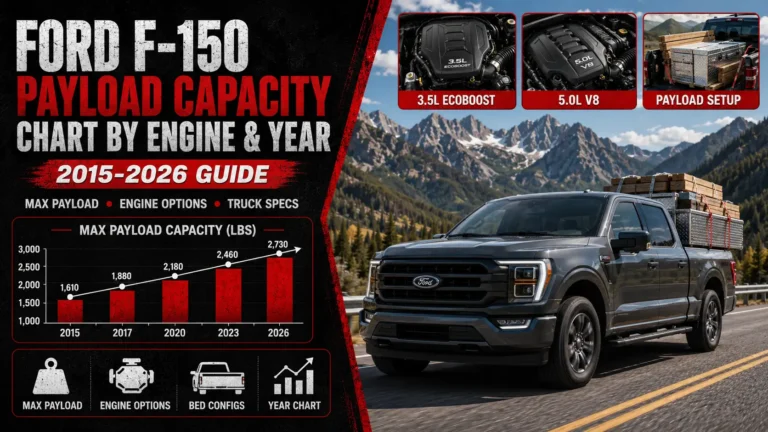
Midsize Pickup Payload Ratings (1,000–1,800 lbs)
The midsize segment experienced a significant architectural shift between 2023 and 2026. Older platforms rarely sustained more than 1,400 pounds of true cargo capacity once four doors and four-wheel drive were optioned. Modern fully boxed frames and updated spring architecture push basic 4×2 work configurations toward 1,800 pounds. However, off-road variants equipped with dual-locking differentials, underbody armor, and multi-valve adaptive shock reservoirs routinely drop back toward the 1,000 to 1,200-pound floor.
Half-Ton 1500 Series Payload Ratings (1,300–2,300 lbs)
Half-ton pickups exhibit the widest variation between theoretical maximums and real-world capabilities. A stripped regular cab, two-wheel-drive 1500 equipped with a standard V6 can post a factory specification rating of up to 2,225 pounds. Conversely, a luxury crew-cab four-wheel-drive model featuring a panoramic sunroof, ventilated rear seats, and hybrid propulsion frequently displays an actual door-sticker limit closer to 1,350 pounds. This spread catches many travel-trailer owners off guard when calculating allowable tongue weight.
Heavy-Duty 2500 and 3500 Series Payload Ratings (2,500–7,500+ lbs)
Heavy-duty trucks are split into Class 2b (2500 series, typically capped at 10,000 lbs GVWR to avoid commercial registration fees in several states) and Class 3 (3500 series, scaling up to 14,000 lbs GVWR). Because a Class 2b truck has an artificial weight ceiling, dropping a 1,000-pound diesel engine into a 2500 platform severely cuts payload capacity, sometimes leaving it with less carrying capacity than a heavy-payload half-ton. Moving into 3500 SRW and DRW trucks eliminates this issue by expanding the underlying GVWR ceiling up to the federal 14,000-pound limit.
Year-by-Year Truck Payload Rating Changes and Model Updates
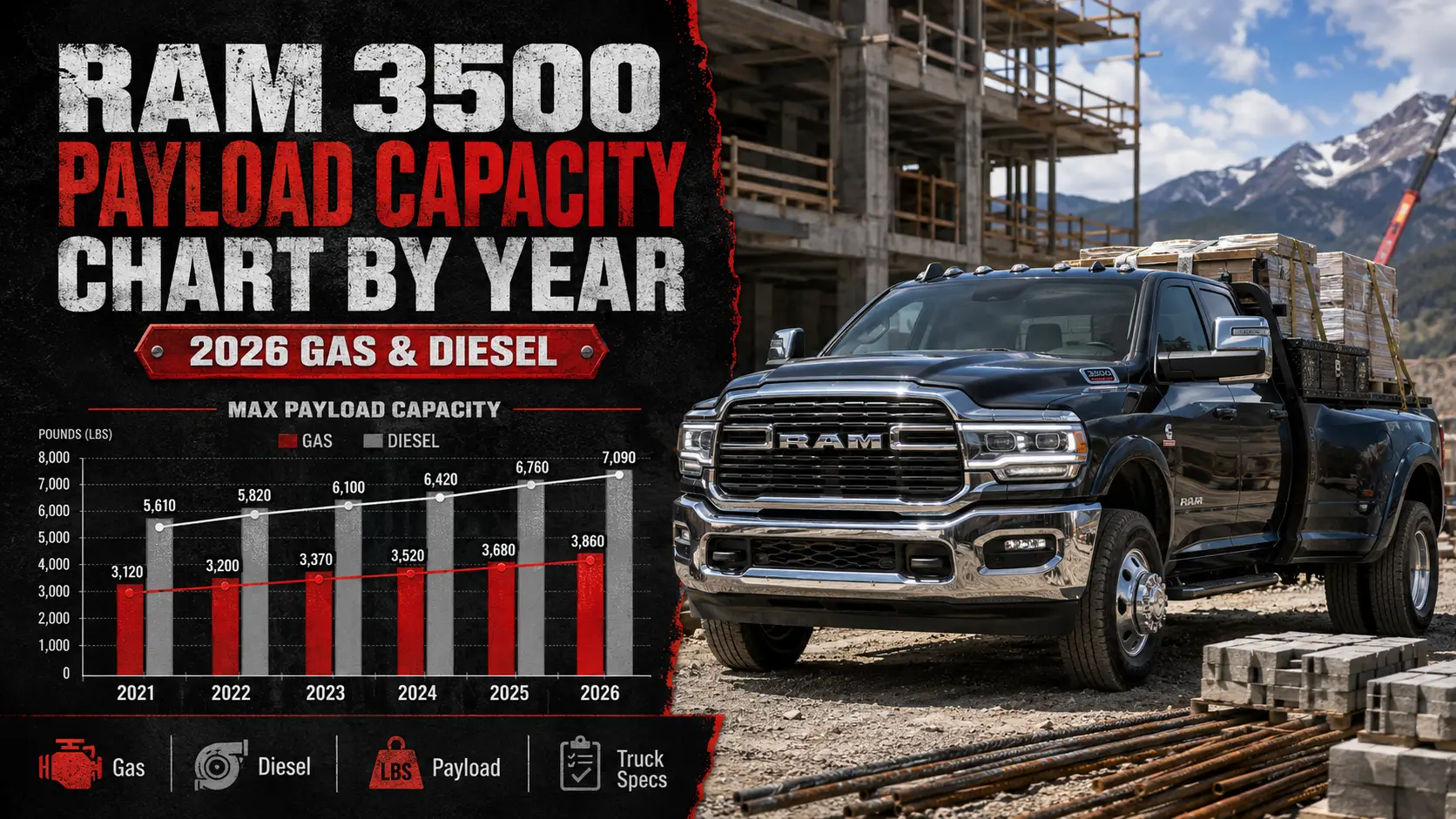
Between 2020 and 2026, pickup truck architectures evolved through two major design pressures: shedding structural tare weight through advanced metallurgy, and absorbing the mass penalties of electrification and high-voltage power-inversion electronics.

Audible — Listen Free for 30 Days
One free credit a month and thousands of titles included.
Listen Free for 30 DaysClass Payload vs. Curb Weight Evolution
Midsize Payload Avg (2020 vs 2026)
Avg Half-Ton Curb Weight Gain
Class 3 GVWR Ceiling Standardization
Structural Frame and High-Strength Steel Advancements (2020–2023)
The transition to fully boxed frames made from up to 98% high-strength steel allowed manufacturers to raise Gross Vehicle Weight Ratings without incurring proportional curb weight increases. Midsize platforms introduced across this window abandoned outdated open-C-channel chassis designs, stiffening beds and rear spring perches. These manufacturing advancements permitted midsize truck payload allowances to exceed 1,700 pounds on basic trims, closing the operational gap with older half-ton models.
Electrification and Hybrid Battery Weight Penalties (2022–2026)
The integration of hybrid and fully electric drivetrains has complicated payload dynamics. The addition of a 1.5 kWh to 24 kWh liquid-cooled hybrid battery, along with permanent-magnet drive motors and power-inverter circuitry, adds roughly 200 to 450 pounds of tare curb weight to the vehicle. Because light-duty half-ton platforms are mechanically limited by braking capacity and passenger tire load ratings, automakers cannot simply expand GVWR indefinitely without reclassifying the vehicle. As a result, hybrid-equipped half-tons commonly lose 200 to 300 pounds of usable bed payload relative to equivalent turbo-gas variants.
Class 2b and Class 3 Heavy-Duty GVWR Bracket Shifts
In response to increasingly heavy fifth-wheel recreational trailers and commercial gooseneck designs, manufacturers substantially re-engineered their Class 3 (one-ton) platforms between 2023 and 2026. While three-quarter-ton trucks largely remained constrained by the traditional 10,000-pound regulatory threshold, one-ton single-rear-wheel ratings advanced from 11,500-pound ceilings up to 12,400 pounds. This structural recalibration unlocked usable payloads above 4,500 pounds in single-rear-wheel layouts, allowing operators to handle demanding hitch pin weights without requiring a dual-rear-wheel configuration.
How Engine Option and Trim Level Alter Truck Load Capacity Charts
Recommended Best Deal Products

Checking a generic vehicle payload specification guide often sets incorrect expectations. A specific truck’s actual payload rating is determined by three mechanical decisions: powertrain block material, cab and bed configuration, and optional accessory packaging.
Every mechanical addition bolted to the chassis during manufacturing chips away at the available payload allowance. Two trucks leaving the assembly line with the same frame, axles, and engine can have a payload divergence of more than 700 pounds purely due to options like massaging leather seats, panoramic moonroofs, integrated tailgate steps, and skid plates.
The Diesel Weight Paradox: Gas vs Diesel Payload Limits
Heavy-duty turbo-diesel engines deliver tremendous torque for pulling heavy grades, but their structural mass works against overall payload capacity. A cast-iron 6.7L turbo-diesel engine with its associated emissions equipment, dual alternators, heavy-duty cooling loops, and oversized transmission weighs between 700 and 1,000 pounds more than a modern large-displacement pushrod gas V8.
In a 2500 series truck capped at a 10,000-pound GVWR, opting for a diesel engine cuts legal payload capacity by roughly 900 pounds. While the diesel can pull heavier weights along flat ground, it can legally carry significantly less pin weight, gravel, or slide-in camper gear than its gas-powered twin.
Cab Configuration and Bed Length Trade-Offs
Every square foot of cab metal, sound deadening, passenger glass, and frame extension adds dead weight. A two-door regular cab with an 8-foot bed offers the lightest passenger chassis and the most efficient payload-to-GVWR ratio. Transitioning to a four-door crew cab with a 6.5-foot or 8-foot bed adds 350 to 600 pounds of steel and interior components. This added structural tare mass reduces the remaining cargo payload allowance on an exact pound-for-pound basis.
Audible Premium Plus — Annual Membership
12 audiobook credits up front, plus the full Audible catalogue.
See Annual PlansTrim Creep: How Luxury Packages Drain Available Payload
Base trims (work trucks and entry utility packages) have basic interiors, manual seat adjustments, and lighter wiring harnesses. Premium luxury trims (such as King Ranch, Limited, Denali, or High Country) introduce power running boards, sound-dampening laminated acoustic glass, complex multi-motor seating assemblies, electronic tailgate mechanisms, and 20- to 22-inch wheel assemblies. This feature density routinely strips 300 to 500 pounds of payload capacity away compared to base configurations with identical engines and gear ratios.
Reading Your Truck Payload Guide: GVWR, Curb Weight, and Axle Limits
To safely manage cargo and towing setups, drivers must rely on certified vehicle weight ratings rather than marketing materials. The physical weight data plate on your vehicle’s B-pillar serves as the authoritative legal document governing your specific chassis.
Available Payload = GVWR – Actual Curb Weight
Where Actual Curb Weight equals the real-world scale weight of the completely fueled truck including all installed accessories, cargo, and hitch hardware.
The Fundamental Engineering Formula: GVWR Minus Curb Weight
Gross Vehicle Weight Rating (GVWR) is the maximum operating weight of the vehicle established by the manufacturer, verified through Federal Motor Vehicle Safety Standards (FMVSS). This figure is non-negotiable. If a truck features an assigned GVWR of 7,100 pounds and its actual curb weight on a certified scale sits at 5,350 pounds with fuel, the vehicle’s true available payload capacity is exactly 1,750 pounds.
Front and Rear Gross Axle Weight Ratings (GAWR)
In addition to total GVWR, trucks are governed by Front Gross Axle Weight Rating (FGAWR) and Rear Gross Axle Weight Rating (RGAWR). These figures define the maximum structural load either axle assembly can carry, including tires, wheels, springs, brakes, and housing tubes. Importantly, summing the FGAWR and RGAWR together always yields a number higher than the overall GVWR. Automakers provide this margin so loads do not have to be split between axles with pinpoint precision. However, you cannot legally or mechanically exceed the total GVWR even if both individual axles stay underneath their respective GAWR limits.
Decoding the Driver-Side B-Pillar Tire and Loading Sticker
Open the driver-side front door and inspect the B-pillar jamb. Locate the federally mandated tire specification sticker containing the text: “The combined weight of occupants and cargo should never exceed XXX kg or XXX lbs.” This is your vehicle’s factory-certified baseline payload capacity.
Find the adjacent metal or vinyl certification sticker displaying your VIN, build date, GVWR, and individual Front/Rear GAWR figures. Verify that tire sizes and load index ratings match your vehicle’s current equipment.
Remember that this placard records the truck’s weight when it rolled off the assembly line. It does not account for dealer-installed steps, bed covers, hitches, toolboxes, or cargo loaded after manufacturing.
Real-World Factors That Reduce Factory Payload Specifications
Recommended Best Deal Products
Exceeding a pickup’s certified payload capacity rarely happens because of bed cargo alone. Most over-limit conditions stem from overlooked deductions like passenger weights, heavy hitch hardware, and trailer tongue downloads.
A truck will almost always run out of payload capacity long before reaching its maximum advertised towing capacity. An 8,000-lb trailer places an average tongue weight of 960 to 1,200 lbs directly on the hitch. This single item consumes 65% to 80% of a typical half-ton pickup’s 1,500-lb payload rating before any passengers or gear enter the cab.
- Trailer Tongue Weight and 5th-Wheel Pin Weight Subtractions: Conventional bumper-pull trailers require 10% to 15% of their total gross trailer weight directly on the ball to prevent high-speed sway. Gooseneck and fifth-wheel recreational trailers require 15% to 25% of their weight resting over the rear axle. This downward force counts entirely as bed payload. If your fifth wheel transfers 3,000 pounds of pin weight, your truck must have at least 3,000 pounds of available payload capacity plus the weight of the hitch mount and cab passengers.
- Aftermarket Modifications and Cab Occupant Weight: Factory payload numbers assume an empty truck with zero passengers (or a nominal 150-lb driver under selective SAE J2807 tow calculations). Four 200-lb adult passengers drain 800 pounds of cargo capacity immediately. Adding a spray-in bedliner (60 lbs), a fiberglass commercial topper (180–220 lbs), a heavy-duty steel front bumper with a winch (250 lbs), and a drawer storage system (150 lbs) strips away nearly 700 pounds of carrying capacity before any tools or luggage are loaded.
- The Suspension Air Bag Myth: Installing aftermarket helper springs, high-pressure rear air bags, or heavier sway bars levels the truck’s ride height and stabilizes headlight alignment. However, they do not increase the legal GVWR or payload rating. Payload limits are established based on frame rail thickness, axle bearings, rear differential cooling, braking heat dissipation, and tire sidewall shear strengths. Levelling the rear suspension does not upgrade these critical wear surfaces, and it does not change your legal liability limit.
- Mechanical Hazards and Enforcement Risks: Operating past GVWR ratings accelerates mechanical wear. Overloading leads to brake rotor overheating and fading, cracked wheel hubs, premature ring-and-pinion gear failure, and severe frame fatigue near the rear axle perches. Commercial Vehicle Enforcement personnel and Department of Transportation (DOT) weigh stations operate on axle scale limits. In personal-use scenarios, exceeding your door sticker ratings can create clear liability exposure in civil court if an overloaded condition contributed to a braking failure during an accident.
Payload-Safe Towing Habits
Weigh your fully packed rig at a public CAT scale (Certified Automated Truck scale). This provides three clear readings: steer axle, drive axle, and trailer axles. This step confirms that no individual axle or total GVWR limit is exceeded.
Dangerous Assumptions
Assuming your half-ton truck can pull its advertised 12,000-lb towing limit with four family members, two dirt bikes in the bed, and luggage in the back. That setup almost always exceeds the factory GVWR by hundreds of pounds.
Truck Payload Capacity Chart Questions Answered
What is the difference between towing capacity and payload capacity?
Payload capacity measures the total downward weight your truck’s chassis, axles, and bed can carry inside and on top of the vehicle itself. Towing capacity measures the maximum horizontal rolling weight the truck can pull behind it. Trailer tongue weight bridges these metrics: the downward weight applied to your hitch ball counts directly against your truck’s payload capacity.
Does fuel reduce the payload capacity shown on the door sticker?
No. Federally mandated Tire and Loading Information placards calculate payload with all fluid reservoirs filled to 100% capacity, including a full tank of gas or diesel and engine oil. However, it accounts for zero passengers and zero aftermarket cargo accessories unless specifically noted by a dealer modification addendum sticker.
Can you increase a truck’s payload capacity with E-rated tires or helper springs?
Upgrading to Load Range E tires, heavy-duty bump stops, helper leaf springs, or pressurized air suspension will increase handling stability and reduce rear suspension sag under load. However, these upgrades do not legally alter the factory-certified Gross Vehicle Weight Rating (GVWR) assigned to your VIN. The vehicle’s legal payload capacity remains the original figure stamped on the door-jamb compliance placard.
Why do 2500 series diesel trucks often have lower payload than gas versions?
Most Class 2b three-quarter-ton pickups (such as the F-250, Silverado 2500, and Ram 2500) have an artificial Gross Vehicle Weight Rating cap of 10,000 pounds to keep them within non-commercial registration brackets. A heavy-duty turbo-diesel engine package weighs 700 to 1,000 pounds more than a gas V8. Because the overall 10,000-lb ceiling remains fixed, the engine’s extra tare weight directly subtracts from the truck’s available cargo payload.
Final Guidance on Real-World Truck Payload Management
A truck’s payload capacity is an absolute engineering ceiling determined by calculating Gross Vehicle Weight Rating (GVWR) minus actual curb weight. While glossy brochures feature best-case payload numbers for basic trims, your truck’s true capacity is determined by its specific engine, cab style, and factory options. Towing dynamic loads, hauling equipment, and mounting truck campers all place significant demands on payload limits. Trailer tongue weight, passenger weight, and aftermarket gear all directly reduce the capacity listed on your door placard. Heavy turbo-diesel powertrains deliver impressive pulling torque, but their physical block mass reduces carrying capacity in Class 2b trucks compared to gas-powered equivalents. Suspension air bags and helper springs can level your ride height, but they do not raise your truck’s legal GVWR. Before hitting the road with a heavy load or new trailer, check the yellow-and-white Tire and Loading Information placard on your driver-side door jamb, load your vehicle safely, and run your setup across a certified scale.

![How to Use a Trailer Brake Controller: Gain & Override Guide [2026]](https://truckguider.com/wp-content/uploads/2026/03/how-to-use-trailer-brake-controller-featured.webp)