Ford Ranger Engine Swap Compatibility Specification Chart By Year (1998–2026)

Quick Answer
Engine swap compatibility for the Ford Ranger varies significantly by generation. The 1998–2011 models (T6/DE98) offer high modularity for Lima and Cologne engines, while the 2019–2026 global/US platform requires complex integration due to CAN-bus architecture. Compatibility depends heavily on transmission bellhousing patterns, motor mount locations, and ECU communication protocols. Always verify your specific chassis VIN and factory service manual before purchasing a donor engine.
Unlocking the true potential of your Ford Ranger often begins with discarding the factory engine for a high-performance alternative. However, navigating engine bay dimensions, complex wiring harnesses, and strict emissions laws makes engine swapping a daunting puzzle. This guide provides the definitive compatibility data and engineering requirements to successfully transplant your next motor into a Ford Ranger chassis produced between 1998 and 2026.


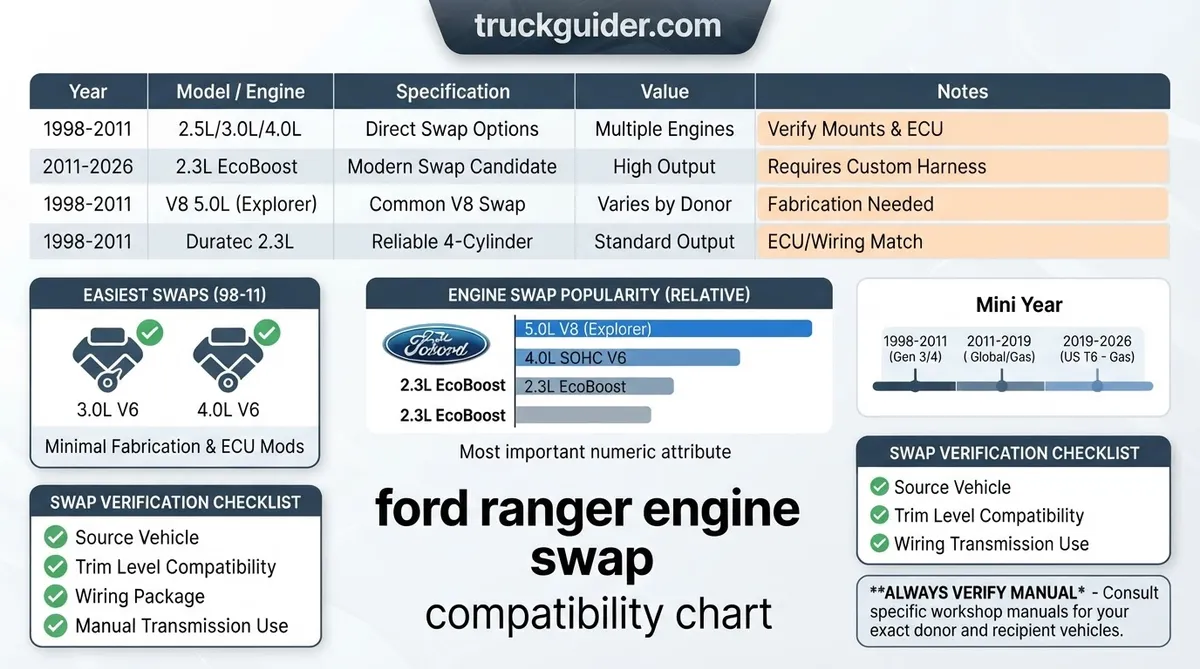
Ford Ranger Engine Swap Compatibility Chart By Year (1998–2026)
📤 Share Image
This chart covers the transition from the T2 chassis (1998–2011) to the global T6 platform (2019–present). Values represent common swap feasibility. Always verify your specific VIN and emissions compliance before purchasing a donor unit. Last reviewed: August 2026.
| Model Years | Chassis Type | Common Swap Targets | Difficulty Level | Notes |
|---|---|---|---|---|
| 1998–2011 | T2 (Legacy) | Ford 5.0L Windsor | Moderate | Well-documented; high parts availability. |
| 1998–2011 | T2 (Legacy) | GM LS-Series | High | Requires custom crossmember/exhaust. |
| 2019–2026 | T6 (Global) | 2.3L/2.7L EcoBoost | High (Electronic) | Complex CAN-bus integration. |

Key Data Scope and Accuracy Notes
The “difficulty level” assigned above accounts for both physical fitment and the integration of the powertrain control module (PCM). For 1998–2011 models, the wide engine bay allows for pushrod V8s, provided the front crossmember is modified to accommodate the oil sump. In contrast, 2019–2026 models utilize a highly integrated electronic architecture, making “swaps” more akin to system-level upgrades rather than traditional mechanical transplants.
Configuration-Specific Swap Requirements
When planning your project, consider the following constraints:
- Transmission Tunnel Clearance: The T2 chassis has a narrow tunnel; fitting modern 6R80 or 10R80 transmissions usually requires chassis “persuasion” or tunnel fabrication.
- Emission Compliance: In the US, it is a federal violation to install an older engine into a chassis newer than the engine. Always ensure your donor engine is the same year or newer than your Ranger.
- Mounting: Use aftermarket cradle plates to transition from the 4.0L Cologne V6 mounts to small-block Ford or GM engine mounts.
Ford Ranger Engine Bay Dimensions and Clearance Realities
Measuring Firewall and Tunnel Clearance
The primary physical hurdle is the depth of the engine bay. The distance from the radiator support to the firewall is approximately 30 inches in the T2 chassis. Using a plumb bob is an effective way to verify that the crankshaft centerline of your target engine aligns with the existing transmission output position, preventing driveshaft binding.



28–32″
Managing Increased Engine Bay Heat Output
When swapping from an I4 to a V8, engine bay temperatures rise significantly. Ensure your cooling system strategy includes a high-flow aluminum radiator. Custom motor mount bushings are essential to minimize vibration, as polyurethane bushings transfer more resonance to the cabin than stock rubber units.
Electrical and ECU Integration for Engine Swaps
Solving ECU and PCM Communication Barriers
Electrical integration is the most common point of failure for modern swaps. For 2019+ models, the CAN-bus network expects specific signals from the stock ECU. If you replace the heart of the engine, the transmission and gauge cluster will lose communication. Many builders opt for standalone engine management systems (like Holley Terminator X or FuelTech) to bypass these hurdles, though this often disables factory features like cruise control or dashboard readouts.
Maintaining OBD-II Functionality
To retain OBD-II functionality, you must keep the original PCM connected to the chassis harness, while using a piggyback controller to manage the engine itself. This “dual-ECU” approach allows for diagnostic checks while letting the performance engine run independently.
Mechanical Components: Driveline, Cooling, and Exhaust
- Driveline: Transmission output shafts often require a custom-length driveshaft. Have your shaft measured only after the engine and transmission are bolted in their final resting positions.
- Oil Pan/Crossmember: The stock front crossmember is a significant interference point. You will likely need a custom-fabricated oil pan with a rear sump to clear the steering rack and crossmember.
- Exhaust: Factory manifolds rarely clear the frame rails. Expect to fabricate custom headers or modify shorty headers to snake through the cramped Ranger engine bay.
- Cooling: Standard cooling capacity is rarely sufficient for a higher-displacement engine. Upgrade to a multi-core radiator and high-CFM electric cooling fans.
Proven Ford Ranger Engine Swap Build Paths and Kits
The 5.0L Windsor Swap Advantages
The Ford 5.0L Windsor remains the gold standard for T2 Rangers because of its compact width and historical parts support. Numerous companies sell “cradle kits” that essentially make this a bolt-in affair, saving hundreds of hours of fabrication time.
Always buy an engine-specific wiring harness rather than trying to salvage the donor vehicle’s harness; the time saved in debugging is worth the investment.


✅ Pros
- High aftermarket support
- Predictable power delivery
- Pre-made engine mounting kits
❌ Cons
- Weight penalty on front end
- Requires cooling upgrades
- Chassis-to-transmission tunnel fitment
Regardless of the engine path chosen, engine bay width is the primary limiting factor for V8s, while wiring and ECU integration represent the highest risk of project failure. Before you secure your engine, double-check your chassis generation specifications and source a reputable swap kit. Always verify your local legal requirements before turning a wrench, as emission laws change rapidly and can affect vehicle registration status.
Ford Ranger Engine Swap Compatibility Chart: Frequently Asked Questions
Will a 5.0L V8 fit in a stock Ranger engine bay?
Yes, a 5.0L Windsor V8 is a classic swap for 1998–2011 Rangers. It fits physically, but requires custom motor mounts, a modified oil pan for steering linkage clearance, and typically an upgraded cooling system. While the engine fits the frame width, extensive work is required to adapt the fuel system, exhaust headers, and the transmission tunnel for the larger gearbox.
Is it legal to swap an older engine into a newer chassis?
In most jurisdictions, especially those following EPA or CARB guidelines, it is illegal to install an engine that is older than the chassis. The vehicle must meet or exceed the emissions standards of the year the vehicle was manufactured. Always check your state’s specific engine swap laws, as installing a pre-OBD-II engine in a modern, computer-controlled truck will likely result in inspection failure.
Do I need to upgrade the suspension for a V8 swap?
Yes. Most V8 engines are significantly heavier than the stock 4-cylinder or V6 powerplants. To maintain proper ride height and handling, you must upgrade to higher-rate front coil springs or torsion bars. Failure to do so will result in ‘nosediving,’ premature wear on front suspension components, and dangerous handling characteristics that could compromise steering geometry and braking.
Will the stock gauges work with a non-Ford engine?
Generally, no. The stock Ranger instrument cluster relies on data transmitted via the vehicle’s CAN-bus or specific analog sender signals that rarely match a donor engine’s sensors. You will likely need to integrate an aftermarket gauge suite, use specialized conversion interfaces, or perform complex wiring modifications to translate the new engine’s sensor data into signals the factory cluster can interpret.


Which Ranger years are best for engine swaps?
The 1998–2011 model years are widely considered the most ‘swap-friendly’ due to their simpler electrical systems and more spacious engine bays. These platforms were built using modular architectures that allow for relatively straightforward swaps within the Ford engine family. Conversely, 2019–2026 models feature heavily integrated electronic systems and advanced safety sensors that make non-factory engine swaps extremely difficult to complete without full custom control modules.