Delmonico Red Paint Code Identification And: Causes & Fixes [2026]

The striking depth of Delmonico Red Pearl (PRV) is more than just a color; it is a sophisticated multi-layered finish that defines the premium aesthetic of modern RAM and Chrysler vehicles. Since its introduction, this shade has become a hallmark of the Stellantis (formerly FCA) color palette, offering a rich, liquid-like appearance that shifts dramatically under different lighting conditions. However, for owners and refinishing professionals, locating the exact paint code and achieving a seamless match for repairs can be daunting. The complexity of the pearl pigments requires a nuanced approach to both sourcing and application. This expert guide provides the technical precision needed to identify, source, and apply the Delmonico Red paint code with the reliability expected by industry professionals, ensuring your vehicle maintains its showroom-quality finish.
Locating the Delmonico Red Paint Code PRV on Your Vehicle
📤 Share Image
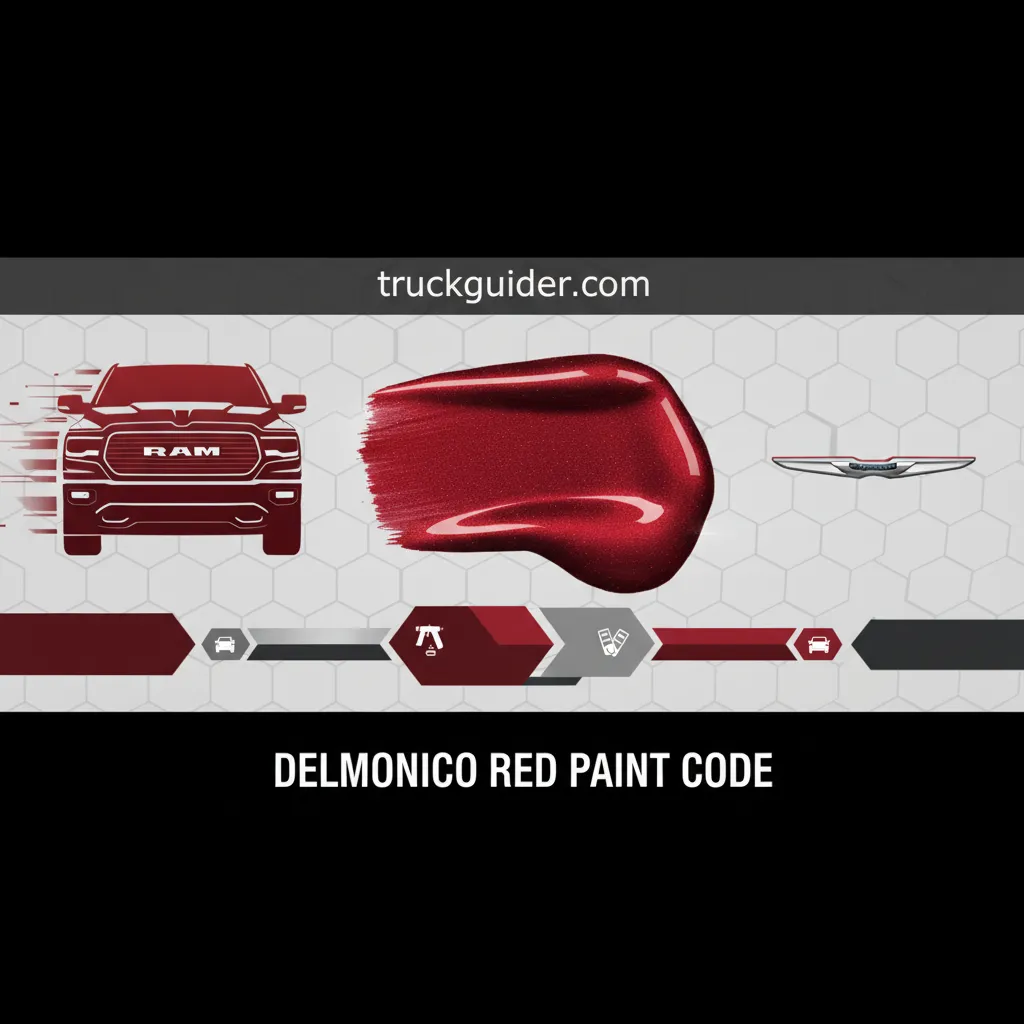
Precision is the foundation of any quality automotive repair. When dealing with a complex pearlescent finish like Delmonico Red, guessing is not an option. The primary identifier for this color is the PRV code, which has been a staple in the Stellantis lineup since approximately 2016. It was introduced to replace the aging ‘Deep Cherry Red’ (PRP), offering a slightly more sophisticated metallic structure and a deeper undertone. While the sales brochures might call it “Delmonico Red,” your mixing scale only cares about the alphanumeric code.

📋
Step-by-Step Identification Guide
Locate the Safety Standard Certification Label. This is usually a white or silver sticker found on the inner pillar or the edge of the door itself. Look for the “PNT:” prefix followed by three characters.
On the sticker, the paint code is explicitly labeled as PNT:PRV. In some Chrysler vehicles, you may see it listed near the bottom of the VIN barcode section. Ensure you are not confusing it with the interior trim code.
Consider a common scenario involving a 2019 RAM 1500. At a distance, Delmonico Red can look remarkably similar to Flame Red (PR4) or Redline Pearl (PRY) under harsh midday sun. However, Flame Red is a solid base coat without metallic flakes, while Redline has a much higher concentration of bright red pearls. If you apply PR4 to a PRV-coded vehicle, the repair will stand out as flat and dull. This is why expert refinishers always verify the code against the VIN (Vehicle Identification Number) through an authorized dealer’s parts department if the door sticker is damaged or missing. A quick call with the last 8 digits of your VIN will provide comprehensive confirmation of the factory-applied finish.
Always distinguish between the base coat and the clear coat. Delmonico Red is a base-clear system, meaning the PRV code only refers to the color layer. You must use a professional-grade clear coat to achieve the final gloss and protection.

Technical Composition and Visual Characteristics of Delmonico Red Pearl
What makes Delmonico Red so visually captivating is the advanced pearl pigment technology embedded in its chemistry. Unlike traditional metallic paints that use flat aluminum flakes to reflect light, PRV utilizes mica-coated alumina flakes. These microscopic particles act like tiny prisms. When light hits the surface, it doesn’t just bounce off; it refracts through the layers of the pearl, creating a “color travel” effect that moves from a dark, brooding maroon in the shade to a vibrant, fiery crimson in direct sunlight.
From a technical standpoint, while PRV is classified as a two-stage (base-clear) system, it behaves much like a tri-stage finish in terms of depth. The Light Reflectivity Index (LRI) of Delmonico Red is significantly higher than non-metallic reds, meaning it absorbs less light and reflects more of the underlying pigment structure. This is the hallmark of a trusted, high-end automotive finish. The specific ratio of dark red toners to the translucent pearl mid-layer is what gives it that signature “shimmer” without looking overtly “glittery” like the heavy metallic silver paints of the 1990s.
When compared to Octane Red (PRR)—another popular Stellantis color—Delmonico Red reveals a more “natural” red spectrum. While Octane Red leans heavily into purple and blackberry undertones, PRV stays firmly in the dark cherry and crimson family. Maintaining this aesthetic requires a complete understanding of the clear coat’s role. A high-solids, UV-resistant clear coat is essential to protect those delicate alumina flakes. Without it, the sun’s rays will eventually degrade the pearl layer, leading to the “clouding” often seen on lower-quality resprays.
Professional Application Techniques for PRV Paint Repair
Applying Delmonico Red (PRV) is an exercise in control and environment. Over my 15 years in the industry, I have seen many reliable painters struggle with “mottling” or “tiger-striping” when applying this specific code. These issues occur when the pearl particles settle unevenly, creating dark and light patches on the panel. To avoid this, you must adhere to a strict professional protocol.
Optimal Primer Choice
Use a dark gray primer (Value Shade 4). This allows the red pigments to achieve full opacity faster, reducing the number of coats and preventing excessive film build.
Spray Gun Calibration
A 1.3mm to 1.4mm nozzle is mandatory for HVLP guns. Set your inlet pressure to 20-25 PSI to ensure the pearl particles are fully atomized before hitting the surface.
The secret to a comprehensive match lies in the “drop coat” or “mist coat.” After applying two medium-wet coats of base color to achieve coverage, the third coat should be applied at a slightly greater distance (roughly 10-12 inches) with a faster arm speed. This orientates the metallic flakes evenly. Furthermore, ambient temperature is critical; trusted paint manufacturers recommend a 70-degree Fahrenheit environment. If it’s too cold, the paint stays wet too long, allowing the pigments to settle and “clump.” If it’s too hot, the solvents flash off too quickly, leaving a dry, textured “orange peel” finish.
When refinishing a single panel, such as a damaged fender on a RAM truck, a “fade-out” or blending technique is essential. You never stop the new paint at the edge of the panel. Instead, you expertly taper the color into the adjacent door and hood, then clear coat both panels. This tricks the eye into seeing a seamless transition, even if there is a fractional difference in the paint batch compared to the factory application.
Never rush the flash times between coats of PRV. Trapping solvents under subsequent layers will cause “solvent pop”—tiny bubbles that ruin the professional finish once the clear coat is applied and baked.
Sourcing Trusted and Reliable Touch-Up Materials
For minor chips and scratches, sourcing the right quality materials is just as important as the application. While many big-box retailers sell “universal red” spray cans, these will never match the depth of Delmonico Red. To get a reliable result, you must use paint that has been mixed using computer-controlled scales at a dedicated automotive “jobber” store.
✅ Pros of Professional Mixing
- Exact spectral match to the PRV formula.
- Ability to adjust for paint “aging” or UV fading.
- Higher concentration of real mica pearls.
- Compatible with high-solids 2K clear coats.
❌ Cons of Off-the-Shelf Cans
- Often use “generic” red pigments.
- Poor pearl suspension leads to uneven color.
- Lower UV resistance.
- Propellants can react poorly with factory clear.
When purchasing supplies, consider the scale of the repair. A standard OEM touch-up pen contains approximately 0.5 ounces of paint—enough for a few dozen stone chips. However, for a bumper scuff, you will need at least a pint of professional-grade PRV. Always insist on a two-part (2K) clear coat. Unlike 1K clear coats found in rattle cans, 2K clear uses a chemical hardener (activator). This results in a surface that is significantly more resistant to gasoline, bird droppings, and the abrasive nature of automatic car washes. The gloss retention of a 2K clear coat is vastly superior, maintaining that deep “wet look” that makes Delmonico Red so famous.
By The Numbers
Sq. Ft. Coverage per Quart
Recommended Primer Shade
Standard Flash Time
Maintenance Protocols for Preserving the Delmonico Red Finish
Once your Delmonico Red finish is restored or freshly purchased, the goal shifts to preservation. Dark, rich pearlescent colors like PRV are notorious for showing “swirl marks”—micro-scratches caused by improper washing techniques. These scratches catch the light and create a hazy web effect that dulls the pearl’s brilliance. To keep a RAM 2500 Laramie or a Chrysler 300 looking its best, you must implement a comprehensive maintenance routine.
Start with a non-abrasive decontamination process. Once a year, use a quality clay bar to remove industrial fallout and brake dust from the clear coat. These contaminants are often invisible but can make the paint feel rough and reduce its reflectivity. Always use pH-neutral soaps; harsh detergents can strip away protective wax or sealant layers, leaving the clear coat vulnerable to oxidation.
The Case for Ceramic Coatings
For a color as deep as PRV, I highly recommend a professional ceramic coating. These coatings provide a 9H hardness level, which is significantly more scratch-resistant than factory clear coat. More importantly, they enhance the “depth of field” of the paint, making the Delmonico Red appear even darker and the crimson highlights even more vibrant.
Finally, perform an annual inspection of high-impact areas. On heavy-duty RAM trucks, the leading edge of the hood and the area behind the wheel wells are prone to stone chips. Addressing these with a trusted PRV touch-up pen immediately will prevent moisture from creeping under the paint and causing oxidation (rust). A proactive approach ensures that your vehicle’s aesthetic value remains as high as its mechanical performance.
Accurate identification of the PRV code on the vehicle’s door jamb is the foundation of any successful repair or project. By understanding the pearlescent composition of mica-coated alumina flakes, you can apply better application techniques, such as the drop coat, to achieve a professional match. Utilizing high-quality, 2K clear coats and dedicated automotive paint sources ensures a durable result that mirrors the factory finish. For the best results, always cross-reference your VIN with a trusted parts specialist and follow strict environmental controls during the spray process to protect your Delmonico Red investment for years to come.
Frequently Asked Questions
What is the exact paint code for Delmonico Red?
The primary paint code for Delmonico Red is PRV. However, depending on the manufacturer’s catalog, it may also be referred to by the sales code MRV or the touch-up part number NRV. It is a pearl coat finish used extensively across the RAM, Chrysler, and Jeep lineups from 2016 onward.
Can I use a universal red paint for small chips on my Delmonico Red truck?
Using a universal red is not recommended. Delmonico Red (PRV) is a complex pearlescent paint with specific mica pigments that create depth and color shift. Universal reds lack these metallic elements and will result in a flat, noticeable patch that does not match the surrounding factory finish.
Is Delmonico Red a tri-coat paint system?
While Delmonico Red has the visual depth of a tri-coat, it is typically applied as a ‘pearl base-coat’ followed by a clear-coat in most factory and repair settings. However, achieving the correct color match requires careful attention to the ‘Value Shade’ of the primer used underneath to ensure the final hue is accurate.
Where is the paint code located on a RAM 1500?
On a RAM 1500, the paint code is located on the driver-side door jamb on the Safety Standard Certification Label. Look for the abbreviation ‘PNT:’ followed by the three-character code PRV. If the sticker is missing, any dealership can provide the code using your vehicle’s VIN.
How do I ensure the pearl flakes in PRV paint lay down correctly during a spray repair?
To ensure proper pearl orientation, use a high-quality HVLP spray gun with a consistent air supply. Apply the paint in medium-wet coats with a 50% overlap. Finishing with a ‘drop coat’—sprayed slightly further back at a lower pressure—will help the metallic and pearl particles settle evenly and prevent dark spots or mottling.
![2002 Dodge Ram 1500 Interior Configuration, Material [2026]](https://truckguider.com/wp-content/uploads/2026/03/featured-1d381560-768x768.webp)