Dodge Ram Generations Chart – The Definitive (1981-2025 Present)

From a rugged, no-frills workhorse to a symbol of American power, luxury, and technological innovation, the Ram truck has carved an indelible legacy into the automotive landscape. Its journey is a captivating story of evolution, beginning as a continuation of the venerable Dodge D-Series, surviving corporate restructuring, and ultimately emerging as a standalone powerhouse under the Stellantis umbrella.
For decades, it has been a force on and off the road, defined by game-changing designs, legendary powertrains like the Cummins diesel and HEMI V8, and a relentless push to redefine what a pickup truck can be.
This comprehensive guide provides the most detailed, data-driven look at all five generations of the Dodge Ram and Ram trucks. It is designed to be the ultimate resource for enthusiasts, current owners, and potential buyers, charting the truck’s complete history from 1981 to the latest models and answering every critical question about its capabilities, features, and long-term reliability.
The Legendary Lineage
A Visual Guide to Dodge & Ram Generations
From a utilitarian workhorse to a segment-defining luxury vehicle, the Ram truck has an iconic history. This visual guide charts its evolution through five distinct generations, highlighting the innovations that cemented its place in automotive history.
Timeline of a Titan
1st Gen
1981–1993
2nd Gen
1994–2001
3rd Gen
2002–2008
4th Gen
2009–2018
5th Gen
2019-Pres.
Generation Deep Dive
First Gen (1981-1993)
The foundational years. Marketed as “Dodge Ram,” it introduced the iconic Ram hood ornament and laid the groundwork for future durability.
- ⚙️ Introduced the legendary 5.9L Cummins Turbo Diesel in 1989.
- 🔧 Simple, rugged design based on the preceding Dodge D-Series.
- 📊 Focused on utility and payload over comfort.
Second Gen (1994-2001)
A revolutionary redesign featuring a muscular “big-rig” front fascia that changed the truck market forever. Sales exploded as a result.
- 🚚 Distinctive dropped-fender and large grille styling.
- 🚪 Introduced the Quad Cab, the first four-door club cab in a full-size pickup.
- 💪 Offered a powerful 8.0L Magnum V10 option.
Third Gen (2002-2008)
Refinement and power took center stage, with an all-new frame, suspension, and the introduction of the modern 5.7L HEMI V8.
- 🚀 Re-introduction of the HEMI engine, a major performance milestone.
- 🛋️ Vastly improved interior quality and comfort.
- 🤯 Introduced the Mega Cab and the SRT-10 with a Viper V10 engine.
Fourth Gen (2009-2018)
A focus on ride quality and innovation. This generation saw “Dodge Ram” split into the standalone “Ram Trucks” brand in 2010.
- 🔄 Revolutionary multi-link coil-spring rear suspension for a smoother ride.
- 📦 Introduced the class-exclusive RamBox Cargo Management System.
- ✨ Interiors became more luxurious, competing with premium sedans.
Fifth Gen (2019-Present)
The current generation redefines the modern truck with a focus on technology, efficiency, and unparalleled luxury, winning numerous “Truck of the Year” awards.
- 🖥️ Massive 12-inch Uconnect touchscreen sets a new industry standard.
- ⚡ Introduction of the eTorque mild-hybrid system for improved efficiency.
- 👑 High-end trims like Limited and Tungsten offer true luxury experiences.
- 🦖 Launched the 702-hp Ram 1500 TRX to compete in the high-performance off-road segment.
The Heart of the Beast
The Ram’s soul has always been its powerful engines. This chart tracks the horsepower evolution of its top-tier gasoline V8 engine, showcasing the relentless pursuit of performance. The reintroduction of the HEMI in the 3rd generation marked a significant turning point in the brand’s power credentials.
From Workhorse to Mainstay
Key features that were once unimaginable in a pickup truck are now standard. This table highlights the dramatic evolution in suspension, cabin configuration, and in-cab technology across the generations.
| Generation | Rear Suspension | Max Cab Config | Top Infotainment |
|---|---|---|---|
| 1st Gen (1981-1993) | Leaf Spring | Single / Club Cab | AM/FM Radio, Cassette |
| 2nd Gen (1994-2001) | Leaf Spring | Quad Cab | CD Player |
| 3rd Gen (2002-2008) | Leaf Spring | Mega Cab | Navigation, DVD Player |
| 4th Gen (2009-2018) | Coil Spring (1500) | Crew Cab | 8.4″ Uconnect Touchscreen |
| 5th Gen (2019-Pres.) | Coil Spring (1500) | Crew Cab | 12″ Uconnect Touchscreen |
Frequently Asked Questions
When did Dodge Ram become just Ram?
In 2010, Ram was spun off from Dodge to become its own standalone brand, Ram Trucks. This allowed Dodge to focus on cars and SUVs while Ram focused exclusively on trucks and commercial vehicles. The last model year to officially carry the “Dodge Ram” name was 2010.
What is considered the most reliable Ram generation?
While reliability varies by engine, the second-generation Ram (1994-2001) equipped with the 12-valve 5.9L Cummins diesel is widely regarded by enthusiasts as one of the most durable and long-lasting truck powertrains ever built. Source: MotorTrend
.What was the first year of the 5.7 HEMI in a Ram?
The modern 5.7L HEMI V8 was introduced in the Ram 1500 for the 2003 model year, part of the third generation. It was a game-changer for the brand’s performance image. For a deeper dive, you can compare the 5.7 HEMI vs 6.4 HEMI to see how the engine family evolved.
Dodge Ram Generations Chart: A Quick Reference Guide
To immediately answer the core question of Ram’s lineage, this chart provides a high-level overview of all five generations. It serves as a quick reference to identify key eras before diving into the detailed history of each.
| Generation | Model Years | Branding | Defining Feature / Nickname | Landmark Engines |
| First | 1981-1993 | Dodge Ram | “The First Ram” | Slant-6, 5.9L Cummins |
| Second | 1994-2001 | Dodge Ram | “The Big-Rig” | Magnum V8/V10 |
| Third | 2002-2008 | Dodge Ram | “Return of the HEMI” | 5.7L HEMI V8 |
| Fourth | 2009-2018 | Dodge Ram / Ram | “The Brand Split” | Pentastar V6, EcoDiesel |
| Fifth | 2019-Present | Ram | “Luxury & Tech Leader” | eTorque, Hurricane I6 |
The Detailed History of Ram Trucks by Generation
Each generation of the Ram represents a distinct chapter in its evolution, marked by significant changes in design, technology, and market strategy.
First Generation (1981-1993): The “Ram Tough” Era Begins
The first-generation Dodge Ram, introduced in October 1980 for the 1981 model year, was a pivotal rebranding effort that replaced the long-serving Dodge D-Series pickups. This launch officially revived the “Ram” name, a symbol of strength Dodge had first used on hood ornaments back in the 1930s.
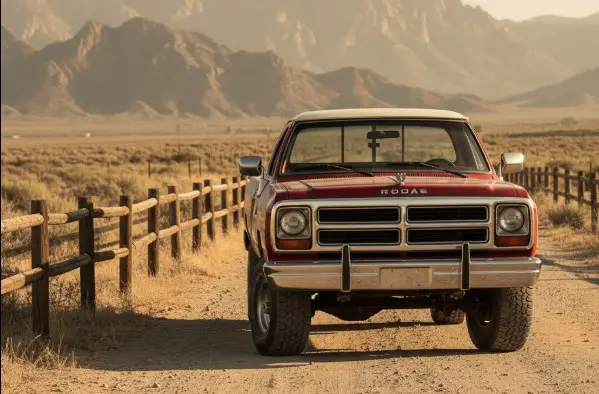
While not a ground-up redesign, it was a significant facelift of the 1972-era platform, featuring more modern, squared-off body lines, larger wraparound taillamps, and distinctive dual rectangular headlamps.
Models and Naming Convention
The first generation established a naming system that would last for years. Trucks were designated “D” or “Ram” for two-wheel drive models and “W” or “Power Ram” for four-wheel drive variants. Following industry standards, payload capacities were indicated by numbers: 150 for a half-ton, 250 for a three-quarter-ton, and 350 for a one-ton truck.
A variety of configurations were available to suit different needs, including a standard cab, an extended “Club Cab,” and a four-door crew cab, paired with either 6.5-foot or 8-foot bed lengths. However, some of these options were phased out during the generation to make way for the new Dodge Dakota pickup.
Engine Evolution – The Road to Modern Power
Initially, the engine lineup was a continuation of proven, carbureted Chrysler powerplants: the durable 3.7L (225 ci) Slant-6, the 5.2L (318 ci) V8, and the 5.9L (360 ci) V8. The latter half of the generation, however, saw crucial technological advancements.
- 1988: The aging Slant-6 was retired in favor of a modern 3.9L V6 equipped with electronic fuel injection. The popular 5.2L V8 also received EFI in the same year, marking a major leap forward in efficiency, reliability, and ease of starting.
- 1989: This year marked a revolutionary moment in pickup truck history with the introduction of the 5.9L Cummins 12-valve inline-six turbodiesel engine. This was not merely another engine option; it was the beginning of a legendary partnership with Cummins that would define Ram’s heavy-duty identity for decades. Producing a massive 400 lb-ft of torque, it instantly roared past the competition and established the Dodge Ram as the go-to choice for serious towing.
The first generation served as a critical bridge between two distinct eras of truck design. It carried the torch from the classic, mechanically simple Dodge trucks of the 1970s, with its facelifted body and initial carbureted engines. At the same time, it laid the essential groundwork for the future by introducing the foundational technologies—electronic fuel injection and the Cummins turbodiesel—that would become the pillars of the brand’s modern identity. It closed the book on one chapter while simultaneously writing the preface to the next.
Second Generation (1994-2001): The Revolutionary “Big-Rig” Redesign
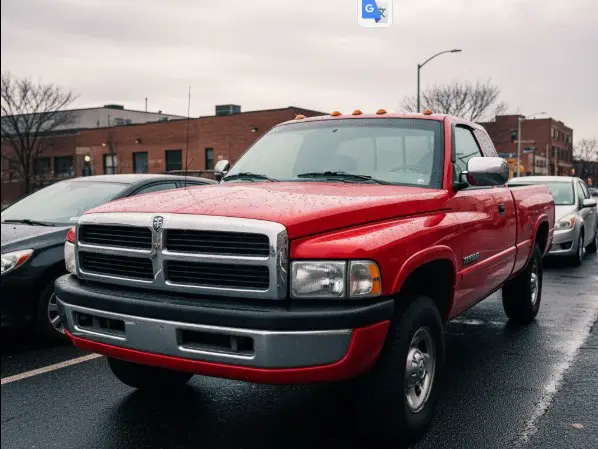
The debut of the second-generation Ram in 1994 was a seismic event that reshaped the entire pickup truck market. Dodge abandoned the conservative, evolutionary approach and introduced a radical new design inspired by the commanding presence of Class 8 semi-trucks. With its massive, imposing grille, dropped front fenders, and muscular, rounded silhouette, the new Ram looked like nothing else on the road.
This audacious design gamble paid off spectacularly, leading to a massive increase in sales and earning the truck the prestigious 1994 MotorTrend Truck of the Year award.
Key Changes and Features
This generation brought more than just a new look. The model designations were officially simplified to 1500, 2500, and 3500 across the lineup. The interior received a complete overhaul, moving away from a purely utilitarian design to a more ergonomic, comfortable, and car-like cabin. Higher trim levels, like the new Laramie SLT, offered amenities such as power windows, an updated instrument panel,
and improved audio systems, catering to a growing market of buyers using trucks as daily drivers. Body styles included a Regular Cab, an Extended Club Cab with more rear passenger room, and eventually a four-door Quad Cab with rear-hinged doors.
Engine Lineup – The Magnum Era
The powertrain lineup was significantly upgraded and rebranded under the “Magnum” name, signifying improved performance from new multi-port fuel injection systems.
- Gasoline Engines: The core lineup included the 3.9L V6 Magnum, 5.2L V8 Magnum, and 5.9L V8 Magnum.
- Heavy-Duty Power: For the 2500 and 3500 models, Dodge unleashed a monstrous 8.0L V10 Magnum engine, the largest in its class, designed for customers with extreme towing and hauling needs.
- Cummins Dominance: The legendary 5.9L Cummins turbodiesel remained a cornerstone of the heavy-duty lineup, receiving significant power and torque upgrades throughout the generation, further cementing its reputation for unmatched durability and pulling power.
The success of the second generation was a masterclass in market disruption through design. Before 1994, all major American trucks adhered to a similar, safe, and boxy design language. Dodge’s decision to adopt the “big-rig” aesthetic was a high-risk, high-reward strategy that correctly predicted a shift in consumer taste. It proved that truck buyers, often viewed as purely pragmatic, were also aspirational and craved a vehicle with a bold, powerful identity.
This single redesign not only revitalized the brand but also forced competitors to rethink their own design philosophies, influencing truck styling for years to come and transforming the pickup from a simple tool into a powerful statement piece.
Third Generation (2002-2008): Refinement and the Return of the HEMI
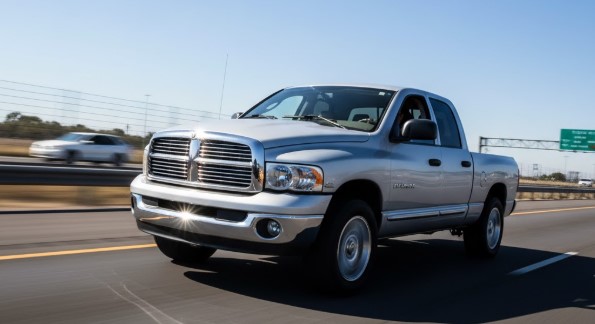
The third-generation Ram, unveiled for the 2002 model year, was an evolution of the revolutionary second-gen design. It featured a major update with an all-new frame that was significantly more resistant to torsion, a completely new suspension, and refined sheet metal that smoothed out the lines for a more modern, yet still muscular, appearance.
Mechanical and Feature Upgrades
Significant engineering changes occurred underneath the new bodywork. A key update for the 1500 model was the introduction of an independent front suspension on two-wheel-drive models, which, paired with a new rack-and-pinion steering system, delivered vastly improved ride quality and handling precision. This generation also saw the debut of the “Mega Cab” configuration, which offered an enormous, class-leading cabin with cavernous rear-seat space, appealing to families and work crews alike.
Engine Lineup – The HEMI’s Triumphant Return
The most celebrated development of this era was the reintroduction of a legendary name to the powertrain lineup.
- The Legend is Reborn: The aging 5.9L Magnum V8 was replaced by the all-new 5.7L HEMI V8. This was a brilliant engineering and marketing move, bringing the iconic HEMI name—synonymous with Mopar muscle—back into the mainstream. It quickly became the brand’s signature gasoline engine, celebrated for its impressive power and distinctive sound.
- Other Powertrains: The base V6 was updated to a 3.7L unit, while the 5.2L V8 was replaced by a more modern overhead-cam 4.7L V8.
- The Apex Predator: SRT-10: To cement its performance credentials, Dodge created the ultimate halo truck: the Ram SRT-10. Produced from 2004 to 2006, this limited-edition model was powered by the 8.3L V10 engine from the Dodge Viper supercar. With over 500 horsepower, it briefly held the Guinness World Record as the fastest full-size production pickup truck on the planet, a testament to the brand’s audacious engineering philosophy.
While the second generation established Ram’s identity through radical design, the third generation solidified it through powertrain supremacy. The revival of the HEMI V8 was a strategic masterstroke, tapping into a deep well of brand heritage and creating a powerful emotional connection with buyers. The creation of the Viper-powered SRT-10, while impractical for most, served as an unmistakable declaration of dominance in the horsepower wars.
This generation cemented the dual-pronged powertrain strategy that defines the brand to this day: the unmatched torque and durability of the Cummins diesel for heavy-duty work, and the legendary horsepower and charisma of the HEMI V8 for performance-oriented gasoline buyers.
The Great Divide: Why Dodge and Ram Split
In 2009, a major corporate restructuring of Chrysler Group LLC set the stage for one of the most significant branding changes in the truck world: the separation of Ram from Dodge. Ram Trucks was officially launched as a standalone division in 2009, with the first trucks bearing only the Ram logo appearing for the 2010 and 2011 model years. This move, while confusing to some long-time owners, was a deliberate and calculated strategic decision.
The core reason for the split was to allow each brand to cultivate a more focused and distinct identity, thereby maximizing its appeal to different market segments. Before the split, the Dodge brand had to serve two masters: the muscle car enthusiast drawn to the Charger and Challenger, and the “serious truck customer” who demanded rugged capability. This created diluted marketing messages and divided engineering resources.
The separation allowed for a strategic decoupling of these two distinct product philosophies.
- Ram’s Focus: As a standalone brand, Ram could dedicate all its resources to building the best possible trucks and commercial vehicles. This meant a laser focus on the needs of truck buyers: towing capacity, payload, durability, and innovative features like the RamBox and advanced suspension systems. The brand adopted the slogan “Guts. Glory. Ram.” to underscore its tough, hardworking identity.
- Dodge’s Focus: Freed from its truck-building duties, Dodge was able to double down on its identity as America’s premier performance brand. Resources were channeled into perfecting its muscle cars and performance-oriented SUVs like the Durango, solidifying its reputation for high-octane excitement.
The strategy proved to be a resounding success. Both brands flourished in their respective domains, achieving higher sales and stronger brand recognition than they likely could have under a single, shared banner.
Fourth Generation (2009-2018): A New Brand, A New Focus on Comfort
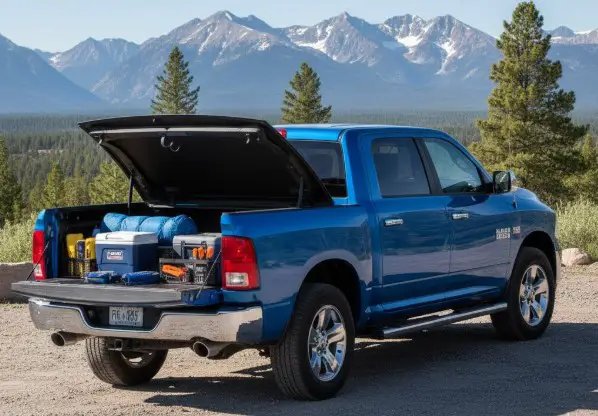
Launched in the midst of the brand separation, the fourth generation was the first to fully embody the new Ram Trucks identity. While its exterior styling was a handsome evolution of the third generation’s design, the most profound changes happened inside the cabin and underneath the frame, where Ram introduced innovations that would once again redefine the segment.
Game-Changing Features
This generation was defined by features that prioritized driver and passenger experience over pure utility.
- Coil-Spring Rear Suspension: In a revolutionary move for a full-size pickup, Ram replaced the traditional, stiff-riding leaf springs on the 1500 with a sophisticated multi-link, coil-spring rear suspension. This engineering feat delivered a dramatically smoother and more composed ride, akin to an SUV, without compromising its towing and hauling capabilities. This became a key differentiator, setting a new standard for ride comfort in the class.
- RamBox Cargo Management System: Another class-exclusive innovation was the RamBox system. These lockable, weatherproof, and drainable storage compartments were integrated directly into the sides of the pickup bed, offering secure storage for tools and gear without sacrificing bed space.
- Interior Revolution: The fourth generation marked a quantum leap in interior design and quality. Ram began offering cabins with premium materials, meticulous craftsmanship, and advanced technology that rivaled luxury sedans, challenging the notion that a truck’s interior had to be Spartan.
Engine Lineup – Efficiency Meets Power
The powertrain lineup was modernized for a new era of fuel economy standards.
- The venerable 5.7L HEMI V8 continued as the premier V8 option.
- Pentastar Power: The outdated 3.7L V6 was replaced by the advanced 3.6L Pentastar V6. This modern dual-overhead-cam engine offered a substantial increase in both horsepower and fuel efficiency, making the base model Ram a much more compelling option.
- EcoDiesel Introduction: In 2014, Ram once again broke new ground by introducing the 3.0L V6 EcoDiesel. This made the Ram 1500 the first light-duty, full-size pickup in the modern era to offer a small-displacement diesel engine, providing exceptional fuel economy and ample torque for towing.
The fourth generation fundamentally changed the perception of a pickup truck. By engineering a comfortable, car-like ride with the coil-spring suspension and offering a near-luxury experience inside the cabin, Ram successfully broadened its appeal beyond traditional truck buyers. It became a viable and desirable option for families who might have otherwise chosen an SUV.
This strategic pivot from pure utility to everyday “livability” was the primary driver behind Ram’s significant gains in market share, as it expanded the definition of what a modern pickup truck could be.
Fifth Generation (2019-Present): The Age of Technology and Luxury
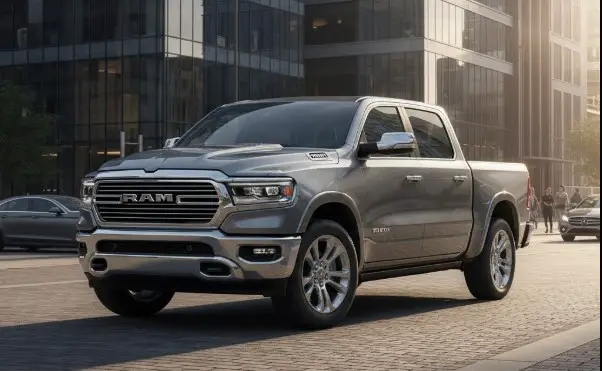
The fifth-generation Ram 1500, launched for the 2019 model year, represents the culmination of the brand’s evolution. It established a new benchmark for technology, luxury, and refinement in the full-size truck segment, forcing competitors into a frantic game of catch-up. With a sleek, aerodynamic redesign and a focus on a premium user experience, this generation completed the truck’s transformation into a high-tech luxury product that also happens to be immensely capable.
Technology and Luxury at the Forefront
The interior of the fifth-generation Ram is its defining feature.
- The Uconnect Screen: The centerpiece of the cabin is the available, vertically-oriented 12-inch Uconnect touchscreen. This massive, tablet-style interface was a revelation in the truck world, offering intuitive control over navigation, media, and vehicle settings, and instantly making competitors’ dashboards look a decade old.
- Premium Cabin: The commitment to luxury was evident throughout the cabin, with the use of high-quality materials like real wood and metal trim, active noise cancellation for a whisper-quiet ride, and available features like reclining and ventilated rear seats.
Engine Lineup – The End of an Era, The Start of a New One
The powertrain story of the fifth generation is one of refinement and a bold step into the future.
- eTorque Mild-Hybrid System: Both the 3.6L Pentastar V6 and the 5.7L HEMI V8 were offered with a new eTorque mild-hybrid system. This technology uses a small electric motor-generator to provide smoother engine stop-start functionality, short bursts of extra torque, and improved overall fuel efficiency.
- The TRX: Ram unleashed the 1500 TRX, a high-performance off-road super-truck designed to dominate the segment. Powered by a 702-horsepower supercharged 6.2L HEMI V8, the TRX is a marvel of engineering, combining blistering speed with incredible suspension travel
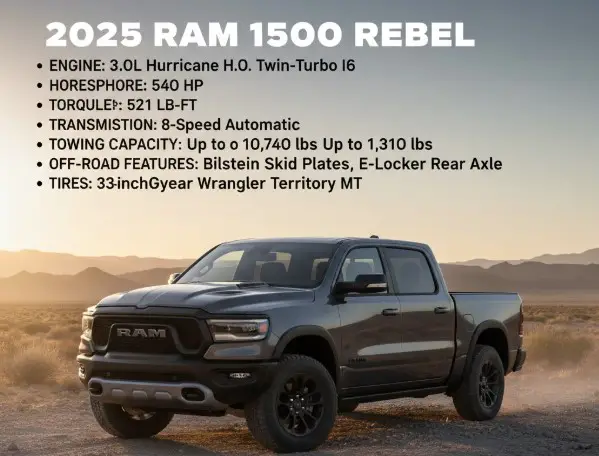
- The Hurricane Arrives (2025+): The 2025 model year marks a monumental shift. After more than two decades, the legendary 5.7L HEMI V8 has been retired from the Ram 1500 lineup. It is replaced by the new 3.0L “Hurricane” twin-turbocharged inline-six engine. This advanced powerplant is available in a standard-output version with 420 horsepower and a high-output version making a staggering 540 horsepower, offering more power and greater efficiency than the V8 it replaces.
The fifth generation represents the final blurring of the lines between a work vehicle and a premium consumer good. By integrating technology and luxury features previously reserved for high-end European brands, Ram is now competing not just with Ford and Chevrolet, but also with luxury SUVs for the same affluent customers. The bold decision to replace the iconic HEMI V8 with a smaller, more efficient, and more powerful twin-turbo inline-six is a clear signal of the brand’s direction.
It prioritizes modern engineering and adaptation to a changing automotive world over pure tradition. The Ram 1500 is now, unequivocally, a technology product that can also haul a trailer.
Ram Truck Reliability: Best Years, Worst Years, and Common Problems
While Ram trucks are celebrated for their power, innovation, and style, their reliability record can be a mixed bag depending on the specific generation and model year. This section provides a data-driven, objective analysis to help potential buyers navigate the used market and understand the most common issues associated with each era.
| Generation | Model Years | Overall Reliability | Common Problems | Noteworthy Years (Best/Worst) |
| First | 1981-1993 | Good | Rust, basic electrical faults, “Killer Dowel Pin” (KDP) on early Cummins engines. | Best: 1989-1993 (for robust Cummins models). |
| Second | 1994-2001 | Fair | Automatic transmission failures, severely cracked dashboards, plenum gasket leaks, rust. | Best: 2001 (late-model refinements). |
| Third | 2002-2008 | Fair to Poor | Automatic transmission failures, severely cracked dashboards, plenum gasket leaks, and rust. | Worst: 2003 (high complaint volume). Best: 2008 (many issues addressed). |
| Fourth | 2009-2018 | Average | TIPM electrical failures, HEMI engine issues (lifter tick), front-end wear leading to “Death Wobble,” and rust. | Worst: 2012-2014 (high complaint volume). Best: 2017-2018 (most reliable of the generation). |
| Fifth | 2019-Present | Good | Uconnect infotainment glitches (blank screens, random reboots), early-model electrical bugs, eTorque system issues. | Worst: 2019 (first model year issues). Best: 2020+ (fewer reported problems). |
Deep Dive into Key Problems
Certain issues have become notoriously associated with specific RAM generations. Understanding them is crucial for any potential buyer.
The “Death Wobble”
This alarming issue is a violent, uncontrollable shaking of the vehicle’s front end, typically triggered by hitting a bump at highway speeds. It is most prevalent on heavy-duty models (2500/3500) with solid front axles, but has also been reported by 1500 owners. The root cause is a cascading failure of worn steering and suspension components, such as ball joints, tie rod ends, and the track bar. Once it starts, the only way to stop it is to slow the vehicle down significantly.
TIPM (Totally Integrated Power Module) Failures
The TIPM is the electronic brain and fuse box of the truck, controlling nearly all electrical functions. In third and fourth-generation Rams, it is a well-documented point of failure. A faulty TIPM can cause a bewildering array of random electrical problems, including the horn blaring uncontrollably, power windows opening on their own, the fuel pump continuing to run after the engine is off, or a no-start condition. These issues can be difficult to diagnose and expensive to fix.
The “HEMI Tick”
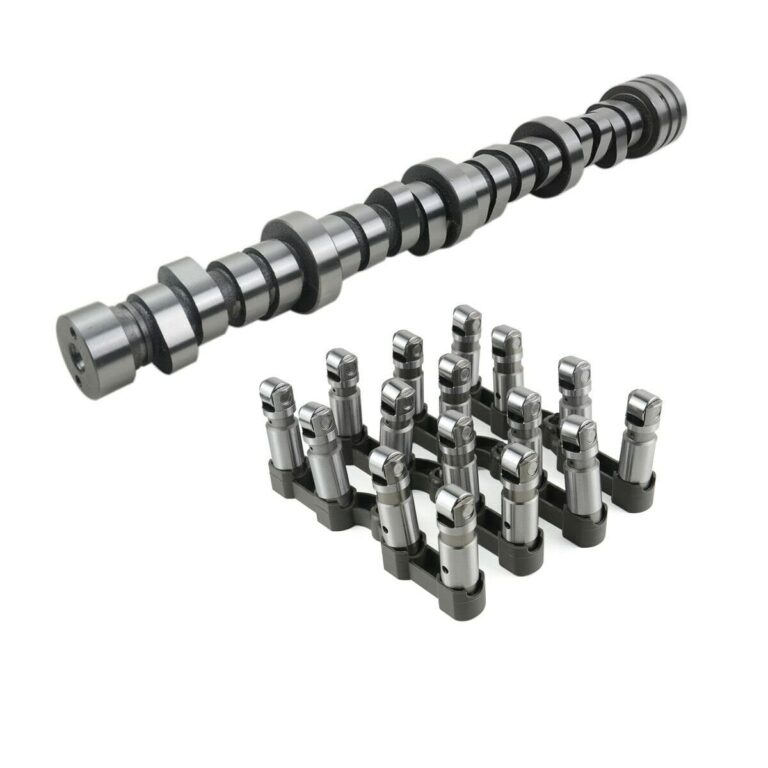
This is a ticking noise from the engine bay, particularly noticeable on the 5.7L HEMI V8. In many cases, the sound is caused by broken exhaust manifold bolts, a common and relatively straightforward repair. However, it can also be a symptom of a more severe internal engine problem: failing hydraulic lifters and subsequent damage to the camshaft. This is a much more serious and costly issue that can lead to engine failure if not addressed. Regular oil changes with high-quality oil are considered critical for preventing this issue.
Conclusion: The Enduring Legacy of the Ram
The journey of the Ram truck is a remarkable story of adaptation and ambition. It transformed from the simple, “Ram Tough” first generation into the segment-defining fifth generation, a vehicle that seamlessly blends brute strength with sophisticated technology and luxury. Along the way, it has been defined by a series of bold, strategic moves that reshaped the market.
The revolutionary “big-rig” design of 1994 proved that style could sell trucks. The return of the HEMI in 2002 cemented its performance identity. The brand split from Dodge in 2009 allowed for a focused pursuit of truck excellence. The fourth generation’s coil-spring suspension proved that a truck could be both capable and comfortable.
Today, the Ram stands as a leader in the industry, consistently pushing the boundaries of what a pickup can offer. As it moves into a new era with the advanced Hurricane inline-six engine and prepares for an electric future with the upcoming Ram 1500 REV, the brand continues to build on its legacy of innovation. The Ram’s evolution is a testament to its ability to not only meet the demands of truck buyers but to anticipate their desires, securing its place as an enduring American icon.
Frequently Asked Questions (FAQs)
Q1: What are the Dodge Ram generations by year?
- First Generation: 1981-1993
- Second Generation: 1994-2001
- Third Generation: 2002-2008
- Fourth Generation: 2009-2018
- Fifth Generation: 2019-Present
Q2: When did Dodge and Ram officially split?
Dodge and Ram began their separation in 2009 as part of a corporate restructuring by Chrysler. Ram was established as a standalone brand for trucks and commercial vehicles, with the first models sold exclusively under the Ram brand appearing for the 2010 model year. This allowed Dodge to focus on its performance cars and SUVs.
Q3: What is the most reliable Ram 1500 generation?
While the first-generation Cummins-powered trucks are legendary for their mechanical durability, modern data suggests that the late fourth-generation models (2017-2018) and the fifth-generation models (2020-present) offer the best overall reliability when factoring in modern features and technology. These later models have had many of their earlier issues resolved.
Q4: What Ram 1500 years should be avoided?
Based on the highest volume of owner complaints and reported issues, buyers should exercise caution with the 2003 model year (third generation) and the 2012-2016 model years (fourth generation). These years are associated with a higher frequency of problems related to the electrical system (TIPM), engine, and transmission.
Q5: What is the “death wobble” on Ram trucks?
The “death wobble” is a term for a violent, uncontrollable shaking of the front suspension, usually occurring at highway speeds after hitting a bump. It is most common on heavy-duty trucks with solid front axles, but has been reported on 1500 models as well. It is typically caused by a combination of worn steering and suspension components that need replacement.
Q6: What is considered the best engine in a Ram truck?
This depends on the need. For sheer durability and immense towing torque in heavy-duty trucks, the 5.9L and 6.7L Cummins turbodiesel engines are legendary. For a powerful and charismatic V8 in the Ram 1500, the 5.7L HEMI is a celebrated icon.7 For a reliable and efficient daily driver, the 3.6L Pentastar V6 is a solid, proven workhorse.