Ford F-150 XLT vs Lariat: Which Is Worth the Upgrade? 2026

For most 2026 Ford F-150 buyers, the XLT is the better value, while the Lariat makes more sense if you want premium seating, more standard driver-assistance technology, and fewer option packages.
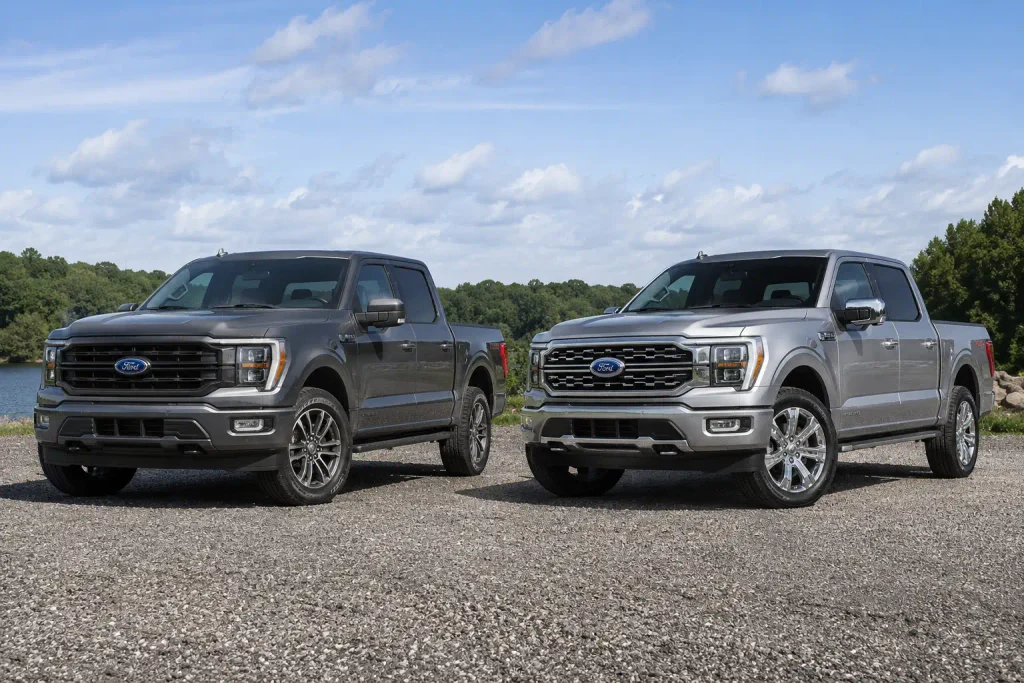
The important point is that Lariat does not automatically give you more towing capability. Both trims can share the 5.0L V8, 3.5L EcoBoost V6, and 3.5L PowerBoost Full Hybrid V6, depending on configuration. Ford also lists current XLT and Lariat trucks with identical maximum trailer ratings.

Prime for Young Adults — 6 Months Free
Students and 18–24s get six months of Prime free, then half price.
Start 6 Months FreeIf you are comparing F-150 XLT vs Lariat, start with how you actually use the truck. Price, cab configuration, comfort, engine choice, and towing setup matter more than the badge on the fender.
2026 F-150 XLT vs Lariat Buyer Guide
Choose based on equipment and use case, not trim position alone.
Choose XLT If You Want
Choose Lariat If You Want
Which Trim Fits Your Use Case?
Do not assume the Lariat automatically tows more. Engine, drivetrain, axle ratio, cab, wheelbase, payload, and towing equipment determine the final trailer rating. Properly configured XLT and Lariat trucks can carry the same maximum trailer rating.
Start with the XLT if value and truck capability are your priorities. Choose the Lariat when you already want its premium seating, convenience technology, and daily-driving upgrades. If a loaded XLT reaches Lariat pricing, compare the actual equipment on both trucks before buying.
2026 F-150 XLT vs Lariat Quick Comparison
Recommended Best Deal Products


The biggest difference between XLT and Lariat is how much equipment Ford includes before you start adding packages.
| Feature | 2026 F-150 XLT | 2026 F-150 Lariat |
|---|---|---|
| Price including destination | About $47,290 | About $62,155 |
| Standard seating | Cloth 40/20/40 | Premium bucket seating with ActiveX and leather-trimmed configurations |
| Heated front seats | Optional | Standard |
| Ventilated front seats | Not listed as standard | Standard |
| Climate control | Single-zone manual standard | Dual-zone automatic standard |
| 12-inch touchscreen | Standard | Standard |
| 12-inch digital display | Standard | Standard |
| Adaptive cruise control | Optional | Standard |
| B&O sound system | Optional | Standard |
| BlueCruise | Optional | Equipped with 90-day trial |
| Pro Trailer Hitch Assist | Available | Standard |
| Pro Trailer Backup Assist | Available | Standard |
| Cab choices | SuperCab and SuperCrew | SuperCrew |
| Bed choices | 5.5 or 6.5 ft depending on cab | 5.5 or 6.5 ft |
| Best for | Value, work, flexible builds | Comfort, commuting, premium daily use |
Kelley Blue Book currently lists the XLT at about $47,290 and Lariat at $62,155, including a $2,595 destination charge. That puts the starting difference at about $14,865.
Those numbers explain the basic decision. The XLT is not a stripped truck, while the Lariat asks you to pay significantly more for equipment Ford makes optional on XLT.
How Much More Does the 2026 Lariat Cost
Using current pricing that includes destination, the Lariat starts about $14,865 above the XLT. That is enough money to make the trim decision worth examining carefully rather than automatically moving upward.
Base MSRP figures published by Ford dealers put the XLT around $44,695 and Lariat around $59,560 before destination and additional options. Current market listings then climb quickly as engines, 4WD, appearance packages, towing equipment, and technology are added.

Audible — Listen Free for 30 Days
One free credit a month and thousands of titles included.
Listen Free for 30 DaysOptioned XLT vs Base Lariat
A base-price comparison does not tell the whole story.
Ford’s current inventory contains XLT configurations around $60,000 to $69,000, depending on equipment. One 2026 XLT SuperCrew 4×4 was listed at $69,295, while a nearby Lariat was $69,240. Both carried a 10,400-pound maximum trailer rating.
That is the point where the Lariat becomes much more attractive.
If your XLT build needs premium seating, BlueCruise, better audio, additional trailer technology, 4WD, and a higher-output engine, compare its actual window sticker against a Lariat rather than comparing base MSRPs.
What the Lariat Premium Buys
The added money primarily buys standard equipment, not an entirely different truck platform.
Lariat adds or upgrades features such as adaptive cruise control, heated and ventilated front seats, a heated steering wheel, B&O audio, Pro Trailer Hitch Assist, Pro Trailer Backup Assist, Trailer Reverse Guidance, power-folding mirrors, and BlueCruise equipment with a 90-day trial.
XLT can match some of that equipment through options, but doing so reduces its original price advantage.
Which F-150 XLT and Lariat Engine Is Better
Recommended Best Deal Products


Lariat does not automatically make more power than XLT because both trims share several F-150 powertrains.
Audible Premium Plus — Annual Membership
12 audiobook credits up front, plus the full Audible catalogue.
See Annual PlansThe engine choice matters more than the trim badge when comparing acceleration, towing, fuel use, and available onboard power.
2026 F-150 XLT Engine Choices
Ford lists four engines for the 2026 XLT:
- 2.7L EcoBoost V6: 325 horsepower and 400 lb-ft of torque
- 5.0L Ti-VCT V8: 400 horsepower and 410 lb-ft
- 3.5L EcoBoost V6: up to 382 horsepower and 500 lb-ft in Ford’s current XLT trim listing
- 3.5L PowerBoost Full Hybrid V6: 420 horsepower with Ford listing up to 578 lb-ft on its current XLT page
The 2.7L EcoBoost V6 is the normal standard engine on XLT, although Ford specifically states that the 3.5L EcoBoost becomes standard on XLT trucks with a 157-inch wheelbase for 2026.
2026 F-150 Lariat Engine Choices
Lariat offers:
- 3.5L EcoBoost V6
- 5.0L Ti-VCT V8
- 3.5L PowerBoost Full Hybrid V6
Ford’s 2026 model update specifically says the 3.5L EcoBoost V6 is standard on Lariat 4×2 configurations, while the 5.0L V8 remains available. Ford’s current Lariat trim page also lists the PowerBoost hybrid as an option.
For everyday driving, the 2.7L EcoBoost keeps an XLT lighter on price while still providing strong torque.
For heavier towing, the 3.5L EcoBoost deserves closer attention. Buyers who want V8 character can configure the 5.0L in either trim, while the PowerBoost combines strong torque with available Pro Power Onboard capability.
Does the F-150 Lariat Tow More Than XLT
No. Lariat does not automatically tow more than XLT.
Ford states that F-150 towing capability changes with trim series, option content, payload, engine, axle ratio, cab, drivetrain, and overall configuration. A trim badge by itself cannot give you the correct trailer rating.
GCWR means Gross Combined Weight Rating, the maximum allowable combined weight of the loaded truck and loaded trailer.
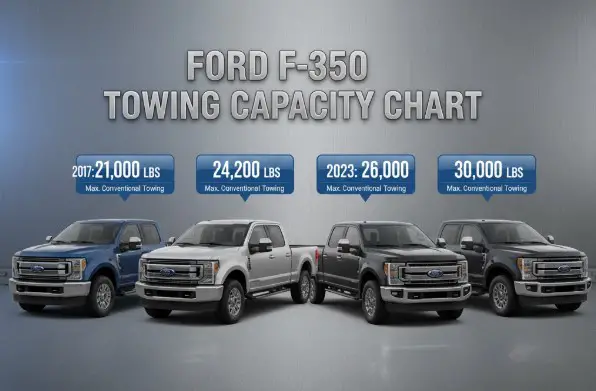
For a broader model-by-model reference, use our Ford towing capacity chart before choosing a truck specifically for trailer duty.
Real XLT and Lariat Towing Examples
Ford’s current 2026 inventory gives a useful real-world comparison.
One XLT SuperCrew 4×4 with a 5.5-foot box carries a 10,400-pound maximum trailer rating. A Lariat SuperCrew 4×4 with the same bed length in the same inventory also carries a 10,400-pound rating.
Other current trucks show how much configuration changes the answer.
Ford inventory includes XLT examples rated at 7,500, 9,300, 10,400, 10,800, and 10,900 pounds. Lariat examples appear at 9,300, 10,300, 10,400, 10,800, and 10,900 pounds.
So a properly configured XLT can tow more than a poorly matched Lariat.
Payload Matters Too
Trailer tongue weight, passengers, accessories, tools, and cargo all count against available payload.
That makes the door-jamb Tire and Loading Information label just as important as the advertised tow rating. Our Ford F-150 payload capacity guide explains how payload changes across F-150 configurations.
If towing is your main reason for buying the truck, compare the exact VIN-level configuration rather than choosing Lariat because it sits higher in the lineup.
F-150 XLT vs Lariat Interior Differences
Recommended Best Deal Products


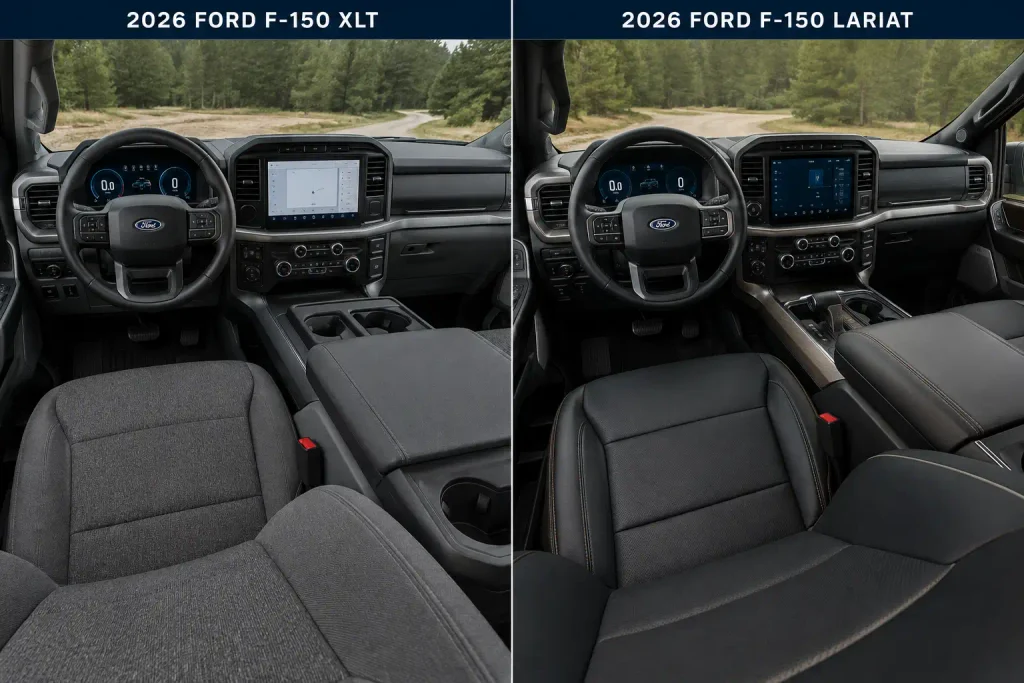
Interior equipment is where the Lariat starts separating itself clearly from the XLT.
Both trucks have modern digital hardware, but the Lariat includes more equipment designed for long drives and daily comfort.
F-150 XLT Interior
Ford gives the XLT standard 40/20/40 cloth front seats, a 12-inch digital productivity screen, a 12-inch SYNC 4 touchscreen, carpeted flooring, and a power driver’s seat arrangement.
ActiveX-trimmed seats and heated front seats are optional. Dual-zone automatic climate control, adaptive cruise control, Intelligent Access, and a console work surface are also optional rather than standard.
That setup makes sense for owners who use the truck for work, carry pets, or simply do not care about ventilated seats and premium trim.
F-150 Lariat Interior
Lariat adds heated and ventilated front seats, dual-zone automatic climate control, a heated steering wheel, adaptive cruise control, power-adjustable pedals with memory, Intelligent Access, and a center console.
Ford also lists ActiveX-trimmed and leather-trimmed seating configurations on the Lariat page.
For someone commuting an hour each way or taking long family trips, these are upgrades you notice every day.
The XLT remains the practical cabin. Lariat is the stronger choice when comfort is part of the reason you are spending $50,000 or more on a half-ton truck.
Which Trim Has Better Technology and Convenience
The technology gap is smaller than the seating gap because XLT already receives much of the F-150’s core digital hardware.
Both trims include SYNC 4, a 12-inch touchscreen, and a 12-inch digital productivity screen. XLT also includes Ford Co-Pilot360 2.0.
The differences appear in equipment that XLT treats as optional.
XLT Optional Technology
Ford lists these among XLT options or packages:
- Adaptive cruise control
- B&O sound system
- BlueCruise equipment
- Pro Trailer Hitch Assist
- Pro Trailer Backup Assist
- Tow and Haul Package
- Mobile Office Package
BlueCruise can be configured with a one-year plus 90-day plan or a one-time purchase option on eligible XLT equipment groups.
Lariat Standard Technology
Lariat includes more of those features from the factory.
Ford lists adaptive cruise control, Pro Trailer Hitch Assist, Pro Trailer Backup Assist, Trailer Reverse Guidance, B&O audio, Connected Navigation, and BlueCruise equipment with a 90-day trial as standard equipment.
That makes Lariat easier to recommend when you already know these features are on your wish list.
If you would disable most of them and simply want a capable truck with a modern screen, XLT saves a substantial amount of money.
Which Trim Gives More Cab and Bed Choices
XLT has an important advantage that feature comparisons often miss: configuration flexibility.
Ford lists the 2026 XLT as available with a SuperCab and 6.5-foot bed, or a SuperCrew with either a 5.5-foot or 6.5-foot bed.
The 2026 Lariat is SuperCrew only, with either a 5.5-foot or 6.5-foot box.
For contractors or buyers who want more cab and box flexibility without paying for a luxury-oriented trim, XLT is the stronger starting point.
Lariat’s SuperCrew-only approach fits its role better as a family truck, commuter, and premium daily driver.
When the 2026 F-150 XLT Is Better
Choose the 2026 F-150 XLT when capability and configuration matter more than premium cabin equipment.
XLT makes the most sense when:
- You want the best overall value. The starting-price difference is roughly $14,865 including current destination pricing.
- The truck will see regular work use. Cloth seats and simpler standard equipment reduce the cost of buying features you may not need.
- You want broader configuration choices. XLT gives you SuperCab and SuperCrew options.
- You want to choose the engine separately from luxury equipment. The V8, 3.5L EcoBoost, and PowerBoost are available without moving to Lariat.
- You mainly care about towing capability. An XLT with the correct drivetrain, engine, axle, and tow equipment can match a Lariat.
- Your optioned XLT still stays well below Lariat pricing. That is where the value argument remains strongest.
For many owners, XLT is the sweet spot because it already has the large screens, SYNC 4, safety technology, and available towing hardware that matter most.
When the 2026 F-150 Lariat Is Better
Choose the 2026 F-150 Lariat when you would add most of its premium equipment to an XLT anyway.
Lariat makes more sense when:
- You want heated and ventilated front seats.
- Dual-zone climate control matters.
- You want adaptive cruise control without adding another option group.
- B&O audio is already on your shopping list.
- You regularly use trailer-assist technology.
- BlueCruise matters for highway commuting.
- The truck serves as your family vehicle and daily driver.
- Your preferred XLT build has already reached the low or mid-$60,000 range.
When the Recommendation Flips
The recommendation flips when a loaded XLT gets close to the price of the Lariat configuration you actually want.
Ford’s current inventory shows exactly that situation. A 2026 XLT at $69,295 appeared alongside a Lariat at $69,240, both with 4×4, SuperCrew configuration, 5.5-foot beds, and a 10,400-pound maximum trailer rating.
At that point, choosing XLT purely because it is supposed to be cheaper no longer makes sense.
Compare actual window stickers feature by feature.
F-150 XLT vs Lariat Final Verdict
For most 2026 F-150 buyers, we recommend starting with the XLT.
| Buyer Type | Better Choice | Why |
|---|---|---|
| Best overall value | XLT | Much lower starting price |
| Work and jobsite use | XLT | Practical cabin and flexible builds |
| Custom engine build | XLT | Multiple available powertrains |
| SuperCab buyer | XLT | Lariat is SuperCrew only |
| Family daily driver | Lariat | Better standard comfort |
| Highway commuter | Lariat | Adaptive cruise and BlueCruise equipment |
| Premium interior buyer | Lariat | Heated and ventilated seating |
| Technology-focused buyer | Lariat | More features included as standard |
| Towing buyer | Depends on configuration | Trim alone does not determine tow rating |
| Loaded XLT shopper | Compare both stickers | Price difference may disappear |
XLT wins because it already covers the core features most F-150 buyers need without forcing a move into premium-trim pricing.
Lariat wins when comfort and convenience are part of the truck’s job. If you spend hours behind the wheel every week, heated and ventilated seats, adaptive cruise, better audio, and additional trailer technology may justify the extra cost.
6 Common F-150 XLT vs Lariat Questions
Is the F-150 Lariat Worth the Extra Money Over XLT?
Yes, if you want most of the Lariat’s standard comfort and technology equipment. If you only need capability, modern infotainment, and a few selected options, the XLT is usually the better value.
Does the F-150 Lariat Tow More Than the XLT?
Not automatically. Ford says towing varies with engine, axle, drivetrain, payload, cab, wheelbase, options, and other configuration details. Current Ford inventory includes XLT and Lariat trucks with the same 10,400-pound maximum trailer rating.
Does the F-150 XLT Have Leather Seats?
Standard 2026 XLT front seats are cloth. Ford lists ActiveX-trimmed seats as optional, while Lariat includes upgraded ActiveX and leather-trimmed seating configurations.
Which F-150 Trim Is Better for Daily Driving?
Lariat is better for buyers who prioritize daily comfort because it includes heated and ventilated seats, adaptive cruise control, dual-zone climate control, and more premium convenience features. XLT remains the better choice if purchase price matters more.
Can an F-150 XLT Have the Same Engine as a Lariat?
Yes. Both trims offer the 5.0L Ti-VCT V8, 3.5L EcoBoost V6, and 3.5L PowerBoost Full Hybrid V6 in eligible configurations. XLT also offers the lower-cost 2.7L EcoBoost V6.
Which Has Better Resale Value XLT or Lariat?
Lariat will usually sell for more dollars used because it costs more and carries additional equipment, but that does not guarantee better percentage retention. Condition, mileage, engine, drivetrain, options, local demand, and the original purchase price can matter more than the trim name alone.
Which F-150 Trim Should You Buy
The F-150 XLT vs Lariat decision becomes simple once you separate capability from comfort.
Choose the XLT if you want strong F-150 capability, more configuration flexibility, and the lowest sensible purchase price. It is our value pick for most buyers.
Choose the Lariat if heated and ventilated seating, adaptive cruise control, B&O audio, trailer-assist technology, and a more premium daily-driving environment are features you already plan to buy.
For towing, ignore the trim hierarchy and compare the exact engine, drivetrain, axle, cab, payload label, and Ford trailer rating for the truck you are considering. That gives you a much better answer than assuming the more expensive F-150 automatically does more.