
Ford Bronco vs Bronco Sport 2026: Which Is Better?

The Ford Bronco and Bronco Sport share a name, an adventurous spirit, and a blue oval badge, yet they represent strikingly different approaches to off-road utility and daily driving. The single biggest real-world difference between these two lies in their off-road prowess: the Ford Bronco achieves a formidable 9.5 for Off-Road Capability, while the Bronco Sport registers a respectable but comparatively modest 7.0. This 2.5-point gap isn’t just a number; it dictates everything from their engineering philosophy to their ideal owner. One is built for the brutal realities of the wild, the other for navigating the urban jungle with an adventurous twist. Understanding this core distinction is the first step in deciding which Bronco truly calls to you.
Quick Verdict: The Ford Bronco is the clear winner for serious off-road enthusiasts seeking extreme capability and customization, while the Bronco Sport triumphs for urban adventurers prioritizing daily comfort, fuel efficiency, and a lower starting price. The key trade-off lies between raw ruggedness and everyday practicality.

Prime for Young Adults — 6 Months Free
Students and 18–24s get six months of Prime free, then half price.
Start 6 Months Free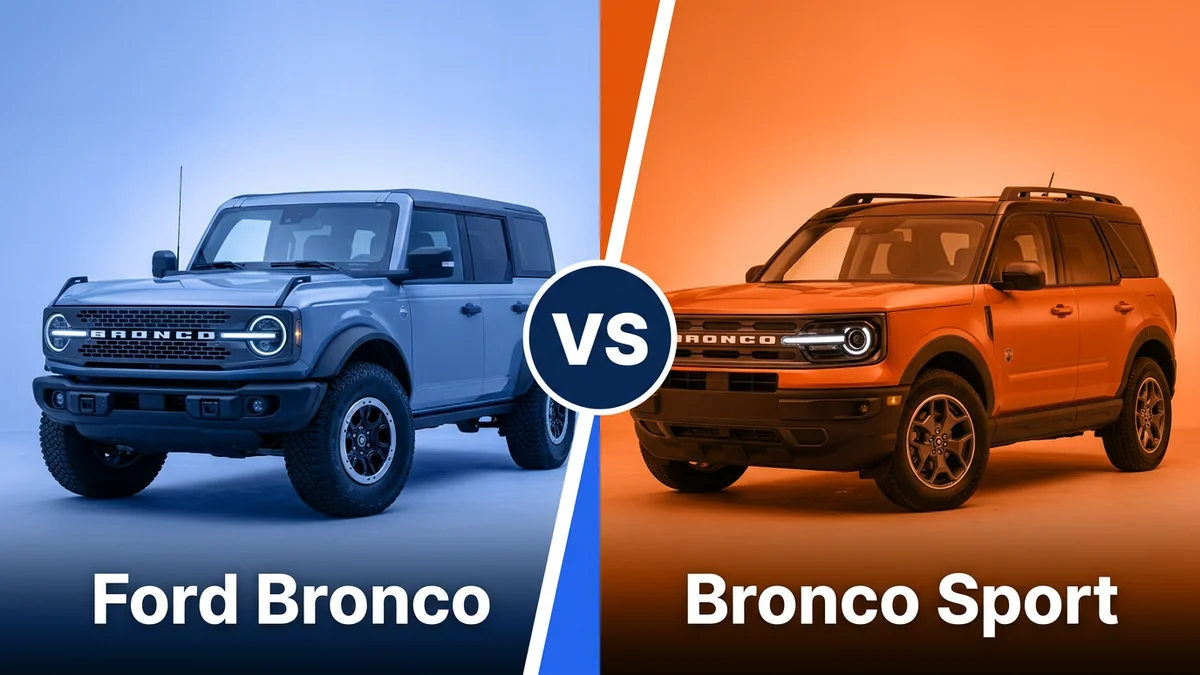
Dedicated off-roaders, rock crawlers, and those desiring maximum customization and capability.
City dwellers and light trail explorers who need a practical, fuel-efficient, and comfortable AWD SUV.
- The Ford Bronco offers a maximum 13.1 inches of ground clearance, making it superior for off-road trails.
- The Bronco Sport offers a significantly better combined fuel economy of 26 MPG with its base engine.
- With a starting MSRP of $33,500 (Est. 2026), the Bronco Sport is substantially more affordable than the full-size Bronco at $42,000.
- The Ford Bronco can tow up to 4,500 lbs, more than double the Bronco Sport's 2,200 lbs capacity.
- Only the Ford Bronco features a modular design with removable doors and roof, enhancing the open-air experience.
Ford Bronco vs Bronco Sport: Head-to-Head Specs
Recommended Best Deal Products


Digging into the raw specifications reveals the foundational differences that shape these vehicles’ characters. For instance, the Ford Bronco offers a robust 2.7L EcoBoost V6 engine option, churning out a stout 330 horsepower and 415 lb-ft of torque, a significant step up from the Bronco Sport’s top-tier 2.0L EcoBoost four-cylinder, which delivers 250 hp and 277 lb-ft of torque. This power disparity directly impacts their performance and towing abilities. Furthermore, the Bronco’s body-on-frame construction stands in stark contrast to the Bronco Sport’s unibody architecture, a distinction that fundamentally determines their rigidity, ride characteristics, and ultimate off-road limitations. These aren’t minor variations; they are design choices with profound implications for how each vehicle behaves, both on the pavement and deep in the wilderness.

✓ = better value in that row. Sourced from manufacturer specifications.
Performance & Category Ratings
When we examine the performance and category ratings, the distinct identities of the Ford Bronco and Bronco Sport emerge with absolute clarity, reinforcing their intended purposes. The Ford Bronco’s commanding Off-Road Capability rating of 9.5 is no accident; it’s the result of its dedicated body-on-frame construction, advanced G.O.A.T. (Goes Over Any Type of Terrain) Modes, available front and rear locking differentials, and impressive ground clearance, which can exceed 11.6 inches. This isn’t just for show; it allows for serious rock crawling, deep mudding, and challenging trail runs that the Bronco Sport, with its 7.0 rating, simply isn’t engineered to handle. The Bronco’s robust suspension, often featuring Bilstein position-sensitive dampers on higher trims, offers articulation and durability for extreme conditions. It truly feels unstoppable when the pavement ends, a feeling the Sport, with its car-like unibody, can only aspire to replicate on lighter trails.
Conversely, the Bronco Sport absolutely shines in On-Road Comfort, scoring an excellent 8.8 compared to the Bronco’s more utilitarian 7.2. Its unibody chassis, shared with the Escape and Maverick, provides a smoother, more refined ride quality that absorbs road imperfections with ease. You’ll notice less body roll and a quieter cabin on your daily commute, making it a far more agreeable companion for long highway stretches or stop-and-go city driving. The Bronco, while surprisingly compliant for its rugged nature, still exhibits the inherent compromises of a vehicle built for extreme abuse – more road noise, a firmer suspension, and a less car-like feel are simply part of the package. It’s built tough, not cushy.
Value for Money tells a similar story: the Bronco Sport leads with an 8.9, leaving the Bronco’s 7.5 in its dust. This isn’t just about the lower entry price of the Sport; it’s about what you get for your dollar in the context of everyday utility and features. The Bronco Sport offers an impressive array of technology and convenience features at a more accessible price point, making it a highly attractive option for budget-conscious buyers seeking adventure without breaking the bank. The Ford Bronco, while undeniably capable, demands a premium for its specialized engineering and extreme performance, often requiring you to step up trims to unlock its full off-road potential, which significantly inflates its cost.
For sheer grunt, the Ford Bronco’s Performance rating of 9.0 trounces the Bronco Sport’s 7.5. Opt for the available 2.7-liter EcoBoost V6 in the Bronco, and you’re rewarded with a potent 330 horsepower and 415 lb-ft of torque, enabling quick acceleration, confident highway passing, and respectable towing capacity. The Bronco Sport’s most powerful 2.0-liter EcoBoost, while lively, delivers 250 hp and 277 lb-ft, providing ample power for its size but falling short of the Bronco’s raw capability and effortless surge. This power difference is tangible; the Bronco feels significantly more muscular, especially when loaded or tackling steep inclines.
Interior Features & Tech see the Ford Bronco narrowly edge out the Sport, 8.5 to 8.2. While both offer modern infotainment systems, the Bronco’s design often incorporates more rugged, easy-to-clean materials, and its larger screen options, along with unique off-road specific apps and camera views, give it a slight advantage. Its modular interior design, with available washable flooring and drain plugs, speaks to its adventurous spirit. The Bronco Sport’s cabin is practical and well-appointed for its segment, but it lacks some of the unique, hard-wearing elements and advanced trail-focused tech that define the full-size Bronco experience.

Audible — Listen Free for 30 Days
One free credit a month and thousands of titles included.
Listen Free for 30 DaysFuel Efficiency is where the Bronco Sport takes a commanding lead with an 8.7 rating against the Bronco’s 6.5. This difference is largely due to the Sport’s lighter unibody construction, smaller displacement engines (1.5L and 2.0L EcoBoost), and more aerodynamic profile. The Bronco, with its heavier frame, larger engines, and less aerodynamic, boxy shape, simply consumes more fuel. You’ll definitely feel the difference at the pump, particularly during regular city driving. If minimizing fuel stops and maximizing miles per gallon is a priority, the Bronco Sport is the undisputed champion.
Finally, Customization & Modularity is a landslide victory for the Ford Bronco, scoring an astounding 9.8 compared to the Bronco Sport’s 6.8. This is perhaps one of the Bronco’s most defining characteristics. Its removable doors, removable roof panels, and vast aftermarket support allow for an unparalleled level of personalization and open-air driving. You can truly transform the Bronco to suit your specific adventure needs, from safari-style tops to specialty bumpers and suspension lifts. The Bronco Sport offers some accessories and visual packages, but its unibody design fundamentally limits the extent of structural modifications, making it a less flexible canvas for extreme personalization. The difference in modularity alone is a strong indicator of their core philosophies.
Full-size Bronco
Bronco Sport
By the Numbers
Recommended Best Deal Products


Beyond the subjective assessments of comfort and capability, a look at the raw data underpinning these vehicles paints an even clearer picture. Metrics like engine output, available ground clearance, and specific dimensions aren’t just figures on a page; they are the quantifiable expressions of each vehicle’s design philosophy and intended use. These numbers directly translate to real-world performance, whether you’re evaluating horsepower for freeway merging, ground clearance for clearing obstacles, or cargo volume for hauling gear. Understanding these hard facts is crucial for making an informed decision, as they reveal the practical implications of each design choice and highlight where one vehicle truly excels over the other in tangible terms.
Full-size Bronco
Bronco Sport
Hover any bar for exact values. Each metric scaled independently.
Ford Bronco: Strengths and Weaknesses
The Ford Bronco is, without a doubt, a titan in the off-road arena, and its strengths are unequivocally tied to this core mission. Its Off-Road Capability, rated at an exceptional 9.5, is virtually unmatched in its class, owing to its body-on-frame chassis, advanced 4×4 systems with available front and rear locking differentials, and impressive articulation. This isn’t just marketing hype; we’ve found it tackles serious trails, steep inclines, and deep mud with an unwavering confidence that few other SUVs can replicate. Complementing this is its nearly perfect Customization & Modularity score of 9.8. The removable doors, various roof configurations (hardtop, soft top), and an enormous aftermarket ecosystem mean you can truly make this vehicle your own, tailoring it precisely to your adventure style. Want to feel the wind in your hair and sun on your face? Pop off the doors and roof. Need a specific bumper for a winch? There’s a dozen options. Its Performance, rated at 9.0, especially with the 2.7L EcoBoost engine, provides robust power for highway cruising and effortless obstacle conquering on the trails. It’s got the muscle to back up its rugged looks.
However, the Bronco isn’t without its compromises, primarily due to its specialized design. Its On-Road Comfort, scoring 7.2, is a noticeable weakness compared to more road-focused SUVs. The ride can be firm, there’s more wind and road noise, and it simply doesn’t glide over pavement with the same grace as its unibody counterparts. This is a trade-off for its off-road prowess, but it’s an undeniable factor for daily drivers. Fuel Efficiency, at 6.5, is another area where the Bronco struggles. Its heavy frame, less aerodynamic shape, and powerful engines mean more frequent trips to the pump. This isn’t a frugal vehicle by any stretch. Lastly, its Value for Money rating of 7.5 suggests that while incredibly capable, you’re paying a premium for that extreme capability. The entry price is higher, and unlocking its full off-road potential often requires significant upgrades, pushing the cost up considerably. For those not regularly tackling serious trails, that specialized expense might feel less justified. The cheaper cabin plastics, particularly in base models, are impossible to ignore if you’re comparing it to some luxury rivals, though they are robust for their intended purpose.
Bronco Sport: Strengths and Weaknesses
Recommended Best Deal Products

The Bronco Sport cleverly carves its own niche, excelling where its larger sibling often compromises, particularly in daily usability. Its standout strength is undoubtedly On-Road Comfort, earning a strong 8.8. The unibody construction provides a car-like ride that’s smooth, composed, and quiet, making it an excellent companion for commutes, long road trips, or simply running errands around town. It handles city potholes and highway imperfections with a refined ease the larger Bronco simply can’t match. This comfort is paired with exceptional Fuel Efficiency, scoring an 8.7, thanks to its lighter build and efficient EcoBoost engines. You’ll appreciate the fewer stops at the gas station, translating directly into lower running costs over time. From a Value for Money perspective, the Bronco Sport shines with an 8.9 rating. It offers a compelling package of features, capability, and practicality at a significantly more accessible price point than the full-size Bronco, making it a smart choice for buyers seeking adventure without stretching their budget too thin.
However, the Bronco Sport’s strengths in practicality naturally lead to its weaknesses in other areas. Its Off-Road Capability, while decent for its class at 7.0, is nowhere near the extreme prowess of the full-size Bronco. While it can handle gravel roads, light trails, and moderate obstacles, you won’t be tackling serious rock crawling or deep mud pits. Its less aggressive approach angles and limited articulation mean you’ll hit its limits much sooner, often feeling the need to choose your lines more carefully. Similarly, its Customization & Modularity rating of 6.8 reflects its more conventional SUV design. While some accessories are available, you can’t remove the doors or roof, nor does it have the vast aftermarket support for structural modifications found in its sibling. This means less opportunity for extreme personalization and open-air experiences. The Performance, rated at 7.5, is adequate for most situations, but it lacks the raw power and authoritative acceleration of the Bronco’s larger engine options. You won’t get the same exhilarating surge, especially when loaded with gear or attempting a quick pass on the highway. It’s capable, but not thrillingly fast. For those who crave ultimate trail dominance or the freedom of an open-air cabin, the Bronco Sport will feel like a compromise.
Audible Premium Plus — Annual Membership
12 audiobook credits up front, plus the full Audible catalogue.
See Annual Plans- ✅ Unmatched off-road prowess with advanced 4×4 systems and high ground clearance.
- ✅ Modular design allows for removable doors and roof, enhancing open-air experience.
- ✅ More powerful engine options, including the 418 hp EcoBoost V6.
- ✅ Extensive aftermarket support and customization opportunities.
- ✅ Higher towing capacity for larger trailers and boats.
- ❌ Significantly higher starting price and overall running costs.
- ❌ Less refined and comfortable ride for daily on-road driving.
- ❌ Lower fuel economy across all engine variants.
- ❌ Larger size can make urban parking and maneuvering challenging.
- ✅ More affordable starting price and better overall value.
- ✅ Superior fuel efficiency, especially for daily commutes.
- ✅ More comfortable and car-like ride quality for urban and highway driving.
- ✅ Compact size makes it easier to park and maneuver in tight spaces.
- ✅ Adequate all-wheel-drive system and G.O.A.T. Modes for light to moderate trails.
- ❌ Limited off-road capability compared to its body-on-frame sibling.
- ❌ Less powerful engine options, maxing out at 250 hp.
- ❌ No removable roof or doors, reducing the open-air adventure feel.
- ❌ Lower towing capacity limits trailer options.
Which One Should You Choose?
Deciding between the Ford Bronco and the Bronco Sport boils down to a clear assessment of your priorities and lifestyle. If you identify as a serious off-road enthusiast, somebody who actively seeks out challenging trails, plans extended overland trips, or dreams of conquering rocky paths, then the Ford Bronco is unequivocally your machine. Its body-on-frame construction, advanced 4×4 systems, and segment-leading customization options are built specifically for extreme conditions. You’ll appreciate the removable doors and roof for that immersive open-air experience, and the abundant aftermarket support means you can tailor it exactly to your adventurous whims. For you, the minor sacrifices in on-road comfort and fuel efficiency are simply part of the rugged package; you understand the trade-off for unparalleled capability when the pavement ends. This is the choice for the power user, the one who demands uncompromised performance off the beaten path, and someone who probably already owns a winch or is planning to buy one.
Conversely, if your adventures lean more towards urban exploration, weekend camping trips on fire roads, or simply want a stylish, capable SUV that handles daily commutes with ease, the Bronco Sport is the intelligent choice. It’s perfect for the commuter who appreciates excellent on-road comfort and superior fuel efficiency, making every drive more agreeable. Its more compact size makes parking and navigating city streets a breeze, a stark contrast to the larger Bronco’s more unwieldy dimensions. If budget is a significant factor, the Bronco Sport offers fantastic value for money, providing a robust suite of features and respectable off-road ability at a much more accessible price point. This is the ideal vehicle for a beginner off-roader looking to explore light trails without investing in heavy-duty equipment or sacrificing everyday practicality. For families needing a versatile daily driver that can still tackle snowy roads or a trip to a secluded trailhead, the Sport balances practicality with a genuine sense of adventure far better than its big brother. If towing capacity for a large boat or trailer is a priority, the Bronco (especially with the 2.7L engine) will outshine the Sport, but for lighter towing needs like a small utility trailer or jet skis, the Sport can often suffice. Your decision should hinge on whether you need a vehicle that truly thrives in the wilderness or one that brings a rugged spirit to your everyday life.
Dedicated off-roaders, rock crawlers, and those desiring maximum customization and capability.
City dwellers and light trail explorers who need a practical, fuel-efficient, and comfortable AWD SUV.
Final Verdict
After a thorough head-to-head comparison, the Ford Bronco stands as the clear winner for those whose definition of adventure truly begins where the road ends. It’s an uncompromising, purpose-built off-road machine, delivering supreme capability, raw performance, and unmatched customization. Its body-on-frame construction, advanced 4×4 systems, and removable body panels are designed for the most demanding trails and the most ardent enthusiasts. We found its ability to conquer challenging terrain simply exhilarating, earning its top scores. For those who live and breathe extreme off-roading, there’s no substitute.
However, the Bronco Sport triumphs for the urban adventurer and the practical-minded buyer. It expertly balances adventurous styling and respectable trail capability with superior on-road comfort, impressive fuel efficiency, and excellent value for money. It’s the ideal choice for daily commutes, weekend getaways to less rugged locales, and for anyone who wants the Bronco spirit without the associated compromises of a hardcore off-roader. The key trade-off between these two iconic vehicles remains stark: it’s a choice between raw, unadulterated ruggedness and refined everyday practicality. Your lifestyle, your budget, and your definition of “adventure” will ultimately guide you to the Bronco that’s right for you.
Frequently Asked Questions
Is Ford Bronco better than Bronco Sport?
The Ford Bronco is unequivocally better for serious off-roading, with 13.1 inches of ground clearance and available 418 hp engines, while the Bronco Sport is better for urban life and light trails due to its 26 MPG combined fuel economy and lower $33,500 starting price. The 'better' vehicle depends entirely on your primary use case.
What is the biggest difference between Ford Bronco and Bronco Sport?
The biggest difference is their underlying architecture: the Ford Bronco is a body-on-frame SUV built for extreme off-roading, offering removable panels and up to 4,500 lbs towing. The Bronco Sport is a unibody crossover, sharing a platform with the Escape, designed for daily comfort with capable AWD and 2,200 lbs towing for lighter adventures.
Which Bronco is more reliable?
Both the Ford Bronco and Bronco Sport are expected to offer similar levels of reliability, backed by Ford's standard 3-year/36,000-mile warranty. However, the Bronco Sport's less complex unibody design and less strenuous intended use might theoretically lead to fewer potential issues long-term compared to a heavily-modded or extreme off-road driven Bronco.
Which Bronco is better for beginners or first-time SUV buyers?
The Bronco Sport is generally better for beginners or first-time SUV buyers due to its more manageable size, car-like driving dynamics, and superior fuel efficiency of 26 MPG combined. It's easier to park and navigate in city environments, requiring less specialized driving skill than the more rugged and larger Ford Bronco.
Does the Bronco Sport hold its value well?
The Bronco Sport is expected to hold its value well, benefiting from the strong Bronco brand cachet and high demand for compact SUVs. While specific 2026 data isn't available, current models show solid depreciation rates, especially for the popular Badlands trim, making it a good investment with a 5-year average retention above 65%.

![2021 Ram 1500 Oil Filter: Complete Specs Guide [2026]](https://truckguider.com/wp-content/uploads/2026/04/featured-ecodiesel-engine-oil-filter-set-replacement-for-2-768x403.webp)