Ford F-150 TPMS Reset: Step-by-Step Without a Tool 2026

A Ford F150 TPMS reset retrains the Tire Pressure Monitoring System so the truck associates each pressure sensor with the correct wheel position. The procedure is especially important after tire rotation when your F-150 specifies different front and rear tire pressures.
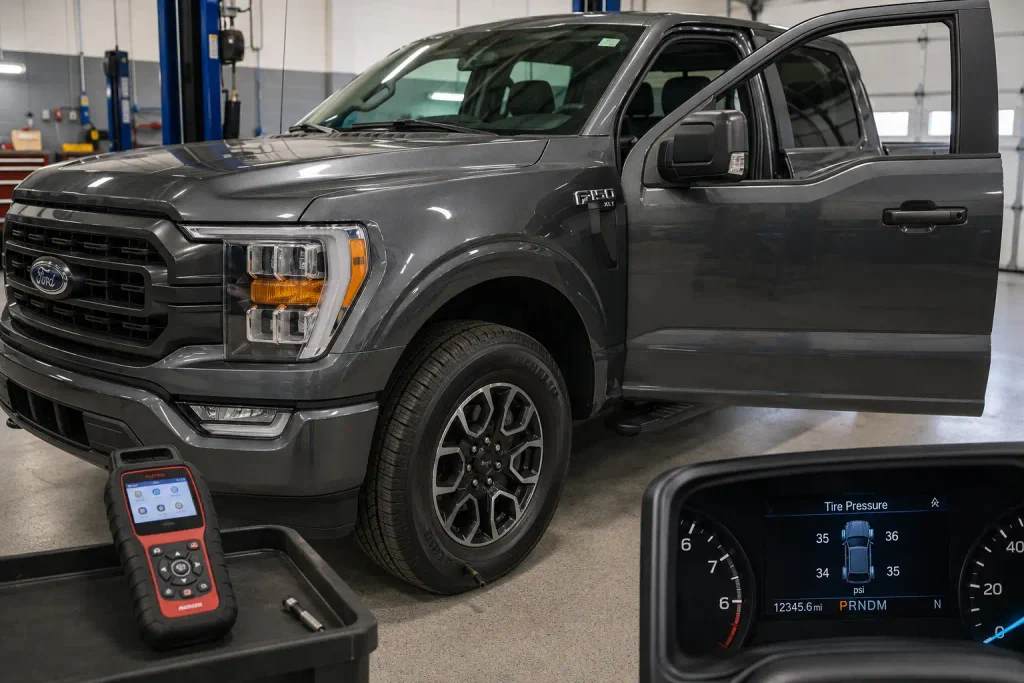
The main exception is the 2009 F-150. Ford used a brake-pedal and ignition-cycle routine with an activation tool on applicable trucks. From 2010 onward, Ford documentation uses the simpler ignition and hazard-flasher training routine across multiple F-150 generations.

Prime for Young Adults — 6 Months Free
Students and 18–24s get six months of Prime free, then half price.
Start 6 Months FreeAlways set final tire pressure according to the Tire Label on your specific truck. Do not copy a PSI value from another F-150 because tire size, payload package, and configuration can change the required pressures. If you are replacing worn tires, our best tires for Ford F150 guide compares the options.
Ford F150 TPMS Reset Process
Typical 2015 to 2026 training flow. Verify the exact procedure in the owner’s manual for your model year.
Drive the Truck
Drive above 20 mph for at least two minutes when specified by Ford.
Switch Power Off
Park safely where you can reach all four tires and an air source.
Enter Training Mode
Switch power on without starting, then cycle the hazard flashers three times.
Train Each Sensor
Start at the left front and wait for a horn chirp before moving to the next wheel.
Restore Tire Pressure
Inflate every tire to the cold pressure printed on your F-150 Tire Label.
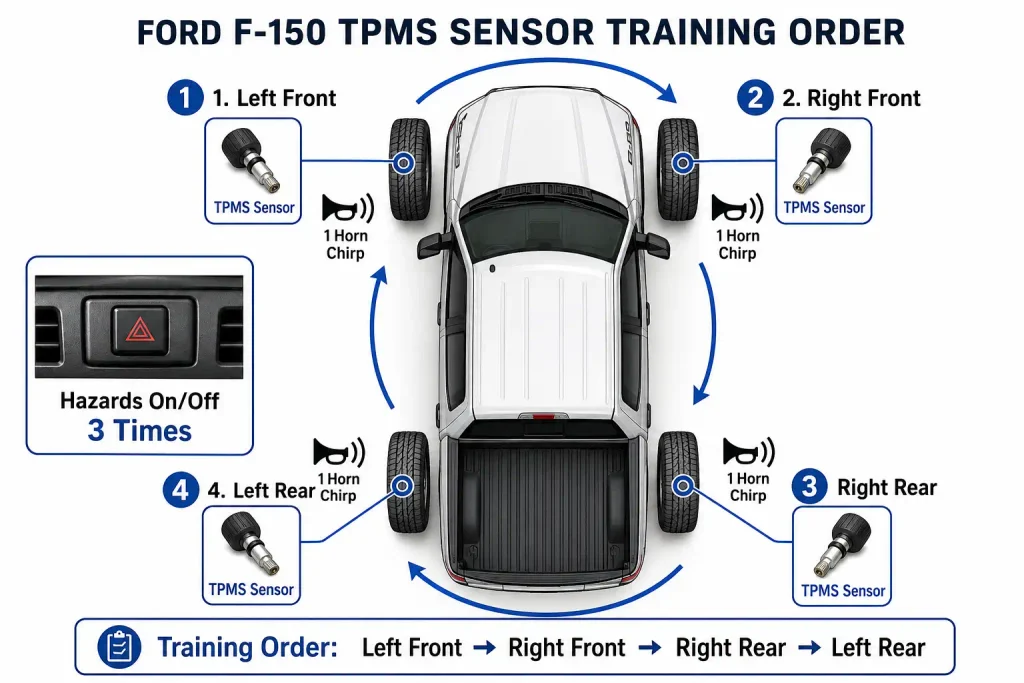
Correct Ford F150 TPMS Training Order
Which Ford F150 TPMS Reset Method Fits Your Year
Recommended Best Deal Products


The first step is matching your truck to the correct training procedure.
| Ford F-150 Year | Reset Method | How Sensor Is Triggered | Main Difference |
|---|---|---|---|
| 2009 | Brake pedal and ignition cycling | Ford TPMS activation tool on applicable trucks | Older training-mode entry |
| 2010-2014 | Ignition plus hazard flashers | Release tire pressure until horn chirps | Newer training sequence |
| 2015-2020 | Ignition plus hazard flashers | Release tire pressure or use compatible activation tool | Same clockwise training order |
| 2021-2024 | Ignition or power on plus hazard flashers | Release tire pressure until horn confirms | Information display shows training status |
| 2025-2026 | Power or ignition on plus hazard flashers | Pressure-release training or compatible tool | Current system retains clockwise relearn sequence |
Ford’s 2010, 2015, 2021, 2024, and 2026 documentation all use the same basic modern sequence: drive the truck, switch the ignition off and back on without starting, cycle the hazard lights three times, then train the sensors clockwise.

Audible — Listen Free for 30 Days
One free credit a month and thousands of titles included.
Listen Free for 30 DaysThe 2009 truck is the important outlier, so owners of that model year should use the dedicated procedure below.
How the 2009 Ford F150 TPMS Reset Works
Ford’s 2009 procedure applies to trucks equipped with different recommended front and rear tire pressures. Ford supplied those trucks with a special TPMS reset tool stored with the owner’s guide materials.
Ford states that the first six steps must be completed within 60 seconds. )
- Put the ignition in the OFF position and leave the key inserted.
- Press and release the brake pedal.
- Cycle the ignition from OFF to ON three times, ending in ON. Do not start the engine.
- Press and hold the brake pedal for two seconds, then release it.
- Turn the ignition OFF without removing the key.
- Cycle the ignition from OFF to ON three more times, ending in ON.
- Listen for one horn chirp and look for TRAIN LEFT FRONT TIRE in the message center.
- Start at the left-front wheel.
- Hold the Ford TPMS reset tool against the tire sidewall near the valve stem, with the tool directed toward the rim.
- Activate the tool until the horn chirps.
- Repeat at the right front, right rear, and finally left rear.
- Turn the ignition OFF after the last wheel is accepted.
The correct training order is:
Left Front → Right Front → Right Rear → Left Rear
Ford states that one horn chirp confirms successful sensor recognition. Two short horn sounds mean the procedure failed and must be repeated.
If the original reset tool is missing or no longer works, use a compatible Ford TPMS activation tool rather than guessing with an unrelated sensor programmer.
How 2010 to 2014 Ford F150 TPMS Training Works
Recommended Best Deal Products


The 2010 F-150 changed to the reset process most owners recognize today. Ford removed the brake-pedal entry routine from the standard procedure and used the hazard flashers instead.
Audible Premium Plus — Annual Membership
12 audiobook credits up front, plus the full Audible catalogue.
See Annual PlansFor these trucks:
- Drive above 20 mph for at least two minutes.
- Park where you can reach all four tires and have access to an air pump.
- Turn the ignition OFF.
- Turn the ignition ON without starting the engine.
- Switch the hazard flashers ON and OFF three times within 10 seconds.
- Wait for one horn chirp and the TPMS indicator to flash.
- Begin at the left-front tire.
- Remove the valve cap and reduce pressure until the horn chirps.
- Move to the right-front tire and repeat.
- Continue to the right rear.
- Finish at the left rear.
- Turn the ignition OFF.
- Reinflate every tire to the pressure printed on your truck’s Tire Label.
Ford’s 2010 manual states that the single horn chirp confirms the sensor identification code has been learned for that wheel position. A double horn indicates an unsuccessful reset.
The 2013 F-150 manual also states that trucks with different front and rear recommended pressures need retraining after tire rotation.
How 2015 to 2026 Ford F150 TPMS Reset Works
For most 2015-2026 F-150 owners, the procedure remains very similar to the 2010 method.
Ford’s 2015 manual provides the complete sequence, and Ford continued documenting the same basic process in later F-150 manuals, including 2021 and 2026.
Follow these steps:
- Drive the F-150 faster than 20 mph for at least two minutes.
- Park safely with access to an air pump.
- Switch the ignition or vehicle power OFF.
- Switch it back ON without starting the engine.
- Turn the hazard flashers ON and OFF three times.
- Complete the hazard sequence within 10 seconds.
- Listen for one horn chirp.
- Start with the left-front tire.
- Release air until the horn chirps.
- Move to the right-front tire.
- Continue to the right rear.
- Finish with the left rear.
- Switch the ignition or vehicle power OFF.
- Reinflate all four tires to the pressures on the Tire Label.
The sensor order stays:
Left Front → Right Front → Right Rear → Left Rear
Ford warns that you should not wait longer than two minutes between sensors. If the system times out, you must restart the full four-wheel procedure.
Ford also recommends carrying out the training away from another Ford undergoing TPMS training. A separation of at least 3 ft or 1 m helps reduce the chance of sensor interference.
Push Button Start Trucks
On newer F-150s, Ford documentation describes switching vehicle power ON without starting the engine rather than using a traditional ignition key. The hazard-flasher sequence and clockwise wheel training remain the key parts of the procedure.
Do not use generic internet instructions that tell you to press the start button five or six times unless that sequence appears in the manual for your exact F-150.
Ford F150 TPMS Reset vs Sensor Relearn
Recommended Best Deal Products


A TPMS reset and a replacement-sensor relearn are related, but they are not always the same job.
| Situation | What You Usually Need |
|---|---|
| Tires inflated to correct pressure | Drive the truck and allow readings to update |
| Tires rotated | Retrain sensor positions when required |
| Original sensor moved to another wheel | Position relearn |
| New TPMS sensor installed | Compatible sensor plus activation or relearn |
| New aftermarket wheels installed | Correct sensors plus system training |
| One sensor shows no reading | Diagnose that sensor before repeating reset |
| Warning lamp flashes | Diagnose a TPMS fault, not just tire pressure |
If your F-150 has new wheels or sensors and one position refuses to register, our guide to a new TPMS sensor not reading covers the checks that matter after installation.
Ford’s 2015-2023 F-150 TPMS sensor kit includes four sensors and an activation tool. Ford specifically states that the tool can retrain sensors after tire rotation. (https://www.ford.com/)
A basic reset cannot correct an incompatible or non-transmitting sensor.
When a Ford F150 TPMS Reset Tool Is Needed
A handheld activation tool is useful when you want to trigger the sensor electronically rather than releasing tire pressure.
When Air Pressure Is Enough
Ford’s owner-manual procedure for many 2010 and newer F-150s tells you to remove the valve cap and reduce tire pressure until the horn sounds.
That method works without buying a handheld tool, provided the sensor and TPMS receiver are operating correctly.
When an Activation Tool Helps
A compatible activation tool is useful after:
- Installing replacement TPMS sensors
- Installing a second wheel and tire set
- Rotating wheels frequently
- Working with sensors that need to be triggered without losing air
For 2015-2023 F-150s, Ford’s M-1180-B kit includes an activation tool specifically intended for sensor retraining.
Ford Performance documentation for 2025-2026 F-150 packages also references Ford TPMS tool 204-D081A for sensor activation. (Performance Parts)
When a Tool Will Not Fix It
An activation tool will not repair:
- A physically damaged sensor
- A dead sensor battery
- A sensor incompatible with the truck
- A TPMS receiver or related electronic fault
- A wheel installation that damaged the valve-mounted sensor
If the pressure displayed on the dash seems wrong even after training, check our guide to a TPMS sensor reading the wrong pressure before replacing parts.
What One or Two TPMS Horn Chirps Mean
The F-150’s horn tells you where the relearn process stands.
| Horn or Display Response | Meaning | What to Do |
|---|---|---|
| One chirp after entering training mode | Reset mode is active | Start with left front |
| One chirp after releasing air | Sensor was learned | Move to next tire |
| Two chirps during training | Reset failed | Restart procedure |
| No chirp at one wheel | Sensor was not detected | Check sensor or activation method |
| No chirp after hazard sequence | Training mode was not entered | Repeat ignition and hazard steps |
| Procedure stops between wheels | Training may have timed out | Restart all four wheels |
Ford says one horn sound confirms that the sensor identification code has been learned. A double horn means the reset was unsuccessful.
If only one wheel consistently fails while the other three train correctly, focus diagnosis on that sensor rather than repeating the entire process indefinitely.
6 Reasons a Ford F150 TPMS Reset Fails
A failed Ford F150 TPMS reset usually points to the entry sequence, timing, or one sensor that is not communicating.
Wrong Reset Sequence
The 2009 procedure differs significantly from the 2010 and newer method.
Using the brake and ignition routine on a modern F-150, or the hazard-only method on the applicable 2009 configuration, can prevent training mode from starting.
Sensor Training Timed Out
Ford allows no more than two minutes between sensors on the documented modern procedure.
Move around the truck promptly once training starts.
Sensor Does Not Respond
If the horn sounds for three wheels but not one, that sensor may not be transmitting.
After recent tire installation, also inspect for valve-stem or sensor damage. Our TPMS sensor after a tire change guide covers this exact situation.
Replacement Sensor Is Incompatible
A replacement sensor must match the F-150’s TPMS system and model-year application.
Ford lists its M-1180-B sensor and tool kit specifically for 2015-2023 F-150 applications, which shows why sensor fitment should be verified instead of assuming one Ford sensor works across every year.
Tire Pressure Is Incorrect
TPMS training does not replace proper inflation.
Use the Tire Label on the B-pillar or driver-door area for the correct cold pressures. Ford directs owners to this label throughout its F-150 TPMS reset instructions.
System Fault Is Still Present
A flashing TPMS warning can indicate the system is not functioning normally.
Ford advises having the system checked when the tires are correctly inflated, the temporary spare is not in use, and the system still reports a malfunction.
A reset should not be used to hide an active TPMS fault.
How to Verify the Ford F150 TPMS Reset Worked
The final horn chirp means the wheel-position training has completed, but you should still verify the system.
- Reinflate every tire to its specified cold pressure.
- Reinstall all four valve caps.
- Switch the ignition or vehicle power back on.
- Check the individual pressure readings in the truck information display where equipped.
- Drive above 20 mph if the readings do not update immediately.
- Confirm the TPMS warning lamp remains off.
Ford notes that TPMS sensors can enter a low-power sleep state while the truck sits. Ford Performance states that driving above 20 mph for at least two minutes can wake the sensors and update pressure information.
Ford’s 2009 manual also states that it can take up to two minutes of driving above 20 mph for the warning light to turn off after correcting tire pressure.
Best Ford F150 TPMS Reset Approach by Situation
For a 2009 F-150 with different front and rear specified pressures, use Ford’s brake-pedal, ignition-cycle, and activation-tool procedure.
For 2010 and newer F-150s, the documented procedure generally uses a short drive, ignition or power ON with the engine stopped, three hazard-flasher cycles, then clockwise training from left front to left rear.
If you installed a new sensor, verify that the sensor is compatible before assuming the Ford F150 TPMS reset procedure is failing.
If one sensor repeatedly refuses to train while the other three work, diagnose that wheel and sensor first.
5 Common Ford F150 TPMS Reset Questions
How Do I Put My Ford F150 in TPMS Training Mode?
On many 2010-2026 F-150s, drive above 20 mph for two minutes, switch the ignition off, switch it back on without starting, then cycle the hazard flashers on and off three times within 10 seconds. A horn chirp confirms training mode.
The 2009 procedure is different and uses brake-pedal and ignition cycling on applicable trucks.
Can I Reset Ford F150 TPMS Without a Tool?
Yes, many 2010 and newer F-150 manuals describe training the sensors by releasing tire pressure until the horn chirps.
A compatible activation tool can make the job easier, especially when working with replacement sensors or multiple wheel sets.
Why Does My Ford F150 Horn Chirp Twice During TPMS Reset?
Two horn sounds mean the training procedure was unsuccessful on Ford’s documented F-150 reset procedure. Restart the reset and maintain the correct wheel sequence and timing.
Repeated failure at the same wheel points toward a sensor or communication issue.
Why Will My New Ford F150 TPMS Sensor Not Relearn?
A new sensor may fail to relearn if it is incompatible, damaged, inactive, or not communicating with the truck.
Verify the sensor application for your exact F-150 year before replacing additional parts. A reset cannot make the truck recognize hardware that does not match its TPMS system.
Do I Need to Reset Ford F150 TPMS After Tire Rotation?
Ford requires the reset after tire rotation on F-150 configurations that use different recommended front and rear pressures.
Check the Tire Label on your truck because the requirement depends on the pressure specification for that configuration.