Ford F-150 Wheel Bolt Pattern Chart: 1996-2026 Year (All Models)

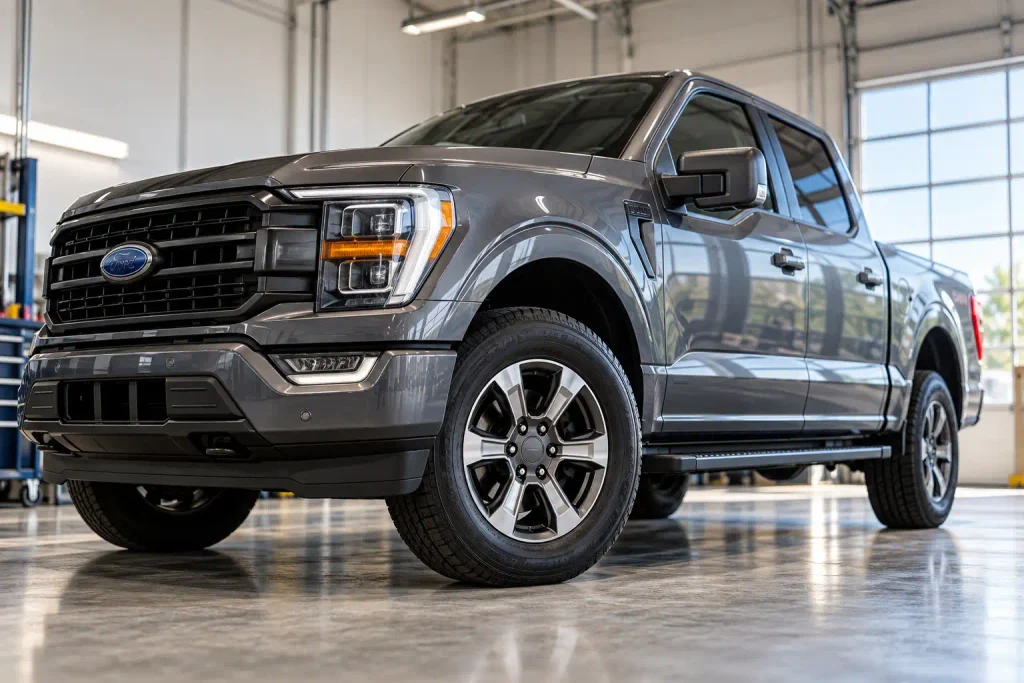
The Ford F150 wheel bolt pattern chart has three main patterns for standard trucks: 5×139.7 mm for 1975–1996, 5×135 mm for 1997–2003, and 6×135 mm for most redesigned 2004–2026 models. The 2004 F-150 Heritage retained the earlier five-lug arrangement. Selected Heavy-Duty Payload trucks used a less common 7×150 mm pattern.
Before ordering wheels, identify your exact model and count the wheel studs. The year alone can give the wrong answer on a Heritage or seven-lug truck. The chart below separates those exceptions, then explains how to verify complete wheel fitment.

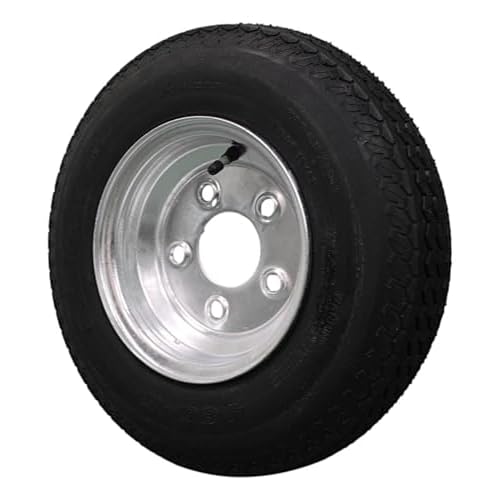

Compare lug counts, bolt-circle diameters and model-year exceptions before choosing replacement wheels.
1975–1996 / 1997–2003
Plus standard 2004 Heritage
Most redesigned F-150 trucks2004–2026
Selected 7700 / Heavy-Duty Payload configurations only
PCD is the diameter of the circle through the centers of the wheel studs. A matching PCD alone does not guarantee fitment. On mobile, swipe the table sideways to see all columns.
| Years | Configuration | Bolt pattern | Key note |
|---|---|---|---|
| 1975–1996 | Standard F-150 | 5×139.7 | Original five-lug PCD |
| 1997–2003 | Standard F-150 | 5×135 | Five-lug metric circle |
| 2000–2003 | Selected 7700 package | 7×150 | Verify actual seven-stud hub |
| 2004 | Standard F-150 Heritage | 5×135 | Carryover body design |
| 2004 | Heritage heavy-payload configuration | 7×150 | Seven-stud exception |
| 2004–2026 | Redesigned, standard F-150 | 6×135 | Typical modern factory pattern |
| 2004–2014 | Selected Heavy-Duty Payload models | 7×150 | Not standard; verify specific truck |
Pattern shown = lug count × pitch-circle diameter (mm). Visuals are simplified stud layouts, not scale drawings. Confirm hub bore, offset, load rating, lug-seat design and model-specific hardware separately.
Ford F150 Wheel Bolt Pattern Chart by Year
A standard 2026 Ford F-150 uses six wheel studs on a 135 mm bolt circle, written 6×135 mm or approximately 6×5.31 inches. The same basic pattern is used on most regular-production F-150 trucks back to the 2004 redesign.
| Model Year | F-150 Configuration | Lug Count | Bolt Pattern | Fitment Note |
|---|---|---|---|---|
| 1975–1996 | Standard F-150 | 5 | 5×139.7 mm (5×5.5 in) | Older five-lug pattern |
| 1997–1999 | Standard F-150 | 5 | 5×135 mm (5×5.31 in) | Not interchangeable with 5×139.7 |
| 2000–2003 | Standard F-150 | 5 | 5×135 mm (5×5.31 in) | Check lug hardware separately |
| 2000–2003 | Selected 7700 / Heavy Payload trucks | 7 | 7×150 mm (7×5.91 in) | Special seven-lug hub |
| 2004 | F-150 Heritage, standard | 5 | 5×135 mm (5×5.31 in) | Carryover body design |
| 2004 | F-150 Heritage with Heavy Payload Package | 7 | 7×150 mm (7×5.91 in) | Not the standard Heritage wheel |
| 2004–2008 | Redesigned F-150, standard | 6 | 6×135 mm (6×5.31 in) | New body design |
| 2009–2014 | Standard F-150 | 6 | 6×135 mm (6×5.31 in) | Includes ordinary six-lug models |
| Selected 2004–2014 | Heavy-Duty Payload configurations | 7 | 7×150 mm (7×5.91 in) | Confirm factory package and stud count |
| 2015–2020 | Standard F-150 | 6 | 6×135 mm (6×5.31 in) | Bolt circle retained after redesign |
| 2021–2026 | Standard F-150 | 6 | 6×135 mm (6×5.31 in) | Wheel dimensions still vary by trim |
These are factory-style patterns, not a guarantee for trucks with swapped axles, converted hubs, or aftermarket adapters. The seven-lug rows apply only to trucks actually equipped with those hubs. A wheel bolt-pattern reference by model and year provides a useful cross-check for the metric sizes.
Quick interpretation: The first number is the number of studs or mounting holes. The second is the diameter, in millimeters, of the imaginary circle passing through their centers. A 5×135 wheel and a 6×135 wheel share the same circle diameter but have different numbers of holes, so they cannot bolt directly onto the same hub.
When Did the Ford F150 Bolt Pattern Change
The standard F-150 wheel pattern changed in 1997 and again with the 2004 redesign. These boundaries matter when buying used factory wheels, especially from trucks that look similar but belong to different generations.
The 1997 Five-Lug Change
Ford’s earlier F-150 used a 5×139.7 mm (5×5.5-inch) pattern through 1996. The redesigned 1997 truck switched to 5×135 mm. Both arrangements have five holes, but the mounting circles differ by 4.7 mm.
That difference prevents direct installation. A seller describing both wheels as “Ford five-lug” has not provided enough information to establish compatibility.
The 2004 Six-Lug Change
The redesigned 2004 F-150 adopted 6×135 mm for ordinary configurations. That six-lug pattern continued through subsequent generations, including the 2026 model year.



However, 2004 was also the final model year for the carryover F-150 Heritage. For that reason, a listing that says only “2004 F-150 wheels” is incomplete. Identifying the body style comes first.
Which 2004 Ford F150 Uses Five or Six Lugs
The 2004 F-150 Heritage and the redesigned 2004 F-150 do not use the same standard bolt pattern. The Heritage kept the earlier truck’s five-lug, 5×135 mm layout. The redesigned truck used six lugs with a 6×135 mm pattern.
The Heritage also had an exception. Ford’s 2004 F-150 Classic Owner’s Guide explicitly distinguishes five-lug trucks from Heavy Payload Package trucks with seven lug nuts.
| 2004 Model | Typical Factory Arrangement | What to Verify |
|---|---|---|
| F-150 Heritage, regular configuration | 5×135 mm, five lugs | Carryover body and five studs |
| F-150 Heritage, Heavy Payload | 7×150 mm, seven lugs | Actual seven-stud hub and factory equipment |
| Redesigned 2004 F-150, standard | 6×135 mm, six lugs | New body and six studs |
If the truck has seven studs, do not order five-lug Heritage wheels. Also avoid identifying a wheel solely by the shape of its center cap: count the actual fasteners or mounting holes.
Which Ford F150 Trucks Have Seven Lug Wheels
Some F-150s ordered with a 7700 or Heavy-Duty Payload Package used a seven-lug, 7×150 mm wheel arrangement. These were specialized configurations, not the normal pattern for every XL, XLT, or towing-equipped truck.
The exception appears among early-2000s 7700-package trucks and later heavy-payload builds. Importantly, Ford’s 2014 F-150 brochure identifies 17-inch seven-lug wheels as equipment included with the Heavy-Duty Payload Package. That establishes the exception was still relevant in 2014.
Do not assume a truck has seven lugs just because it has a long bed, a tow hitch, or a Max Trailer Tow Package. Wheel stud count and the exact factory configuration are more reliable than appearance or a seller’s description.
Seven-lug wheels are not direct replacements for either 5×135 or 6×135 wheels. When replacing one, confirm the 7×150 mounting pattern, hub opening, offset, fastener specification, and wheel load rating before purchasing.
How to Measure the Ford F150 Wheel Bolt Circle
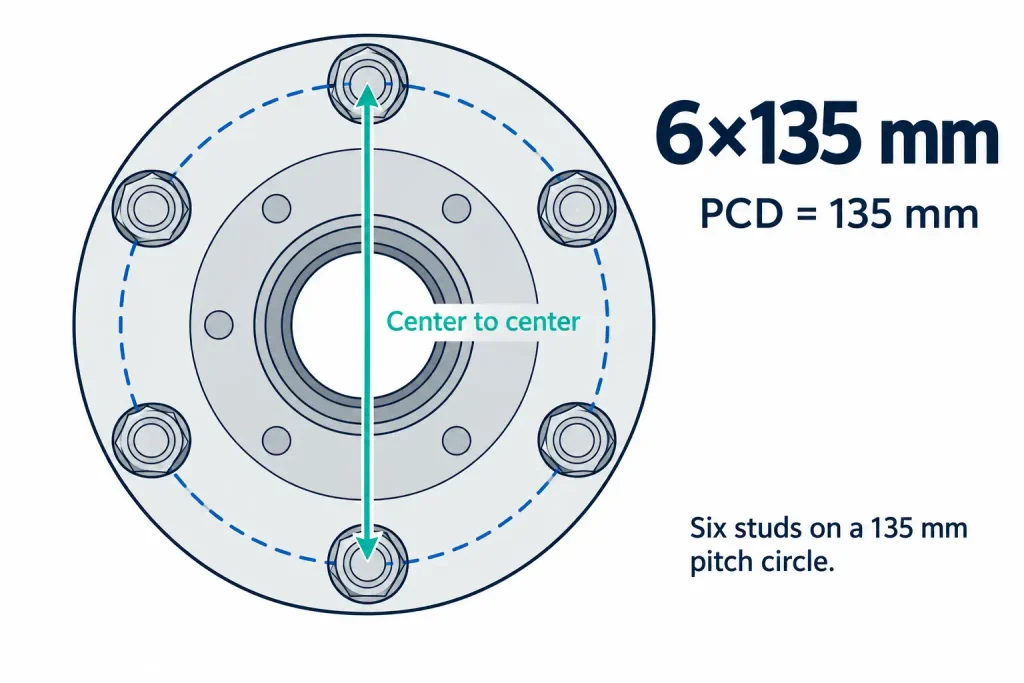
A bolt pattern is also called a pitch circle diameter (PCD). You can confirm the pattern by counting the studs and determining the diameter of the circle through their centers.
- Count the studs. Identify whether the hub has five, six, or seven wheel studs. This determines the first number in the pattern.
- Measure a six-lug hub. On a six-stud pattern, measure center-to-center between two studs directly opposite each other. A 135 mm reading corresponds to 6×135 mm.
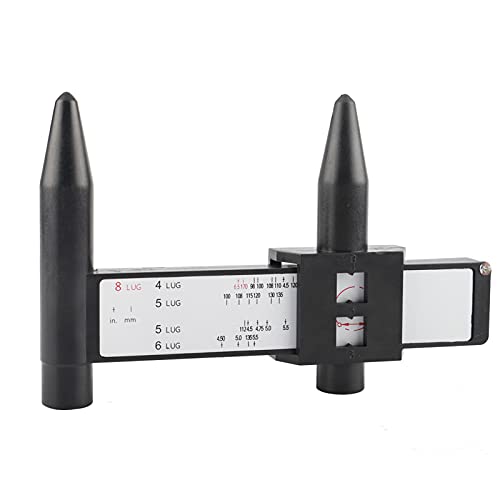
- Use a PCD gauge for odd-lug hubs. With five or seven studs, there is no stud directly opposite another. A properly marked bolt-pattern gauge or a verified wheel specification is more dependable than guessing from adjacent studs.
- Cross-check the model information. Compare the result with the truck’s model year, body generation, factory equipment, and any records of hub or axle changes.
Measure carefully with an appropriate gauge or caliper, and do not confuse the spacing between neighboring studs with the bolt-circle diameter. If the wheel must be removed, use the correct lifting procedure for your truck and tighten it afterward to its own factory specifications.
On an even-numbered six-lug hub, opposite stud centers lie across the full pitch circle. That direct measurement is not available on a five- or seven-lug hub, which is why a pattern gauge is useful.
Will Ford F150 Wheels Fit Across Different Years
Matching bolt pattern is necessary, but it does not guarantee that two F-150 wheels interchange. The wheel also needs to clear the brakes, center correctly on the hub, accept the right fasteners, and meet the truck’s load requirements.



Consider three common used-wheel situations:
- 1996 wheels on a 1997 F-150: Both trucks have five lugs, but 5×139.7 and 5×135 are different patterns. The wheels do not bolt on directly.
- 2003 wheels on a standard 2004 redesigned F-150: The 2003 five-lug wheel cannot directly mount on a six-lug 2004 hub. A standard 2004 Heritage is a different case because it retained five lugs.
- 2012 six-lug wheels on a 2022 F-150: Both use 6×135 mm, but you must still verify center bore, width, offset, brake clearance, load rating, and the correct lug nuts before calling the swap compatible.
Other components may interchange across model years for completely different reasons. The existing Ford F-150 parts interchangeability guide covers broader parts compatibility, while this chart is specifically about wheel mounting patterns.
Bolt-pattern adapters should not be treated as an automatic fix for a mismatch. They alter how the wheel mounts and can change effective offset. Have a qualified wheel specialist evaluate the setup and all required clearances before considering them.
Which F150 Wheel Specifications Matter Beyond Bolt Pattern
The PCD establishes where the mounting holes sit. A proper wheel-fitment check also includes several dimensions that are not represented by the bolt-pattern number.
Center Bore and Hub Fit
The wheel’s center opening must fit over the truck’s hub pilot. A wheel with too small an opening cannot seat correctly. For an aftermarket wheel with a larger opening, follow the wheel manufacturer’s centering and hardware instructions; do not assume every hub ring is suitable for every wheel.
Width Offset and Brake Clearance
Wheel width and offset determine where the wheel sits relative to the hub. A wheel can share the correct 6×135 pattern yet contact a brake caliper, suspension component, or fender at certain steering angles.
Changing tire diameter or width creates another fitment question. Use the Ford F150 tire size chart for the separate tire-dimension and clearance discussion.
Lug Nut Threads and Torque
Stud diameter, thread pitch, and lug-seat design can differ across F-150 generations. Never choose lug nuts merely because two wheels share 6×135 mm. Confirm the fastener type for the truck and the seat profile required by the wheel.
As a verified modern example, the 2026 Ford F-150 Owner’s Manual lists M14×1.5 wheel fasteners and 150 lb-ft (204 N·m) torque. It directs owners to retighten the wheel nuts within 100 miles (160 km) after wheel disturbance. Those are not universal specifications for older F-150s.
For perspective, Ford’s 2004 Classic guide identifies M14×2.0 at 150 lb-ft for its five-lug setup, but M12×1.75 at 100 lb-ft for the seven-lug Heavy Payload setup. Even within one model-year family, the correct hardware can be different.
Wheel Load Rating
A wheel must be rated for the load imposed on it. This matters especially on work trucks carrying substantial cargo or towing. The truck’s actual allowable payload varies by configuration; the Ford F-150 payload capacity chart provides related loading context, but the specific truck’s door labels and wheel ratings govern the final check.
How to Check F150 Wheel Fitment Before Buying
Before buying replacement wheels, verify the truck and the wheel separately. A four-step check can prevent a costly order or a dangerous installation.
- Identify the truck. Confirm model year, whether a 2004 truck is Heritage or redesigned, and whether it has a special payload package. Check for previous axle or hub modifications.
- Match the bolt pattern. Count the studs and verify the PCD. For example, six holes on a 135 mm circle mean 6×135 mm, not 5×135 mm.
- Confirm physical clearance. Compare the wheel’s center bore, diameter, width, and offset with the truck’s hub, brakes, and suspension. Check that the tire clears throughout the required steering and suspension travel.
- Confirm installation hardware and capacity. Use the correct lug-seat type, thread specification, wheel load rating, and model-specific tightening procedure. Recheck torque at the interval directed by the applicable owner’s manual.
If the wheel seller cannot confirm these specifications for your configuration, do not treat the matching bolt pattern as proof of fitment.


How to Choose the Right Ford F150 Wheels
The Ford F150 wheel bolt pattern chart is straightforward for standard trucks: 5×139.7 mm through 1996, 5×135 mm from 1997 through 2003, and 6×135 mm on most redesigned 2004–2026 F-150s. The 2004 Heritage is a five-lug carryover, while selected Heavy-Duty Payload trucks use seven lugs with a 7×150 mm pattern.
Start with your truck’s stud count, then verify its exact factory configuration. A matching PCD only answers the first fitment question; center bore, offset, brake clearance, lug hardware, and wheel load rating determine whether the wheel is suitable. Confirm each before ordering or installing replacement wheels.
Ford F150 Wheel Bolt Pattern Questions Answered
What Is the Bolt Pattern on a 2026 Ford F150
A standard 2026 Ford F-150 uses a 6×135 mm wheel bolt pattern, with six mounting holes on a 135 mm circle. Check the exact wheel dimensions, lug hardware, and load rating before purchasing replacements.
Is the 2004 Ford F150 Pattern 5×135 or 6×135
Both appear in the 2004 model year. The standard 2004 Heritage uses 5×135 mm, while the redesigned 2004 F-150 uses 6×135 mm. A Heritage Heavy Payload truck can instead have a seven-lug arrangement, so count the studs.
Which Ford F150 Trucks Have Seven Lug Wheels
Selected F-150 7700 and Heavy-Duty Payload configurations used 7×150 mm wheels. Ford documented seven-lug arrangements in its 2004 Classic guide and 2014 F-150 brochure. Confirm that your truck actually has seven studs rather than assuming a towing package changes the bolt pattern.
Will 6×135 Wheels Fit Every Newer Ford F150
No. The 6×135 mm pattern is shared by most standard redesigned F-150s from 2004 onward, but bolt pattern alone does not confirm fitment. Verify hub opening, wheel offset and width, brake clearance, load rating, and lug nut compatibility for both the wheel and truck.
Are 5×135 and 5×139.7 Bolt Patterns Interchangeable
No. They both use five lugs, but their pitch-circle diameters are different. A 5×135 mm wheel will not mount directly on a 5×139.7 mm hub, so confirm the actual bolt circle instead of relying on lug count alone.