Ford F150 Tire Size Chart: 2026 Component Breakdown & Guide

The Ford F150 tire size chart maps the factory-recommended tire dimensions based on trim levels and wheel configurations. It details the relationship between tire width, aspect ratio, and rim diameter, which is critical for maintaining correct speedometer calibration, transmission gear ratios, and suspension clearance within the vehicle’s drive system.
📌 Key Takeaways
- Standard tire sizes range from 17-inch to 22-inch diameters depending on the specific chassis configuration.
- The sidewall markings (e.g., 275/60R20) provide the width in millimeters, aspect ratio, and internal rim diameter.
- Always maintain the manufacturer-recommended PSI found on the driver-side door jamb sticker for optimal safety.
- Incorrect tire sizing is the most common cause of inaccurate speedometer readings and ABS sensor errors.
- Consult a professional if attempting to upsize tires, as body modification may be required to prevent wheel well rubbing.
Selecting the correct tire for a Ford F-150 requires more than simple aesthetic preference; it demands a deep understanding of the vehicle’s mechanical engineering and suspension geometry. Whether you are aiming for improved off-road clearance or optimizing fuel efficiency on the highway, your tire selection must align with the truck’s OEM load ratings and physical clearance constraints. This guide serves as a comprehensive technical reference, detailing the tire-to-suspension interface, generational bolt patterns, and critical calibration requirements. By utilizing the following data, you ensure that your Ford F-150 tire size chart selection maintains peak performance, handling stability, and long-term drivetrain reliability while avoiding catastrophic rubbing or improper TPMS readings.
[DIAGRAM_PLACEHOLDER: A schematic drawing showing an F-150 wheel assembly, highlighting the relationship between the tire sidewall, the inner wheel well liner, the upper control arm, and the strut/coilover assembly. Callouts label the wheel hub, lug studs (6×135 pattern), and the clearance gap at full steering lock.]
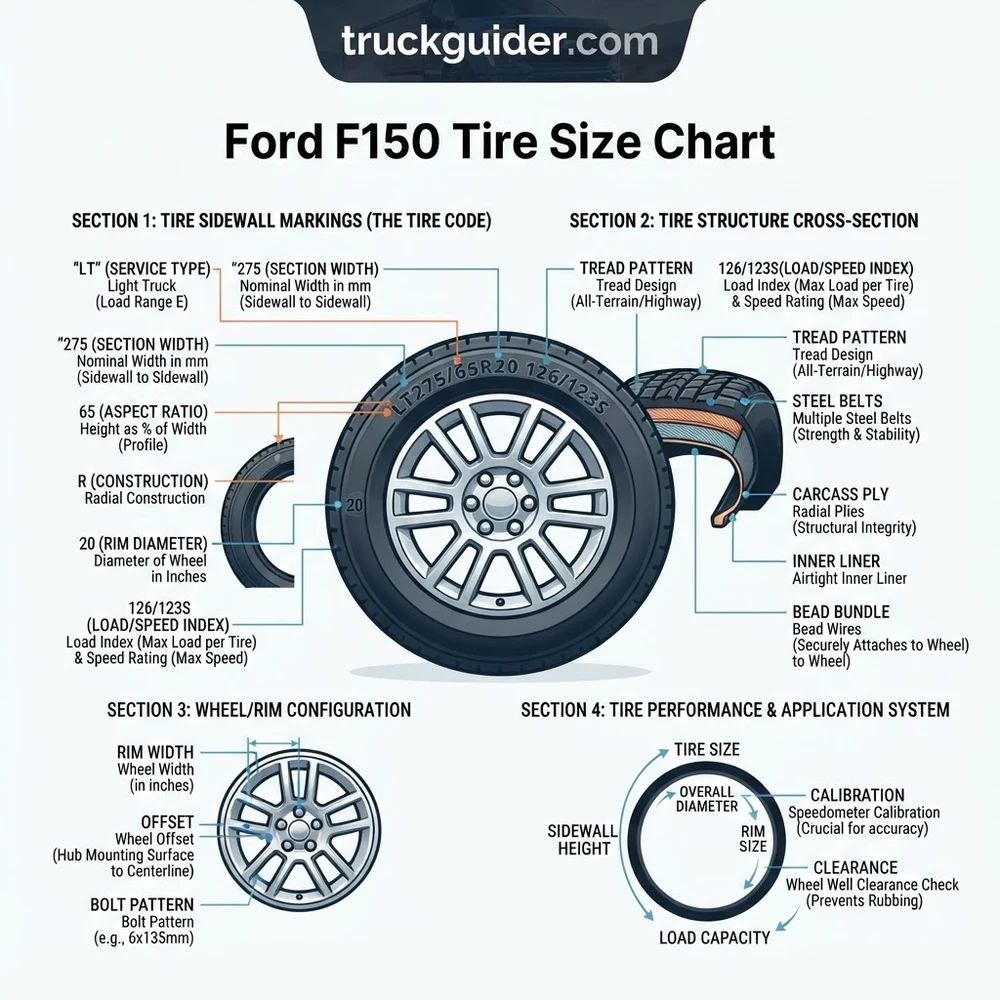
Ford F150 Tire Size Chart: Structural Components Overview
Recommended Best Deal Products


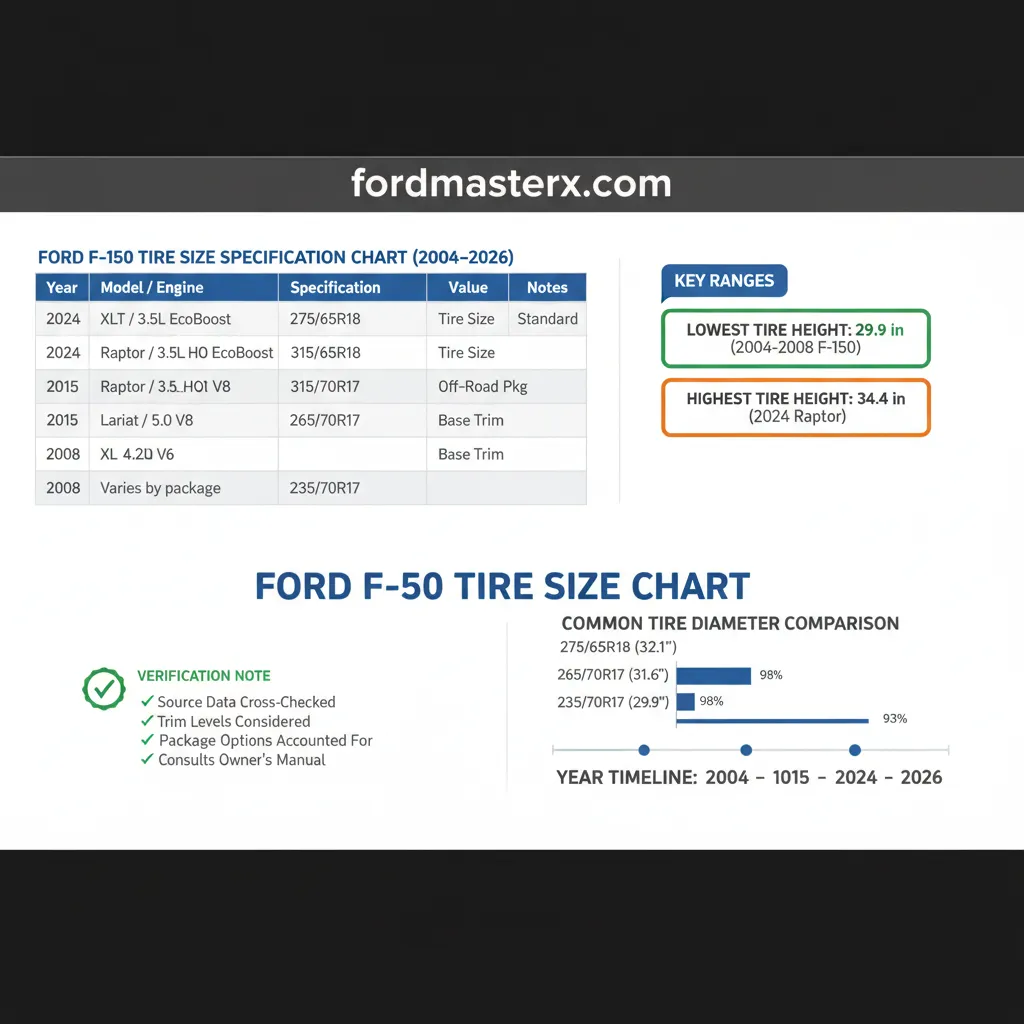
The physical relationship between a tire and the Ford F-150 chassis is dictated by the structural configuration of the wheel well, suspension, and hub assembly. When evaluating a tire size increase, technicians must assess the entire clearance envelope rather than just the tire’s static outer diameter. The tire sidewall serves as the primary flexible component, but its interaction with the suspension system—specifically the upper control arm (UCA)—is the most frequent point of mechanical interference during steering articulation.
The wheel hub assembly on modern F-150s (2004–present) typically utilizes a 6×135 bolt pattern. The hub-centric design of the wheel is crucial for preventing vibration; the wheel must seat perfectly against the hub pilot to ensure structural load distribution. When analyzing the layout of the suspension, notice that the front strut/coilover assembly occupies significant lateral space. As you increase tire width, the proximity of the tire sidewall to the UCA decreases, often requiring wheels with a lower offset (or aggressive negative offset) to maintain the necessary clearance.
The inner wheel well liner serves as a critical protective structure for the truck’s internal wiring harnesses, including the ABS sensor leads and the electronic steering rack connections. If you install an oversized tire, you risk damaging these components during full-lock turns. Furthermore, the distance between the tire and the sway bar must remain within OE tolerances to prevent premature wear on the sway bar end links. The blueprint of the F-150 suspension indicates that the rear wheel well has more longitudinal clearance, but the front section is strictly limited by the bumper fascia and the frame rail.
For all 2015-2024 Ford F-150 models, the factory lug nut torque specification is 150 lb-ft. Using a torque wrench is mandatory to prevent stud fatigue or rotor warping caused by uneven clamping forces.
Comprehensive Ford F150 Tire Size Chart for All Generations

The following data provides the standardized configuration for F-150 wheel and tire fitments. This chart helps distinguish between P-Metric (passenger vehicle) tires and LT (Light Truck) tires, which feature significantly higher ply ratings and, consequently, higher cold inflation pressure requirements.
| Generation | Bolt Pattern | Stock Fitment Range | Max Recommended (No Lift) |
|---|---|---|---|
| 2004–2008 | 6×135 | 255/65R17 – 275/55R20 | 33″ x 11.5″ |
| 2009–2014 | 6×135 | 265/60R18 – 275/55R20 | 33″ x 11.5″ |
| 2015–2020 | 6×135 | 265/70R17 – 275/55R20 | 34″ x 11.0″ |
| 2021–Present | 6×135 | 265/70R17 – 275/60R20 | 34″ x 11.5″ |
When referencing load indices, ensure your new tire meets or exceeds the GVWR of your specific truck configuration. For most F-150s, a Load Index of 113 or higher is required. LT-metric tires (Load Range C, D, or E) are suggested for heavy towing or frequent work-site usage, as the thicker sidewall carcass provides superior stability under high vertical loads. Always cross-reference your door jamb placard for recommended PSI; however, note that aftermarket LT tires often require 45-55 PSI for proper wear and structural integrity, significantly higher than the standard 35 PSI found on P-metric tires.
Center Bore Diameter: 87.1mm. When purchasing aftermarket wheels, ensure the bore matches this dimension or utilize precision-machined hub-centric rings to prevent high-speed harmonic vibrations.
How to Read the Ford F150 Tire Size Chart Step by Step
Recommended Best Deal Products


Utilizing a tire size chart effectively requires a systematic approach to geometry and electronic synchronization. Follow these steps to ensure your upgrade remains within the functional envelope of your F-150.
1. Calculate Static Diameter: First, identify your desired tire size (e.g., 285/65R20). Convert the profile to inches. For a 285/65R20, the sidewall height is 65% of 285mm (185.25mm), which is 7.29 inches. Multiply by two (top and bottom of the tire) and add the wheel diameter (20 inches) to achieve the total diameter of 34.58 inches.
2. Verify Suspension Geometry: Compare the calculated diameter against your current ground clearance. If the diameter increases by more than 1.5 inches over the stock setup, you must confirm that your current lift kit (if installed) or OEM suspension provides adequate clearance at full bump and full lock.
3. Assess Offset and Backspacing: As the tire width increases, the wheel backspacing becomes the limiting factor. Excessive backspacing will pull the tire into the suspension structure. A lower backspacing (pushed outward) risks contact with the front inner fender liner or the rear cab mount.
4. Calibrate the Powertrain Control Module (PCM): Any deviation in outer diameter greater than 3% will necessitate a speedometer recalibrator. Failure to update the tire size in the PCM will result in inaccurate speedometer readings, incorrect shift points for the 10R80 transmission, and potential ABS/traction control system errors.
5. Final Load Check: Ensure the Load Index on the sidewall matches or exceeds the OEM tire rating. Installing a tire with a lower index rating than the original equipment constitutes a safety risk for the vehicle’s braking and cornering capability.
Common Ford F150 Tire Size Chart Problems and Fixes
Even with precise planning, enthusiasts often encounter technical hurdles when moving away from the OEM configuration. Addressing these issues early prevents damage to the vehicle’s bodywork and electronic systems.
Fender Liner Rubbing: This is the most common symptom of an oversized tire choice. The fix typically involves “heat gun molding” the plastic liner or, in extreme cases, trimming the liner and the rear of the metal front fender. Always check for electrical wires behind the liner before cutting.
Speedometer and Transmission Shift Errors: If your shift points feel “lazy” or the transmission hunts for gears, your gear-to-tire ratio has been negatively affected by the larger mass and diameter of the tires. Utilizing an OBDII-based diagnostic tool to flash the PCM with the new tire circumference is the only permanent solution.
TPMS Sensor Compatibility: If you are moving to a dedicated off-road wheel set, ensure the sensors are compatible with your truck’s frequency (typically 315MHz or 433MHz depending on the year). If the system cannot relearn the new sensors, you will receive a constant TPMS error light on the dash, which may also disable specific traction control modes.
Steering Rack Strain: Installing tires significantly wider than 12.5 inches adds substantial load to the electric power-assisted steering (EPAS) motor. If you notice a “whine” or increased resistance at low speeds, confirm that your steering fluid (if applicable) or electronic rack firmware is optimized for the increased rotational inertia.
Do not exceed a 35-inch total tire diameter without upgrading the front axle components or considering re-gearing the differential. Failure to re-gear after a significant tire size increase puts excessive strain on the drivetrain, leading to premature ring and pinion gear failure. Once you know your size, see our best tires for Ford F150 for tested options.
Ford F150 Tire Size Chart Questions Answered
Recommended Best Deal Products


Can I install 35-inch tires on a stock F-150?
While some specific F-150 trims (like the Raptor or Tremor) come with clearance for larger rubber, a standard F-150 usually requires a 2-inch leveling kit to fit a 35-inch tire without rubbing the crash bars or fender liners. Always check the specific crash bar configuration, as these structural elements vary by year.
Does changing tire size affect my vehicle warranty?
Under the Magnuson-Moss Warranty Act, the manufacturer must prove that your modifications caused the failure in question. While a larger tire will not automatically void your engine warranty, it may cause a claim denial for suspension components like ball joints, wheel bearings, or the steering rack due to the increased stress and leverage applied to those systems.
Why is my speedometer reading lower than my GPS?
Your speedometer is calculated based on tire revolutions per mile. When you increase the tire diameter, each rotation covers more distance, but the wheel rotates fewer times than the truck’s computer expects. This causes the speedometer to report a lower speed than your actual physical velocity, which is a major reason for recalibration.
What is the difference between Load Range C and E?
Load Range C (6-ply) is generally softer and offers a more comfortable ride, suitable for daily driving and light hauling. Load Range E (10-ply) has a much stiffer sidewall, which provides greater resistance to punctures and better stability under heavy trailer tongue weights, though at the expense of ride comfort due to the higher PSI requirements.
Step-by-Step Guide to Understanding the Ford F150 Tire Size Chart
Identify – Locate the tire placard on the driver-side door jamb to confirm your original factory specifications.
Locate – Find your specific F150 model year and wheel diameter on the tire size chart.
Reference – Compare the chart values against your current tire sidewall markings to identify discrepancies.
Connect/Route – Ensure that any new tire configuration maintains the structural clearance required by the wheel well layout.
Verify – Use a diagnostic scanner to recalibrate the vehicle’s computer if you have installed non-factory tire sizes.
Troubleshoot – Check for rubbing at full lock and monitor tire pressure sensors for any fault codes post-installation.