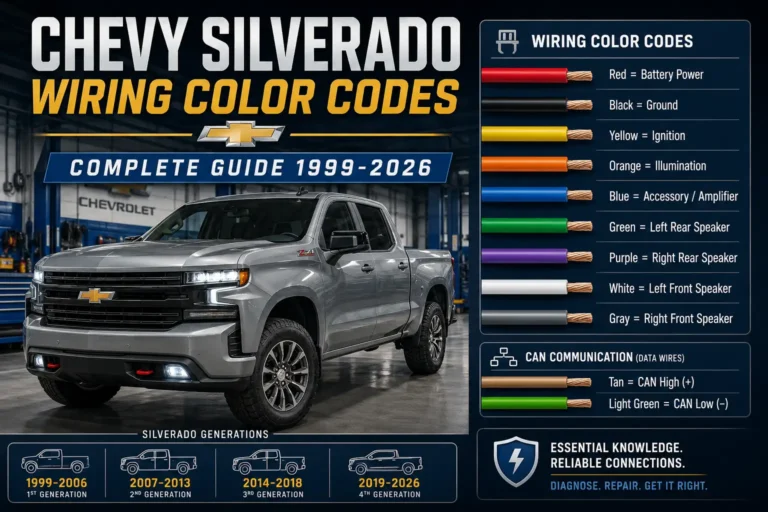
Chevy Silverado Tire Size Chart by Year: 1999-2026 1500, 2500 & 3500

Chevy Silverado tire size depends on three things at once: the generation, the weight class, and the trim. A 2015 Silverado 1500 LTZ, a 2015 Silverado 3500HD Work Truck, and a 1999 base model all wear completely different sizes off the factory floor.
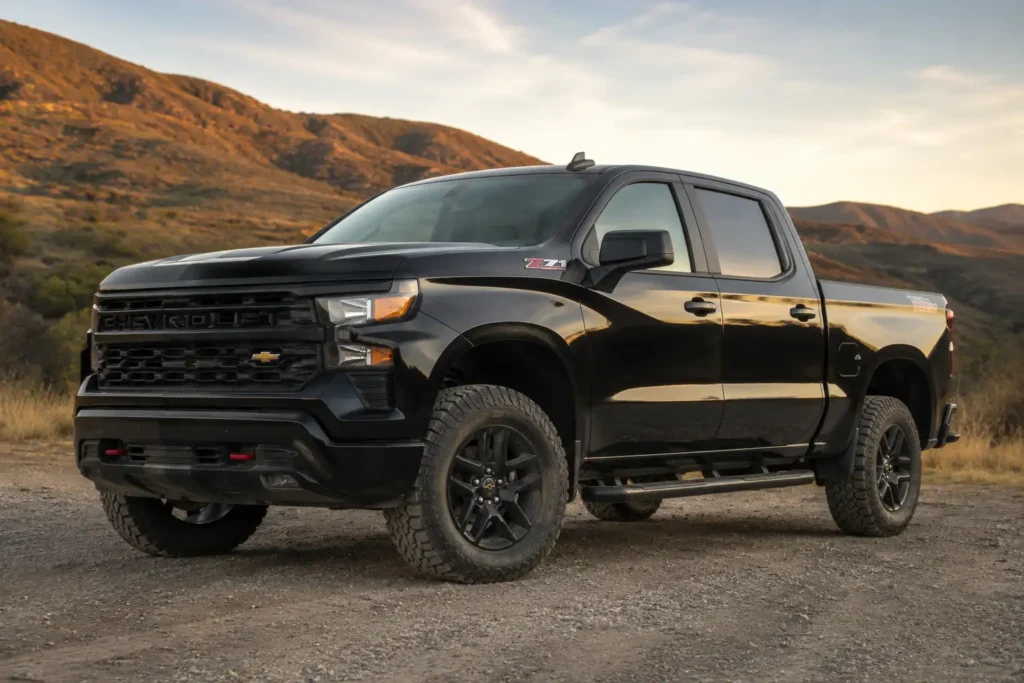
Guessing wrong affects more than looks. It changes load rating, speedometer accuracy, and TPMS sensor compatibility. This chart breaks down every Silverado 1500 generation from 1999 through 2026, plus the 2500HD and 3500HD, by trim and year.


Chevy Silverado Tire Size at a Glance
1999 to 2026, covering the 1500, 2500HD, and 3500HD
Chevy Silverado 1500 Tire Size by Generation
The Silverado 1500 has run through four distinct generations, and wheel diameter has grown with each one. The GMT800 generation covered 1999 through 2006. The GMT900 generation ran 2007 through 2013. The K2XX generation covered 2014 through 2018. The current T1XX generation started in 2019 and continues through the 2022 facelift into 2026.
Base trims in 1999 rolled on 16-inch wheels. Today’s base Work Truck starts at 17 inches, and top trims reach 22 inches. One constant runs through every modern generation: the 1500’s 6×139.7mm bolt pattern, also written as 6×5.5 inches, has held steady since 1999,
which is why older and newer 1500 wheels often bolt up across generations even when tire sizes differ. For a full breakdown of exactly which factory wheels swap between years, see our guide on what year Silverado wheels are interchangeable.
Here is the full breakdown by trim, starting with the current generation.
2019 to 2026 Silverado 1500 Tire Size by Trim
The T1XX generation offers the widest trim spread Chevy has ever built for the 1500, and tire size varies significantly between work-focused and street-focused trims.
| Trim | Factory Tire Size |
|---|---|
| WT (Work Truck) | 255/70R17 or 265/70R17 |
| Custom or LT | 265/65R18, optional 275/60R20 |
| LT Trail Boss | LT275/65R18 (2 inch factory lift) |
| RST | 265/65R18, 275/60R20, or 275/50R22 |
| RST Trail Boss | 275/60R20 |
| LTZ or High Country | 275/60R20 or 275/50R22 |
| ZR2 | 275/70R18 or 33×12.5R18 |
The Trail Boss trims stand apart from the rest of the lineup. LT Trail Boss trucks ship with LT-rated 275/65R18 tires and a genuine 2 inch front lift built into the suspension, not a cosmetic package. RST Trail Boss trucks run the larger 275/60R20 setup instead.
Before 2019, Chevy ran a different trim lineup and smaller factory wheels.
2014 to 2018 Silverado 1500 Tire Size by Trim
The K2XX generation was the first Silverado 1500 to offer a factory 22-inch wheel option, though 17 and 18-inch setups remained the volume sellers.
| Trim | Factory Tire Size |
|---|---|
| Base or LS | 255/70R17 or 265/70R17 |
| Z71 or off-road package | 265/65R18 |
| LTZ or High Country | 275/55R20 |
Trucks factory-equipped with the 22-inch wheel package moved up in overall tire diameter, but the 17 and 18-inch setups above cover the vast majority of K2XX trucks on the road today.
Go back further and wheel sizes shrink again.


1999 to 2013 Silverado 1500 Tire Size by Trim
The first two generations of the modern Silverado covered a full 15-year span and are the most overlooked years by tire size guides, despite a large population of these trucks still in daily use.
| Generation | Trim or Config | Factory Tire Size |
|---|---|---|
| 2007 to 2013 (GMT900) | LS or LT base | 265/70R17 |
| 2007 to 2013 (GMT900) | LT or LTZ 20 inch option | 275/55R20 |
| 2007 to 2013 (GMT900) | Z71 | 265/65R18 |
| 1999 to 2006 (GMT800) | 2WD base | 235/75R16 or 255/70R16 |
| 1999 to 2006 (GMT800) | 4WD base | 245/75R16 |
| 1999 to 2006 (GMT800) | Later years, 17 or 20 inch option | 265/70R17 or 275/55R20 |
GMT800 trucks are the last Silverados built with a 16-inch base wheel as standard. If you are chasing down the right tire size for an older Silverado, it helps to know which model years share the same reliable underlying components. Our breakdown of the best years for the Chevrolet Silverado 1500 covers that in more depth.
The 1500 covers daily-driver duty. The HD trucks are a different animal entirely.
Silverado 2500HD and 3500HD Tire Size by Year
The 2500HD and 3500HD get almost no coverage from tire size guides, despite being some of the most tire-size-sensitive trucks Chevy builds, especially once towing enters the picture.
| Model | Trim or Config | Factory Tire Size |
|---|---|---|
| 2500HD | WT or LT base | 245/75R17, up to 265/70R17 |
| 2500HD | LTZ or High Country | 275/70R18, 275/65R20, or 265/60R22 |
| 2500HD | ZR2 | 305/70R18 |
| 3500HD SRW | WT, LT, or LTZ | 275/70R18 |
| 3500HD DRW (dually) | All trims | 235/80R17 |
The HD trucks also carry a completely different bolt pattern from the 1500. Silverado HD trucks built through 2010 use an 8×165.1mm pattern, commonly written as 8×6.5 inches. Starting with the 2011 model year,
GM switched the 2500HD and 3500HD to an 8x180mm pattern. A 2010 HD wheel will not bolt onto a 2011 or newer HD truck without an adapter, and dually wheels are never interchangeable with single rear wheel setups regardless of year.
If you are shopping take-off wheels for an HD truck, confirm the exact bolt pattern for both the wheel and the year of your truck before buying, and double-check lug nut torque once the new wheels are on. Our Chevy Silverado 1500 lug nut torque specs guide covers the correct torque sequence and spec for the 1500, with the same general re-torquing principle applying across the lineup.
Getting the size right matters for more than fitment. It changes how your truck drives.
How Changing Silverado Tire Size Affects Speedometer and Gear Ratio
Tire diameter and axle gear ratio work as a single system. Larger tires cover more ground per revolution, which lowers effective gearing and drops engine RPM at a given speed. Smaller tires do the opposite, raising RPM for the same road speed.
As a rule of thumb, diameter changes within about 3 percent of stock rarely cause noticeable problems. Changes beyond roughly 5 to 7 percent start to meaningfully affect towing performance and throttle response, and often call for re-gearing to restore the truck’s original feel under load.


Speedometer accuracy moves in step with tire diameter. A truck running tires 3 percent taller than stock will show 60 mph on the dash while actually traveling closer to 62 mph. Left uncorrected, this throws off cruise control, fuel economy tracking, and odometer-based service intervals.
TPMS sensors and ABS wheel speed sensors are also calibrated to the stock tire diameter. A significant size change can trigger false low-pressure warnings or inconsistent traction control behavior even when the tires themselves are healthy.
If you are cross-shopping wheels with a GMC Sierra, here is what carries over and what does not.
Silverado 1500 vs GMC Sierra 1500 Tire and Wheel Compatibility
The Silverado 1500 and GMC Sierra 1500 share the same 6×139.7mm bolt pattern across every modern generation, which is why swapping wheels between the two trucks is common practice among GM truck owners.
Shared bolt pattern does not guarantee an identical tire size. Sierra trim packages do not always map one-to-one onto Silverado trims, and factory offset or TPMS sensor frequency can still differ between a specific Sierra package and its closest Silverado equivalent.
The HD trucks follow the same sharing pattern. Silverado 2500HD and 3500HD use the same 8×165.1mm pattern through 2010 and the same 8x180mm pattern from 2011 forward as their Sierra HD counterparts, but always confirm your exact model year before assuming a direct swap.
Whatever generation or trim you are working with, confirm your exact factory size before you buy.
How to Find Your Exact Factory Silverado Tire Size
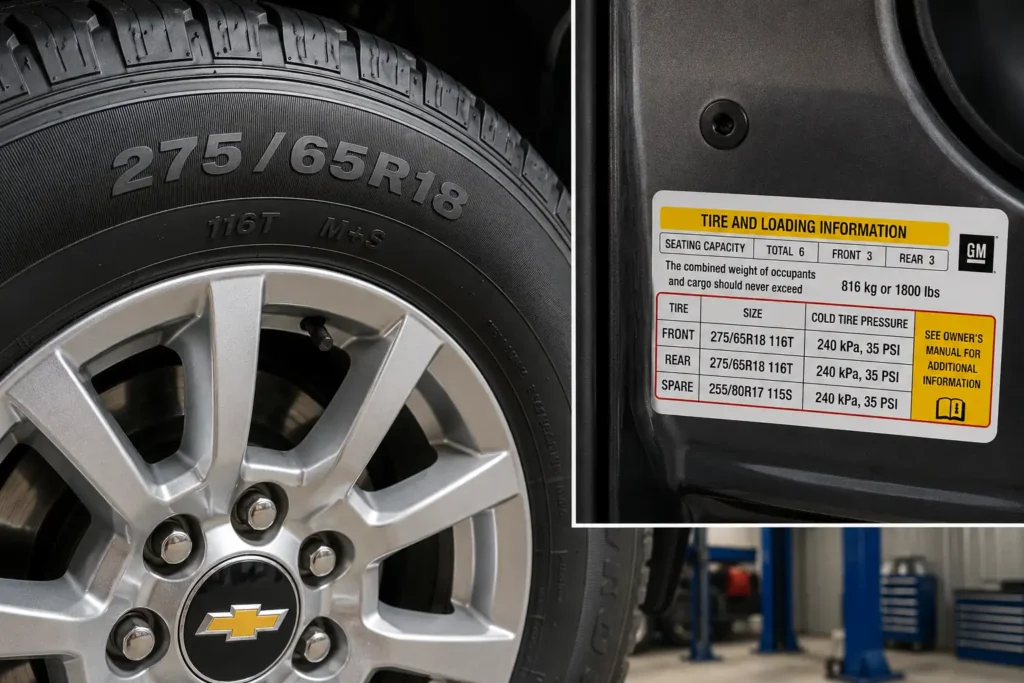
The chart above narrows things down, but your truck’s door jamb placard is the final word on the correct factory size.
- Open the driver’s door and look at the sticker on the door jamb itself, not the door frame on the body.
- Find the line labeled “Tire” for both front and rear positions. Most Silverados use the same size front and rear, but always check both.
- If the placard is faded or missing, check the tire size listed in your owner’s manual under the specifications section.
- Note the recommended cold tire pressure on the same placard. Silverado 1500 trucks typically call for 32 to 36 PSI, while 2500HD and 3500HD trucks run closer to 34 to 35 PSI unladen, rising significantly higher when loaded or towing.
Never use the tire sidewall’s maximum pressure rating as your daily driving pressure. That number is the tire’s ceiling, not Chevy’s recommended setting.
Frequently Asked Questions
What tire size is stock on a 2024 Chevy Silverado 1500?
It depends on trim. A 2024 WT runs 255/70R17 or 265/70R17, while LT and RST trims typically use 265/65R18 or the optional 275/60R20, and LTZ or High Country trims commonly run 275/60R20 or 275/50R22.
Do all Silverado 1500 trims use the same bolt pattern?
Yes. Every Silverado 1500 from 1999 through 2026 uses the 6×139.7mm bolt pattern, regardless of trim or wheel diameter.


Can I put 20-inch wheels on a Work Truck trim Silverado?
Bolt pattern compatibility means the wheels will physically mount, but tire sizing, speedometer calibration, and ride height all change with a wheel diameter jump. Confirm the correct matching tire size before making the switch.
Does the Silverado 2500HD use the same tires as the 1500?
No. The 2500HD runs a different factory size range starting at 245/75R17 and uses an entirely different 8-lug bolt pattern, which is not interchangeable with the 1500’s 6-lug wheels.
Will changing my tire size throw off my speedometer?
Yes, once the diameter change is significant enough. A tire roughly 3 percent taller than stock can push your indicated speed several miles per hour below your actual road speed.
Year, trim, and weight class all determine the correct Chevy Silverado tire size, and there are no shortcuts around checking your specific truck. The door jamb placard is always the final word over any chart,
including this one. Once you have confirmed your exact size, check your lug nut torque spec before driving on any new wheel and tire setup, especially if you are moving up in wheel diameter on an HD truck. Once you know your size, see our best tires for Chevy Silverado 1500 4×4 guide.