Ford Ranger Tire Size Specification Chart By Year (1998–2026)

Quick Answer
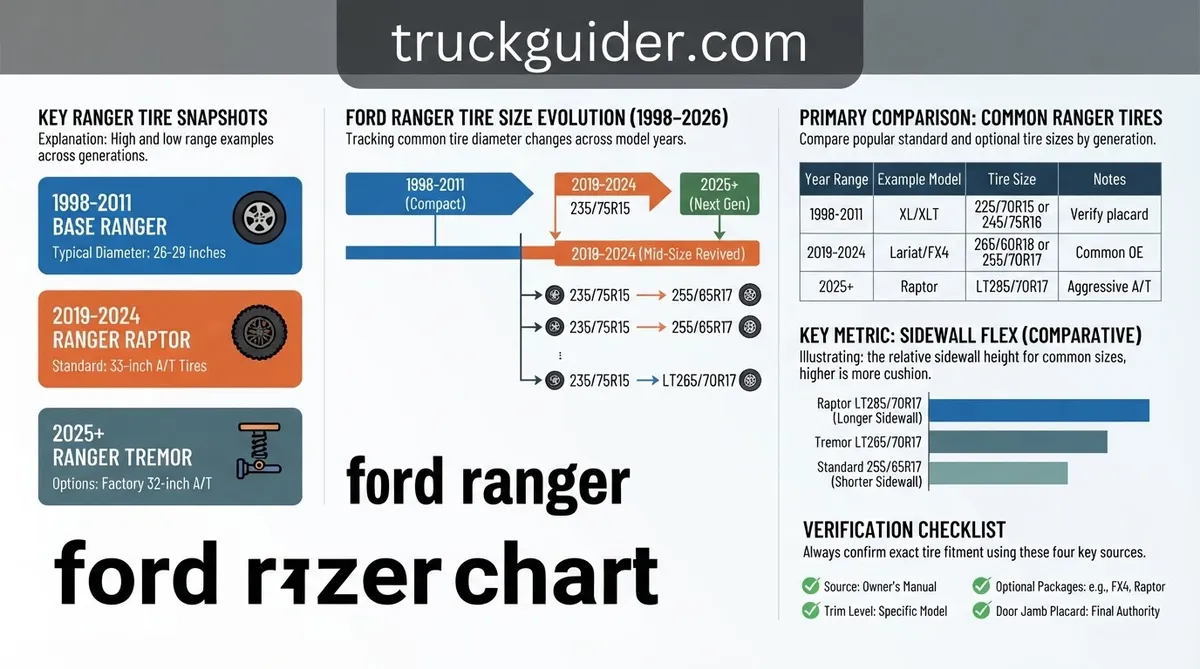
Factory Ford Ranger tire sizes generally range from 225/70R15 on legacy models to 265/70R17 or 285/70R17 on modern, off-road-focused trims like the Raptor. While specific dimensions vary by year, engine option, and configuration (4×2 vs. 4×4), the authoritative source for your specific vehicle is the Tire and Loading Information placard located on the driver-side door jamb.
Upgrading your Ford Ranger’s stance or off-road capability starts with one critical data point: your tire size. Choosing the wrong size can lead to frustrating tire rub, inaccurate speedometer readings, and potential transmission or suspension strain. This guide provides the official factory specifications and the technical knowledge needed to safely select and fit the perfect tire for your specific Ranger model year.


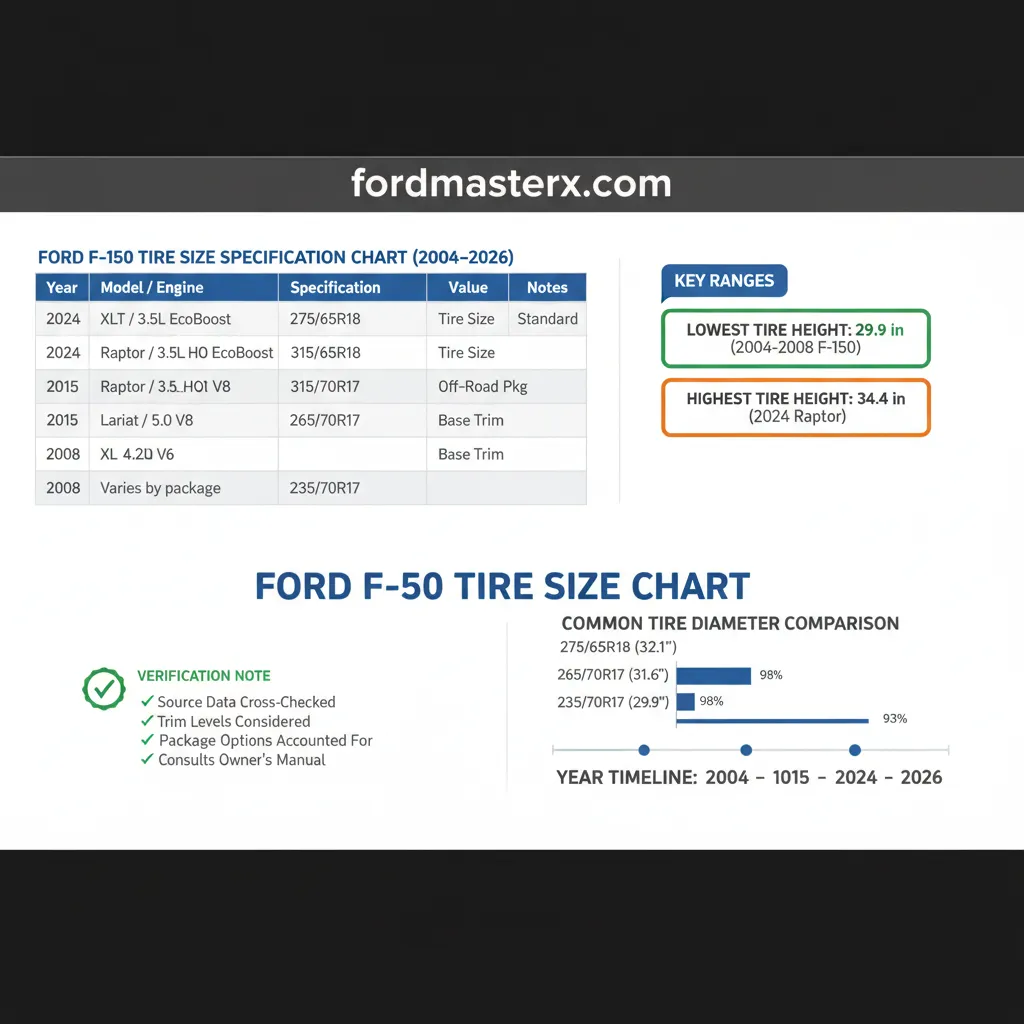
Ford Ranger Tire Size Specification Chart By Year (1998–2026)
📤 Share Image
This chart covers the most common factory-installed tire sizes. Always verify your specific vehicle’s requirements by checking the tire information placard located on the driver-side door jamb. Last reviewed: August 2026.
| Model Years | Engine / Trim | Specification | Notes |
|---|---|---|---|
| 1998–2011 | Standard/XLT | 225/70R15 | Base 15″ steel wheels |
| 2002–2011 | FX4 / Off-Road | 245/75R16 | Common 31″ equivalent |
| 2019–2023 | XLT / Lariat | 265/60R18 | Standard 30.5″ diameter |
| 2024–2026 | Raptor | LT285/70R17 | Factory 33″ tires |

Understanding Factory Tire Size Variations
The Ford Ranger has evolved from the compact platform of the late 90s to the modern mid-size powerhouse. Historically, earlier models utilized standard P-metric sizing, while modern trims like the Raptor rely on “LT” (Light Truck) flotation sizes designed for high-impact durability. Tire diameter is the most critical metric here; moving from a 30-inch factory tire to a 33-inch tire on non-Raptor trims often forces interference with suspension components.
What Affects Ford Ranger Tire Fitment and Clearance
Upgrading tire size is rarely just about fitting a larger rubber compound into the wheel well. Several mechanical factors dictate whether your new setup will remain silent or create aggressive rubbing during full-lock turns.
The Role of Wheel Offset and Backspace
Wheel offset determines how far the wheel sits from the hub mounting surface. A low or negative offset pushes the tire outward, which can clear the frame rails but potentially cause the tire to hit the front fender liner or crash bars at full lock. Conversely, high positive offset pulls the tire inward, risking contact with the upper control arm or steering knuckle.


Identifying Potential Rubbing Points
On 2019+ Ford Rangers, the “crash bars”—steel supports located at the front and rear of the wheel well—are the primary points of interference. While a suspension lift increases the distance between the axle and the body, it does not move these crash bars. If you are running 285mm wide tires, you will likely encounter rubbing at the crash bar regardless of your lift height.
How to Calculate and Install Larger Tires
📋
Installation Checklist
Assess your current tire diameter and measure clearance between the tire sidewall and the closest suspension component at full lock.
Use an OBDII-based calibration tool (like Forscan) to update the tire size in your vehicle’s ECU to ensure the speedometer and odometer remain accurate.
Why Load Indexing is Non-Negotiable
Never install a tire with a lower load index than the factory specification. The Ford Ranger is engineered for specific payload capacities; fitting a tire that cannot support the vehicle’s GVWR (Gross Vehicle Weight Rating) creates a significant safety risk, especially when towing or hauling gear.
Common Ford Ranger Tire Size Pitfalls to Avoid
- Ignoring Load Index: A tire that “looks good” may be a “Passenger” (P) rated tire that lacks the sidewall stiffness for a truck, leading to excessive sway.
- Weight-Induced Stress: Adding 20+ lbs of unsprung weight per corner via heavy mud-terrain tires significantly increases strain on wheel bearings, ball joints, and transmission cooling systems.
- The “Lift Equals Clearance” Fallacy: While a lift kit helps, it often moves the control arm geometry into a position that makes rubbing more likely during articulation. Always verify full-lock clearance before finalizing your purchase.
Every Ford Ranger trim has subtle differences in clearance. A 32-inch tire that fits perfectly on a Raptor may rub heavily on a standard XL trim due to suspension travel differences and crash bar positioning.


In summary, your tire selection should always prioritize the safety data found on your driver-side door jamb. When upgrading, focus on wheel offset to manage clearance, and always recalibrate your electronics for the new tire diameter. Before committing to a set of tires, consult your local tire professional to perform a mock-fitment, especially if you are pushing the limits of your Ranger’s wheel well.
Ford Ranger Tire Size Chart: Frequently Asked Questions
What is the largest tire size I can fit without a lift?
Generally, for the 2019-2026 Ranger, most owners find that a 265/70R17 or a 275/65R17 is the maximum size that fits without suspension modifications or rubbing. However, exact clearance depends on wheel offset and tire tread pattern. Always perform a full-lock turn check to ensure the inner fender liners and crash bars are not impacted.
Will bigger tires affect my speedometer?
Yes. If you install tires with a larger outer diameter than the factory specification, your tires will cover more distance per rotation, causing your speedometer to read slower than your actual vehicle speed. This discrepancy can be corrected by using an OBD-II programming tool to recalibrate the vehicle’s computer to the new tire circumference.
Do larger tires decrease fuel economy?
Yes, installing larger and heavier tires increases both rolling resistance and unsprung weight. Additionally, the increased aerodynamic drag and mechanical resistance from the larger diameter typically result in a measurable drop in MPG. You may also notice a slight reduction in acceleration as the effective final drive ratio is lowered.
Does tire size affect towing capacity?
While the tire size itself does not change the physical towing limit established by Ford, using an incorrect tire type or a lower load index rating can compromise vehicle stability while towing. Always ensure your chosen tires meet the load index (e.g., SL, XL, or Load Range C/D) specified in your owner’s manual for heavy-duty applications.


How do I find my specific Ford Ranger tire size?
The most accurate source for your specific vehicle is the Tire and Loading Information placard located on the inside of the driver’s side door jamb. This sticker lists the factory-recommended tire size, cold inflation pressure, and load requirements specific to your vehicle’s build configuration, including trim level and original equipment wheels.