Ford F-150 Wheel Offset Chart: 1997-2026 All Years and Trims

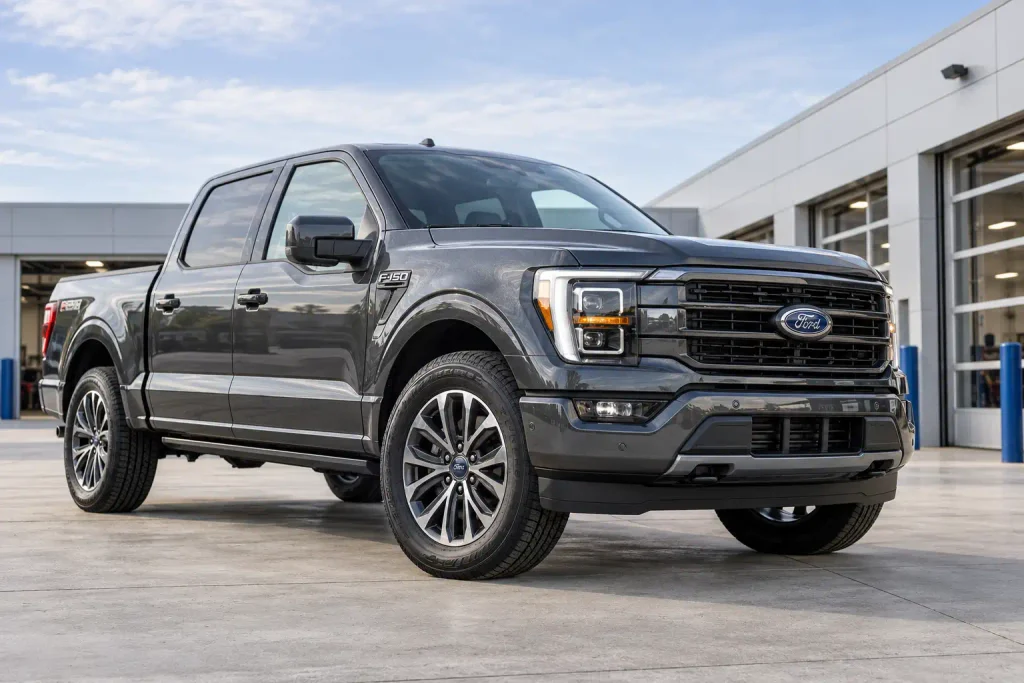
The Ford F150 wheel offset chart starts with two common factory references: approximately +14 mm for standard 1997–2003 five-lug wheels and +44 mm for many 2004–2026 six-lug F-150 wheels. Those numbers are useful starting points, not universal specifications for every trim and wheel package.
A Raptor, an older seven-lug Heavy Duty Payload truck, or a particular 18-inch OEM wheel can use a different setup. Use the year-by-year reference below to identify your likely starting point, then confirm the specifications of the wheel actually fitted to your truck before ordering replacements.


TRUCKGUIDER • WHEEL FITMENT REFERENCE
Ford F-150 Wheel Offset Chart
Common factory-wheel references from 1997–2026, with special-configuration exceptions. Check your actual OEM wheel before ordering replacements.
Offset by Year and Configuration
Selected examples, not a complete factory option list
| Model years | Wheel / configuration | Offset | Bolt pattern |
|---|---|---|---|
| 1997–2003 | Standard • 16×7 | +14 mm | 5×135 |
| 2004 | Heritage standard EXCEPTION | Verify OE | 5×135 |
| 2004–2008 | Redesigned standard • 17×7.5 | +44 mm | 6×135 |
| 2004–2008 | Heavy Duty Payload • 17×7.5 7-LUG | +44 mm* | 7×150 |
| 2009–2014 | Standard • 17×7.5 | +44 mm | 6×135 |
| 2010–2014 | SVT Raptor • 17×8.5 | +34 mm | 6×135 |
| 2015–2020 | Many standard 17-inch wheels | +44 mm* | 6×135 |
| 2017–2020 | Raptor • 17×8.5 | +34 mm | 6×135 |
| 2021–2025 | Selected Tremor OE • 18×7.5 ML3Z-1007-T | +34 mm | 6×135 |
| 2021–2026 | Many standard wheel packages | +44 mm* | 6×135 |
| 2021–2026 | Regular Raptor • 17×8.5 reference | +34 mm* | 6×135 |
| 2023–2026 | Raptor R wheel kit • 17×8.5 EXCEPTION | +30 mm | 6×135 |
* Reference only: Offset may change with rim width, equipment package, or specific wheel part number. The +44 mm modern reference is supported by a 2015–2026-compatible Ford Performance 20×8.5 wheel, but that accessory is not proof of every factory-installed rim.
2004 warning: Heritage (earlier body), redesigned six-lug F-150, and seven-lug heavy-payload versions cannot be grouped under one wheel specification.
The hub-mounting face sits 44 mm toward the wheel’s outer face from its centerline. With equal wheel width, a lower offset shifts the rim outward.
Match the exact wheel part number, rim width, bolt circle, load rating, brake clearance and tire size. This reference does not guarantee fitment.
Ford F150 Wheel Offset Chart for 1997 to 2026
Wheel offset is the distance, in millimeters, between a wheel’s mounting surface and its centerline. The common historical factory sizes and offsets below are documented in the AmericanTrucks F-150 wheel fitment reference. The entries identify representative configurations, not every wheel Ford offered during those years.
| F-150 model years | Wheel or configuration | Reference offset | Bolt pattern |
|---|---|---|---|
| 1997–2003 | Standard 16×7 or 17×7.5 factory wheel | +14 mm | 5×135 mm |
| 2004 Heritage | Earlier-body-style, standard five-lug wheel | Wheel-specific; use original marking or part number | 5×135 mm |
| 2004–2008 | Redesigned standard F-150, 17×7.5 | +44 mm | 6×135 mm |
| 2004–2008 | Heavy Duty Payload seven-lug, 17×7.5 reference | +44 mm reference; confirm OE wheel | 7×150 mm |
| 2009–2014 | Standard F-150, 17×7.5 | +44 mm | 6×135 mm |
| 2010–2014 | SVT Raptor, 17×8.5 | +34 mm | 6×135 mm |
| 2015–2020 | Many standard 17-inch and 20-inch wheel configurations | Commonly +44 mm | 6×135 mm |
| 2017–2020 | Raptor, 17×8.5 | +34 mm | 6×135 mm |
| 2021–2023 | Many standard F-150 factory wheel configurations | Commonly +44 mm; check wheel package | 6×135 mm |
| 2021–2025 | Selected 18×7.5 OEM wheel, part ML3Z-1007-T | +34 mm | 6×135 mm |
| 2021–2026 | Raptor, regular 17×8.5 reference | +34 mm; verify wheel package | 6×135 mm |
| 2024–2026 | Many standard F-150 wheel configurations | Commonly +44 mm; check wheel package | 6×135 mm |
How to read the chart: 17×7.5 means a 17-inch rim diameter and 7.5-inch nominal width. +44 mm means the mounting face is 44 mm toward the wheel’s outside face from its centerline. A 6×135 mm bolt pattern means six lug holes on a 135 mm bolt circle.
The modern +44 mm baseline also has direct manufacturer support: Ford lists a 20×8.5-inch, +44 mm, 6×135 mm Ford Performance wheel, part M-1007-P2085AA, for 2015–2026 F-150 applications. That Ford wheel specification confirms the fitment of that particular wheel, not that every factory-installed wheel in those model years shares its offset. It is not validated for the F-150 Lightning.
Important: The chart is a common-configuration lookup, not a VIN-level factory build record. Appearance packages, special editions, heavy-payload equipment and replacement wheels can differ. If your original rim has a different width or part number, use the specification for that actual rim rather than the year-range average.
Which Ford F150 Models Have Different Wheel Offsets
Three groups deserve extra attention: 2004 Heritage trucks, seven-lug heavy-payload trucks and performance-oriented F-150s. Wheel-lug count and package-specific hardware can matter as much as offset.
2004 F150 Heritage Wheel Fitment
Ford sold the 2004 F-150 Heritage alongside the redesigned 2004 F-150. The Heritage carried over the earlier body and standard five-lug wheel pattern, while the redesigned standard truck used six lugs. Some Heritage heavy-payload configurations had seven-lug wheels.


Do not purchase a wheel advertised simply for a “2004 F-150” without identifying the body style and counting the wheel studs. A five-lug Heritage wheel cannot mount directly to a six-lug redesigned F-150 hub.
Seven Lug Heavy Duty Wheels
Certain older Heavy Duty Payload configurations use the uncommon 7×150 mm bolt pattern. This is different from both the 5×135 mm early standard F-150 pattern and the 6×135 mm pattern of later standard trucks.
A listed +44 mm offset does not make a six-lug wheel compatible with a seven-lug hub. For these trucks, verify the original wheel’s part number, bolt circle, offset and load rating as one set of requirements.
Raptor and Tremor Factory Wheels
The Raptor is a notable exception to the usual +44 mm reference. A Raptor fitment chart from Late Model Restoration lists 17×8.5-inch, +34 mm wheels for the 2010–2014, 2017–2020 and regular 2021-onward Raptor configurations. It lists +30 mm for a distinct later Raptor 37-package wheel, so owners should check the exact wheel rather than applying +34 mm to every package.
Another real factory-wheel exception is 18×7.5-inch, +34 mm, identified with OEM part number ML3Z-1007-T and associated with certain 2021–2025 applications, including a Tremor wheel listing. Its OEM replacement-wheel specification gives a useful part-number-level check. It does not prove that every Tremor or every 18-inch F-150 wheel has +34 mm offset.
How Positive and Negative F150 Wheel Offset Works
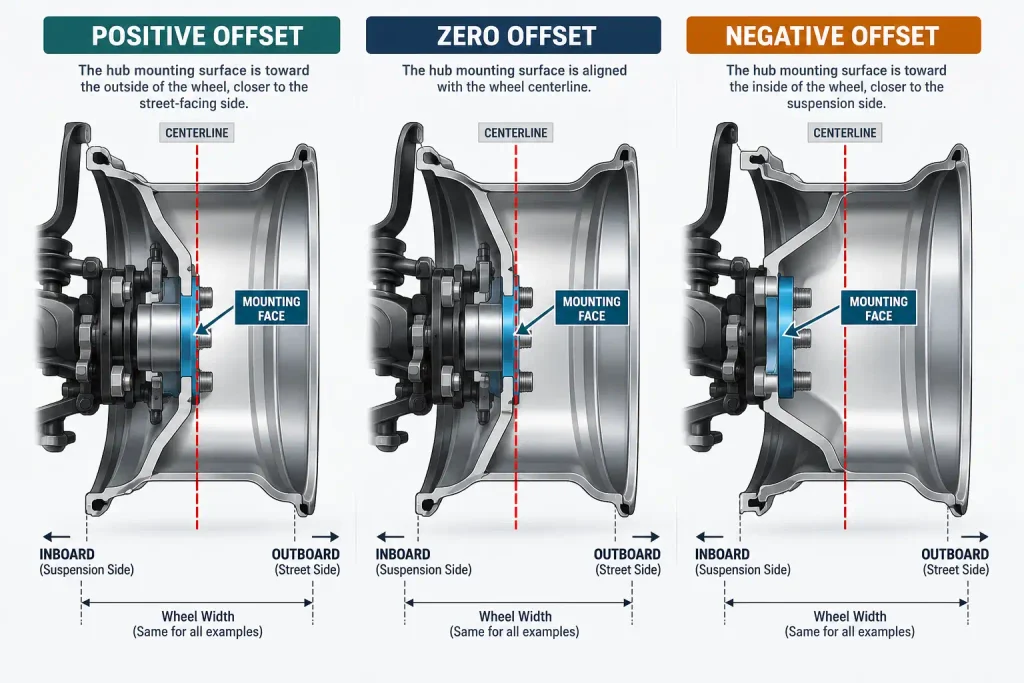
Wheel offset describes the position of the mounting surface relative to the wheel centerline. It does not directly describe tire diameter, total track width or whether a wheel will clear the brakes.
Positive Offset Wheels
A positive-offset wheel places its hub mounting surface outboard of the wheel centerline. With wheel width unchanged, moving from +44 mm to +20 mm pushes the rim 24 mm farther outward and creates 24 mm more inner rim clearance. The tire’s shape and actual clearance still need checking.
Zero Offset Wheels
At 0 mm offset, the hub mounting surface meets the wheel’s centerline. Compared with the same-width +44 mm wheel, the rim sits 44 mm farther outward. That can change fender coverage and the path of the tire during steering.
Negative Offset Wheels
At -12 mm offset, the mounting surface lies inboard of the wheel centerline. For equal-width wheels, changing from +44 mm to -12 mm moves the rim 56 mm outward. A negative-offset rim is not automatically unsafe, but its fitment must be assessed with the chosen tire and suspension.
For the planned illustration, mark the rim centerline, hub mounting surface and positive, zero and negative offsets. These labels explain the measurement more clearly than an exterior truck photo alone.
How to Calculate F150 Wheel Offset and Backspacing
Backspacing is the distance from the wheel’s mounting surface to the inner rim edge. Offset is measured relative to the wheel centerline instead. Because they use different reference points, the numbers cannot be substituted for each other.
An approximate conversion using nominal wheel width is:
Backspacing in inches ≈ (nominal wheel width in inches + 1) ÷ 2 + (offset in mm ÷ 25.4)



The extra inch allows approximately half an inch for each rim flange. Manufacturers may use different actual flange dimensions, so this calculated value is an estimate, not a substitute for a measured backspacing figure.
For a 20×8.5-inch wheel with +44 mm offset, the calculation is (8.5 + 1) ÷ 2 + 44 ÷ 25.4, or approximately 6.48 inches of backspacing. The same nominal-width wheel at +20 mm is about 5.54 inches. Lower offset reduces backspacing when width stays constant.
If you’re comparing two wheels with different widths, calculate both inner and outer positions. A change in width alters the result even when offset stays the same.
How Different F150 Wheel Offsets Change Wheel Position
Consider a 20×8.5-inch +44 mm reference wheel and three hypothetical 20×9-inch alternatives. These figures are calculated rim-position changes relative to the reference, not approved fitments for a particular F-150.
| Wheel specification | Approx. backspacing | Outer rim moves | Inner rim clearance changes |
|---|---|---|---|
| 20×8.5, +44 mm reference | 6.48 in | 0 mm | 0 mm |
| 20×9, +20 mm | 5.79 in | 30.4 mm outward | Gains 17.7 mm |
| 20×9, 0 mm | 5.00 in | 50.4 mm outward | Gains 37.7 mm |
| 20×9, -12 mm | 4.53 in | 62.4 mm outward | Gains 49.7 mm |
The half-inch width increase adds 6.35 mm on each side before the offset change is considered. For example, changing from +44 mm to +20 mm reduces the offset by 24 mm; adding the 6.35 mm width effect moves the outer rim 30.35 mm farther outward.
These are rim-edge geometry calculations, not tire-sidewall or tread-position guarantees. Two tires on identical wheels may have different section widths and shoulder shapes. Brake-caliper shape, steering angle and suspension movement can also determine fitment.
When F150 Wheel Offset Causes Tire Rubbing
A wheel can have the correct 6×135 mm bolt pattern yet still put the tire into a fender liner, bumper edge, crash bar or suspension component. A lower offset moves a same-width tire outward, while higher offset generally reduces inner clearance.
Tire dimensions matter just as much. An aggressive offset combined with a wide tire can create contact at full steering lock even when the truck looks clear while parked. Use the related Ford F150 tire size chart to compare tire diameters before assessing the offset change.
Check these conditions before driving on a new setup:
- Steering clearance: Inspect both front wheels at full left and right lock.
- Inner clearance: Check the control arms, tie rods, brake hardware and suspension components.
- Outer clearance: Look for contact at the fender liner, bumper corners and nearby bodywork.
- Suspension movement: Confirm that compression does not introduce interference.
- Load and hardware: Match wheel load ratings, proper lug seats and hub fit to the truck.
A leveling kit can change available body clearance, but it does not guarantee that a particular wheel and tire combination will fit throughout steering and suspension travel. Any rubbing, unexpected vibration or contact requires correction before regular road use.
How to Verify Your F150 Factory Wheel Offset
The most reliable approach is to identify the exact wheel part, rather than relying only on a model-year chart. You can do this even if your truck has already received aftermarket wheels, provided you can find the original wheel specification from its equipment or parts records.
- Identify your configuration. Record the year, trim, 2WD or 4WD setup, special package and original wheel diameter. Pay particular attention to 2004 Heritage, heavy-payload and Raptor models.
- Count the lugs and inspect the wheel. Confirm whether your truck uses five, six or seven lugs. Look on the back of the wheel for an ET marking, size marking, manufacturer identification or Ford part number.
- Match the original part number. Look up that exact wheel in Ford parts information or a reputable OEM-wheel catalog. Verify its width, diameter, offset, bolt pattern and load capacity.
- Check the mounting hardware. Confirm the center bore, nut-seat type, thread specification and required mounting hardware. Matching the bolt circle alone does not establish compatibility.
- Perform a physical clearance check. Confirm caliper clearance, steering clearance and suspension clearance with the intended tire. A qualified tire or wheel shop should check uncertain fitments before installation.
The driver’s door tire-information label is useful for checking original tire size and recommended inflation pressure. It is not a dependable source of the rim’s offset. For newer front-end layouts, the 2026 Ford F150 front suspension diagram identifies the major nearby components that must remain clear of the wheel and tire.
Which Ford F150 Wheel Offset Should You Choose
For an original-equipment-style replacement, start with the offset and width of your specific factory wheel, not the average for a model generation. The common +14 mm and +44 mm reference points help narrow the search, but Heritage, heavy-payload, Raptor and selected newer factory wheels need their own checks.


For aftermarket rims, compare the new wheel’s width and offset against that verified starting point. Then confirm brake clearance, steering clearance, tire dimensions, load rating, hub fit and correct fasteners. A wheel that moves outward by 30 mm is not necessarily a wheel that fits correctly.
The Ford F150 wheel offset chart is most useful as a starting reference. Verify the actual OEM wheel or approved replacement specification before purchasing.
Ford F150 Wheel Offset Chart Frequently Asked Questions
What Is the Stock Wheel Offset on a Ford F150?
Many standard 1997–2003 five-lug wheels use approximately +14 mm, while +44 mm is a common reference for later standard six-lug configurations. The correct value depends on the model year, wheel size and equipment package. Confirm your original wheel’s stamped marking or OEM part number.
Does Every F150 Use a +44 mm Wheel Offset?
No. Earlier five-lug trucks commonly have lower positive offsets, and Raptor or certain other OEM wheel packages can differ from +44 mm. Even within one model year, wheel options may carry different specifications.
What Is the Factory Ford F150 Raptor Wheel Offset?
A common 17×8.5-inch Raptor wheel reference is +34 mm across several generations. Certain Raptor 37-package wheels are listed differently, so match the year, wheel style and part number before ordering replacements.
Can I Put Zero Offset Wheels on My F150?
Possibly, but 0 mm offset alone does not establish fitment. Wheel width, tire size, brake clearance, suspension configuration and the truck’s original wheel all affect the result. Calculate how far the new assembly moves, then have its physical clearances checked.
Is Wheel Offset the Same as Backspacing?
No. Offset measures the mounting face relative to the wheel centerline, usually in millimeters. Backspacing measures from the mounting face to the inner wheel edge, usually in inches. Both measurements help describe wheel position, but they are not interchangeable.