Ford F250 Years to Avoid and Best Used Trucks to Buying Guide 2026

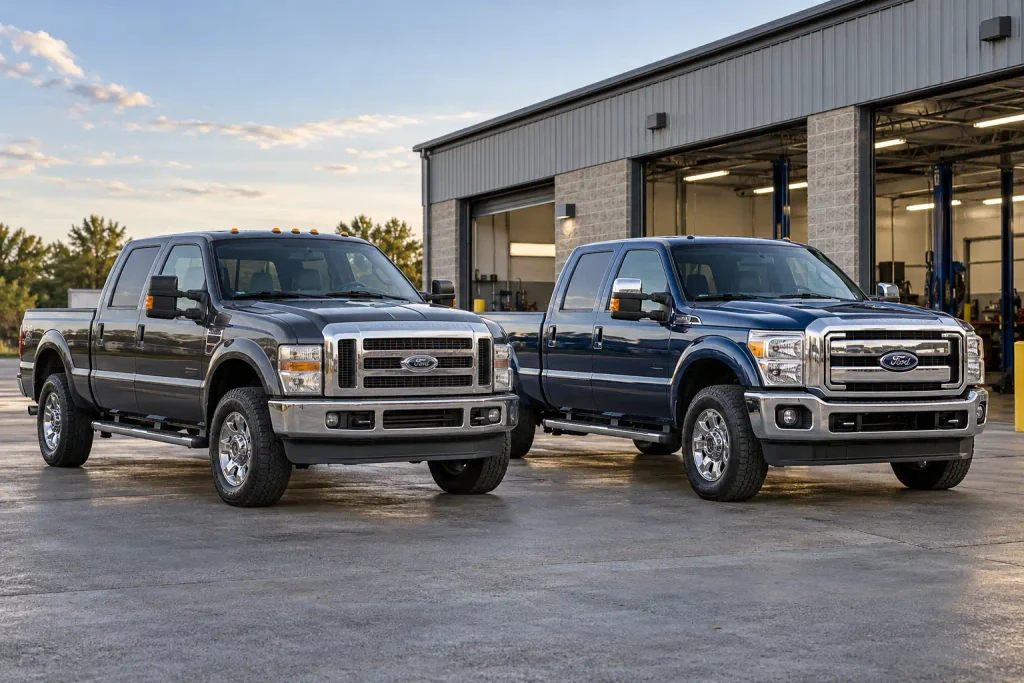
The Ford F250 years to avoid depend on the engine, not just the model-year badge. For diesel buyers, 2003–2007 trucks equipped with the 6.0L Power Stroke V8 and 2008–2010 trucks with the 6.4L Power Stroke V8 demand the most caution.
Gas-powered trucks from those same years do not automatically share the diesel engines’ problems. Later F-250s also have configuration-specific steering and fuel-pump concerns. The buying checks below separate those risks.


Ford F-250 Years to Avoid & Consider
Compare the actual engine and drivetrain first. A model year alone does not determine whether a truck is a good buy.
| Model years | Engine / configuration | What to verify | Buying decision |
|---|---|---|---|
| 1999–early 2003 | 7.3L Power Stroke V8 diesel | Age, rust, transmission and cold-start condition | Consider with inspection |
| 2003–2007 | 6.0L Power Stroke V8 diesel | EGR and oil cooling, injectors, head-gasket repairs | High caution |
| 2008–2010 | 6.4L Power Stroke V8 diesel | Fuel system, cooling, DPF and engine condition | Avoid by default* |
| 2011–2014 | Early 6.7L Power Stroke V8 diesel | Turbo, cooling and service history | Inspect carefully |
| 2015–2016 | Revised 6.7L Power Stroke V8 diesel | Maintenance, fuel-system health, modifications | Shortlist if maintained |
| 2017–2019 | Certain F-250 4WD trucks | Steering oscillation and repair history | Conditional |
| 2020–2022 | Certain 6.7L Power Stroke diesels | VIN-specific 24S78 / possible 26S17 recalls | Verify remedies |
| 2023–2026 | Gas and diesel models | Recalls, records and limited long-term history | Evaluate individually |
Before you buy: 3 required checks
*For buyers who prioritize lower mechanical risk. These are editorial screening categories, not measured failure rates. The 2003 diesel engine crossover matters; gas versions are not automatically subject to diesel-specific concerns. Always verify recalls by VIN.
Ford F250 Years to Avoid by Engine and Year
| Model years | Engine or configuration | Primary buying concern | Initial verdict |
|---|---|---|---|
| 1999–early 2003 | 7.3L Power Stroke V8 diesel | Age, oil-system faults, transmission and rust | Consider with inspection |
| 2003–2007 | 6.0L Power Stroke V8 diesel | EGR and oil cooling, injectors, head gaskets | High caution |
| 2008–2010 | 6.4L Power Stroke V8 diesel | Fuel, cooling and emissions-related failures | Avoid by default if risk-averse |
| 2011–2014 | Early 6.7L Power Stroke V8 diesel | Early turbo and emissions-system concerns | Inspect carefully |
| 2015–2016 | Revised 6.7L Power Stroke V8 diesel | Condition and service history | Used-diesel shortlist |
| 2017–2019 | Certain F-250 4WD trucks | Steering oscillation after road impacts | Inspect steering history |
| 2020–2022 | Certain 6.7L Power Stroke diesels | High-pressure fuel-pump recall | Check VIN and remedies |
| 2023–2026 | Gas and diesel models | Limited long-term service history | Evaluate individually |
These are buyer-risk categories, not calculated failure rates. The 2003–2007 and 2008–2010 cautions apply primarily to their specified diesel engines.
What Determines Reliability in a Used Ford F250
Before comparing listings, narrow the decision using four variables.
Confirm the Actual Engine
A 2003 truck might have the outgoing 7.3L Power Stroke V8 or the newer 6.0L Power Stroke V8.
Match the Truck to the Work
A contractor towing regularly faces different operating costs than someone hauling supplies occasionally. Diesel torque may justify added maintenance complexity for demanding use.
Demand Proof of Maintenance
An invoice for coolant-system repairs, turbo replacement or fuel-system work carries more weight than a seller’s claim that a truck was “fully bulletproofed.” Undocumented modifications are not proof of reliability.
Check Drivetrain and Recall Status
Some steering concerns specifically affect four-wheel-drive trucks. Verify the VIN and ask whether the dealer has documented any required remedy.
When to Avoid a 2003 to 2007 F250 Diesel
The 6.0L Power Stroke V8 is the chief reason 2003–2007 diesels appear on used-truck caution lists.
Why the 2003 Engine Matters
Ford transitioned from the 7.3L to the 6.0L Power Stroke during the 2003 model year.
For a closer engine identification and specification comparison, use the 2003 7.3L Power Stroke specifications.
Which 6.0L Problems Need Documentation
The 6.0L’s trouble areas include the exhaust gas recirculation (EGR) cooler, engine-oil cooler, fuel injection control electronics, high-pressure oil leaks and sticking variable-geometry turbo components. Cooling problems and increased cylinder pressure can also accompany head-gasket failures.
If the truck overheats, pushes coolant out, starts poorly when hot or shows unexplained coolant loss, pause the purchase. A specialist should check cooling-system integrity, engine operating data and available service records.
The financial exposure is real. RepairPal’s F-250 Super Duty head-gasket estimates list $3,433–$4,380 for the 2006 model year. That is a year-specific estimate, not a guaranteed 6.0L diesel quote or a complete engine-repair budget.
Buying verdict: Consider a 6.0L truck only when its condition, diagnostic results and documented repairs support the price. Skip examples with unexplained cooling faults or vague claims about expensive work.
Why 2008 to 2010 F250 Diesels Are High Risk
The 2008–2010 F-250 introduced the 6.4L Power Stroke V8 diesel.


Watch for Fuel and Cooling Faults
Problems reported in technical coverage include fuel-system contamination, radiator leaks and other cooling concerns. Fuel-system damage can involve multiple components, while major engine work may require substantial labor.
Ask whether the fuel system has been repaired, whether the cooling system holds pressure and whether unexplained coolant or oil loss has occurred.
Inspect the Diesel Emissions System
The diesel particulate filter (DPF) collects soot and uses regeneration to manage accumulated material. On the 6.4L, regeneration-related operation can contribute to oil dilution in some circumstances. Repeated DPF faults, unexplained rises in oil level or incomplete emissions repairs deserve attention.
A Ford-capable scan tool should check relevant faults and live data. Technicians must distinguish DPF pressure sensors from exhaust-temperature sensors before replacing parts.
A detailed MotorTrend analysis of 6.4L Power Stroke problems documents several of this engine’s recurring mechanical concerns.
Buying verdict: A risk-averse buyer should usually pass on a 2008–2010 6.4L diesel. Consider an exception only with substantial repair evidence, a favorable price and a satisfactory independent inspection.
Which 2011 to 2016 Ford F250 Models Are Better
Ford replaced the 6.4L diesel with its own 6.7L Power Stroke V8 for 2011.
Inspect the 2011 to 2014 Diesels Carefully
Earlier 6.7L trucks warrant attention to turbocharger operation, EGR cooling, fuel-system condition and service history. Confirm whether the turbocharger has been replaced and what diagnostic findings led to the work.
Request a cold start, a fluid inspection and a Ford-capable diagnostic scan.
Shortlist Maintained 2015 to 2016 Diesels
For 2015, Ford revised important 6.7L Power Stroke hardware, including its turbocharger configuration.
Our 6.7L Power Stroke problems by generation guide covers the engine-specific details that differ across production eras.
Buying verdict: Prefer a maintained, unmodified 2015–2016 6.7L over an undocumented early example when their condition and price are otherwise comparable. A carefully maintained 2011–2014 truck can still be viable after specialist inspection.
What 2017 to 2019 F250 Steering Problems Mean
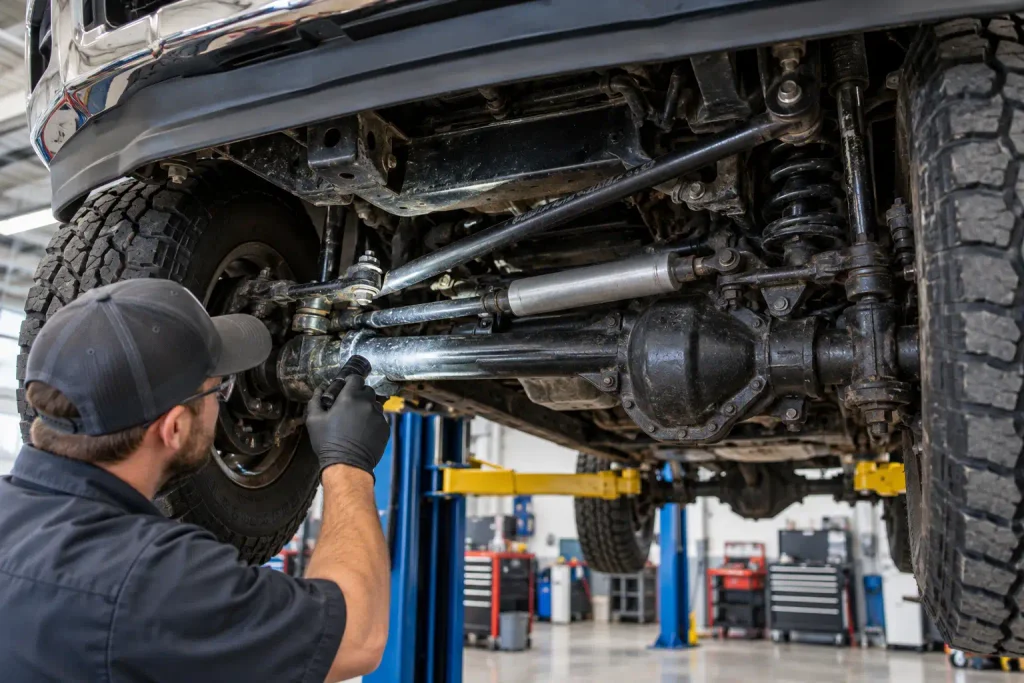
Some 2017–2019 F-250 4WD trucks can develop sustained steering-wheel oscillation after hitting rough pavement or an expansion joint.
Ford’s Technical Service Bulletin 19-2274 identifies 2017–2019 F-250 and F-350 4WD vehicles with the specified complaint above 45 mph. The bulletin describes a steering-linkage damper procedure for qualifying vehicles. A TSB is not automatically a safety recall.
If the seller reports oscillation or the steering feels unstable, require a qualified inspection before buying.
The cited bulletin is specifically for 4WD trucks. It does not establish the same condition on every 2017–2019 2WD F-250, nor does it justify rejecting every truck from those years.


Buying verdict: A stable truck with documented inspections and acceptable steering condition remains worth considering. Walk away from unresolved or recurring steering oscillation until the root cause is addressed.
How to Check 2020 to 2026 F250 Recall Risk
Newer F-250s should not be classified as trouble-free simply because their model years are recent.
Verify 2020 to 2022 Diesel Fuel Pump Campaigns
Ford recall 24S78, identified by NHTSA as 24V957, concerns the high-pressure fuel pump on certain 2020–2022 Super Duty trucks equipped with the 6.7L Power Stroke V8.
The 7.3L gas V8 is not affected by this particular diesel fuel-pump issue.
A follow-up campaign, Ford 26S17 / NHTSA 26V158, addresses certain vehicles that previously received an incorrect software remedy under 24S78. The 2026 Ford recall notice describes free dealer updates to the powertrain and transmission control-module software, with further diagnosis when relevant trouble codes appear.
If a listing says the original recall was completed, verify whether the follow-up campaign also applies. Check the VIN using NHTSA’s recall lookup and request confirmation from a Ford dealer.
Do Not Prematurely Rank 2023 to 2026 Trucks
Trucks from 2023–2026 have had less time to accumulate high-mileage service histories.
Check open campaigns, maintenance, mileage, work use and modifications.
Which Ford F250 Gas or Diesel Engine Fits You
Match the engine to your actual workload, not the badge.
Choose Gas for Less Demanding Use
For occasional towing, local work or shorter drives, a gas-powered F-250 may avoid the added complexity of diesel fuel injection and exhaust aftertreatment. Examples include the older 6.2L gas V8, the 7.3L gas V8 introduced for 2020, and the 6.8L and 7.3L gas V8 choices in the 2023–2026 lineup.
The modern 7.3L gasoline V8 and the discontinued 7.3L Power Stroke diesel are unrelated engines.
Choose Diesel for Sustained Heavy Towing
Diesel buying decisions must account for purchase price and possible turbo, fuel-system or emissions repairs.
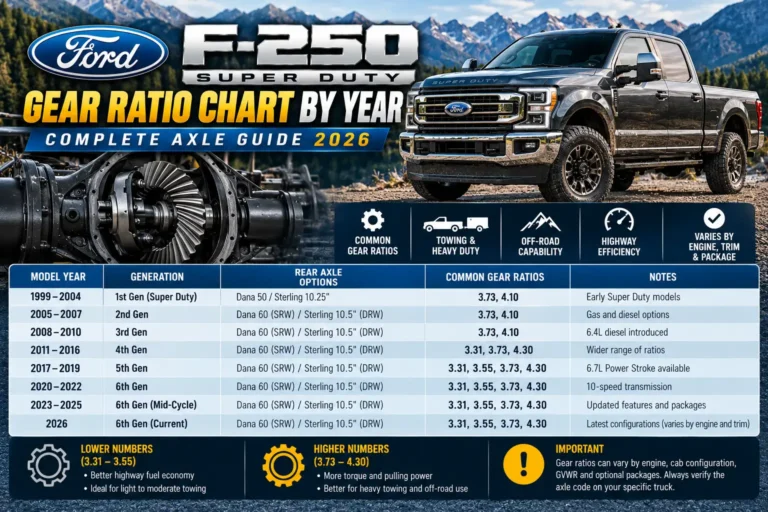
Do not rely on an advertised maximum tow rating. Cab style, axle ratio, drivetrain, hitch arrangement and the individual truck’s labels affect its actual limits. Compare configurations using the Ford towing capacity chart and the appropriate factory towing guide before committing to a trailer.
Buying verdict: Choose the engine that meets the real load requirement with the best verified maintenance record. Do not pay a diesel premium when the application does not require it.
How to Inspect a Used Ford F250 Before Purchase
Use the same inspection order for every used F-250, including supposedly reliable years. Have a qualified shop carry out tests that require specialist equipment or a lift.
- Confirm the configuration. Match VIN records, model year, actual engine, drivetrain, axle ratio and equipment. Be especially careful with the 2003 diesel crossover.
- Review service history. Look for dated oil, coolant, fuel-filter, transmission and differential services. For known trouble areas, ask for itemized repair invoices rather than verbal assurances.
- Check recalls by VIN. Use NHTSA’s VIN recall lookup and a Ford dealer’s service records. Confirm campaign applicability, completion and whether follow-up work is still needed.
- Request a true cold start and scan. Check starting behavior, exhaust smoke, warning lights, stored diagnostic trouble codes and relevant operating data. Do not let the seller clear codes immediately before inspection.
- Inspect the chassis and road manners. Examine frame corrosion, leaks, tires, brakes, steering linkage, suspension, 4WD components and modifications. A technician should perform an appropriate road test; do not intentionally provoke an unsafe steering oscillation.
- Get a written pre-purchase report. Ask the shop to identify urgent safety problems, needed repairs and further diagnostic work. Obtain itemized local quotes before agreeing on a price.
Which Ford F250 Should You Buy or Avoid
Use the following matrix as a screening tool.
| Truck and engine | Key evidence to check | Buy condition | Decision |
|---|---|---|---|
| 1999–early 2003 7.3L diesel | Cold-start behavior, age, rust, transmission | Passes older-truck inspection | Consider |
| 2003–2007 6.0L diesel | EGR/oil cooling, head gaskets, invoices | Repairs and specialist diagnosis verified | High caution |
| 2008–2010 6.4L diesel | Fuel, cooling, DPF and oil condition | Extensive evidence plus clean diagnostics | Avoid by default |
| 2011–2014 6.7L diesel | Turbo and cooling history | No unresolved faults | Inspect carefully |
| 2015–2016 6.7L diesel | Maintenance and fuel-system condition | Strong records and clean inspection | Shortlist |
| 2017–2019 4WD | Steering complaints, repair history | Stable, professionally inspected steering | Conditional |
| 2020–2022 6.7L diesel | 24S78 and possible 26S17 applicability | Correct remedies verified by VIN | Conditional |
| 2023–2026 gas or diesel | Records, recalls, configuration | Clean inspection and suitable workload | Evaluate individually |
Decision rule: If the truck falls into a high-caution group and the seller cannot substantiate critical repairs, pass. If a better candidate has full records and a clean inspection, it belongs higher on the shortlist, even if the model year is older.


When to Reject a Used Ford F250
A bargain price is not a reason to ignore safety or mechanical evidence. Four conditions should stop a purchase until they are resolved.
- If steering oscillation or dangerous looseness remains unresolved, do not buy it as road-ready. Require a qualified diagnosis and proof of repair.
- If the diesel shows active overheating, coolant pressurization or serious oil contamination, pause the deal. A shop must determine the cause and repair scope.
- If a high-risk engine has undocumented major work and fails its diagnostic inspection, walk away.
- If recall records conflict or the seller blocks VIN verification, stop the transaction. Confirm the status directly with Ford before proceeding.
What Ford F250 Years Are Worth Buying Used
For buyers comparing Ford F250 years to avoid, the clearest diesel caution groups are the 2003–2007 6.0L and 2008–2010 6.4L models. They can have expensive mechanical problems, though an individual truck’s repairs and condition still matter. Early 6.7L models deserve careful inspection, while maintained 2015–2016 diesels make a sensible shortlist.
Later trucks need configuration-specific steering checks and VIN-based recall verification. Gas-powered F-250s deserve separate consideration rather than inheriting diesel-specific warnings.
The best used F-250 is not necessarily the newest or the cheapest. Choose the engine that suits your workload, confirm the maintenance history and pay for an independent inspection before purchase.
What Buyers Ask About Ford F250 Reliability
What Is the Worst Ford F250 Year to Buy?
There is no defensible single worst year for every engine and drivetrain. Risk-averse diesel buyers should pay particular attention to 2003–2007 trucks with the 6.0L Power Stroke and 2008–2010 trucks with the 6.4L Power Stroke, then judge the individual truck’s condition.
Is a 2003 Ford F250 a Good Truck?
It can be, but first identify the engine. A 2003 F-250 may have the older 7.3L Power Stroke V8 or the newer 6.0L Power Stroke V8. The two engines have different risk profiles, and either truck needs an age-appropriate inspection.
Which Ford F250 Diesel Engine Is the Most Reliable?
A maintained 7.3L Power Stroke is a popular older-diesel candidate, while the revised 2015–2016 6.7L Power Stroke is a useful newer shortlist. Neither is guaranteed trouble-free. The condition, service history and inspection results determine whether a specific truck is worth buying.
Is a 2017 Ford F250 Worth Buying?
Yes, a 2017 F-250 can be worth considering after a proper inspection. On a 4WD truck, ask about steering oscillation and any related repairs. Engine condition, maintenance and recalls still need verification, regardless of drivetrain.
What Should I Check Before Buying a Used F250?
Confirm the VIN and engine, review maintenance and repairs, check open recalls, request a cold start and diagnostic scan, and inspect steering and frame condition. Finish with a written independent pre-purchase inspection and itemized estimates for any work the truck needs.