Ford Super Duty Towing Capacity Chart By Year (2026 Factory Data)

Quick Answer
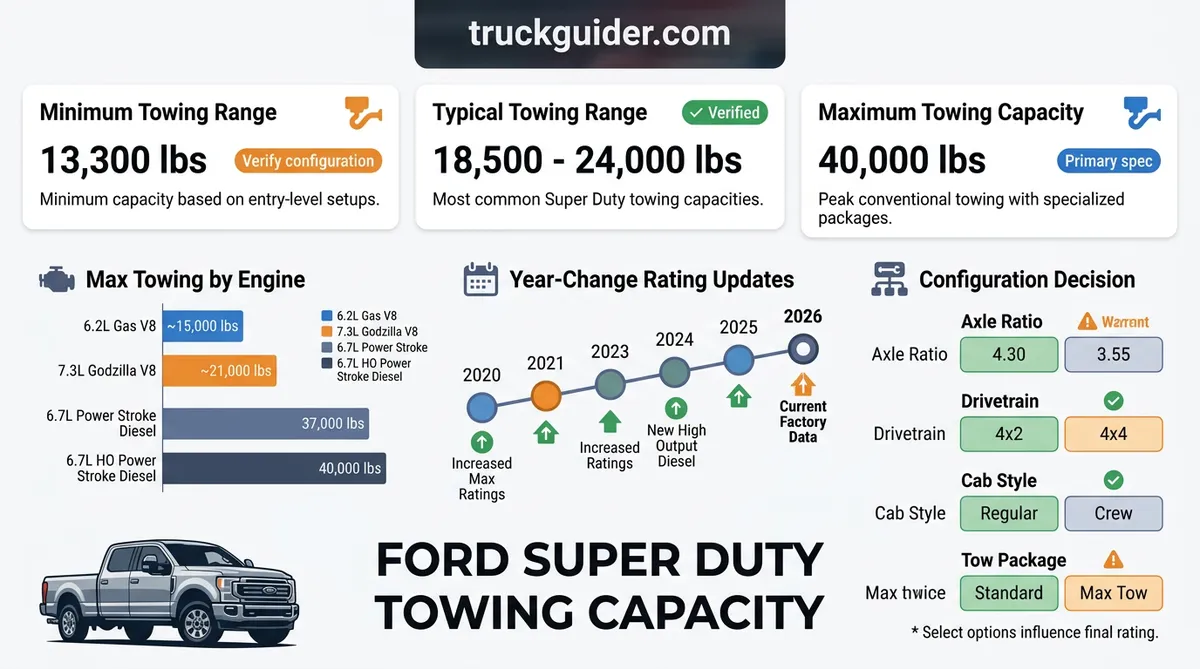
Ford Super Duty towing capacity ranges from 13,600 lbs on base gas F-250 configurations up to a class-leading 40,000 lbs on properly equipped F-450 Regular Cab gooseneck models. Most popular Crew Cab 4×4 diesel configurations tow between 18,200 and 22,000 lbs conventionally. Actual trailering limits are strictly governed by your specific truck’s door jamb payload sticker and Gross Combined Weight Rating (GCWR).
The Ford Super Duty lineup commands headline towing capacities reaching up to an extraordinary 40,000 pounds, but real-world capability spans from 14,000 to 40,000 pounds across the F-250, F-350, and F-450 ranges. While marketing brochures highlight maximum fifth-wheel ratings achieved by stripped-down, two-wheel-drive regular cab dually diesels, the usable capacity of any specific truck depends entirely on cab style, drivetrain, axle gear ratio, hitch architecture, and the vehicle’s legally binding door-jamb payload rating. Understanding how factory specifications translate to the real world is essential for safe, legal trailering.
14,000 lbs
F-250 6.8L V8 Gas Conventional
22,000 lbs
F-250 / F-350 SRW 6.7L Diesel
28,000 lbs
F-450 DRW Class V Receiver
40,000 lbs
F-450 Regular Cab 4×2 HO Diesel
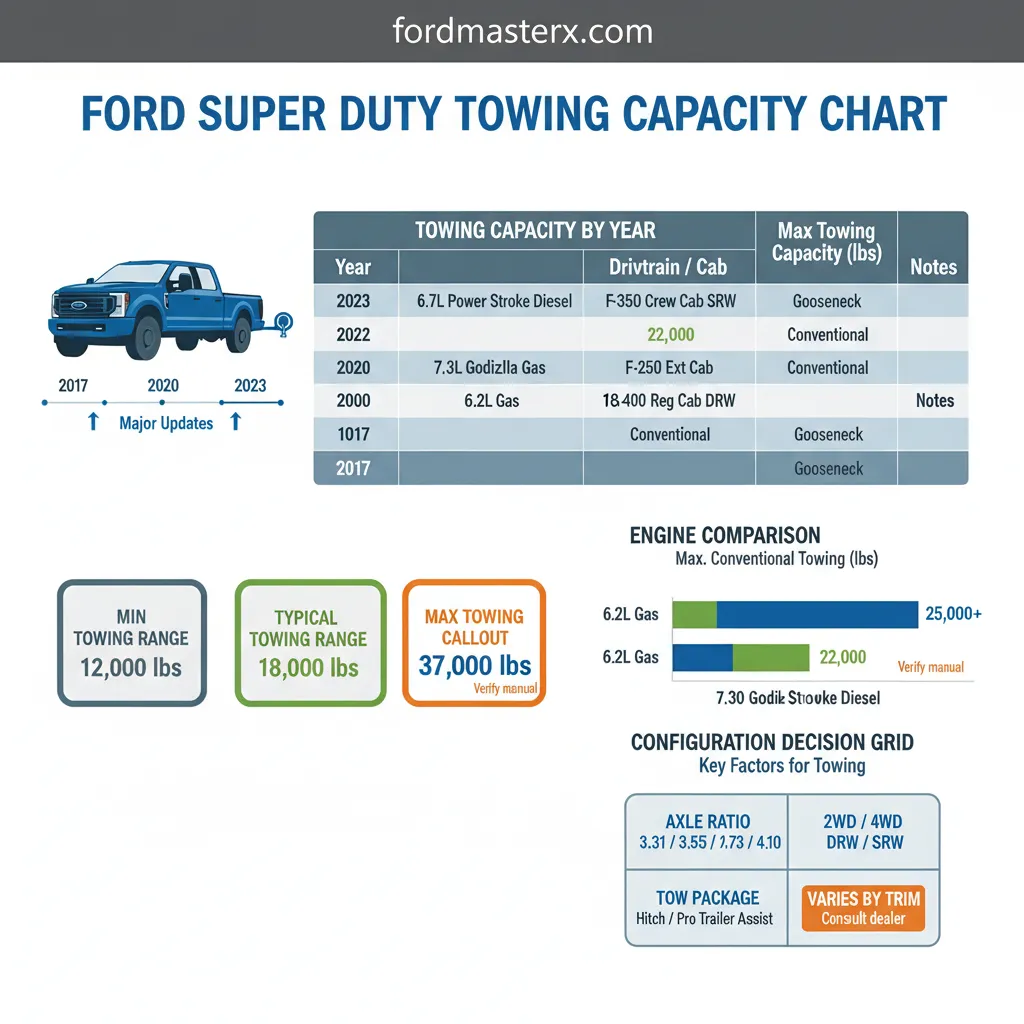
Ford Super Duty Towing Capacity Chart: Year-by-Year Factory Data
Recommended Best Deal Products


📤 Share Image
This chart compiles official Ford Motor Company factory towing specifications spanning model years 2020 through 2026 for the F-250 Super Duty, F-350 Super Duty, and F-450 Super Duty. Ratings represent maximum achievable capabilities under proper axle gearing and factory tow packages. Ratings vary by specific cab layout (Regular, SuperCab, Crew Cab), bed length (6.75-ft vs 8-ft), axle ratio (3.31:1 through 4.30:1), and drivetrain (4×2 vs 4×4). Always verify your individual vehicle’s payload capacity on the driver-side door B-pillar safety certification label before hitching. Last reviewed: October 2026.

Data Scope, Methodology, and SAE J2807 Testing Standards
Ford calculates and validates all Super Duty published tow ratings in accordance with SAE J2807 standardized performance requirements. This engineering standard subjects vehicles to harsh real-world tests, including minimum acceleration profiles on flat ground, 12% grade launch capability, minimum 40 mph sustained speeds up the Davis Dam 7% grade in 100°F ambient heat with air conditioning on full, dynamic sway damping, and stringent braking performance tests. Conventional tow numbers require a weight-distributing Class V receiver hitch when pulling heavy loads, while upper-tier figures demand factory or authorized fifth-wheel/gooseneck prep underbed hardware.
How to Read the Super Duty Towing Specification Chart
The table below distinguishes between bumper-pull conventional towing using the factory receiver hitch and center-bed towing (gooseneck or fifth-wheel). Gooseneck and fifth-wheel setups support substantially higher gross trailer weights than receiver hitches because the trailer’s pin weight rests directly above or slightly ahead of the truck’s rear axle rather than hanging off an extended lever at the rear bumper. Where a range is shown, the lower number reflects crew cab 4×4 configurations with highway-oriented tall gearing, while the higher number reflects regular cab models optimized with performance rear axle ratios and maximum tow packages.
| Model Year | Engine Option | Drivetrain / Cab Configuration | Max Towing Capacity | Configuration Notes & Hardware |
|---|---|---|---|---|
| 2024–2026 | 6.7L HO Power Stroke Turbo Diesel | F-450 DRW Regular Cab 4×2 | 40,000 lbs (Gooseneck) | 4.30:1 axle ratio, factory gooseneck prep, high-capacity boxed frame. Max GCWR 54,600 lbs. |
| 2024–2026 | 6.7L HO Power Stroke Turbo Diesel | F-350 DRW Regular Cab 4×2 | 38,000 lbs (Gooseneck) | 4.10:1 axle ratio, Max Tow Package, 14,000 lb GVWR package. |
| 2024–2026 | 6.7L Standard Power Stroke Diesel | F-350 SRW Crew Cab 4×4 | 27,000 lbs (Gooseneck) / 24,000 lbs (Conv.) | 3.55:1 electronic-locking axle, Class V 3-inch receiver hitch sleeve. |
| 2023–2026 | 7.3L Godzilla V8 Gasoline | F-350 DRW Regular Cab 4×2 | 22,500 lbs (Gooseneck) / 18,900 lbs (Conv.) | 4.30:1 axle ratio, TorqShift 10-speed. Delivers maximum gas payload (up to 8,000 lbs). |
| 2023–2026 | 6.7L Standard Power Stroke Diesel | F-250 Crew Cab 4×4 | 22,000 lbs (Gooseneck) / 22,000 lbs (Conv.) | Requires High Capacity Axle Upgrade / F-250 High Capacity Tow Package. |
| 2023–2026 | 6.8L V8 Gasoline | F-250 Regular / SuperCab 4×2 | 14,800 lbs (Conv.) | 3.73:1 axle ratio, base fleet engine. Standard 2.5-inch receiver hitch. |
| 2020–2022 | 6.7L Power Stroke Turbo Diesel | F-450 DRW Regular Cab 4×2 | 37,000 lbs (Gooseneck) / 24,200 lbs (Conv.) | 475 hp / 1,050 lb-ft tune. 4.30:1 commercial rear axle. |
| 2020–2022 | 6.7L Power Stroke Turbo Diesel | F-350 DRW Crew Cab 4×4 | 35,400 lbs (Gooseneck) / 21,200 lbs (Conv.) | 3.55:1 or 4.10:1 ratio depending on high-capacity options. |
| 2020–2022 | 7.3L Godzilla V8 Gasoline | F-250 / F-350 SRW Crew Cab | 18,200 lbs (Gooseneck) / 15,000 lbs (Conv.) | First release of 10-speed TorqShift paired with pushrod 7.3L gas platform. |
| 2020–2022 | 6.2L Boss V8 Gasoline | F-250 All Cabs (4×2 / 4×4) | 15,800 lbs (Gooseneck) / 15,000 lbs (Conv.) | Paired with TorqShift-G 6-speed automatic; replaced entirely in 2023 by 6.8L V8. |
Footnote: Table values represent absolute maximum factory specification limits per configuration. Exceeding tire weight ratings, Gross Axle Weight Ratings (GAWR), or Gross Vehicle Weight Ratings (GVWR) as printed on your driver-side B-pillar sticker is illegal and unsafe regardless of published maximum tow limits.
Super Duty Towing Capacity Changes: Year-by-Year Generation Updates
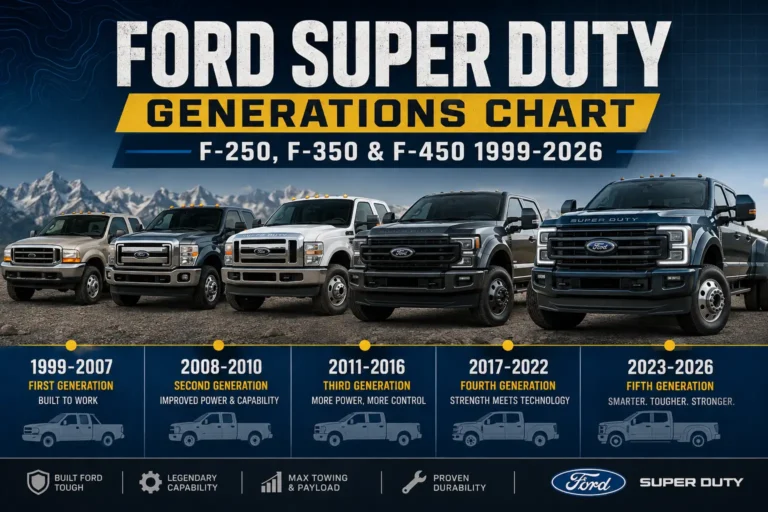
The Ford Super Duty line has evolved through intense engineering upgrades targeting thermal cooling, frame torsional stiffness, and digital integration. Significant jumps in maximum towing ratings occur directly alongside architectural overhauls.
Introduction of the 10-speed TorqShift automatic across top configurations, launch of the 7.3L Godzilla pushrod gas engine, and upgraded 3rd-generation 6.7L Power Stroke with steel pistons pushing output to 1,050 lb-ft and peak towing to 37,000 lbs.
Fully redesigned fully boxed steel frame with thicker crossmembers, updated heavy-duty leaf spring suspension geometry, standard 10-speed across all powertrains, debut of the 6.8L base gas V8, and the 500 hp / 1,200 lb-ft High Output diesel claiming 40,000 lbs towing.
Maturation of onboard scales, 360-degree trailer camera integration, Pro Trailer Hitch Assist, standardized digital thermal monitoring, and expanded High Capacity Tow package availability on single-rear-wheel platforms.
2023 to 2026 Redesign: High-Strength Boxed Frame and High-Output Diesel
The 2023 model year overhaul marked a major mechanical turning point. Ford upgraded its high-strength boxed steel frame with reinforced rear crossmembers and heavier structural hitch attachment plates to handle extreme vertical dynamic loads. Coupled with upgraded auxiliary engine and transmission cooling radiators, these architectural adjustments allowed engineers to push peak gooseneck capability from 37,000 pounds to the benchmark 40,000-pound threshold on commercial-spec F-450 models.
This era also established the 6.7L High Output (HO) Power Stroke Turbo Diesel, sporting a water-cooled turbocharger turbine housing, revised stainless-steel exhaust manifolds, and a factory calibration producing 500 horsepower and 1,200 lb-ft of torque. Every powertrain was standardized onto variations of the heavy-duty TorqShift 10-speed automatic transmission, eliminating the legacy 6-speed gearboxes and optimizing engine RPM management on steep alpine climbs.
2020 to 2022 Architecture: 10-Speed TorqShift Rollout and Godzilla V8
Between 2020 and 2022, Ford introduced major updates to bridge commercial duty and daily drivability. The 10-speed TorqShift automatic rolled out to all heavy diesel models and the newly introduced 7.3L Godzilla V8. With ten tightly stepped gear ratios, the transmission minimized thermal spikes caused by torque-converter slippage and allowed smaller engine speed drops under full load, dramatically improving towing stability over the older 6-speed units.
Engine Options and Towing Capacity: Power Stroke Diesel vs. Gas V8
Recommended Best Deal Products


Selecting the right engine option is the primary choice that shapes your Super Duty’s pulling dynamics, front-axle curb weight, and net payload availability. While the diesel dominates pure gross trailer weights, the gas V8 retains distinct payload and total cost-of-ownership advantages.
Factory Engine Maximum Pull Ratings (Gooseneck Peak)
14,800 lbs
22,500 lbs
34,000 lbs
40,000 lbs
6.7L Power Stroke Diesel Towing Dynamics and Exhaust Braking
The 6.7L Power Stroke V8 Turbo Diesel produces its crushing torque low in the rev band, hitting 1,050 to 1,200 lb-ft starting at just 1,600 to 1,800 RPM. This allows the truck to pull sustained 6% to 7% mountain grades in higher gears without gear-hunting or excessive cabin noise. Furthermore, the factory integrated engine exhaust brake utilizes the turbocharger’s variable-vane geometry to generate immense backpressure, retarding heavy trailer descent and saving your trailer service brakes from overheating.
7.3L Godzilla V8 Gas Towing: High Payload and Simpler Maintenance
While the diesel pulls heavier gross weights, the cast-iron 7.3L V8 Gasoline Engine (Godzilla) offers a key mechanical advantage: weight. The 6.7L diesel powertrain, including its secondary cooling loop, DEF emissions system, massive intercooler, and turbo hardware, adds approximately 800 to 1,000 pounds directly over the front axle. This extra engine weight subtracts pound-for-pound from your truck’s certified door-sticker payload capacity.
⛽ 7.3L Godzilla Gas Strengths
- 800–1,000 lbs higher net payload compared to an identical diesel
- Substantially lower initial purchase cost
- Simpler maintenance: no DEF, no DPF regenerations, lower oil capacity
- Exceptional around-town commercial short-trip durability
🚚 6.7L Diesel Strengths
- Effortless low-end torque for moving 20,000+ lb loads
- Factory driver-selectable exhaust brake saves foundation brakes on grades
- Superior fuel range and thermal endurance when operating near GCWR
- Higher retained resale value on heavy commercial markets
F-250 vs. F-350 vs. F-450: Dually and Chassis Differences
Super Duty models share cab sheet metal and basic styling, but their underpinnings—suspension leaf packs, axle tube wall thicknesses, brake rotors, and steering knuckles—vary considerably across the class lines.
F-250 vs. F-350 SRW: Leaf Packs, Axle Splines, and GVWR Classes
The primary distinction between an F-250 and an F-350 Single Rear Wheel (SRW) comes down to suspension leaf packs and Gross Vehicle Weight Rating (GVWR) certification. The F-250 is traditionally engineered to cap out at 10,000 lbs GVWR (though high-capacity axle packages can boost it to 10,600–11,100 lbs on newer models) to keep owners under commercial registration thresholds and toll classifications in certain states.
Mechanically, standard F-250s employ a lighter rear spring pack without auxiliary overload springs, while the F-350 SRW includes an additional main leaf, integrated auxiliary helper springs, larger axle tubes, and higher-capacity full-floating rear axle variants (such as the Sterling 10.5 or Dana M275). This boosts the F-350 SRW’s GVWR up to 11,500–12,400 pounds, dramatically increasing its legal payload for fifth-wheel pin weights.
Single Rear Wheel vs. Dually (DRW) for Heavy 5th-Wheel Hauling
For fifth-wheel or gooseneck trailers exceeding 18,000 pounds gross weight, dual rear wheels (DRW) become an essential safety upgrade. Single rear tires are hard-limited by their individual tire load index (typically 3,640 to 3,750 pounds per tire for heavy E-rated tires at 80 PSI). Once a trailer’s kingpin places 4,000 pounds of vertical load onto the bed, an SRW truck’s rear axle is operating at or over maximum tire capacity.
F-450 Commercial Hardware: Wide-Track Axle, Brakes, and Wheel Packages
The consumer pickup version of the Ford F-450 occupies a unique class. While it shares the same 14,000-pound GVWR ceiling as the F-350 DRW to remain categorized as a Class 3 pickup for personal registration, its underlying commercial hardware is substantially beefier. The F-450 features a commercial wide-track front axle that allows the front wheels to turn up to 48 degrees (compared to roughly 37 degrees on the F-350), yielding a significantly tighter turning circle despite its massive footprint.
Additionally, the F-450 is equipped with massive 15.3-inch front and 15.7-inch rear commercial disc brake rotors, 10-lug bolt patterns, and commercial 19.5-inch forged aluminum wheels wrapped in steel-belted Continental Hybrid commercial truck tires. While these heavy wheels and tires add rolling inertia and reduce published door payload compared to an F-350 DRW, they offer unmatched heat dissipation and structural durability when handling 30,000+ lb gooseneck trailers.
What Governs Real-World Ford Super Duty Towing Capacity
Recommended Best Deal Products


Safe trailering requires mastering four key weight metrics. Exceeding any single metric compromises safety and creates significant legal exposure in the event of an accident.
Core Weight Ratings Defined
Gross Vehicle Weight Rating: Maximum total operating weight of your truck, including passengers, cargo, fuel, aftermarket options, and tongue/pin weight.
Gross Combined Weight Rating: Maximum combined allowable mass of the fully loaded truck and the fully loaded trailer hitched together.
Gross Axle Weight Rating: The absolute maximum load rated for the front (FGAWR) or rear (RGAWR) axle assembly, springs, and tires.
The Payload Trap: Why Kingpin Weight Limits You First
The most pervasive error in heavy towing is assuming you can pull a 30,000-pound fifth wheel simply because the brochure lists that number. A properly balanced fifth-wheel or gooseneck trailer transfers 20% to 25% of its total gross trailer weight onto the truck bed as pin weight. For a 20,000-pound fifth-wheel, this equates to 4,000 to 5,000 pounds of vertical force directly on the truck chassis.
Consider a 2024 Ford F-350 Crew Cab 4×4 SRW diesel. In standard base XL trim, payload might reach 4,200 pounds. However, step up to a Limited or Platinum trim featuring twin-panel panoramic moonroofs, heated and cooled massaging front seats, power-deployable running boards, and a 12-speaker audio setup, and the door-jamb payload rating drops to approximately 3,300 pounds. Hitch a 15,000-pound fifth wheel with a 20% pin weight (3,000 lbs), and you only have 300 pounds remaining for the driver, passenger, cargo, and hitch hardware before exceeding GVWR.
Axle Ratios and GCWR: Choosing Between 3.31, 3.73, and 4.30 Gears
The differential axle ratio establishes mechanical leverage between the driveshaft and the ground. A higher numerical ratio delivers greater low-end torque multiplication, raising your certified GCWR and pulling capacity at the expense of highway unladen fuel economy.
Matched with 6.7L Diesel powertrains. Built for long-haul highway towing of moderate loads (under 18k lbs) and best unladen fuel economy.
Standard all-around ratio for gas models and heavy SRW diesels. Strikes an ideal balance between grade-climbing power and highway RPM.
Mandatory for maximum GCWR configurations, including gas commercial haulers and F-450 diesels rated to move 30,000 to 40,000 lbs.
Decoding Your Driver-Door B-Pillar Safety Certification Label
Regardless of what you read in marketing guides or promotional materials, the federal certification sticker located on your truck’s driver-side B-pillar is the only legally binding authority governing your vehicle’s weight limits. Follow these three steps to determine your true towing limit:
Locate the yellow-and-white tire card indicating: “The combined weight of occupants and cargo should never exceed XXXX kg or XXXX lbs.” This is your starting available payload.
Subtract the weight of your hitch (a fifth-wheel slider hitch adds 150–250 lbs), driver, all passengers, toolboxes, auxiliary fuel tanks, and all gear packed inside the cab and bed.
Divide the remaining payload capacity by 0.20 (for fifth wheels with 20% estimated pin weight) or by 0.12 (for bumper pulls with 12% tongue weight). This establishes your practical trailer limit.
Ford Super Duty Towing Capacity Questions Answered
Can an F-250 legally tow a 20,000-pound fifth-wheel trailer?
While a properly equipped late-model F-250 diesel boasts a certified pulling rating of 22,000 pounds, pulling a 20,000-pound fifth wheel is almost always legally impossible. A 20,000-pound fifth wheel typically exerts a pin weight between 4,000 and 5,000 pounds. Most F-250 Crew Cab 4×4 diesels carry a door payload rating between 2,200 and 3,100 pounds. The pin weight alone will substantially exceed the truck’s GVWR and Rear Gross Axle Weight Rating (RGAWR).
What is the difference between conventional and gooseneck towing ratings?
Conventional towing attaches to the Class V receiver hitch bolted beneath the rear bumper. Because this creates a long lever arm off the rear axle, maximum ratings cap out between 14,000 and 28,000 pounds across the Super Duty family. Gooseneck and fifth-wheel towing positions the ball directly over or slightly ahead of the rear axle, preventing front-axle lift, improving dynamic sway damping, and raising maximum ratings up to 40,000 pounds.
Do aftermarket leveling kits or oversized off-road tires void or reduce towing capacity?
Yes. Installing a front leveling kit alters suspension caster, reduces front-axle load under acceleration, and alters emergency braking geometry. Furthermore, mounting larger off-road tires reduces effective axle gear multiplication (e.g., transforming a 3.73 axle into the mechanical equivalent of a 3.42) and soft sidewalls increase trailer sway under lateral wind loads. Oversized wheel and tire packages also subtract rotational efficiency and payload from the truck.
What happens if you tow above the door-sticker Gross Axle Weight Rating (GAWR)?
Exceeding your Rear GAWR subjects wheel bearings, axle shafts, ring-and-pinion gears, and wheel hubs to fatigue stress, which can lead to catastrophic component failure. In addition, exceeding tire weight limits creates extreme heat buildup that dramatically raises the risk of highway blowouts. In commercial applications, law enforcement and DOT enforcement can issue heavy fines and immediately impound an overloaded rig.
If your combined truck and trailer weight rating (GCWR) exceeds 26,000 pounds, several states require a non-commercial Class A driver’s license for recreational towing, and the Federal Motor Carrier Safety Administration (FMCSA) mandates a commercial driver’s license (CDL) if the combination is used for commercial hauling or business profit.
Extracting maximum capability from your Ford Super Duty requires matching your engine, cab length, chassis configuration, and axle ratio directly to your trailering demands. While headline numbers reaching 40,000 pounds demonstrate Ford’s chassis engineering, real-world towing safety is ultimately determined by your driver-door payload placard and rear axle ratings. Before securing any trailer hitch, check your truck’s certified B-pillar data, confirm your loaded tongue or pin weight at a commercial CAT scale, and ensure your rig operates comfortably inside its certified factory limits.