Hemi Binance OKX Coinbase Listing: CEX Stages & PoP Specs

Speculation surrounding a potential Hemi Network token listing on Binance, OKX, and Coinbase is surging as the modular protocol approaches key network milestones. Currently, none of these Tier-1 centralized exchanges have opened official spot trading, deposits, or withdrawals for the native HEMI token.
While formal confirmation dates remain pending, evaluating exchange criteria and onboarding stages helps market participants prepare for the token’s eventual debut. Below, we break down verified exchange listing schedules, underlying liquidity structures, and essential security checks to protect your assets from circulating launch scams.
Hemi Binance OKX Coinbase Listing Status: Current Facts & Overview
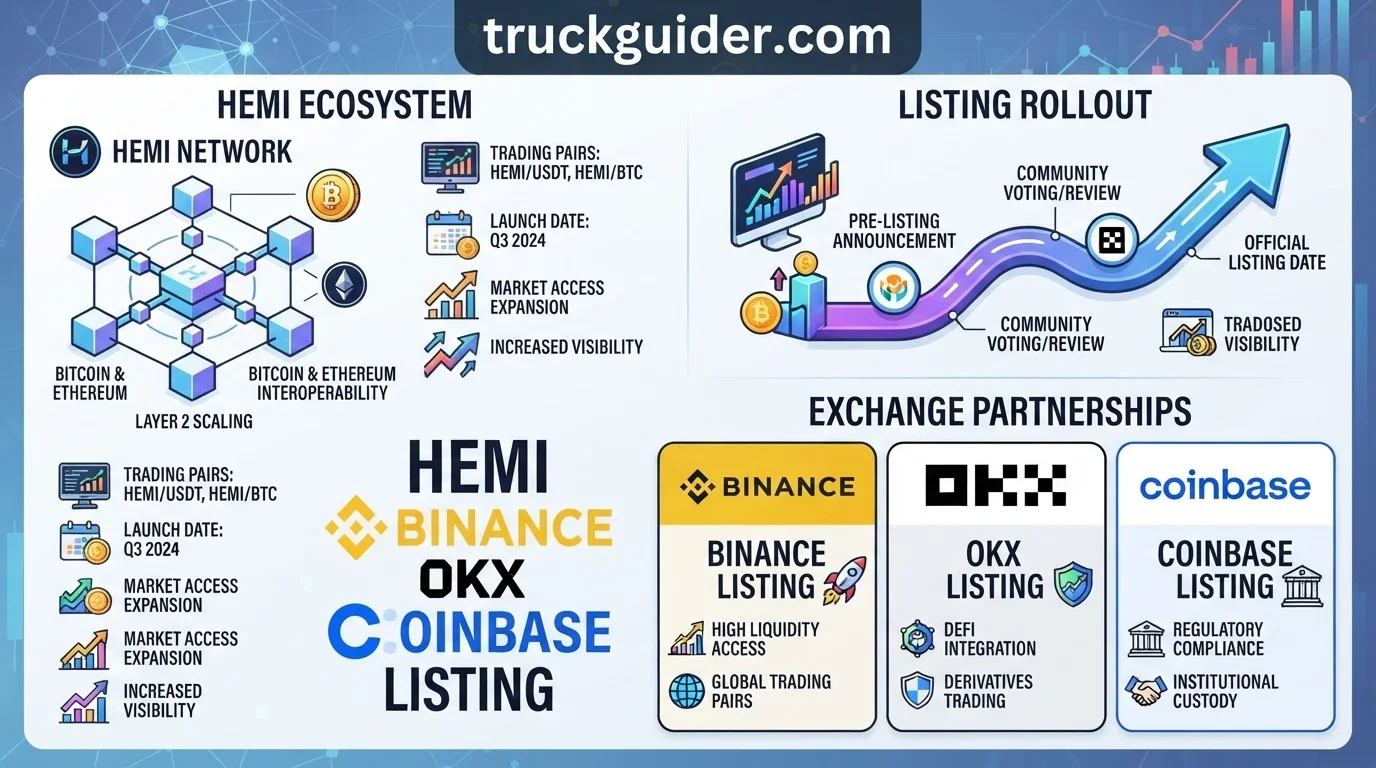
As of today, the HEMI token is not listed or available for spot trading on Binance, OKX, or Coinbase. Any secondary market pools or trading pairs claiming to host authentic HEMI tokens on centralized platforms are inaccurate and unverified.
Current Listing Verification Across Tier-1 Exchanges
Centralized exchange listings are subject to independent compliance, regulatory, and technical review by each individual exchange. Because each platform operates under separate legal frameworks and liquidity risk evaluations, Binance, OKX, and Coinbase rarely coordinate simultaneous debuts for nascent network tokens.
Official exchange listings are only verifiable through the official communication channels of Binance, Coinbase, and OKX (not unverified social media posts). Traders must monitor authentic release desks rather than speculative speculation or third-party syndications.
Safe verification requires checking the Binance Announcement Center, OKX New Listings portal, and the official Coinbase Assets Twitter feed instead of Telegram rumors or viral forum speculation. If an asset is not formally indexed on these official outlets, it cannot be legally deposited or traded on those platforms.
Differentiating Testnet Points from Mainnet Exchange Tokens
Participants in the Hemi ecosystem frequently earn non-transferable points through testnet incentives and network stress tests. These diagnostic points serve strictly as operational engagement markers for protocol benchmarking and do not constitute tradeable mainnet assets.
Testnet points possess zero cash value, have no smart contract settlement layer on central exchanges, and cannot be deposited into custody accounts. Only final, minted mainnet tokens deployed after an official genesis event can meet the technical standards required for Tier-1 order books.
Hemi Network Architecture: PoP Security and hVM Integration Details
Hemi Network is architected as a modular Layer-2 combining security and features from both Bitcoin and Ethereum. This hybrid model delivers the programmability of EVM ecosystems alongside Bitcoin-grade settlement guarantees, fulfilling critical operational benchmarks scrutinized by exchange listing desks.
Proof-of-Proof (PoP) Consensus and Bitcoin Settlement
Hemi anchors its state transitions directly to the Bitcoin blockchain via Proof-of-Proof (PoP) consensus. Independent PoP miners record cryptographic snapshots of Hemi’s ledger into Bitcoin blocks, establishing inherited proof-of-work finality.
For example, PoP achieves finality backed by Bitcoin mining without requiring separate consensus validator trust assumptions. Because reversing a confirmed Hemi block necessitates reorganizing Bitcoin itself, centralized exchanges benefit from near-zero double-spend risk on user deposits.
Hemi is co-founded by early Bitcoin core developer Jeff Garzik. Garzik’s decade-plus track record in protocol development adds significant institutional pedigree, satisfying rigorous leadership and operational assessments during Tier-1 CEX reviews.
Hemi Virtual Machine (hVM) and EVM Composability
The Hemi Virtual Machine (hVM) integrates a functional Bitcoin node directly inside an EVM execution environment. This architecture grants smart contracts native awareness of Bitcoin balances, transactions, and block headers without relying on centralized oracles.
Developers execute standard Ethereum-compatible code that manages Bitcoin-native assets programmatically. By removing the need for external custodial bridges, hVM closes common security vulnerabilities, directly aligning with exchange listing criteria that favor battle-tested smart contract infrastructure.
Tier-1 Exchange Review: Hemi Token Listing Criteria for Binance & OKX
Centralized exchange listings are subject to independent compliance, regulatory, and technical review by each individual exchange. Tier-1 platforms such as Binance, OKX, and Coinbase deploy dedicated listing committees that thoroughly evaluate an asset’s infrastructure, corporate governance, and operational integrity prior to scheduling any spot trading market.
Regulatory and Legal Compliance Due Diligence
Regulatory vetting evaluates an asset’s legal classification across global financial frameworks. Coinbase applies rigorous compliance screens aligned with US SEC scrutiny and the Howey test to prevent unregistered securities listings. This protocol creates jurisdictional listing restrictions, contrasting Coinbase US requirements with Binance International and OKX, which review tokens under offshore and regional frameworks like Dubai’s VARA or the EU’s MiCA.
Technical compliance requires verified smart contract audits from recognized third-party security auditors alongside full vulnerability assessments. Desks rigorously test chain bridge security validation, verifying that cross-chain communication layers and state-validation proofs resist bridge exploits, contract logic bugs, and reentrancy vectors before exchange custodial wallets integrate the token.
Tokenomics, Circulating Float, and Vesting Transparency
Listing desks review tokenomics to prevent destabilizing volatility during market debuts. Analysts measure the circulating float against the fully diluted valuation (FDV), examining the proportion allocated to the community, liquidity reserves, and ecosystem incentives to confirm the asset can support active order book depth.
A central requirement is the evaluation of token distribution curves to ensure market makers and early backers cannot dump illiquid supply on retail. Committees demand publicly documented vesting schedules, prolonged cliff periods for venture capital allocations, and restricted insider unlocks to prevent aggressive secondary market sell pressure.
Finally, listing desks demand proof of secure multi-signature management and timelocks over unminted or unreleased treasury reserves. Transparent token emission models and on-chain verifiable lockups remain prerequisite criteria before an asset passes Tier-1 liquidity and compliance filters.
The Hemi Binance OKX Coinbase Listing Stages: From Deposits to Spot
Centralized exchanges like Binance, OKX, and Coinbase do not launch new digital assets instantaneously. Instead, exchanges typically list assets in stages, often beginning with deposit enablement, followed by spot pairs, and later derivatives or margin products to safeguard platform liquidity.
Custodial Wallet Architecture and Network Support
Before any trading occurs, an exchange establishes underlying custodial infrastructure for the HEMI token. Exchange engineering teams deploy secure signing nodes and partition reserves across hot, warm, and air-gapped cold storage clusters.
This phase verifies remote procedure call (RPC) reliability between the Hemi Network and internal ledger engines. Engineers test multisig withdrawal routines and threshold signature schemes (TSS) to ensure high-throughput processing during peak volume periods.
Deposit Opening, Order Book Call Auctions, and Live Trading
Platforms map deposit gateways to segregated vault addresses across cold and hot liquidity pools, testing multi-signature authorization scripts.
Users generate inbound addresses. Crediting deposits requires hitting specific block confirmations—often 64 to 128 blocks—to protect against network chain reorganizations.
Exchanges open call auctions to establish fair pricing before live spot trading begins against base pairs like USDT, USDC, and BTC.
Once market depth stabilizes, venues roll out linear perpetual futures contracts, isolated margin borrowing, and native earning programs.
A standard deployment timeline involves Binance enabling HEMI/USDT spot trading 4 hours after opening ERC-20/native deposits. This operational window allows sufficient circulating supply to accumulate inside the exchange, preventing artificial order book illiquidity upon launch.
Order Book Depth and Liquidity Insights for the HEMI Token Debut
Market Maker Obligations and Spread Maintenance
Designated market makers (DMMs) play an essential operational role during a Tier-1 debut by seeding initial liquidity across the order book. Contractual agreements obligate these firms to post continuous two-sided quotes within tight price bands, preventing order book vacuums immediately after spot trading opens to the public.
Exchange listing tiers directly dictate daily trading volume expectations and institutional participation. Top-tier global venues attract high-frequency algorithmic desks capable of deploying deep capital reserves, ensuring the primary spot order book can absorb substantial transaction sizes without suffering catastrophic price dislocation or fragmentation.
In the opening 15 minutes of trading, aggressive flow imbalances typically cause a wide 2% bid-ask spread. As arbitrage algorithms balance inventory across exchanges and liquidity pools mature, this spread compresses rapidly toward 0.05%, signaling that baseline price discovery has successfully stabilized.
Managing Initial Slippage and Price Discovery Volatility
Early trading minutes remain subject to violent price discovery volatility. Retail influx, initial token unlocks, and cross-market arbitrage collide simultaneously, creating fragmented book depth near the mid-market price where even modest trading volume can trigger immediate, rapid price swings.
Executing unhedged market orders during this initial window presents severe slippage risks. When liquidity is thin, a market buy order sweeps through multiple price levels on the ask side, resulting in an effective execution price substantially higher than the prevailing market quote.
Deploying strict limit orders mitigates this vulnerability by enforcing fixed execution thresholds. While market orders drain critical book depth during high-volatility spikes, resting limit orders provide essential counterparty liquidity, helping stabilize the token’s trading corridor across the exchange’s core trading pairs.
Tier-1 CEX Listings vs. DEX Pools: HEMI Market Structure Comparison
Liquidity and Slippage Dynamics Across Exchange Types
Automated market makers (AMMs) execute trades against smart contract reserves. Swapping HEMI on a decentralized exchange (DEX) like Uniswap v3 depends entirely on concentrated liquidity ranges, where large trade sizes can trigger severe slippage if capital is thin.
Tier-1 centralized exchanges (CEXs) like OKX rely on central limit order books (CLOBs). Institutional market makers provide tight bid-ask spreads and deep capital buffers, shielding retail traders from rapid price impact during standard volume spikes.
Lower-tier CEXs often display deceptive order books. While automated market makers provide transparent on-chain liquidity depth, smaller exchanges frequently use wash trading and inflated metrics, leading to unexpected slippage and severe execution delays during volatile sessions.
Custody, KYC Verification, and Access Rules
Trading on a DEX pool using a self-custody solution like MetaMask grants permissionless, global access. Traders maintain absolute control over their private keys, bypassing identity checkpoints, but they assume full liability for smart contract interactions and key security.
Conversely, trading HEMI on OKX requires mandatory Know Your Customer (KYC) identity verification, proof of address, and two-factor authentication (2FA). Regional restrictions prevent users in specific jurisdictions from accessing spot pairs or fiat deposits.
Centralized platforms hold user assets in exchange-managed hot and cold wallets. While users forfeit asset sovereignty, they benefit from account recovery mechanisms, stop-loss order infrastructure, and direct integration with regulated banking channels.
How to Read the Market Structure Comparison
This comparison classifies execution venues according to technical design, regulatory compliance, and market security. The execution engine column contrasts central limit order books (CLOB) against programmatic automated market makers (AMM). AMM trades incur deterministic price impact governed by invariant curves, whereas CLOB models rely on active market maker quotes.
Custody labels specify whether private key authority rests with the individual or an intermediary. Identity screening indicates the presence of Anti-Money Laundering (AML) gates, which restrict jurisdiction access. Where policies fluctuate rapidly on smaller platforms, criteria are designated as verify for exact configuration to avoid unverified assumptions. Volume authenticity reflects the operational risk of synthetic liquidity, which differs significantly between transparent blockchain ledgers and unregulated off-chain matching engines.
Avoiding Scams Around the Hemi Binance OKX Coinbase Listing Info
Identifying Counterfeit Smart Contracts and Fake DEX Pools
Bad actors capitalize on Tier-1 listing anticipation by deploying counterfeit token contracts on decentralized exchanges like Uniswap. These fraudulent pools are falsely promoted as early “pre-listing allocations” or discounted presale rounds targeting speculative retail buyers.
Because open-source protocols permit anyone to mint arbitrary tokens using duplicate tickers, searching for “HEMI” on DEX search bars surfaces clone scams. Traders must verify the canonical contract address exclusively through Hemi’s official technical documentation and verified block explorer registries.
Fake Telegram groups announcing a ‘HEMI Token Presale Claim’ linking to wallet drainer smart contracts are prevalent during major exchange rollouts. Connecting web3 wallets to these counterfeit portals executes malicious approval transactions that liquidate account balances.
Verifying Exchange Announcements and Avoiding Phishing Links
Official exchange listings are only verifiable through the official communication channels of Binance, Coinbase, and OKX (not unverified social media posts). Scammers routinely hijack compromised, verified social media accounts to circulate fraudulent Binance Launchpool, OKX Jumpstart, or Coinbase Earn links.
Legitimate Tier-1 centralized venues never require participants to send collateral to external personal wallets to secure token allocations. Authentic programs run exclusively within verified exchange infrastructure accessible directly via bookmarked domain URLs or official mobile applications.
Traders must also evaluate compliance-driven jurisdictional lockouts. For example, US residents are strictly barred from Binance.com launch events and OKX spot listings. Any third-party promoter promising alternative access routes or VPN bypasses to restricted listing events is operating a phishing scheme.
Key Takeaways
-
✓
Tier-1 exchange listing criteria for Binance, OKX, and Coinbase prioritize verifiable testnet metrics, Proof-of-Proof (PoP) security, and protocol decentralization. -
✓
Official exchange rollouts follow distinct deployment stages: technical deposit integration, liquidity buffering, spot order book launch, and withdrawal activation. -
✓
Hemi’s modular architecture integrates the hVM (Hemi Virtual Machine) with Bitcoin finality, meeting Tier-1 technical compliance standards. -
✓
Debut liquidity conditions depend on initial market maker depth, comparing centralized order books directly against decentralized liquidity pools. -
✓
Scam prevention requires cross-referencing all token contract information against official foundation channels before interacting with unverified trading pairs.
❓ Frequently Asked Questions
1
What is the Hemi Binance OKX Coinbase listing process?
The listing process involves Tier-1 centralized exchanges conducting comprehensive technical due diligence, evaluating Hemi Network’s Proof-of-Proof consensus, and establishing localized liquidity pools. Exchanges roll out trading in phased stages—opening deposits first to build order book depth before activating public spot trading pairs and withdrawals.
2
How does Hemi Network’s architecture impact exchange listings?
Hemi combines Ethereum compatibility via the hVM with Bitcoin-anchored security using Proof-of-Proof consensus. This dual-layer architecture provides Tier-1 compliance teams at Binance, OKX, and Coinbase with institutional-grade settlement guarantees, reducing standard chain reorganization risks and satisfying strict technical audit standards required for mainnet token integration.
3
Why are deposit stages opened before spot trading on OKX and Binance?
Tier-1 centralized exchanges enforce staged listing schedules to accumulate sufficient organic liquidity across their internal ledger before matching buyers and sellers. Opening deposits allows market makers and early token holders to populate the order book, preventing severe slippage and extreme volatility upon market opening.
4
What are the differences between HEMI CEX listings and DEX pools?
Centralized exchanges like Coinbase, Binance, and OKX provide traditional order book matching with deep institutional liquidity and regulatory oversight. Conversely, decentralized liquidity pools rely on automated market maker (AMM) bonding curves, offering immediate permissionless access but exposing early traders to higher initial slippage and sandwich attacks.
5
How can traders verify genuine HEMI token listing information?
Traders must cross-reference exchange announcements with Hemi’s verified public repository and official foundation domains. Authentic listings are accompanied by specific cryptographic contract addresses and published on verified exchange announcement subdomains. Any token claiming listing availability without synchronized exchange confirmations should be treated as a potential scam.
6
Is HEMI officially listed on Binance, Coinbase, or OKX yet?
Detail the current live verification process, pointing to official exchange announcement centers and warning readers to verify directly before sending funds.