How to Calculate Towing Capacity: The Definitive Guide

Imagine this scenario: a truck owner, proud of their new purchase, confidently buys a 10,000-pound travel trailer. The dealership brochure and the manufacturer’s website both proclaimed a “maximum towing capacity” of 12,000 pounds, leaving a comfortable 2,000-pound buffer. Yet, on the first trip out, the experience is anything but comfortable.
The truck’s steering feels light and unresponsive, the rear sags alarmingly, and every passing semi-trailer creates a terrifying, white-knuckle sway. This scenario is not just common; it’s a dangerous reality born from a fundamental misunderstanding of what towing capacity truly means.
The “max tow rating” advertised by manufacturers is a powerful marketing tool, but it is often achieved under highly idealized and unrealistic conditions. This figure typically represents a base model truck with no options, a single 150-pound driver, and no additional cargo.
The moment passengers climb in, gear is loaded into the bed, or a heavier trim level is chosen, that number becomes a fiction. Your vehicle’s true, safe towing capacity is not a static number on a spec sheet; it is a dynamic calculation that must account for every pound of weight added to your vehicle and trailer.
This guide will demystify the entire process. We will move beyond the sticker number to provide a step-by-step method for calculating your vehicle’s actual safe towing capacity, empowering you to tow with confidence and, most importantly, safety.
We will decode the technical jargon, analyze the mechanical factors that dictate towing power, and provide the tools you need to make an informed, safe decision for you, your family, and everyone else on the road.
Powering a Greener Tomorrow
Renewable sources are revolutionizing the global energy landscape. Explore the key data driving this monumental shift towards a sustainable future.
The Current Global Energy Mix
While fossil fuels still dominate, renewables have carved out a significant and growing portion of the world’s energy supply. This chart illustrates the current composition, highlighting the challenge and the opportunity ahead.
Leaders in Renewable Capacity
Several nations are leading the charge in installed renewable capacity, driving innovation and large-scale adoption. Here are the top countries making the biggest impact on a global scale, measured in gigawatts (GW).
Decade of Growth: Solar & Wind Surge
The last ten years have witnessed an explosive growth in renewable energy adoption, particularly in solar and wind power. This trendline showcases the rapid acceleration of these key technologies as costs have fallen and efficiency has improved.
Global Investment Landscape
Financial commitment is a critical driver of the green transition. This chart breaks down the billions of dollars flowing into different renewable sectors, comparing investment levels between emerging and developed economies.
Projected Growth to 2030
The momentum is set to continue. Projections show a significant increase in the share of renewables in the global energy mix by 2030. This area chart visualizes the expected expansion, emphasizing the growing volume of clean energy.
The Quick Answer: The Foundational Towing Capacity Formula
For those seeking an immediate answer, the most basic formula for determining a vehicle’s maximum trailer weight rating is a simple subtraction problem. This calculation provides a theoretical starting point and is often what search engines look for.
The Basic Formula:
The simplest calculation for towing capacity is the vehicle’s Gross Combined Weight Rating (GCWR) minus the vehicle’s curb weight.
Maximum Trailer Weight Rating=GCWR−Vehicle Curb Weight
In this formula, the Gross Combined Weight Rating (GCWR) is the absolute maximum weight of the fully loaded truck and the fully loaded trailer combined. The Curb Weight is the weight of the empty vehicle with a full tank of fuel and all necessary operating fluids.
However, relying solely on this formula for real-world towing is dangerously incomplete. It ignores the single most critical variable that limits the majority of towing setups: payload capacity. This simple calculation tells you what your engine and brakes can theoretically move and stop, but it says nothing about what your truck’s chassis, suspension, and axles can physically carry. The following sections will explain why this distinction is the most important concept in safe towing.
Decoding the Alphabet Soup: A Glossary of Essential Towing Terms
To safely calculate towing capacity, one must first speak the language. The automotive industry uses a series of acronyms that are crucial for understanding how vehicle weight limits work together. These are not just technical terms; they are legal and mechanical limits set by engineers to ensure safety. Exceeding them can lead to component failure, loss of control, and catastrophic accidents.
Gross Combined Weight Rating (GCWR)
The Gross Combined Weight Rating (GCWR) is the absolute, non-negotiable maximum weight of the entire road-going system. This includes the fully-loaded tow vehicle and the fully-loaded trailer. It accounts for the vehicle, the trailer, all passengers, all cargo in both the vehicle and trailer, fuel, and all other fluids. Think of it as the total mass that the vehicle’s engine, transmission, and braking system are designed to handle safely.
This number is determined by the manufacturer based on the strength of the vehicle’s frame, engine torque, radiator capacity, and other core components. The GCWR can typically be found in the vehicle’s owner’s manual or the manufacturer’s official towing guide.
Gross Vehicle Weight Rating (GVWR)
The Gross Vehicle Weight Rating (GVWR) is the maximum allowable weight of the tow vehicle itself when it is fully loaded. This rating includes the vehicle’s base curb weight, the weight of all passengers, all cargo in the cab and bed, and—most critically—the downward force exerted by the trailer on the hitch, known as tongue weight.
It is important to note that the weight of the trailer resting on its own axles is not part of the GVWR. The GVWR is a limit dictated by the vehicle’s suspension, axles, and tires. This rating is always listed on the Safety Compliance Certification Label, a sticker located on the driver’s side door jamb.
Gross Axle Weight Rating (GAWR)
The Gross Axle Weight Rating (GAWR) is the maximum amount of weight that can be placed on an individual axle. Vehicles will have separate GAWRs for the front (FR) and rear (RR) axles, as they are designed to support different loads. This rating is critical because improper loading can easily overload the rear axle, even if the total vehicle weight is under the GVWR. This can lead to tire blowouts, axle failure, and poor handling. Like the GVWR, the GAWR is found on the sticker in the driver’s door jamb.
Curb Weight
Curb Weight is the weight of the vehicle in its ready-to-drive state, with all standard equipment and a full tank of fuel and all necessary operating fluids, but with no passengers or cargo. It serves as the baseline weight of your truck before any people or gear are added.
Payload Capacity
Payload Capacity is one of the most misunderstood and important figures in towing. It is the maximum amount of weight that can be added to a vehicle’s curb weight without exceeding its GVWR. This includes the combined weight of all passengers, pets, gear in the cab, cargo in the bed, any aftermarket accessories (like a bed cover or winch), and the trailer’s tongue weight.
The most accurate payload figure for a specific vehicle is found on the “Tire and Loading Information” label on the door jamb, which often reads, “The combined weight of occupants and cargo should never exceed XXX kg or XXX lbs”. It can also be calculated using the formula:
Payload Capacity = GVWR – Curb Weight
Gross Trailer Weight (GTW)
The Gross Trailer Weight (GTW) is not a rating but a measurement. It is the actual, measured weight of your trailer when it is fully loaded with all your gear, water, propane, and other supplies. The only way to know your true GTW is to weigh the trailer on a certified scale, such as one at a truck stop or quarry.
Tongue Weight (TW)
The Tongue Weight (TW) is the downward force that the fully loaded trailer’s coupler exerts on the tow vehicle’s hitch ball. Proper tongue weight is essential for towing stability. This weight is considered part of the vehicle’s payload and counts against its GVWR.
The relationship between these terms, particularly GVWR and GCWR, is what creates confusion. A vehicle’s ability to pull a heavy load (related to GCWR) and its ability to carry a heavy load (GVWR) are two separate but interconnected limits. The engine and brakes might be strong enough to handle a 12,000-pound trailer, keeping the total weight under the GCWR. However, if that trailer has a heavy tongue weight, and the truck is also loaded with a family and camping gear,
the vehicle’s suspension and axles could be dangerously overloaded, exceeding the GVWR. The true, safe towing capacity is always dictated by whichever limit is reached first. For most non-commercial towers, that limit is the vehicle’s payload capacity and its corresponding GVWR.
| Term | Full Name | What It Measures | Analogy | Where to Find It |
| GCWR | Gross Combined Weight Rating | Max weight of loaded truck + loaded trailer | The entire train’s weight limit | Owner’s Manual, Manufacturer Towing Guide |
| GVWR | Gross Vehicle Weight Rating | Max weight of the loaded truck itself | The truck’s “backpack” weight limit | Driver’s Door Jamb Sticker |
| GAWR | Gross Axle Weight Rating | Downward force from the trailer on the hitch | How much each leg can hold | Driver’s Door Jamb Sticker |
| Payload | Payload Capacity | Max weight of cargo/passengers in/on the truck | What you can put in the backpack | Tire & Loading Info Sticker (Door Jamb) |
| GTW | Gross Trailer Weight | The actual weight of your loaded trailer | The weight of the cart you’re pulling | Must be measured on a scale |
| TW | Tongue Weight | Downward force from trailer on the hitch | The weight of the cart’s handle on your hands | Must be measured or calculated |
The Real-World Calculation: A Step-by-Step Guide to Your True Towing Capacity
Now, let’s move from theory to practice. This step-by-step guide will walk you through the process of calculating the true, safe towing capacity for your specific vehicle and load. It is essential to use the numbers from your actual vehicle, not from a marketing brochure.
Step 1: Find Your Vehicle’s Official Ratings
Begin by gathering the foundational numbers directly from your vehicle and its official documentation.
- On the Vehicle: Open the driver’s side door and locate the stickers on the door jamb.
- On the Safety Compliance Certification Label, find and record the GVWR and the GAWR for both the front and rear axles.
- On the Tire and Loading Information Label, find the statement “The combined weight of occupants and cargo should never exceed XXX lbs.” This number is your vehicle’s specific Payload Capacity as it left the factory. This is the most accurate payload number to use.
- In the Documentation: Consult your vehicle’s owner’s manual or the manufacturer’s official online towing guide for your specific model year.
- Find and record the GCWR for your vehicle’s specific configuration (engine, axle ratio, drivetrain).
- Find and record the vehicle’s listed Curb Weight.
Step 2: Calculate Your Actual Load (The Payload Killers)
This is the most critical step, as it accounts for the real-world weight your vehicle must carry. Be thorough and honest in your estimations; it is always better to overestimate than to underestimate.
Calculate the total weight of everything you will put in or on your tow vehicle:
- Occupants: The weight of yourself and all passengers, including children and pets.
- Cargo: The weight of all gear inside the cab and in the truck bed. This includes toolboxes, coolers, firewood, generators, luggage, and anything else you’re bringing along.
- Aftermarket Accessories: The weight of any equipment added after the vehicle left the factory. This can be substantial and includes items like a bed liner, a tonneau cover or canopy (which can weigh over 100 pounds), a winch, a bull bar (often 80+ pounds), or roof racks.
- Hitch: The weight of the hitch itself. A standard ball mount is light, but a weight-distribution hitch can weigh 50 to 100 pounds.
Sum these numbers to get your Total Actual Load.
Step 3: Calculate Your Remaining Payload for Tongue Weight
Now, subtract your actual load from your vehicle’s payload capacity to see how much carrying capacity is left for the trailer’s tongue weight.
Remaining Payload=Payload Capacity (from sticker)−Total Actual Load
This resulting number is the absolute maximum tongue weight your vehicle can handle with your current load of passengers and gear.
Step 4: Determine Your Payload-Limited Towing Capacity
Because a trailer’s tongue weight should be between 10% and 15% of its total weight for safe towing, you can use your remaining payload to calculate the maximum size trailer your vehicle can support from a carrying capacity standpoint. Using a conservative 13% is a safe middle ground.

For example, if you have 780 pounds of remaining payload, your payload-limited max trailer weight would be pounds.
Step 5: Determine Your GCWR-Limited Towing Capacity
Next, calculate the maximum trailer weight your vehicle can handle from a pulling and braking standpoint. This uses the GCWR and accounts for the total weight of your loaded truck.
Loaded Truck Weight = Curb Weight + Total Actual Load
Max GTW (GCWR-Limited) = GCWR – Loaded Truck Weight
Step 6: Identify Your True Towing Capacity
Your true, safe, real-world towing capacity is the LOWER of the two numbers calculated in Step 4 and Step 5. In the vast majority of cases for family and recreational towing, the payload-limited number will be significantly lower than the GCWR-limited number.
Worked Example: A Family Camping Trip
Let’s apply this to a realistic scenario: A family of four with a 2024 Ford F-150 SuperCrew 4×4 with the 3.5L EcoBoost engine.
- Step 1: Vehicle Ratings
- From Door Sticker (GVWR): 7,150 lbs
- From Door Sticker (Payload): 1,740 lbs
- From Towing Guide (GCWR): 17,000 lbs
- From Towing Guide (Curb Weight): 5,410 lbs
- Step 2: Actual Load
- Passengers (2 adults, 2 teens): 600 lbs
- Camping Gear (coolers, chairs, firewood): 250 lbs
- Aftermarket Tonneau Cover: 60 lbs
- Weight-Distribution Hitch: 100 lbs
- Total Actual Load:
lbs
- Step 3: Remaining Payload
lbs
- This truck can only handle a maximum tongue weight of 730 pounds.
- Step 4: Payload-Limited Towing Capacity
- Using the 13% rule:
lbs
- Based on its carrying capacity, this truck should not tow a trailer heavier than about 5,600 pounds.
- Using the 13% rule:
- Step 5: GCWR-Limited Towing Capacity
- Loaded Truck Weight:
lbs
- Max GTW:
lbs
- Loaded Truck Weight:
- Step 6: True Towing Capacity
- The lower of the two calculated limits is 5,615 pounds.
- Even though the manufacturer might advertise a “max towing” of over 11,000 pounds for this configuration, this family’s true, safe towing capacity is just over 5,600 pounds. The payload capacity is the limiting factor by a margin of nearly 5,000 pounds.
It is also critical to recognize that the payload capacity listed on a vehicle’s door jamb sticker is specific to that vehicle as it was assembled. Every factory-installed option, from a sunroof to an upgraded audio system to a 4×4 drivetrain, adds to the curb weight. Since the GVWR is a fixed rating for a given model configuration, any increase in curb weight directly results in a decrease in available payload.
A fully-loaded Lariat or Platinum trim level will have a significantly lower real-world payload capacity than a base XL model, even if they share the same advertised tow rating. This is why it is imperative to check the sticker on the specific truck you intend to buy or use, rather than relying on figures from a brochure or website.
What Really Determines Your Truck’s Towing Power?
The weight ratings on the door sticker are the ultimate authority for safety and legality, but they are the result of complex engineering decisions. Understanding the mechanical components that produce these numbers can help you choose the right vehicle for your needs. Towing capacity is not an arbitrary figure; it’s a carefully calculated limit based on the vehicle’s core systems.
Engine Power vs. Torque
In the world of towing, torque is king. While horsepower gets a lot of attention, it is a measure of work done over time and is more relevant for acceleration at high speeds. Torque, on the other hand, is the raw rotational force an engine can produce. It’s this twisting force that gets a heavy, stationary load moving. An engine that produces high torque at low engine RPMs will feel much more capable and less strained when pulling a heavy trailer up a hill or accelerating from a stop.
This is why modern turbocharged gasoline engines and diesel engines excel at towing. For example, a Ford F-150 with a 3.5L EcoBoost V6 engine often has a higher tow rating than one with a 5.0L V8, because the turbocharged engine produces more torque at a lower, more accessible RPM range.
The Axle Ratio Trade-Off
The axle ratio is one of the most significant factors in a truck’s towing ability, yet it is often overlooked. The ratio describes how many times the driveshaft must rotate to turn the wheels one full revolution. For example, a 4.10:1 axle ratio means the driveshaft turns 4.1 times for every single rotation of the wheels.
- A higher numerical ratio (e.g., 3.92:1 or 4.10:1) acts as a lower gear, multiplying the engine’s torque more effectively. This makes it significantly easier to pull heavy loads from a standstill and reduces strain on the transmission. The trade-off is that the engine must run at higher RPMs at highway speeds, which historically has led to lower fuel economy.
- A lower numerical ratio (e.g., 3.21:1 or 3.31:1) is often called a “highway gear.” It requires fewer engine revolutions to turn the wheels, resulting in better fuel efficiency during unloaded highway cruising. However, this comes at the cost of reduced pulling power, and the vehicle may struggle or “hunt” for gears when towing heavy loads.
For a deeper technical understanding of how gear ratios multiply torque, a valuable resource is this(https://towexpert.com.au/upgrading-your-axle-ratio-for-improved-towing-capacity/).
| Axle Ratio | Best For | Towing Performance | Fuel Economy | Example Use Case |
| 3.21:1 / 3.31:1 | Daily Driving, Light Towing | Struggles with heavy loads, strains the engine | Excellent (at highway speeds) | Small utility trailer, jet skis |
| 3.55:1 / 3.73:1 | Balanced Performance | Good for moderate loads (5k-10k lbs) | Good balance, the “all-arounder” | Mid-size travel trailer, boat |
| 3.92:1 / 4.10:1 | Heavy & Frequent Towing | Excellent power, less engine strain | Sacrificed for performance | Large RV, horse trailer, equipment |
Interestingly, the long-standing compromise between towing power and fuel economy is becoming less pronounced. With the advent of modern 8-, 9-, and 10-speed automatic transmissions, engineers can program the vehicle to use very low starting gears to mimic the torque multiplication of a high axle ratio, while also providing multiple tall overdrive gears to keep engine RPMs low for efficient highway cruising.
In fact, some manufacturers have stated that there is no significant difference in the official EPA fuel economy ratings between trucks equipped with a standard axle ratio versus a max-tow axle ratio, because the advanced transmission can optimize performance in either scenario. This means that buyers who plan to tow can often opt for a “Max Tow Package” with a higher axle ratio without suffering the significant fuel economy penalty of the past.
Configuration and Equipment
Other factors also play a role. A 4×2 (two-wheel drive) truck typically has a slightly higher towing capacity than its 4×4 counterpart because the 4×4 system adds several hundred pounds to the vehicle’s curb weight, which must be subtracted from the GCWR. Furthermore, factory towing packages are essential. They are more than just a hitch receiver; they often include crucial upgrades like an integrated trailer brake controller, an upgraded rear axle, enhanced engine and transmission cooling systems, and sometimes a stronger frame.
Finally, the hitch itself has a weight limit. Trailer hitches are rated in classes from I to V, and the hitch’s capacity must always be greater than the weight of the trailer being towed.
| Hitch Class | Gross Trailer Weight (GTW) | Typical Use |
| Class I | Up to 2,000 lbs. | Small cars, light utility trailers |
| Class II | Up to 3,500 lbs. | Crossovers, small boats |
| Class III | Up to 8,000 lbs. | SUVs, most half-ton trucks, mid-size trailers |
| Class IV | Up to 12,000 lbs. | Heavy-duty trucks, larger travel trailers |
| Class V | 10,000+ lbs. | Commercial, 5th-wheel/gooseneck applications |
The Physics of Safe Towing: Mastering Weight Distribution
Calculating your capacity is only half the battle. A trailer that is well within your vehicle’s weight limits can become uncontrollably dangerous if it is loaded improperly. Understanding the basic physics of weight distribution is not just recommended; it is a prerequisite for safe towing.
The 60/40 Rule
The fundamental principle of loading a trailer is the 60/40 rule. Approximately 60% of the total cargo weight should be placed in the front half of the trailer (ahead of the axles), and the remaining 40% should be placed in the rear half (behind the axles). The load should also be balanced as evenly as possible from side to side. This distribution is the key to achieving proper tongue weight.
Tongue Weight: The Key to Stability
Tongue weight is the single most important factor for preventing trailer sway. As explained earlier, it is the downward force the trailer exerts on the hitch.
- Proper Tongue Weight: For a conventional bumper-pull trailer, the tongue weight should be 10% to 15% of the total Gross Trailer Weight (GTW). For larger fifth-wheel and gooseneck trailers, this increases to 15% to 25% of the GTW. This downward pressure keeps the trailer’s coupler firmly seated on the hitch ball and helps the entire rig track straight.
- Too Little Tongue Weight (<10%): When a trailer is “tail-heavy,” with too much weight behind the axles, the center of gravity shifts rearward. This causes the trailer’s coupler to have insufficient downward force, or even to exert an upward force, on the hitch. This condition is the primary cause of trailer sway, a violent and often uncontrollable side-to-side oscillation that can easily lead to a total loss of control.
- Too Much Tongue Weight (>15%): When a trailer is “nose-heavy,” the excessive downward force on the hitch overloads the tow vehicle’s rear axle and suspension. This causes the rear of the vehicle to squat, which in turn lifts the front wheels. This reduces the weight on the front tires, severely diminishing steering control and braking effectiveness.
Diagram of Proper Trailer Tongue Weight
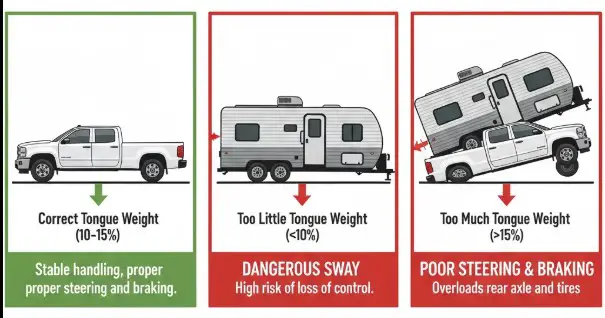
- Panel 1 (Correct): A diagram showing a truck and trailer level and balanced. Labeled: “Correct Tongue Weight (10-15%). Stable handling, proper steering, and braking.”
- Panel 2 (Incorrect – Low TW): A diagram showing the rear of the trailer squatting and the front of the trailer high, causing the truck’s rear to lift slightly. An arrow indicates a side-to-side oscillation at the rear of the trailer. Labeled: “Too Little Tongue Weight (<10%). DANGEROUS SWAY. High risk of loss of control.”
- Panel 3 (Incorrect – High TW): A diagram showing the trailer nose-down and the truck’s rear squatting severely, with its front wheels visibly light on the ground. Labeled: “Too Much Tongue Weight (>15%). POOR STEERING & BRAKING. Overloads rear axle and tires.”
How to Measure Tongue Weight
While specialized tongue weight scales are available, the most accurate and comprehensive method is to use a multi-platform certified scale, commonly found at truck stops (often called a CAT scale). The process involves taking two separate weight measurements:
- First Weighing (Combined Weight): Drive your fully-loaded truck and hitched trailer onto the scale. Position the truck’s front axle on the first platform and the rear axle on the second platform. The trailer axles should be on the third platform. Record the weights for each axle group.
- Second Weighing (Vehicle Only): Pull off the scale, find a safe place to unhitch the trailer, and drive only the fully-loaded truck back onto the scale. Record the new weights for the front and rear axles.
With these two measurements, you can determine all your critical weights:
- Gross Trailer Weight (GTW): Subtract the total weight of the truck (from the second weighing) from the total combined weight (from the first weighing).
- Tongue Weight (TW): Subtract the weight of the truck’s rear axle from the second weighing from the weight of the truck’s rear axle in the first weighing. The difference is the downward force the trailer was applying.
- Verification: Check that your calculated tongue weight is 10-15% of your calculated GTW. Also, ensure that none of your individual ratings (GVWR, GCWR, GAWR) have been exceeded.
Manufacturer Towing Guides & Resources
While this guide provides the methodology for calculating your towing capacity, the specific ratings for your vehicle must come from the manufacturer. These official guides are the ultimate source of truth for your vehicle’s capabilities.
- Ford: Ford provides comprehensive annual RV & Trailer Towing Guides that detail the specific capacities for every combination of model, engine, axle ratio, and configuration. These are the definitive resources for any Ford owner. You can find the official guides for your Ford vehicle here.
- Ram: Ram Trucks offers an online Towing & Payload Capacity Guide. This tool allows users to select their model year and vehicle to see the relevant specifications and towing charts. Access the(https://www.ramtrucks.com/towing/towing-capacity-guide.html).
- Chevrolet: Chevrolet maintains a Trailering & Towing Guide page with links to downloadable PDF guides for all of their trucks and SUVs. These detailed guides provide charts, definitions, and important safety information. The(https://www.chevrolet.com/trucks/trailering-and-towing-guide).
- Third-Party Resource: For decades, a trusted independent resource for towers has been the annual(https://www.rvda.org/RVDA/RVDA/Facts_Sheets_Members_Only/Tow_Rating_Resources.aspx). It compiles towing capacities for vehicles from nearly all manufacturers, providing a useful cross-brand reference. For an even deeper dive into towing terminology and equipment,(https://www.curtmfg.com/towing-capacity)
Conclusion: Tow Smart, Tow Safe
Navigating the world of towing capacities can seem daunting, but it boils down to a few core principles that prioritize safety above all else. By understanding and applying these principles, you can ensure every journey with a trailer is a safe one.
The key takeaways are:
- The advertised “Max Tow Rating” is a marketing figure and should be treated only as a theoretical starting point, not the final word.
- Payload is almost always the first limit you will hit. A vehicle’s ability to carry weight—including passengers, cargo, and the trailer’s tongue weight—is just as important as its ability to pull weight. Do the math on your payload before you even consider a trailer.
- Your true towing capacity is the lowest of your various limits. You must remain below your vehicle’s GCWR, GVWR, GAWR, and hitch rating at all times.
- Proper weight distribution is non-negotiable. Adhering to the 60/40 loading rule to achieve a tongue weight that is 10-15% of the total trailer weight is the most critical step in preventing dangerous and uncontrollable trailer sway.
Don’t guess, know. Before you hitch up and hit the road, do the math, check your vehicle’s door jamb stickers, and get your fully-loaded rig weighed at a certified scale. A few minutes of preparation and a few dollars spent at a scale can provide the peace of mind that comes from knowing you are operating safely, protecting your investment, your family, and everyone you share the road with.
Frequently Asked Questions (FAQs)
Q1: Does payload capacity affect towing capacity?
Absolutely, it is arguably the most critical factor. Your trailer’s tongue weight is subtracted directly from your vehicle’s available payload capacity. Once you add the weight of passengers and cargo in your truck, the remaining payload often becomes the true limiting factor for how heavy a trailer you can safely and legally tow.
Q2: Where can I find my truck’s exact weight ratings?
Your vehicle’s specific weight ratings can be found in two primary places. The GVWR and GAWR are printed on the Safety Compliance Certification Label in the driver’s side door jamb. Your vehicle’s specific Payload Capacity is on the Tire and Loading Information sticker, also in the door jamb. The GCWR and the manufacturer’s maximum trailer weight rating are located in your owner’s manual or in the official towing guide available on the manufacturer’s website.
Q3: How much does axle ratio really matter for towing?
It matters immensely for performance and vehicle longevity. A higher numerical axle ratio (e.g., 3.92:1, 4.10:1) provides significantly more pulling power by multiplying the engine’s torque more effectively. This makes towing feel easier, reduces strain on the engine and transmission, and improves control. A lower numerical ratio (e.g., 3.21:1) prioritizes fuel economy when unloaded but will cause the vehicle to work much harder when towing heavy loads.
Q4: Can I increase my truck’s towing capacity?
Officially and legally, no. The weight ratings set by the manufacturer (GVWR, GCWR, GAWR) are the result of extensive engineering and testing of the entire vehicle system, including the frame, suspension, brakes, and powertrain. These ratings are legal limits that cannot be changed. While aftermarket products like airbags or enhanced brakes can improve stability and handling within those established limits, they do not increase the vehicle’s certified maximum ratings.
Q5: What happens if I exceed my towing capacity?
Exceeding your vehicle’s towing capacity is extremely dangerous and can have severe consequences. It can lead to a catastrophic failure of the braking system, transmission overheating, suspension damage, or even a bent frame. It dramatically increases the risk of losing control due to trailer sway and can significantly lengthen stopping distances. Furthermore, in the event of an accident, operating beyond your vehicle’s legal limits could void your vehicle’s warranty and potentially your insurance coverage.