The Definitive Ram 1500 Towing Capacity Guide (2019-2025)

The 2025 Ram 1500 ushers in a new era of power and capability, boasting a maximum towing capacity of 11,580 pounds when properly equipped with the new 3.0L Hurricane Standard-Output engine. This model year marks a monumental shift in the Ram 1500’s powertrain strategy, as the legendary HEMI V8 makes way for the advanced, twin-turbocharged 3.0L Hurricane inline-six engine family. This transition from displacement to forced induction changes the landscape of Ram’s performance, efficiency, and towing dynamics.
This guide serves as the most comprehensive resource for understanding Ram 1500 towing capabilities. It provides not only detailed charts for the new 2025 models but also a complete historical look back at the peak HEMI and EcoDiesel years from 2019 to 2024. Furthermore, this report will demystify the complex factors that determine a truck’s true towing capacity, define critical terminology like GVWR and payload in practical terms, and offer real-world examples of what these numbers mean for you.
Ram 1500 Towing Capacity
An interactive visual guide to understanding the power and capability of the Ram 1500 lineup.
Maximum Available Towing
When equipped with the 5.7L HEMI® V8 engine with eTorque, the Ram 1500 achieves a best-in-class available V8 towing capacity. This impressive figure is the starting point for a versatile range of capabilities across different configurations.
Towing Capacity by Engine
The heart of the Ram 1500’s capability is its powertrain. This chart compares the maximum conventional towing capacity for each available engine, showing a clear hierarchy of power.
Payload vs. Tongue Weight
Towing isn’t just about pulling power; it’s also about what the truck can carry. This shows the maximum payload and how a typical 10% trailer tongue weight consumes a portion of that capacity.
How Configuration Affects Towing
Choosing your Ram 1500 involves more than just the engine. Selections like cab size, bed length, and drivetrain (4×2 vs. 4×4) create a matrix of possibilities, each with a specific towing limit. Follow the path to see how choices narrow down the final capability.
1. Choose Engine
5.7L HEMI V8
3.6L Pentastar V6
3.0L EcoDiesel V6
2. Select Cab & Bed
Quad Cab / 6’4″ Box
Crew Cab / 5’7″ Box
Crew Cab / 6’4″ Box
3. Pick Drivetrain
4×2 (Higher Towing)
4×4 (Lower Towing)
Result
Your Max
Towing
Towing Technology Spotlight
Modern trucks use advanced technology to make towing safer and easier. The Ram 1500 offers a suite of features designed to give you confidence when hauling heavy loads.
-
⚙️
eTorque Mild Hybrid System
Adds torque during shifts and launch for smoother power delivery without sacrificing efficiency.
-
💨
Active-Level™ Four Corner Air Suspension
Automatically lowers the truck at highway speeds to reduce drag and improve fuel economy.
-
🔗
Trailer Reverse Steering Control
Allows you to steer the trailer with a knob while the system controls the truck’s steering wheel.
-
👁️
Blind Spot Monitoring with Trailer Detection
Scans the blind spot zones behind the vehicle and alongside the trailer.
Ram 1500 vs. The Competition
How does the Ram 1500 stack up against its main rivals? This chart compares the maximum available towing capacities for the top half-ton trucks on the market.
2025 Ram 1500 Towing & Payload Capacity Charts
The 2025 model year introduces three distinct powertrain options, each with its own unique performance profile. Understanding the maximum capabilities of each engine is the first step in selecting the right truck for your needs.
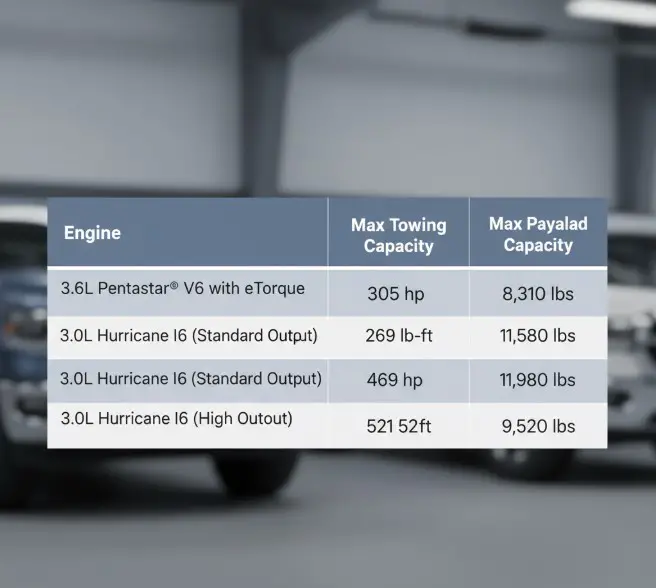
2025 Ram 1500 Towing Capacity at a Glance (By Engine)
For a quick overview, the following chart summarizes the maximum potential towing and payload capacities for each of the 2025 Ram 1500’s new engines. These figures represent the highest possible rating, which requires a very specific vehicle configuration.
A clear, concise table showing the top-line specs for each new engine, allowing for quick comparison.
| Engine | Horsepower | Torque | Max Towing Capacity | Max Payload Capacity |
| 3.6L Pentastar® V6 with eTorque | 305 hp | 269 lb-ft | 8,110 lbs | 2,370 lbs |
| 3.0L Hurricane I6 (Standard Output) | 420 hp | 469 lb-ft | 11,580 lbs | 1,980 lbs |
| 3.0L Hurricane I6 (High Output) | 540 hp | 521 lb-ft | 9,920 lbs | 1,520 lbs |
A notable point from this data is that the most powerful engine—the 540-horsepower High-Output (HO) Hurricane—does not provide the highest towing capacity. The Standard-Output (SO) version, with 120 fewer horsepower, actually tows 1,660 pounds more. This is not due to a lack of power in the HO engine. Instead, it is a result of vehicle configuration and tuning. The HO engine is primarily reserved for the heaviest, most feature-laden luxury trims like the Limited, Limited Longhorn, and Tungsten, as well as the specialized, off-road-focused RHO model.
The higher curb weight of these premium trims reduces the available towing capacity within the truck’s Gross Combined Weight Rating (GCWR). The RHO model’s towing is further limited by its unique suspension, which is engineered for high-speed desert running and wheel articulation rather than maximum load-bearing strength.
Detailed 2025 Ram 1500 Towing Chart (By Full Configuration)
A truck’s maximum advertised towing capacity is rarely the number applicable to every version of that truck. The true rating is highly specific and depends on a combination of four critical factors: Engine, Drivetrain (4×2 vs. 4×4), Cab/Bed Size, and Axle Ratio. The following table, built from the official 2025 Ram Towing Capacity Guide, provides the granular data needed to find the precise rating for a specific configuration.
A detailed, multi-column table that allows users to look up a specific truck configuration (engine, cab, drivetrain, axle ratio) to find its exact J2807-compliant tow rating.
2025 Ram 1500 Maximum Trailer Weight (lbs) – SAE J2807 Compliant
| Engine | Drivetrain | Cab / Bed | Axle Ratio | Max Towing (lbs) |
| 3.6L Pentastar V6 | 4×2 | Quad Cab / 6’4″ | 3.55 | 8,110 |
| 3.6L Pentastar V6 | 4×4 | Quad Cab / 6’4″ | 3.55 | 7,480 |
| 3.6L Pentastar V6 | 4×2 | Crew Cab / 5’7″ | 3.55 | 7,580 |
| 3.6L Pentastar V6 | 4×4 | Crew Cab / 5’7″ | 3.55 | 7,370 |
| 3.0L Hurricane SO | 4×2 | Quad Cab / 6’4″ | 3.92 | 11,550 |
| 3.0L Hurricane SO | 4×4 | Quad Cab / 6’4″ | 3.92 | 11,450 |
| 3.0L Hurricane SO | 4×2 | Crew Cab / 5’7″ | 3.92 | 11,510 |
| 3.0L Hurricane SO | 4×4 | Crew Cab / 5’7″ | 3.92 | 11,340 |
| 3.0L Hurricane SO | 4×2 | Crew Cab / 6’4″ | 3.92 | 11,480 |
| 3.0L Hurricane SO | 4×4 | Crew Cab / 6’4″ | 3.92 | 11,260 |
| 3.0L Hurricane HO | 4×4 | Crew Cab / 6’4″ | 3.92 | 9,920 |
| 3.0L Hurricane HO | 4×4 | Crew Cab / 5’7″ | 3.92 | 9,340 |
| 3.0L Hurricane HO (RHO) | 4×4 | Crew Cab / 5’7″ | 3.92 | 8,380 |
Understanding 2025 Ram 1500 Payload Capacity
While towing capacity gets the headlines, payload capacity is an equally critical, and often more restrictive, metric for safe hauling. Payload is the total weight a truck can carry in its cab and bed, which includes all passengers, cargo, and—most importantly—the downward force of a trailer’s tongue weight.
For 2025, the Ram 1500 achieves its highest payload capacity of 2,370 pounds when equipped with the 3.6L Pentastar V6 engine in a 4×2 Quad Cab configuration. There is a clear inverse relationship between engine power and maximum payload capacity across the lineup. The payload ratings descend as engine power increases: the 3.6L V6 offers up to 2,370 pounds, the 3.0L Hurricane SO provides up to 1,980 pounds, and the 3.0L Hurricane HO is rated for up to 1,520 pounds. This is because the more powerful Hurricane engines, with their twin turbochargers and associated hardware, are physically heavier than the Pentastar V6. Since payload is calculated as
Payload = GVWR - Curb Weight, a heavier engine increases the truck’s curb weight, which directly subtracts from the available payload capacity. This creates a crucial trade-off: buyers who need to maximize what they can carry in the truck—such as contractors with heavy tools or families with a slide-in camper—are best served by the 3.6L V6, even though it has a lower towing rating.
Ram 1500 Towing Capacity by Model Year (2019-2024)
For the significant number of buyers in the used truck market, understanding the capabilities of previous model years is essential. This period represents the zenith of the HEMI V8 and the popular EcoDiesel engine.
Ram 1500 Max Towing Capacity (2019-2025): A Historical View
A look at the maximum towing capacity over the last several model years reveals a clear trend. The period from 2019 to 2024 stands out as the peak for the Ram 1500’s towing prowess.
A simple table showing the maximum towing capacity for each year, highlighting the peak years and the key engine responsible.
| Year | Max Towing Capacity | Key Engine for Max Towing |
| 2025 | 11,580 lbs | 3.0L Hurricane SO |
| 2024 | 12,750 lbs | 5.7L HEMI V8 w/ eTorque |
| 2023 | 12,750 lbs | 5.7L HEMI V8 w/ eTorque |
| 2022 | 12,750 lbs | 5.7L HEMI V8 w/ eTorque |
| 2021 | 12,750 lbs | 5.7L HEMI V8 w/ eTorque |
| 2020 | 12,750 lbs | 5.7L HEMI V8 w/ eTorque |
| 2019 | 12,750 lbs | 5.7L HEMI V8 w/ eTorque |
The data clearly shows that the 2019-2024 model years represent the “golden age” of Ram 1500 towing, with a consistent peak rating of 12,750 pounds. This class-leading figure was achieved with a very specific configuration: a Tradesman or Lone Star trim equipped with the 5.7L HEMI V8 with the eTorque mild-hybrid system, a Quad Cab, and a 4×2 drivetrain. For buyers whose primary and overriding priority is achieving the absolute highest tow rating possible in a half-ton Ram, the 2019-2024 used market is the definitive answer.
2024 Ram 1500 Towing Capacity Chart
The 2024 model year was the final farewell for the venerable HEMI V8 in the Ram 1500. Its capabilities are summarized below.
| Engine | Max Towing Capacity | Max Payload Capacity |
| 3.6L Pentastar V6 w/ eTorque | 7,730 lbs | 2,300 lbs |
| 5.7L HEMI V8 w/ eTorque | 12,750 lbs | 1,860 lbs |
| Supercharged 6.2L HEMI V8 (TRX) | 8,100 lbs | 1,360 lbs |
2019-2023: The HEMI and EcoDiesel Era
This period was defined by a diverse engine lineup. Alongside the dominant HEMI V8, the 3.0L EcoDiesel V6 was a popular choice for those prioritizing torque and fuel efficiency. The EcoDiesel produced a stump-pulling 480 lb-ft of torque and achieved an impressive peak towing capacity of 12,560 pounds in the 2022 model year. This engine was discontinued after early 2023, making used models from 2020-2023 the only way to acquire this capable and efficient powertrain in the fifth-generation Ram 1500.
Understanding the Numbers: Key Factors Affecting Towing Capacity
The numbers in the charts are the final result of a complex engineering equation. Understanding the variables in that equation is key to comprehending why a truck is rated the way it is.
Engine Power is Only Half the Story
While engine output is fundamental, the roles of horsepower and torque are distinct. Torque is the rotational force that gets a heavy load moving from a standstill, while horsepower is the power that maintains that speed, especially up grades. As demonstrated with the 2025 Hurricane engines, more horsepower does not automatically translate to a higher tow rating; factors like vehicle weight and configuration are just as important.
Axle Ratio Explained: The Unsung Hero of Towing
The axle ratio is one of the most critical yet least understood components in towing. In simple terms, it acts as a torque multiplier, similar to the gears on a bicycle.
- A higher numerical ratio (e.g., 3.92) means the engine’s driveshaft turns more times for every one rotation of the wheels. This multiplies the engine’s torque, making it much easier to pull heavy loads from a stop. This is the preferred ratio for maximum towing.
- A lower numerical ratio (e.g., 3.21) is better for fuel efficiency and quiet highway cruising, as the engine runs at a lower RPM. However, it provides less pulling power and results in a lower tow rating.
How Cab, Bed, and Drivetrain Choices Impact Your Rating
The physics of towing are simple: every pound of the truck itself is a pound that cannot be allocated to the trailer and its cargo within the vehicle’s GCWR.
- Cab and Bed Size: A spacious Crew Cab is heavier than a Quad Cab. A long bed (6’4″) is heavier than a short bed (5’7″). Therefore, the lightest configurations, typically a 4×2 Quad Cab, often boast the highest tow ratings.
- Drivetrain: A 4×4 system adds significant weight from components like a transfer case, front differential, and front axles. This added weight is why 4×2 trucks consistently have slightly higher maximum tow ratings than their 4×4 counterparts. For those who don’t need off-road capability, a 4×2 configuration is the key to unlocking maximum towing potential.
Towing Terminology You MUST Know
To tow safely and legally, it is imperative to understand the language of vehicle weight ratings. These acronyms are not just suggestions; they are hard safety limits set by the manufacturer.
Towing Capacity vs. Payload Capacity: What’s the Difference?
These two terms are often confused but are fundamentally different.
- Towing Capacity: The maximum weight you can pull behind the truck with a trailer.
- Payload Capacity: The maximum weight you can carry in the truck’s cab and bed.
Crucially, payload capacity includes the weight of all passengers, any cargo in the truck, and the trailer’s tongue weight.
GVWR vs. GCWR: The Two Most Important Acronyms
These are the foundational ratings from which all other capacities are derived.
- GVWR (Gross Vehicle Weight Rating): This is the absolute maximum permissible weight of the fully loaded truck. It is calculated as the truck’s curb weight plus all of its payload (passengers, cargo, and tongue weight). You must never exceed the GVWR, which can be found on the sticker inside the driver’s door jamb. The formula is:
.
- GCWR (Gross Combined Weight Rating): This is the absolute maximum permissible weight of the fully loaded truck and the fully loaded trailer combined. This master rating, determined by the manufacturer’s engineers, dictates the vehicle’s maximum towing capacity.
The Critical Role of Tongue Weight
Tongue weight is the downward force that the trailer’s coupler exerts on the truck’s hitch ball. For a conventional trailer, it should be 10-15% of the total loaded trailer weight to ensure stable, sway-free towing.
This is where many towers make a critical mistake. While a truck may be well within its maximum towing capacity, it can be dangerously overloaded in terms of payload. The trailer’s tongue weight counts against the truck’s payload capacity and its GVWR.
Consider this common scenario:
- A truck has a payload capacity of 1,800 pounds and a towing capacity of 11,500 pounds.
- The owner hooks up a 10,000-pound travel trailer, which is well under the max tow rating.
- Using the 13% rule for tongue weight, that 10,000-pound trailer places 1,300 pounds of force directly onto the truck’s hitch.
- This 1,300 pounds is immediately subtracted from the truck’s payload capacity:
.
- This leaves only 500 pounds of remaining payload capacity for the driver, all passengers, and any gear inside the truck’s cab or bed. A family of four could easily exceed this limit, overloading the truck’s suspension, axles, and tires, even while being “under” the advertised tow rating. This makes understanding payload the single most important factor for safe towing.
What is the SAE J2807 Standard?
All modern trucks, including the Ram 1500, have their towing capacities rated according to the SAE J2807 standard. This is a standardized set of rigorous performance tests developed by the Society of Automotive Engineers to create a level playing field for all manufacturers. Before this standard, manufacturers could essentially invent their own testing criteria, leading to inflated and inconsistent numbers.
Key tests a vehicle must pass to earn its J2807 rating include acceleration tests on flat ground, braking performance evaluations, and the infamous “Davis Dam” grade climb. This test requires a fully loaded truck and trailer to climb a steep, 11-mile grade in 100°F heat while maintaining a minimum speed, ensuring the cooling and powertrain systems can handle extreme stress. For more information, the(
https://en.wikipedia.org/wiki/SAE_J2807) provides an excellent overview.
What Can the Ram 1500 Actually Tow? (Real-World Examples)
Translating these numbers into tangible examples helps put the Ram 1500’s capabilities into perspective.
- Towing up to 8,000 lbs (e.g., 3.6L V6 models): This range is ideal for most recreational towing needs. It can comfortably handle typical ski boats, a pair of jet skis on a tandem trailer, most pop-up campers, and small-to-midsize travel trailers.
- Towing up to 11,500 lbs (e.g., 3.0L Hurricane SO / 5.7L HEMI models): This level of capability is for serious hauling. It can manage larger travel trailers (in the 25-30 foot range), substantial center-console boats, and car hauler trailers with a second vehicle.
- Towing 12,750 lbs (e.g., properly equipped 2019-2024 HEMI eTorque): This is the absolute peak for the Ram 1500 platform. This capacity is sufficient for large travel trailers, some smaller fifth-wheel trailers (while paying extremely close attention to payload limits), and equipment trailers carrying heavy machinery like a skid steer or mini-excavator.
Frequently Asked Questions (FAQ)
Which Ram 1500 has the highest towing capacity?
For the 2025 model year, the Ram 1500 configured with the 3.0L Hurricane Standard Output engine, 4×2 drivetrain, Quad Cab, and 3.92 axle ratio has the highest towing capacity at 11,580 pounds. Historically, the 2019-2024 models with the 5.7L HEMI V8 with eTorque hold the all-time record for the Ram 1500 at 12,750 pounds.
How much can a Ram 1500 with a HEMI V8 tow?
The last generation of Ram 1500 (model years 2019-2024) equipped with the 5.7L HEMI V8 with the eTorque mild-hybrid system could tow a maximum of 12,750 pounds when properly configured. The version without eTorque was rated slightly lower, typically around 11,610 pounds.27
Did the 2025 Ram 1500 lose towing capacity?
Compared to the absolute peak rating of the previous generation’s HEMI V8 (12,750 lbs), the 2025 model’s maximum rating is lower at 11,580 lbs. However, the new standard 3.0L Hurricane engine offers significantly more horsepower and torque than the outgoing 5.7L HEMI, providing superior real-world performance for the majority of configurations.
Can a Ram 1500 tow a fifth-wheel trailer?
While technically possible for some of the lightest fifth-wheel models, it is generally not recommended. The primary limiting factor is the truck’s payload capacity. The heavy pin weight of a fifth-wheel trailer (which can be 15-25% of the trailer’s weight) can easily overload the Ram 1500’s rear axle and suspension. For safe and stable fifth-wheel towing, a heavy-duty truck like the Ram 2500 is the appropriate choice.
What is the Ram 1500 Max Tow Package?
The Max Tow Package is an optional equipment group available on specific trims (historically the Tradesman and Big Horn/Lone Star) designed to unlock the truck’s highest advertised tow rating. It typically includes the most aggressive axle ratio (3.92), an integrated trailer brake controller, upgraded mirrors, and sometimes enhanced cooling to achieve the maximum SAE J2807-certified capacity.
Conclusion: Choosing the Right Ram 1500 for Your Towing Needs
The 2025 Ram 1500 marks a bold step into the future with its powerful and technologically advanced Hurricane engine family, delivering a formidable maximum towing capacity of up to 11,580 pounds. This new lineup prioritizes horsepower, torque, and modern engineering, setting a new standard for the brand.
However, the data reveals a clear choice for prospective buyers. For those whose sole mission is to secure the highest possible towing number in a Ram 1500, a well-maintained used model from 2019-2024 with the 5.7L HEMI V8 and eTorque remains the undisputed champion at 12,750 pounds. For drivers who value the latest technology, superior horsepower, and excellent all-around capability, the 2025 lineup is the clear path forward.