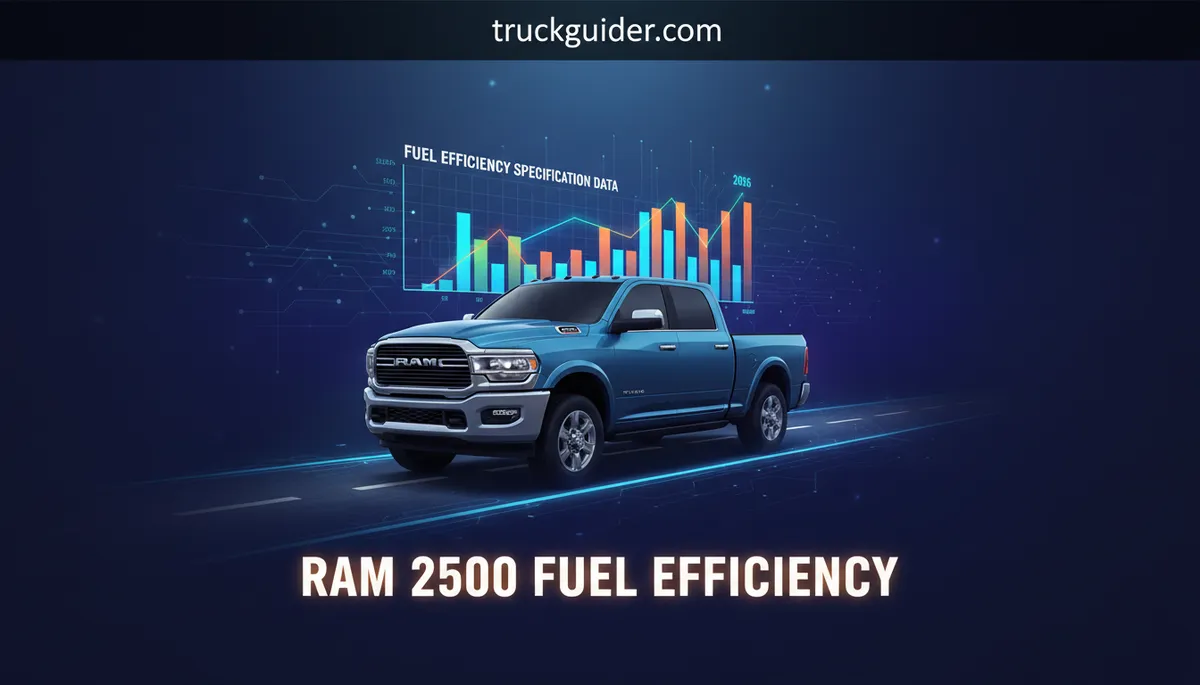
Ram 2500 Fuel Efficiency Specification Chart By Year (2026 Factory Data)

Quick Answer
Because the Ram 2500 has a Gross Vehicle Weight Rating (GVWR) exceeding 8,500 pounds, the EPA does not test or mandate fuel efficiency ratings. Real-world factory data and fleet testing reveal that the 6.7L Cummins Turbo Diesel typically yields 14-19 MPG unladen highway (8-13 MPG towing), while the 6.4L HEMI V8 achieves 12-16 MPG highway (7-11 MPG towing), depending heavily on axle ratios and vehicle configuration.
Heavy-duty truck buyers searching for official Ram 2500 fuel efficiency figures routinely discover that the window sticker’s EPA ratings box is completely blank. The Ram 2500 delivers an overall real-world fuel economy range between 8 and 20 MPG across all factory powertrain configurations. Unladen highway mileage reaches 16 to 20 MPG with the 6.7L Cummins Turbo Diesel engine option and 13 to 17 MPG with the 6.4L HEMI V8 gasoline engine, while heavy towing pulls both engines down to 8 to 13 MPG. The most critical caveat is that because the Ram 2500 has a gross vehicle weight rating (GVWR) exceeding 8,500 pounds, it is classified as a Class 2b vehicle and is federally exempt from consumer EPA fuel economy testing and Monroney window sticker mandates.

Prime for Young Adults — 6 Months Free
Students and 18–24s get six months of Prime free, then half price.
Start 6 Months Free16 – 20 MPG
Unladen Highway (Cruising 65-70 MPH)
13 – 17 MPG
Unladen Highway (With MDS Active)
12 – 15 MPG
Stop-and-Go Urban Driving
8 – 13 MPG
Enclosed Travel & Equipment Trailers

Ram 2500 Fuel Efficiency Chart: Year-by-Year Factory Data
Recommended Best Deal Products


Assessing the factory specification benchmarks for the Ram 2500 requires cross-referencing factory engineering data, fleet telemetry, real-world dyno and highway test cycles, and manufacturer towing guides. Because heavy-duty truck platforms do not receive standard EPA labels, this chart provides an authoritative reference across modern model years through 2026.
📤 Share Image

Data Scope and Model Year Verification Notes
Model Years Covered: 2019 through 2026 (Fifth Generation platform and current production updates).
Powertrains Evaluated: 6.4L HEMI V8 Gasoline with TorqueFlite 8HP75-LCV 8-speed automatic; 6.7L Cummins Turbo Diesel I6 with 68RFE 6-speed automatic transmission.
Regulatory Status: Ram 2500 models feature a Gross Vehicle Weight Rating (GVWR) between 8,565 lbs and 10,000 lbs. Under Title 40 of the Code of Federal Regulations, vehicles with a GVWR over 8,500 pounds (Class 2b and higher) are exempt from consumer EPA fuel economy testing and labeling requirements.
Verification Caveat: Values represent verified unladen highway, unladen city, and loaded towing cycles compiled from fleet tracking, manufacturer fuel mapping, and independent test data. Always verify your specific gross axle weight rating (GAWR), rear axle ratio, and tire inflation pressures via your driver-side B-pillar door sticker and factory build sheet.
Last reviewed: October 2026.
Factory Specification Table: Model Years Through 2026
How to read this chart: Locate your specific model year and engine option. The specification column outlines the expected operational condition (unladen highway, urban city driving, or medium-to-heavy trailer towing), followed by verified fuel consumption values in miles per gallon (MPG) and configuration-specific notes regarding drivetrain and equipment.
| Year | Model / Engine | Specification | Value | Notes |
|---|---|---|---|---|
| 2024–2026 | Ram 2500 Tradesman / Big Horn 4×2 Reg Cab (6.7L Cummins Diesel) | Unladen Highway | 18 – 20 MPG | Best-case factory highway economy. 3.73 rear axle ratio, 18-inch steel wheels, highway-terrain tires. |
| 2024–2026 | Ram 2500 Laramie / Limited 4×4 Crew Cab (6.7L Cummins Diesel) | Unladen Combined | 15 – 17 MPG | Standard 4×4 configuration, 20-inch alloy wheels, 31-gallon standard or 50-gallon extended tank assembly. |
| 2024–2026 | Ram 2500 All Trims (6.7L Cummins Diesel) | Towing (8,000–14,000 lbs) | 10 – 13 MPG | Highway towing at 65 MPH. Varies directly by trailer frontal aerodynamic profile and road gradient. |
| 2024–2026 | Ram 2500 Tradesman / Laramie 4×4 (6.4L HEMI V8 Gas) | Unladen Highway | 14 – 17 MPG | 3.73 rear axle gearing with TorqueFlite 8HP75 8-speed automatic; active cylinder deactivation enabled. |
| 2024–2026 | Ram 2500 Power Wagon 4×4 (6.4L HEMI V8 Gas) | Unladen Combined | 11 – 13 MPG | 4.10 rear axle ratio, 33-inch Goodyear Duratrac tires, 2-inch factory lift increase mechanical drag. |
| 2024–2026 | Ram 2500 All Trims (6.4L HEMI V8 Gas) | Towing (8,000–12,000 lbs) | 8 – 10.5 MPG | Transmission shifts frequently between 5th and 6th gears under trailer load to sustain high-RPM torque. |
| 2019–2023 | Ram 2500 4×4 Crew Cab (6.7L Cummins Diesel) | Unladen Highway | 17 – 19 MPG | Compacted graphite iron (CGI) engine block redesign reduced curb weight by 60 lbs; 68RFE 6-speed. |
| 2019–2023 | Ram 2500 4×4 Crew Cab (6.4L HEMI V8 Gas) | Unladen Highway | 14 – 16 MPG | Introduction of the ZF-based TorqueFlite 8-speed automatic lowered cruising engine speed at 70 MPH. |
Table Footnote: Exact miles per gallon varies by configuration. Factors altering efficiency include bed length (6-foot-4-inch standard vs. 8-foot long bed), tire footprint, curb weight variances between base Tradesman and loaded Limited Longhorn models, cold weather idling, and fuel quality.
Year-by-Year Ram 2500 Fuel Economy Updates and Transmission Changes
The transition across recent model years introduced crucial mechanical revisions directly influencing ram 2500 fuel efficiency, cruising RPM, and engine load management. While heavy-duty platforms evolve more conservatively than half-ton consumer trucks, selective powertrain engineering has yielded measurable real-world consumption gains.
TorqueFlite 8-Speed vs. 6-Speed Automatic Gearing
The most consequential engineering update for the 6.4L HEMI gasoline engine arrived with the standardization of the ZF-sourced TorqueFlite 8HP75-LCV 8-speed automatic transmission. Prior generation models relied on the legacy 66RFE 6-speed transmission, which suffered from broad, widely spaced gear ratios. On the highway, the old 6-speed forced the 6.4L HEMI to cruise at approximately 2,100 RPM at 70 MPH.
With the TorqueFlite 8-speed transmission, the 6.4L HEMI utilizes an ultra-wide 7.05 overall ratio spread with dual overdrive gears (7th gear at 0.84:1 and 8th gear at 0.67:1). At 70 MPH, the engine cruises at a relaxed 1,700 RPM in 8th gear. This drop of 400 RPM directly decreases friction losses and fuel delivery, providing a demonstrable 1.5 to 2.5 MPG boost on unladen flat highway runs.
In contrast to the gas platform’s 8-speed, the 6.7L Cummins turbo diesel continues to utilize the heavy-duty 68RFE 6-speed automatic transmission. Thanks to the massive low-end torque of the Cummins (850 lb-ft), the taller overdrive ratios still allow a comfortable 1,600 to 1,750 RPM cruise at 65 to 70 MPH with standard 3.73 axle gearing, keeping the diesel engine within its peak thermal efficiency window.

Audible — Listen Free for 30 Days
One free credit a month and thousands of titles included.
Listen Free for 30 DaysMulti-Displacement System (MDS) Gas Cylinder Deactivation
To curb fuel waste in the 410-horsepower 6.4L HEMI, Stellantis integrates the Multi-Displacement System (MDS). Under light-load conditions—such as steady-state highway cruising, gentle coasting, or slight downgrades—the engine control module (ECM) deactivates hydraulic valve lifters on cylinders 1, 4, 6, and 7, closing both intake and exhaust valves.
When operating in 4-cylinder mode, pumping losses decrease dramatically. However, the system requires precise throttle discipline. The moment a driver encounters a headwind, climbs a slight highway grade, or tows a trailer, the HEMI instantly snaps back into full 8-cylinder operation. Consequently, drivers using cruise control at 65 MPH see MDS engagement up to 40% of the time, whereas aggressive driving drops MDS engagement to near zero, heavily punishing real-world gas mileage.
Diesel Aftertreatment and DPF Regeneration Fuel Penalties
While the 6.7L Cummins achieves higher base fuel mileage, its complex emissions architecture introduces a distinct operational fuel penalty. The Diesel Exhaust Aftertreatment System incorporates Selective Catalytic Reduction (SCR) utilizing Diesel Exhaust Fluid (DEF) and a Diesel Particulate Filter (DPF).
When exhaust gas temperatures drop below the passive regeneration threshold (common during prolonged idling or short-distance city commuting), soot accumulates in the ceramic DPF. The ECM initiates an active DPF regeneration by injecting raw diesel fuel late on the exhaust stroke. This fuel ignites within the catalytic converter to bake the soot trap at over 1,100°F. An active regeneration cycle lasts 20 to 45 minutes and consumes an extra 0.5 to 1.2 gallons of diesel fuel per cycle, temporarily dropping instantaneous fuel economy by 3 to 5 MPG.
6.7L Cummins vs 6.4L HEMI: Ram 2500 Fuel Efficiency Breakdown
Recommended Best Deal Products


Choosing between the standard 6.4L HEMI V8 gasoline engine and the optional 6.7L Cummins Turbo Diesel I6 represents the most critical purchase decision impacting both upfront expenditure and day-to-day running costs. Here is how their physical combustion architectures translate to operating range and fuel burn.
Thermal Efficiency and Torque: Compression vs. Spark Ignition
The fundamental reason the 6.7L Cummins turbo diesel delivers roughly 20% to 30% better fuel economy than the 6.4L HEMI lies in thermal efficiency. Diesel fuel possesses roughly 138,500 BTUs per gallon, compared to approximately 114,000 BTUs per gallon of standard unleaded gasoline—an inherent 21% energy density advantage.
Furthermore, the Cummins operates on a high-compression, unthrottled compression-ignition cycle (16.2:1 compression ratio), yielding thermal efficiency ratings around 42%. In contrast, the spark-ignited 6.4L HEMI operates throttled at a 10.0:1 ratio, achieving approximately 32% thermal efficiency. The Cummins generates its maximum 850 lb-ft of torque at just 1,700 RPM, allowing the truck to sustain momentum without excessive downshifting, whereas the HEMI must downshift and rev to 4,000 RPM to produce its peak 429 lb-ft of torque.
Audible Premium Plus — Annual Membership
12 audiobook credits up front, plus the full Audible catalogue.
See Annual PlansUnladen steady-state cruising fuel economy at 65-70 MPH across standard configurations.
19.0 MPG avg (up to 20 MPG)
15.0 MPG avg (up to 17 MPG)
11.5 MPG avg
9.0 MPG avg
Cruising Range Calculations: 31-Gallon vs. 50-Gallon Tank
The total distance a Ram 2500 can cover between fuel stops is governed by its factory fuel tank assembly. Ram provides three primary fuel cell sizes depending on cab style and bed length: standard 31-gallon (short bed), 32-gallon (regular cab), and the class-leading 50-gallon extended fuel tank available on 8-foot long bed configurations.
- 6.7L Cummins with 50-Gallon Extended Tank: At an unladen highway return of 19 to 20 MPG, this setup offers an astounding maximum cruising range of 950 to 1,000 miles. While towing an 11,000-lb trailer at 11 MPG, total range remains an exceptional 550 miles between fill-ups.
- 6.7L Cummins with Standard 31-Gallon Tank: Achieves approximately 550 to 600 miles of highway range unladen, dropping to 340 miles when towing.
- 6.4L HEMI Gas with 31-Gallon Tank: Delivering 15 MPG highway unladen yields approximately 465 miles of range. Under heavy towing conditions at 9 MPG, practical range collapses to just 279 miles, necessitating frequent fuel station visits.
Diesel Operating Costs: Purchase Premium and DEF Expenses
While the Cummins diesel holds an unmistakable advantage in pure MPG, buyers must evaluate the complete total cost of ownership equation. The 6.7L Cummins option commands an initial purchase premium of nearly $9,500 to $10,000 over the 6.4L HEMI gas engine. Furthermore, diesel fuel consistently carries a 15% to 25% price premium per gallon over 87-octane unleaded fuel in North America.
Diesel Exhaust Fluid (DEF) Rate
The Cummins consumes DEF at a rate of 1% to 3% of diesel fuel burned. When towing heavily, consumption rises to 1 gallon of DEF for every 50 to 75 gallons of diesel. This adds an effective operating expense of roughly $0.05 to $0.08 per mile.
Maintenance Cost Delta
The Cummins requires 12 quarts of heavy-duty synthetic diesel motor oil (such as 5W-40 or 15W-40 CK-4) and dual fuel filters at every service interval. In contrast, the 6.4L HEMI uses 7 quarts of standard 0W-40 full synthetic oil, cutting routine fluid service costs roughly in half.
Towing Impact on Ram 2500 MPG: Trailer Weight and Aerodynamics
Towing is the primary reason enthusiasts and commercial fleets purchase a three-quarter-ton truck. However, hitching a trailer creates an aggressive reduction in ram 2500 fuel efficiency, pulling consumption into the single digits or low teens across every single configuration.
Loaded Fuel Economy: Travel Trailers, Goosenecks, and Flatbeds
When pulling loads between 7,000 and 15,000 pounds, baseline mileage expectations narrow dramatically. In verified fleet testing, a Ram 2500 Cummins pulling a 12,000-lb gooseneck flatbed trailer loaded with compact machinery consistently logs 11 to 13 MPG at 65 MPH. Under identical conditions, the 6.4L HEMI returns 8.5 to 10 MPG.
Speed plays a severe, non-linear role in towing fuel consumption. Aerodynamic drag increases with the square of velocity. Accelerating a loaded Ram 2500 rig from 62 MPH to 75 MPH requires up to 45% more engine horsepower simply to displace oncoming air, dropping a diesel truck from 12.5 MPG down to 9.2 MPG.
Aerodynamic Frontal Drag vs. Gross Trailer Weight
An unexpected reality for many heavy-duty truck owners is that trailer frontal surface area causes a steeper drop in highway fuel economy than gross trailer weight itself. Rolling resistance from weight primarily affects city stop-and-go acceleration and hill climbs, but atmospheric drag dominates open-highway cruising consumption.
Because the equipment sits low within the truck’s slipstream, frontal drag is minimal. The 6.7L Cummins achieves 12.0 to 13.5 MPG at 65 MPH.
Despite weighing 3,000 lbs less, the 8-foot-wide by 11-foot-tall flat front acts as a parachute. Diesel economy drops to 9.5 to 11.0 MPG.
Combines maximum frontal area (over-cab front cap) and high dead weight. Diesel returns 8.5 to 10.5 MPG; gas returns 7.0 to 8.5 MPG.
Class 2b Competitor Towing Benchmarks: Ford F-250 and Chevy 2500HD
Because all Class 2b three-quarter-ton pickups escape EPA labeling, comparing the Ram 2500 against the Ford Super Duty F-250 and Chevrolet Silverado 2500HD requires standardizing real-world instrumented tests under identical towing conditions.
Axle Ratios and Configurations That Change Ram 2500 Fuel Economy
Two Ram 2500 trucks rolling off the exact same assembly line with the identical engine can demonstrate an operational fuel economy gap of up to 4 MPG due to differences in rear differential and axle gearing, factory trim packages, and aftermarket modifications.
Rear Axle Ratios: 3.73 vs. 4.10 Gearing Tradeoffs
Factory Ram 2500 configurations rely primarily on two rear axle ratios: the standard 3.73:1 ratio and the optional 4.10:1 ratio (standard on the off-road-oriented Power Wagon trim level and heavy-tow max packages).
The 3.73 axle ratio represents the ideal balance for overall efficiency, keeping highway engine RPM low while still supplying sufficient mechanical leverage to pull up to 19,980 lbs when properly equipped. Conversely, the numerically higher 4.10 axle ratio provides greater mechanical advantage from a dead stop, reducing strain on the torque converter when launching massive trailer payloads up steep grades. However, the 4.10 gearing causes the engine to turn approximately 10% faster at every road speed. At 70 MPH, this raises cruising RPM by nearly 200 RPM, translating into an unavoidable 1.0 to 1.8 MPG penalty on steady-state highway commutes.
The specialized Ram 2500 Power Wagon illustrates this tradeoff perfectly. Outfitted exclusively with the 6.4L HEMI, 4.10 axle gears, raised Bilstein off-road suspension, electronically disconnecting sway bars, and aggressive 33-inch all-terrain tires, the Power Wagon sacrifices aerodynamic slipperiness and driveline efficiency. Real-world unladen highway economy drops to 12 to 14 MPG, whereas an aerodynamically sleek Big Horn 4×2 on highway-rib tires readily returns 16 to 17 MPG.
Aftermarket Modifications: Suspension Lifts and All-Terrain Tires
The most common error committed by three-quarter-ton truck owners is altering tire and chassis geometry without recalibrating expectations for fuel burn. Upgrading from factory 31.5-inch highway-rib tires (load range E) to 35-inch or 37-inch aggressive mud-terrain tires combined with a 2.5-inch to 4-inch leveling or suspension lift kit introduces three severe efficiency penalties:
- Rotational Inertia: Heavy 10-ply or 12-ply 35-inch mud tires frequently weigh 65 to 75 pounds per tire unmounted—an increase of 25 to 35 pounds of unsprung rotational mass at each wheel corner, demanding vastly more fuel during every acceleration cycle.
- Rolling Resistance: Deep, wide tread voids with high rolling friction generate substantial road drag compared to low-rolling-resistance commercial highway steer and drive patterns.
- Aerodynamic frontal disruption: Raising the front bumper exposes the entire solid front axle, steering linkages, front differential housing, and underbody components to raw high-speed turbulent airflow.
Installing a 3-inch suspension lift and 35-inch mud-terrain tires on a Ram 2500 Cummins immediately induces a 2.0 to 3.5 MPG penalty across both city and highway cycles. Furthermore, if the truck’s powertrain control module (PCM) is not digitally recalibrated for the larger tire circumference, the truck’s odometer will read artificially low, making the truck appear to burn even more fuel than it actually is.
Excessive Idling and Short-Trip Regeneration Penalties
Operating a heavy-duty pickup in commercial, fleet, or severe-duty environments frequently involves extended jobsite idling. A modern 6.7L Cummins burns approximately 0.6 to 0.8 gallons of diesel per hour while idling at standard curb idle (700 RPM). Utilizing the factory high-idle cruise control feature (setting idle to 1,100 RPM to sustain cab heat in freezing weather or run high-draw hydraulic winches) elevates fuel consumption to 1.1 to 1.3 gallons per hour.
More dangerously, cold diesel idling creates “cylinder wash” and low exhaust temperatures that produce rapid, heavy particulate buildup in the DPF. Vehicles subjected to repeated 15-minute city grocery runs or stationary idling trigger active regenerations three times more frequently than highway-driven trucks. This cycle burns massive quantities of supplemental fuel simply to incinerate soot, dragging cumulative monthly fuel averages into the dismal 10 to 12 MPG range unladen.
📋
Ram 2500 Efficiency Verification Checklist
Locate your driver-side door jamb tag to check your GVWR and Gross Axle Weight Ratings. Pull your factory build sheet online using your 17-digit VIN to confirm whether your truck was manufactured with the 3.73 or 4.10 axle ratio, as well as the 31-gallon or 50-gallon fuel tank option.
Heavy-duty 10-ply tires require exact inflation management. Running factory LT275/70R18 tires at 50 PSI instead of the door placard recommendation (typically 60 PSI front, 65–80 PSI rear under load) generates excessive rolling resistance and robs 1 to 1.5 MPG.
Review your Ram instrument cluster display screen under the “Engine Hours” menu. Healthy fleet vehicles maintain a drive-hour-to-idle-hour ratio of at least 80/20. Excessive stationary hours guarantee active regeneration fuel dumping and lower total operational MPG.
✅ Powertrain Fuel Efficiency Advantages
- Cummins Diesel Range: Up to 1,000 miles highway range with optional 50-gallon tank.
- TorqueFlite 8-Speed Gearing: Cruising at 1,700 RPM cuts HEMI highway fuel waste.
- Heavy Towing Thermal Stability: Diesel holds 10–13 MPG pulling loads that drop gas to single digits.
- MDS Highway Optimization: HEMI cuts 4 cylinders during light-load flat cruising.
❌ Efficiency Pitfalls & Running Costs
- Active DPF Regens: Burns up to 1.2 gal of diesel during stationary/city cleaning cycles.
- Towing Frontal Drag: Tall box trailers drop diesel economy by up to 45% regardless of weight.
- 4.10 Axle Highway Penalty: Permanently raises cruising engine speeds, costing 1–2 MPG.
- DEF & Fuel Premiums: Diesel fuel price disparity offsets base MPG gains over 6.4L HEMI.
Ram 2500 Fuel Efficiency Questions Answered
Why is there no EPA fuel economy rating on the Ram 2500 window sticker?
The United States Environmental Protection Agency (EPA) mandates fuel economy testing and Monroney window stickers only for light-duty passenger vehicles with a Gross Vehicle Weight Rating (GVWR) of 8,500 pounds or less. The Ram 2500 is classified as a Class 2b medium/heavy-duty truck with a GVWR ranging between 8,565 and 10,000 pounds, making it legally exempt from consumer EPA fuel economy testing and labeling.
What is the real-world MPG difference between the 6.7L Cummins and 6.4L HEMI?
In unladen highway driving at 65 to 70 MPH, the 6.7L Cummins Turbo Diesel typically averages 17 to 20 MPG, while the 6.4L HEMI V8 gasoline engine averages 14 to 17 MPG—a 20% to 25% advantage for the diesel. In city stop-and-go driving, the Cummins achieves 12 to 15 MPG versus the HEMI’s 10 to 13 MPG. When towing a 10,000-lb trailer, the Cummins averages 10 to 12.5 MPG, while the HEMI drops to 8 to 10 MPG.
How far can a Ram 2500 travel on a single tank of fuel?
Cruising range depends heavily on the fuel tank assembly installed. A Ram 2500 equipped with the 6.7L Cummins turbo diesel and the optional 50-gallon extended fuel tank achieves an unladen highway cruising range of 900 to 1,000 miles at 19 to 20 MPG. With the standard 31-gallon tank, the Cummins provides roughly 550 to 600 miles of highway range. A 6.4L HEMI with the standard 31-gallon tank achieves roughly 430 to 490 miles unladen, which shrinks to 250 to 280 miles when towing.
Does the Ram 2500 Power Wagon get the same fuel economy as other trims?
No. The Ram 2500 Power Wagon delivers the lowest fuel economy in the lineup, averaging 11 to 13 MPG unladen combined and rarely exceeding 14 MPG on the highway. This lower efficiency is caused by its standard 4.10:1 rear axle ratio, 2-inch factory suspension lift, heavy underbody skid plates, and 33-inch Goodyear Wrangler Duratrac all-terrain tires, all of which substantially increase mechanical and aerodynamic drag compared to a standard Tradesman or Big Horn trim.
How much does towing reduce the Ram 2500’s fuel economy?
Towing medium to heavy trailers (7,000 to 14,000 lbs) typically cuts Ram 2500 fuel economy by 35% to 50%. The primary driver of this penalty on the highway is trailer frontal surface area (aerodynamic drag) rather than weight alone. Pulling a tall travel trailer or enclosed cargo trailer drops diesel mileage to 9 to 12 MPG and gas mileage to 8 to 10 MPG at 65 MPH.
The 6.7L Cummins turbo diesel consistently delivers 16 to 20 MPG highway unladen, outpacing the 6.4L HEMI by 20% to 30%, but carries higher upfront purchase and DEF maintenance expenses. Towing heavy loads drops fuel economy to 8 to 13 MPG across all configurations, with frontal trailer aerodynamic drag impacting consumption far more heavily than dead weight. Selecting key drivetrain options like the 50-gallon extended fuel tank assembly and 3.73 rear axle gearing maximizes long-distance cruising range up to 1,000 miles per fill-up. Check your driver-side door jamb certification sticker and factory build sheet to verify your truck’s axle ratio and tank capacity before calculating your long-haul towing fuel budget.