Ultimate Ram 2500 Towing Capacity Chart: Expert Guide to Heavy-Duty Performance

For the professional hauler, the Ram 2500 represents the pinnacle of heavy-duty capability, combining sophisticated technology with raw mechanical power. However, with dozens of configurations involving engine types, cab sizes, and axle ratios, finding the exact towing capacity for your specific truck can be confusing and lead to dangerous overestimation. This expert-curated guide provides a definitive Ram 2500 towing capacity chart, breaking down every technical factor to ensure you operate your vehicle with professional precision and safety.

Mastering Heavy-Duty Metrics: Understanding Ram 2500 Towing Terminology
Recommended Best Deal Products


Before diving into the charts, any professional operator must master the technical vocabulary that governs heavy-duty hauling. The most misunderstood metric is the Gross Combined Weight Rating (GCWR). This is the absolute maximum weight allowed for the entire “train”—the truck, the trailer, all passengers, fuel, and cargo. Think of the GCWR as the ultimate ceiling; if you exceed this, you are compromising the structural integrity and braking efficacy of the vehicle.
Equally critical is the Gross Vehicle Weight Rating (GVWR). While towing capacity tells you how much you can pull, GVWR tells you how much the truck itself can carry. This is where many novice haulers fail. When you attach a trailer, approximately 10-15% of that trailer’s weight (the tongue weight) is transferred directly onto the truck’s chassis. Research indicates that the maximum payload capacity for a properly equipped 2023 Ram 2500 is 4,000 lbs. If you have a heavy fifth-wheel trailer with 3,000 lbs of pin weight and four 200-lb passengers in the cab, you are already at 3,800 lbs of payload—leaving almost no room for gear or fuel, even if you are well under the maximum towing limit.
Axle Ratios and Curb Weight
The quality of your pull is often determined by the axle ratio. A 3.73 ratio offers better fuel economy for highway cruising, while a 4.10 ratio provides a significant mechanical advantage for getting heavy loads moving from a dead stop. Furthermore, remember that every luxury option added to the truck (sunroofs, power running boards, winch kits) increases the Curb Weight, which directly subtracts from your available payload and towing headroom. For a complete understanding, always check the blank” rel=”noopener”>official guide for technical specifications.
Exceeding your GVWR is a common pitfall. A driver might be pulling a 15,000 lb trailer—well within the 20,000 lb limit—but because the trailer is poorly balanced, it places 2,500 lbs on the hitch. Combined with a truck bed full of tools, this can easily exceed the 4,000 lb payload limit, leading to suspension failure or legal liability in the event of an accident.
Comprehensive Ram 2500 Towing Capacity Charts by Model Year
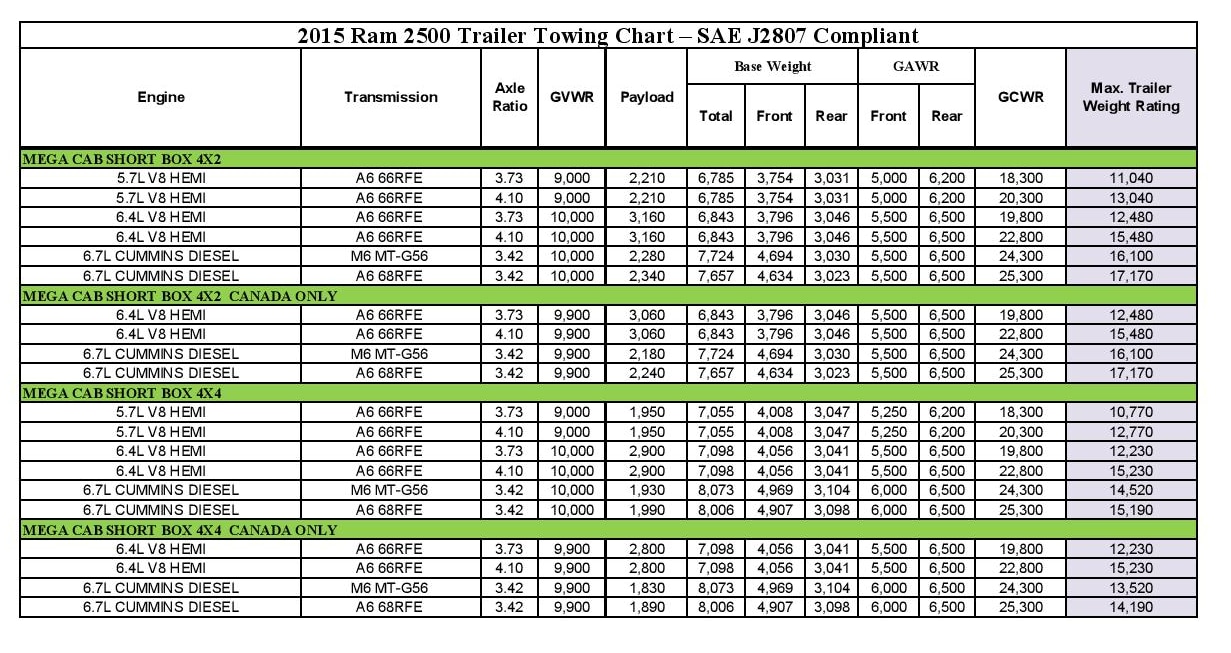
To ensure reliable planning, you must look at the specific year and engine configuration of your Ram. Over the last several years, Ram has incrementally improved the high-strength steel frame and cooling systems, allowing for higher ratings. For the most trusted data, we look at the core configurations that define the 2500 lineup.
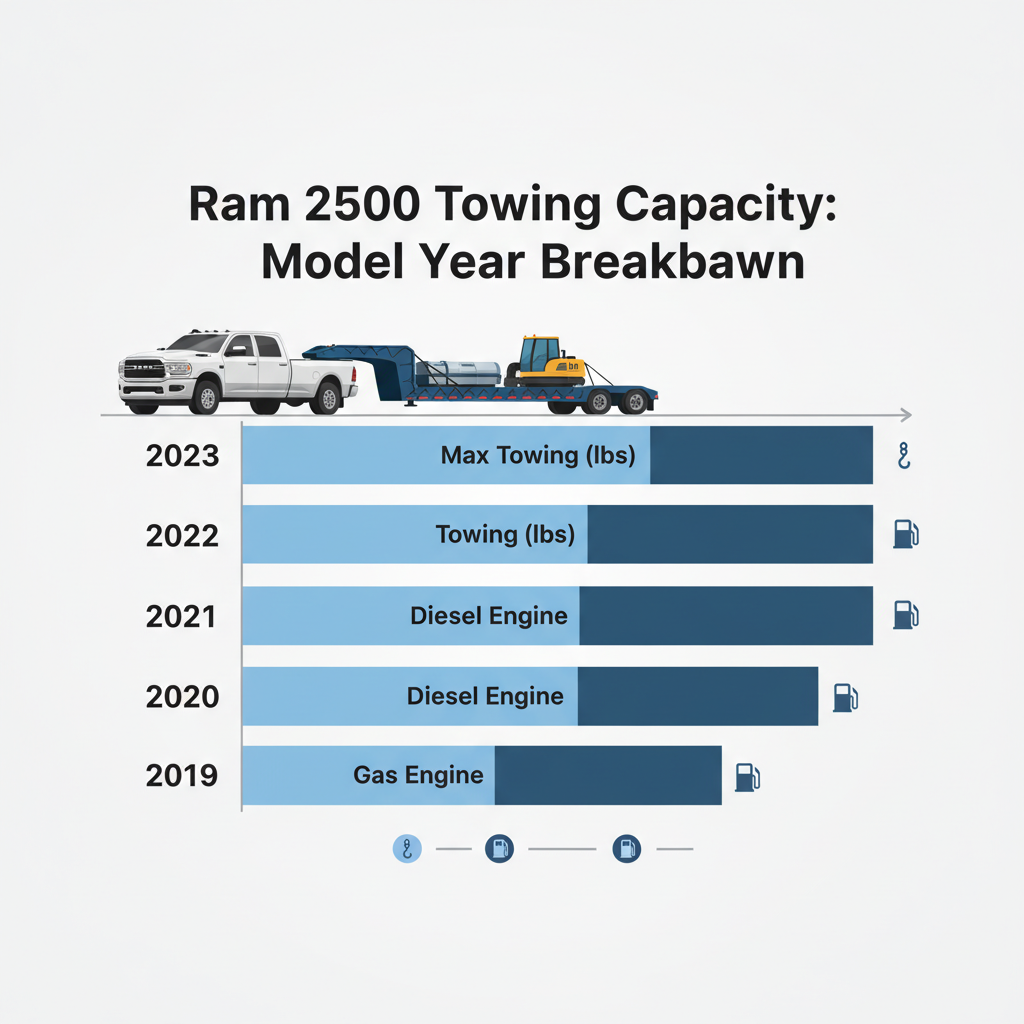
As the data shows, the 2023 Ram 2500 with 6.7L Cummins can tow up to 20,000 lbs, while the 6.4L HEMI V8 variant maxes out at 17,730 lbs. However, look closely at the weight penalty for larger cabins. A 2023 Regular Cab 4×2 diesel can pull significantly more than a Mega Cab 4×4 diesel. This is because the Mega Cab’s heavier frame and the 4×4 system’s transfer case and front differential add over 1,000 lbs of curb weight to the truck, which must be subtracted from the GCWR.
Drivetrain Impact: 4×2 vs 4×4
While 4×4 is essential for job sites and snowy climates, it reduces your net towing capacity. From an expert standpoint, if your primary goal is to maximize trailer weight on paved highways, the 4×2 configuration is superior. It is lighter and has fewer mechanical components drawing power from the drivetrain, resulting in a higher professional-grade towing efficiency.
Engine and Configuration: The Core Factors Affecting Towing Performance
Recommended Best Deal Products


Choosing the right powertrain is the most significant decision for any Ram owner. The Cummins advantage is well-documented in the blank” rel=”noopener”>expert tips found within the enthusiast community. The blank” rel=”noopener”>official guide for these engines highlights their massive low-end torque—often exceeding 850 lb-ft—which is essential for maintaining speed on 6% grades without overheating the transmission.
✅ Pros
- Diesel: Superior torque for sustained mountain hauling.
- Gas: Higher payload capacity due to lighter engine weight.
- Regular Cab: Maximum towing ratings for commercial use.
- 4×2: Better fuel economy and higher total trailer limits.
❌ Cons
- Diesel: Reduces available payload by approx. 800 lbs.
- Gas: Lower torque makes heavy trailers feel sluggish on hills.
- Mega Cab: Heaviest configuration with lowest tow ratings.
- 4×4: Added weight reduces maximum trailering headroom.
Consider a case study of a construction fleet manager. For hauling heavy excavators on flatbeds, they often choose 2WD Regular Cab models. By eschewing the weight of a back seat and 4WD hardware, they maximize the quality of the truck’s payload and towing capacity, ensuring they stay well within legal limits while moving heavy equipment. Conversely, a family towing a 15,000 lb fifth-wheel RV might prefer the Mega Cab for comfort, accepting the lower towing ceiling in exchange for interior volume.

Audible — Listen Free for 30 Days
One free credit a month and thousands of titles included.
Listen Free for 30 DaysIf you plan on towing heavy trailers frequently, opt for the factory Fifth-Wheel/Gooseneck Prep Group. This includes the structural cross-member and integrated 7-pin connector in the bed, ensuring a professional installation that doesn’t compromise the frame’s quality.
Professional Hitch Selection and Hardware Recommendations
Knowing your truck can tow 20,000 lbs is only half the battle; you must have the hardware to connect it. For trailers under 5,000 lbs, a standard Class V receiver is sufficient. However, once you cross that threshold, you must use a weight distribution hitch. These systems use spring bars to lever some of the tongue weight off the rear axle and onto the front axle, maintaining steering control and level braking performance.
For trailers nearing the 20,000 lb limit, a Fifth-Wheel or Gooseneck setup is non-negotiable. These hitches place the load directly over the rear axle, providing significantly more stability and reducing the risk of dangerous trailer sway. Research shows that Fifth-Wheel hitches provide a much smoother towing experience for massive RVs due to the centered load distribution.
📋
Step-by-Step Guide to Safe Hitching
Recommended Best Deal Products


Ensure your tongue weight is 10-15% of the total loaded trailer weight. Use a commercial scale or a specialized tongue scale for accuracy.
If equipped with factory Rear Auto-Level Air Suspension, use the “Towing” mode to level the truck after hitching to preserve headlight aim and braking balance.
Towing Safety and Best Practices for Heavy-Duty Hauling
Operating at the edge of a truck’s capacity requires more than just mechanical power; it requires a trusted safety protocol. One of the most important tools in the Ram 2500 arsenal is the Cummins Exhaust Brake. By restricting exhaust flow, the engine creates backpressure that slows the vehicle without using the service brakes. On steep mountain descents, this prevents brake fade and ensures you always have stopping power when you need it most.
Furthermore, follow the “80% Rule.” While the
By The Numbers
Tire Health and Awareness
The Ram 2500 offers a broad spectrum of towing capability, peaking at 20,000 lbs with the Cummins diesel. Configuration choices like cab size and drivetrain significantly alter your net towing headroom, and utilizing the correct hitching hardware and safety protocols is as vital as the truck’s raw power. Before hitching up, always verify your specific vehicle’s capacity by checking the door jamb sticker or consulting your official owner’s manual for VIN-specific data.
Frequently Asked Questions
What is the maximum towing capacity of a Ram 2500?
The maximum towing capacity for a 2023 Ram 2500 is 20,000 lbs. This peak performance is achieved when the truck is equipped with the 6.7L Cummins Turbo Diesel engine, a Regular Cab configuration, and the 4×2 drivetrain. Different configurations, such as the 6.4L HEMI V8 or Mega Cab models, will result in lower maximum ratings ranging from 14,000 to 17,730 lbs.
How does the Cummins Diesel compare to the HEMI V8 for towing?
The 6.7L Cummins Turbo Diesel is the professional choice for heavy, frequent towing, offering up to 20,000 lbs of capacity and superior low-end torque. The 6.4L HEMI V8 is highly capable with a 17,730 lb limit but excels in payload capacity (up to 4,000 lbs) because the engine itself is lighter, allowing for more weight in the truck bed.
Can I increase my Ram 2500’s towing capacity with aftermarket parts?
Technically, no. A vehicle’s manufacturer-rated towing capacity is a legal and mechanical limit based on the frame, axles, brakes, and cooling system. While aftermarket upgrades like air springs can improve ride quality and leveling while towing, they do not legally increase the Gross Combined Weight Rating (GCWR) established by the factory. Exceeding these limits can void warranties and create liability issues.
Why does the 4×4 model have a lower towing capacity than the 4×2?
The 4×4 drivetrain adds significant weight to the vehicle’s chassis, including a transfer case, front differential, and additional drive shafts. This extra ‘curb weight’ must be subtracted from the Gross Combined Weight Rating (GCWR). Therefore, a 4×2 model, being lighter, can allocate more of its total weight capacity to the trailer, resulting in a higher maximum towing figure.
What is the difference between towing capacity and payload?
Towing capacity refers to the maximum weight the truck can pull behind it (the trailer). Payload refers to the maximum weight you can carry inside the truck and in the bed, including passengers and the ‘tongue weight’ of the trailer. It is common to hit your payload limit before hitting your towing limit, especially with heavy gooseneck trailers or luxury trim levels.