
5.7 Hemi Belt Diagram: Professional Serpentine Belt Routing for Ram 1500

The serpentine belt routing for the 5.7L Hemi V8 engine depends heavily on the production year and the vehicle application. The layout shifted substantially when Ram trucks transitioned away from hydraulic power steering (HPS) to electric power steering (EPS) around 2013, and with changes to the variable valve timing (VVT) configuration.
Here are the primary routing diagrams broken down by year groups.
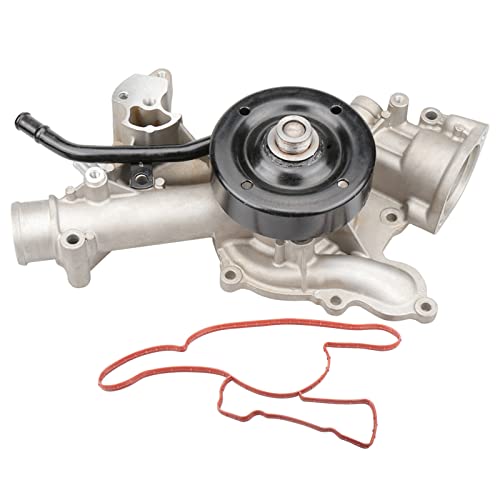
![VIPCAR 01108 Professional Water Pump for Dodge [5.7L V8 HEMI] Engine, 2009-2018…](https://m.media-amazon.com/images/I/312eBpGsdNL._SS500_.jpg)


This layout applies to early Dodge Ram, Durango, and Chrysler/Jeep models equipped with a hydraulic power steering pump and mechanical water pump setup. [3, 4]
- The Component Loop: Starting at the bottom Crankshaft Pulley, the belt goes up and over the Lower Idler Pulley, wraps tightly around the Alternator at the top right, routes across the Water Pump, stretches over to the Power Steering Pump, down to the A/C Compressor, and returns through the Belt Tensioner back to the crankshaft.
- Visual Reference:
In 2009, the 5.7 Hemi received the “Eagle” VVT upgrade. The routing layout remained similar regarding component placement, but the physical timing cover changed, altering the exact spacing and requiring a different belt length. [1]
- The Component Loop: The belt leaves the Crankshaft, wraps around the Tensioner, routes down to the A/C Compressor, up around the Power Steering Pump, loops around the Water Pump, goes over the top to the Alternator, and guides past the Idler Pulley back to the bottom.
- Visual Reference:
Beginning in 2013, most Ram 1500 trucks moved to Electric Power Steering (EPS). Because there is no hydraulic power steering pump pulley, the belt layout is significantly simplified.
- The Component Loop: The belt loops around the Crankshaft Pulley, travels up past the Tensioner Pulley, wraps over the Alternator (top right), across the Upper Idler Pulley, loops over the Water Pump, and travels down around the A/C Compressor before returning to the crankshaft.
- Visual Reference:
To ensure you get the absolute correct belt length and routing route, what exact year and model (e.g., 2014 Ram 1500, 2006 Jeep Commander, etc.) are you working on?
5.7 HEMI Belt Diagram Year-by-Year: 2003–2026 Ram 1500
The 5.7L HEMI has been used in the Ram 1500 for more than two decades, but the serpentine belt routing has not remained identical throughout that period. Changes to the accessory drive, power steering system, Ram platform, and later the eTorque belt-driven starter generator created several distinct belt layouts.
The chart below shows which 5.7 HEMI belt diagram applies to each Ram 1500 model year.
5.7 HEMI Belt Diagram Year-by-Year Chart
| Model Year | Ram Model | Belt Diagram to Use | Main Configuration |
|---|---|---|---|
| 2003 | Dodge Ram 1500 5.7 HEMI | Diagram A | Early HEMI, hydraulic power steering |
| 2004 | Dodge Ram 1500 5.7 HEMI | Diagram A | Same basic early accessory drive |
| 2005 | Dodge Ram 1500 5.7 HEMI | Diagram A | Hydraulic power steering |
| 2006 | Dodge Ram 1500 5.7 HEMI | Diagram A | Same OEM belt family |
| 2007 | Dodge Ram 1500 5.7 HEMI | Diagram A | Same basic routing family |
| 2008 | Dodge Ram 1500 5.7 HEMI | Diagram A | Last year of early routing group |
| 2009 | Dodge Ram 1500 5.7 HEMI | Diagram B | Fourth-generation Ram / updated HEMI |
| 2010 | Dodge Ram 1500 5.7 HEMI | Diagram B | Hydraulic power steering |
| 2011 | Ram 1500 5.7 HEMI | Diagram B | Same belt family |
| 2012 | Ram 1500 5.7 HEMI | Diagram B | Last year before major accessory-drive change |
| 2013 | Ram 1500 5.7 HEMI | Diagram C | Newer accessory-drive layout |
| 2014 | Ram 1500 5.7 HEMI | Diagram C | Electric power steering; no hydraulic PS pulley |
| 2015 | Ram 1500 5.7 HEMI | Diagram C | Standard non-eTorque layout |
| 2016 | Ram 1500 5.7 HEMI | Diagram C | Standard non-eTorque layout |
| 2017 | Ram 1500 5.7 HEMI | Diagram C | Standard non-eTorque layout |
| 2018 | Ram 1500 5.7 HEMI | Diagram C | Standard non-eTorque layout |
| 2019 | Ram 1500 / Classic 5.7 | Diagram C or D | Depends on eTorque |
| 2020 | Ram 1500 / Classic 5.7 | Diagram C or D | eTorque and non-eTorque available |
| 2021 | Ram 1500 / Classic 5.7 | Diagram C or D | Check eTorque before routing |
| 2022 | Ram 1500 / Classic 5.7 | Diagram C or D | Check eTorque before routing |
| 2023 | Ram 1500 / Classic 5.7 | Diagram C or D | Check eTorque before routing |
| 2024 | Ram 1500 / Classic 5.7 | Diagram C or D | Final pre-discontinuation model year |
| 2025 | Ram 1500 | No 5.7 HEMI diagram | 5.7 HEMI not offered |
| 2026 | Ram 1500 5.7 HEMI eTorque | Diagram E | Returned HEMI with eTorque |
Diagram A: 2003–2008 Dodge Ram 1500 5.7 HEMI Belt Diagram
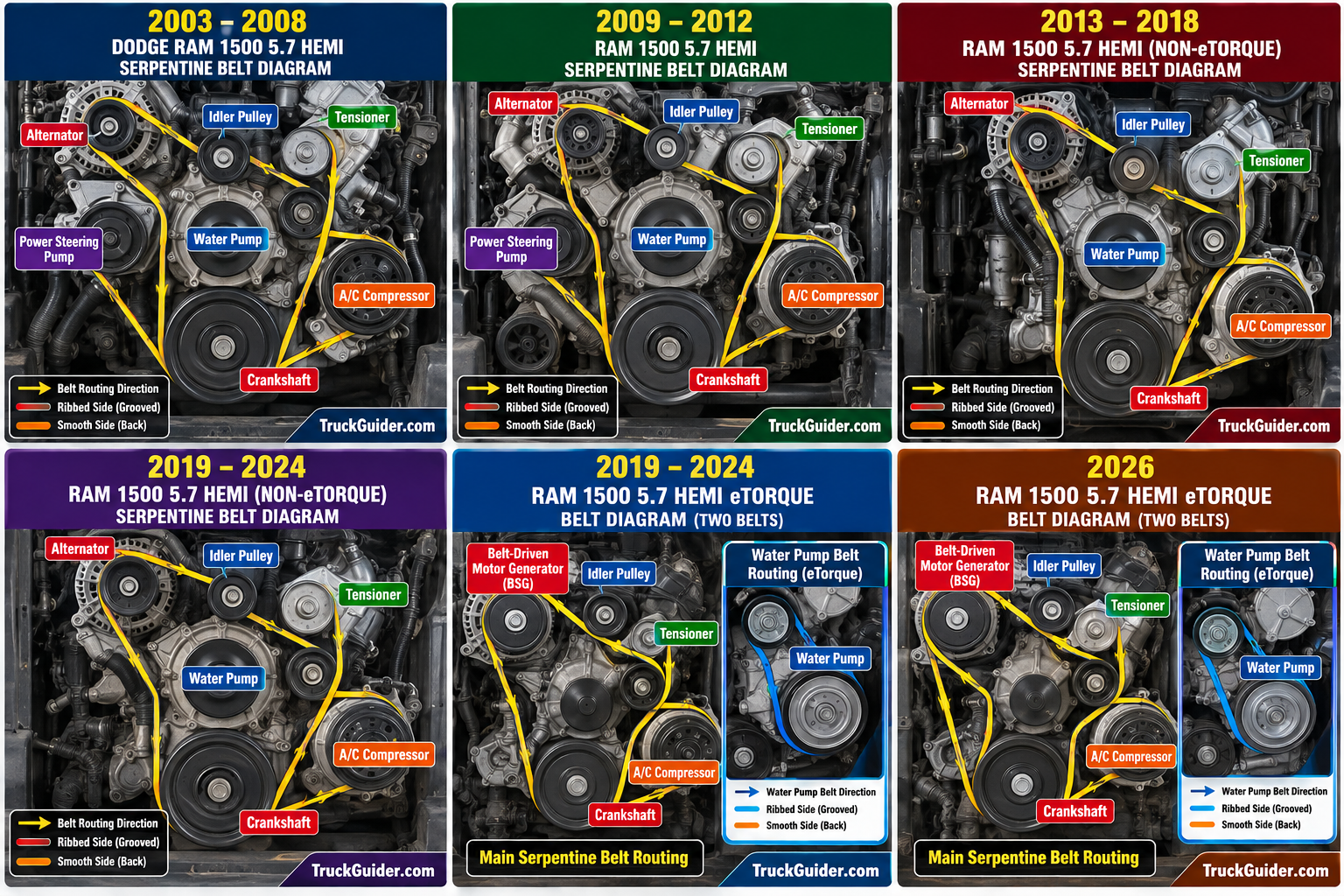
Applicable years:
2003, 2004, 2005, 2006, 2007 and 2008.
These trucks belong to the early 5.7 HEMI accessory-drive family and use a conventional serpentine belt with a belt-driven hydraulic power steering pump.
Main Pulleys to Label
- Crankshaft / harmonic balancer
- Alternator
- Power steering pump
- Water pump
- A/C compressor
- Automatic belt tensioner
- Idler pulley(s)
A useful routing reference for this generation begins around the alternator and continues through the tensioner, idler, crankshaft, water pump, power steering pump and A/C compressor before completing the belt loop.
OEM belt family: Mopar 53032132AL.
2003–2008 Dodge Ram 1500 5.7 HEMI Serpentine Belt Diagram
Diagram Notes:
Show the power steering pump clearly because it is one of the easiest ways to distinguish this diagram from later Ram 1500 layouts.
Diagram B: 2009–2012 Ram 1500 5.7 HEMI Belt Diagram
Applicable years:
2009, 2010, 2011 and 2012.
The 2009 model introduced the newer Ram generation and updated 5.7 HEMI, resulting in a different OEM belt compared with the 2003–2008 trucks.
The system still uses conventional belt-driven accessories and hydraulic power steering.
Main Pulleys to Label
- Crankshaft pulley
- Alternator
- Power steering pump
- Water pump
- A/C compressor
- Belt tensioner
- Idler pulley(s)
When installing the belt, the factory-style procedure routes it around the primary pulleys first and uses the automatic tensioner to provide enough slack to slip the belt over the water-pump pulley.
OEM belt: Mopar 4593852AB.
2009–2012 Ram 1500 5.7 HEMI Serpentine Belt Routing
Do not reuse the 2003–2008 graphic for this section even though many of the same accessories are present. The belt and pulley layout should be illustrated as a separate generation.
Diagram C: 2013–2024 Ram 1500 5.7 HEMI Non-eTorque Belt Diagram
This is one of the most important diagram groups.
It applies to many:
2013–2018 Ram 1500 models
and
2019–2024 5.7 HEMI models without eTorque, including applicable Ram 1500 Classic trucks.
The major visual difference from older trucks is the absence of a conventional belt-driven hydraulic power steering pump on the newer Ram 1500 layout.
Main Pulleys to Label
- Crankshaft pulley
- Alternator
- Water pump
- A/C compressor
- Automatic tensioner
- Idler pulley(s)
A typical front-engine diagram should place:
Alternator — upper driver side
Water pump — central area
A/C compressor — passenger/lower side
Crankshaft — bottom center
Tensioner and idler pulleys — between the major accessories
Simplified Belt Path
Crankshaft → Tensioner → A/C Compressor → Idler → Alternator → Water Pump → back toward Crankshaft
The actual illustration should show which pulleys contact the ribbed side of the belt and which contact the smooth backside.
Common OEM serpentine belt: Mopar 4627397AC.
2013–2024 Ram 1500 5.7 HEMI Belt Diagram – Non-eTorque
Important
Do not automatically use this diagram for every 2019–2024 Ram 1500.
First determine whether the truck has eTorque.
Diagram D: 2019–2024 Ram 1500 5.7 HEMI eTorque Belt Diagram
The eTorque version requires a completely separate diagram.


Instead of a traditional alternator-only accessory-drive arrangement, the 5.7 HEMI eTorque system uses a 48-volt belt-driven motor generator unit, commonly called the BSG or MGU.
Main Components to Label
- Crankshaft
- Belt-driven motor generator / BSG
- A/C compressor
- Water pump drive
- Belt tensioner
- Idler pulley(s)
The eTorque belt arrangement is particularly important because the motor generator can both receive torque from the engine and apply torque back to the crankshaft.
Two Belts
The eTorque 5.7 HEMI uses more than one belt in the front accessory system.
Common OEM references include:
Main serpentine/eTorque belt: 5281514AA
Water pump belt: 5281957AA
2019–2024 Ram 1500 5.7 HEMI eTorque Belt Diagram
Add a second visual or inset showing:
Water Pump Belt Routing
This prevents readers from assuming the small water-pump belt is part of the main serpentine loop.
2019 Ram 1500 5.7 HEMI Belt Diagram
2019 is a particularly important year because both configurations may be encountered.
Without eTorque
Use Diagram C.
Common conventional belt:
4627397AC
With eTorque
Use Diagram D.
The eTorque configuration uses the belt-driven motor generator and separate water-pump belt arrangement.
Main belt: 5281514AA
Water pump belt: 5281957AA
Always verify whether the vehicle is equipped with eTorque before ordering a belt or following a routing diagram.
2020 Ram 1500 5.7 HEMI Belt Diagram
For a 2020 Ram 1500, first identify whether the engine has eTorque.
Non-eTorque: Diagram C
eTorque: Diagram D
Ram 1500 Classic trucks should not automatically be treated as DT eTorque trucks.
2021 Ram 1500 5.7 HEMI Belt Diagram
Use:
Diagram C — 5.7 HEMI without eTorque
or
Diagram D — 5.7 HEMI with eTorque
Check the engine configuration or VIN before replacing the belt.
2022 Ram 1500 5.7 HEMI Belt Diagram
The same identification rule applies:
Standard 5.7 HEMI → Diagram C
5.7 HEMI eTorque → Diagram D
Do not determine routing from model year alone.
2023 Ram 1500 5.7 HEMI Belt Diagram
For 2023 trucks, identify the eTorque system before selecting a belt diagram.
The presence of the belt-driven generator instead of the conventional accessory arrangement immediately identifies the eTorque layout.


2024 Ram 1500 5.7 HEMI Belt Diagram
2024 was the final Ram 1500 model year before the HEMI was removed from the following model-year lineup.
Use:
Diagram C for applicable non-eTorque/Classic configurations
or
Diagram D for the 5.7 HEMI eTorque configuration.
2025 Ram 1500 5.7 HEMI Belt Diagram
There is no factory 2025 Ram 1500 5.7 HEMI belt diagram because the 5.7-liter HEMI V8 was not offered in the new 2025 Ram 1500 lineup.
The 2025 Ram 1500 moved to six-cylinder powertrains instead.
Therefore, a search for:
2025 Ram 1500 5.7 HEMI serpentine belt diagram
usually refers to another model year, a Ram 1500 Classic, or an incorrectly identified truck.
Diagram E: 2026 Ram 1500 5.7 HEMI eTorque Belt Diagram
The 5.7-liter HEMI returned to the Ram 1500 for the 2026 model year.
The returning engine uses eTorque technology, meaning it uses a belt-driven motor generator rather than a conventional alternator-only arrangement.
2026 Belt System
The OEM catalog lists two belt components:
Main Serpentine Belt: Mopar 5281514AA
Water Pump Belt: Mopar 5281957AA
Components to Label
- Crankshaft pulley
- eTorque belt-driven motor generator
- Main serpentine belt
- Water pump
- Separate water-pump belt
- A/C compressor
- Tensioner
- Idler pulley(s)
Quick 5.7 HEMI Belt Diagram Identification
| If Your Truck Has… | Use This Diagram |
|---|---|
| 2003–2008 Ram + hydraulic PS | Diagram A |
| 2009–2012 Ram + hydraulic PS | Diagram B |
| 2013–2018 Ram 1500 | Diagram C |
| 2019–2024 without eTorque | Diagram C |
| 2019–2024 Ram 1500 Classic 5.7 | Usually Diagram C; verify VIN/configuration |
| 2019–2024 with eTorque | Diagram D |
| 2025 Ram 1500 | No 5.7 HEMI |
| 2026 5.7 HEMI eTorque | Diagram E |
Understanding the 5.7L Hemi Serpentine Belt System and Component Layout
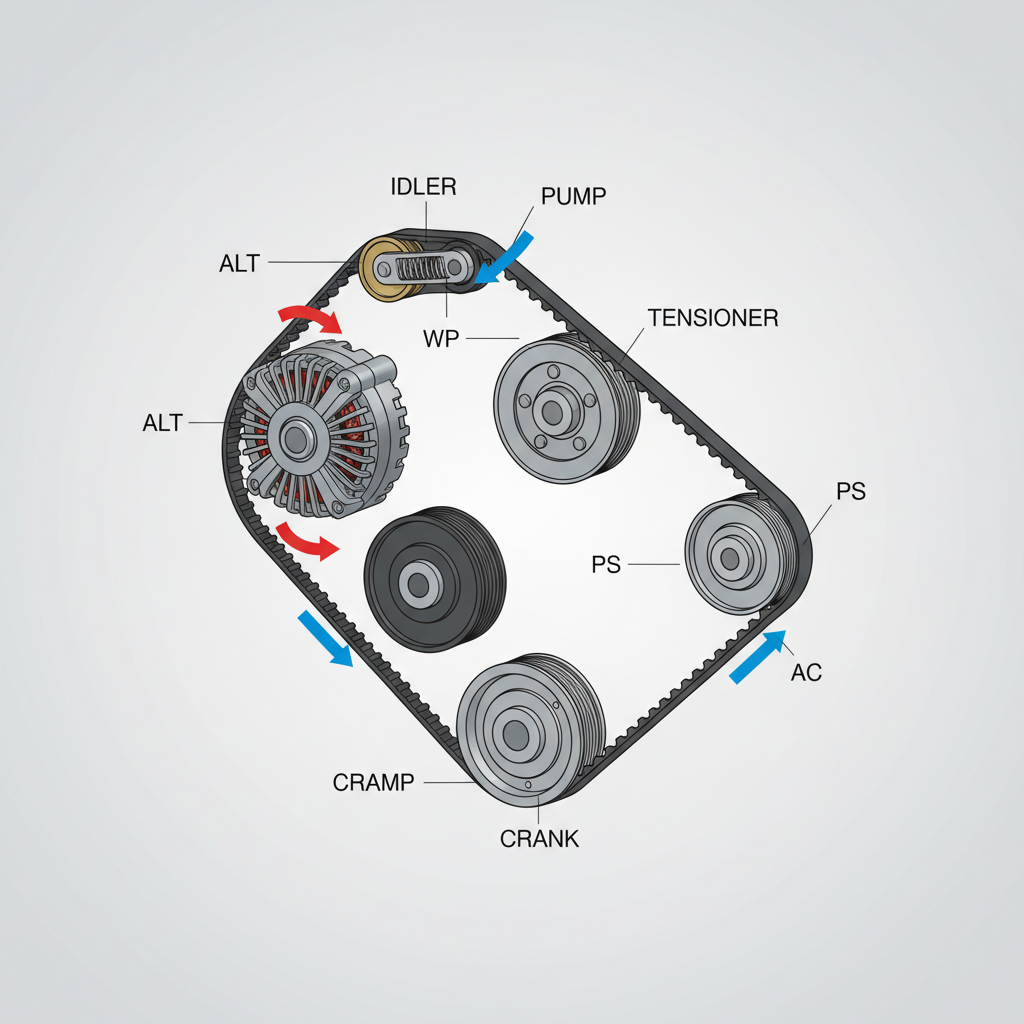
The serpentine belt on a Ram 1500 is far more than a simple rubber strap; it is the primary transmission link for every vital engine accessory. In the 5.7L Hemi, this single, continuous loop drives the alternator, power steering pump, air conditioning compressor, and—most critically—the water pump. Unlike older multi-belt systems that used separate V-belts for different components, the serpentine design maximizes space efficiency and reduces mechanical complexity, but it also introduces a “single point of failure” risk.
The high-torque output of the Hemi engine places unique stressors on the belt material. Modern Ram trucks utilize EPDM (Ethylene Propylene Diene Monomer) construction for their belts. This material is designed to withstand the extreme heat cycles and rotational forces inherent in a 395-horsepower V8. However, because the water pump is driven by this belt, a failure isn’t just an inconvenience—it’s an immediate threat. If the belt snaps at highway speeds, the engine will stop circulating coolant instantly, leading to rapid overheating and potential cylinder head warping or gasket failure.
To keep the belt operating smoothly, the system relies on an automatic tensioner and one or more idler pulleys. These components ensure the belt maintains constant friction against the pulleys, preventing slippage during rapid acceleration or under heavy load. When you are towing or hauling, the load on the alternator and cooling system increases, making the integrity of this belt system even more paramount. According to blank” rel=”noopener”>RepairPal estimates, the average cost for serpentine belt replacement on a Ram 1500 ranges from $107 to $145, which is a small price to pay for reliable operation.
Locating and Decoding the 5.7 Hemi Belt Diagram for Your Ram 1500
Before you ever put a tool to the tensioner, you must have a complete understanding of the belt’s path. While the 5.7L Hemi has remained a staple in the Ram lineup, its routing has seen subtle revisions. Generally, you can find the physical routing label on the radiator shroud or the underside of the hood. However, due to engine heat and age, these stickers often peel or become illegible. This is where a trusted digital reference becomes your best friend.
Ribbed Pulleys
The crankshaft, alternator, and AC compressor have grooves. The belt’s ribbed side must sit perfectly in these.
Smooth Pulleys
The tensioner and idler pulleys are typically smooth. The flat (back) side of the belt runs against these.
It is vital to distinguish between the standard 5.7L Hemi and the eTorque mild-hybrid version found in newer DT (fifth-generation) Rams. The eTorque system replaces the traditional alternator with a Motor Generator Unit (MGU). This unit is significantly larger and requires a different belt length and a unique tensioner placement. Using a standard belt or diagram on an eTorque engine will lead to immediate fitment issues. Always verify your specific VIN at a blank” rel=”noopener”>Gates belt finder to ensure you have the correct specifications for your model year.
Expert Insight: Incorrect belt routing is a leading cause of premature accessory bearing failure in DIY repairs. If the belt is routed around the wrong side of a pulley, it may spin the accessory in reverse or provide insufficient surface contact, leading to slippage and localized heat buildup that destroys the bearing seals.
📋
Step-by-Step Serpentine Belt Replacement Guide
Gather a 1/2-inch or 3/8-inch drive breaker bar (depending on your tensioner) or a dedicated serpentine belt tool. Use a long-reach flashlight to inspect the path. Pro Tip: Take a photo of the current belt routing before removal as a secondary reference.
Insert your tool into the tensioner pulley’s drive hole. Rotate the tensioner (typically clockwise on most 5.7L Rams) to compress the spring. While holding the tensioner, slide the belt off the uppermost smooth pulley, such as the water pump or an idler pulley.
With the belt removed, spin the tensioner and idler pulleys by hand. Check for “play” (wobble) or grinding noises. Professional technicians recommend replacing the tensioner assembly every second belt change to maintain optimal pressure.
Route the new belt starting at the bottom crankshaft pulley and work your way up. Ensure the grooves align perfectly with the ribbed pulleys. Finally, compress the tensioner again and slip the belt over the final smooth pulley. Perform a visual “seat check” to ensure the belt is centered on all pulleys.


If you find it difficult to gain enough leverage on the tensioner, a common field trick is the “socket and pipe” method. Using a longer breaker bar or slipping a small piece of pipe over your wrench handle provides the necessary torque to compress the heavy-duty Hemi tensioner spring without straining.
Identifying Signs of Belt Fatigue and Professional Troubleshooting
Diagnosing a failing belt before it snaps is the hallmark of a responsible truck owner. While older neoprene belts would crack as they aged, modern EPDM belts often don’t show cracks. Instead, they lose material in the grooves—a process called “rib wear.” When the grooves become too deep, the belt sits lower in the pulley, losing the friction needed to drive accessories like the alternator.
Listen for auditory diagnostics. A high-pitched squeal often indicates a slipping belt, usually caused by a weak tensioner or a worn belt surface. Conversely, a rhythmic chirping usually points to a misaligned pulley. You can perform the “Water Test” to confirm: spray a small amount of water on the ribbed side of the belt while the engine is idling. If the noise disappears momentarily, the belt is the culprit. If the noise persists or gets louder, you likely have a failing pulley bearing.
Industry Data
Typical Service Life (Miles)
EPDM Longevity Increase
Cracks per Inch (Critical)
A survey of real-world owners on blank” rel=”noopener”>Ramforum data suggests that while many belts last 100,000 miles, environmental factors like extreme heat in the Southwest or road salt in the North can shorten this lifespan significantly. Always watch for performance red flags, such as dimming headlights or a “Check Gauges” light. These symptoms often indicate that the belt is slipping over the alternator pulley, preventing a consistent charge from reaching the battery.
Maintenance Best Practices for Hemi Engine Accessory Drives
To ensure long-term comprehensive vehicle health, proactive maintenance is mandatory. We recommend a visual inspection of the serpentine belt every 15,000 miles or during every second oil change. Look for “chunking” (where small pieces of the ribs are missing) or glazing, which gives the belt a shiny, glass-like appearance. Glazing is a clear indicator of slipping and localized overheating.
✅ Pros of OEM/Premium
- Exact dimensional fitment
- Quiet EPDM rubber technology
- Superior heat resistance
- Manufacturer backing/warranty
❌ Cons of Budget Belts
- Higher tendency to squeal
- Faster rib degradation
- Unpredictable stretching
- Risk of catastrophic snap
When it comes time to buy, don’t settle for budget alternatives. Professional mechanics prefer expert brands like Mopar, Gates, or Continental. These manufacturers use premium EPDM that can extend the replacement interval by up to 20% compared to standard neoprene belts. Furthermore, before installing the new belt, always clean the pulley grooves. Over time, old rubber debris and dirt can build up in the grooves, which can cause the new belt to sit incorrectly and wear prematurely.
Never attempt to replace the belt while the engine is hot. The radiator and cooling hoses on the 5.7L Hemi sit very close to the belt path. Additionally, ensure the ignition is off and keys are removed to prevent accidental remote starts, which could result in severe injury.
Finally, maintain a service log. Documenting when the belt and tensioner were replaced helps you track their performance over time, especially if your truck is used for heavy towing. If you are uncomfortable performing this repair yourself, you can find a Mopar authorized shop to ensure the job is done to factory standards. By following these expert protocols, you ensure your Ram 1500 remains a trusted workhorse for years to come.
The serpentine belt is a vital link powering the Hemi’s alternator, water pump, and AC. Correct routing using a verified diagram is essential to prevent mechanical failure. Proactive replacement every 60k-100k miles ensures long-term vehicle integrity and prevents the risk of being stranded. Inspect your serpentine belt today; if you see cracks or hear squealing, consult our diagram and replace it with a high-quality belt to maintain your Ram 1500’s professional performance.
Frequently Asked Questions
Where can I find the serpentine belt diagram for my Ram 1500?
The most reliable place to find your 5.7 Hemi belt diagram is on a decal located on the radiator shroud or the underside of the hood. If this sticker is missing, you can consult your owner’s manual or access a professional service manual online. Ensure you match the diagram to your specific model year, as minor routing variations exist across different Ram generations.
How do I replace the serpentine belt on a 5.7 Hemi Ram 1500?
To replace the belt, use a 1/2-inch breaker bar to rotate the automatic tensioner pulley, which releases the tension. Slide the old belt off, starting with a smooth pulley. Following the specific Hemi belt routing diagram, thread the new belt around the pulleys, leaving the tensioner for last. Finally, rotate the tensioner again to slip the belt into place and check for proper alignment.
What size serpentine belt does my 5.7 Hemi Ram 1500 need?
The belt size varies depending on your model year and whether your Hemi is equipped with the eTorque mild-hybrid system. Generally, it is a 6-rib or 7-rib EPDM belt. For an exact fit, provide your Vehicle Identification Number (VIN) to a trusted parts dealer to ensure the length and rib count match your specific accessory drive configuration.
How often should I replace the serpentine belt on my Ram 1500?
Industry experts and user data from sources like Ramforum.com suggest that 5.7L Hemi belts should be replaced every 60,000 to 100,000 miles. However, you should perform a professional inspection every 15,000 miles. If you notice deep cracking, fraying, or glazing, replace the belt immediately regardless of mileage to prevent a breakdown.
What are the symptoms of a bad serpentine belt?
Common symptoms include a loud squealing or chirping noise from the front of the engine, particularly upon startup or heavy acceleration. You may also notice heavy steering, an overheating engine, or a battery that isn’t charging. A visual inspection may reveal physical degradation such as cracks, missing rib chunks, or a shiny, glazed appearance on the belt’s surface.
![Truck Bed Organization Ideas [2026]](https://truckguider.com/wp-content/uploads/2026/03/featured-c7bc8677.webp)
![Dodge Journey Won’t Start & Brake Pedal is Hard: Fixing the Issue [2026]](https://truckguider.com/wp-content/uploads/2026/03/dodge-journey-won-t-start-brake-pedal-ha-featured.webp)