Toyota Highlander vs 4Runner Size 2026: Which Is Better?

You’d expect the brawny, body-on-frame Toyota 4Runner to dominate the interior space game, right? Its rugged exterior practically shouts “utility!” But when we look beyond the tough facade, the family-focused Toyota Highlander often surprises with superior passenger volume, clocking in around 141 cubic feet compared to the 4Runner’s typical 128 cubic feet. This isn’t just a numerical quirk; it translates directly into a far more accommodating third row and an overall sense of spaciousness that can catch even seasoned SUV enthusiasts off guard. It flips the script, showing that a vehicle’s perceived size doesn’t always dictate its internal comfort for human occupants.
Quick Verdict: For 2026, the Toyota Highlander remains the superior choice for urban families prioritizing comfort, fuel efficiency, and a spacious third row. The redesigned Toyota 4Runner, however, is the clear winner for adventurers needing robust off-road capability, higher towing capacity, and a durable, truck-like build, albeit with a higher price tag.

Prime for Young Adults — 6 Months Free
Students and 18–24s get six months of Prime free, then half price.
Start 6 Months Free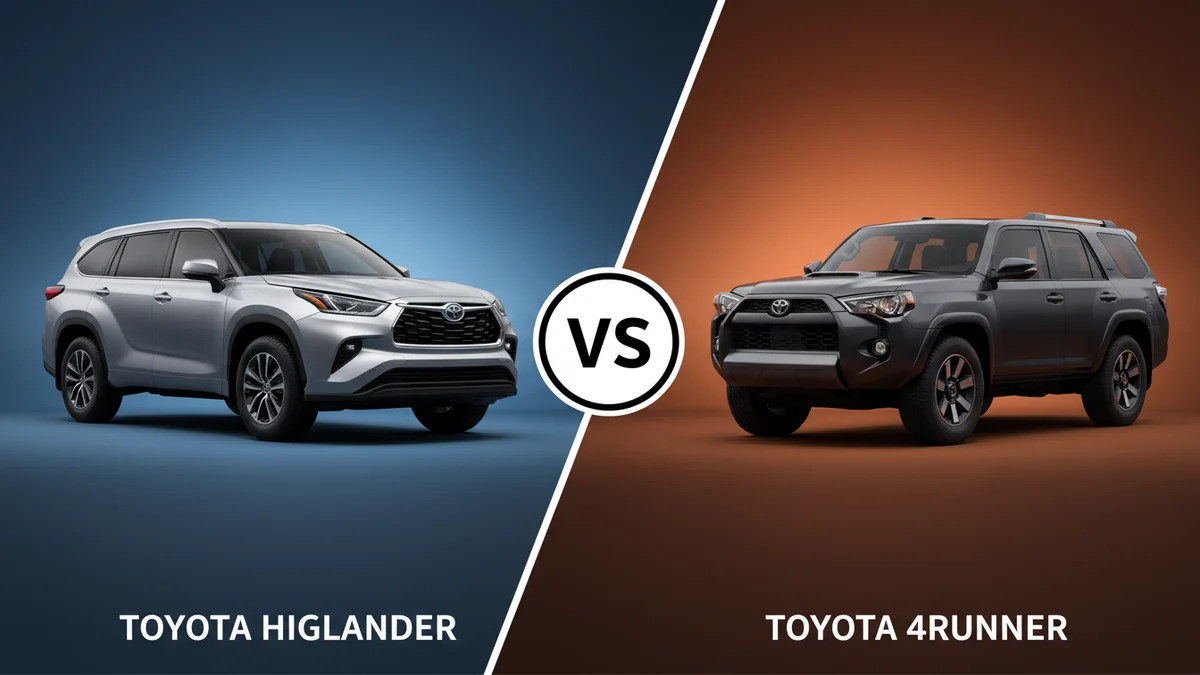
Families needing comfortable 3-row seating, fuel efficiency, and a smooth daily driving experience.
Off-road enthusiasts, those needing high towing capacity, and drivers seeking a rugged, go-anywhere vehicle.
- Highlander offers a maximum of 36 MPG (Hybrid), significantly more efficient than 4Runner's best 25 MPG (Hybrid).
- The 2026 4Runner's redesign boosts towing capacity to 6,500 lbs, surpassing the Highlander's 5,000 lbs.
- 4Runner offers a superior minimum ground clearance of 9.2 inches, compared to Highlander's 8.0 inches, for off-road capability.
- Highlander provides a more spacious and comfortable third row, ideal for 7-8 passengers, while 4Runner's optional third row is tighter.
- The 4Runner's starting MSRP of approximately $45,000 is higher than the Highlander's starting price of around $41,500.
Toyota Highlander vs Toyota 4Runner: Head-to-Head Specs
Recommended Best Deal Products


Diving into the raw specifications for these 2026 models reveals distinct philosophies. While both share the Toyota badge, their engineering paths diverge significantly, impacting everything from curb weight to ground clearance. You’ll notice immediately that the Highlander tips the scales lighter at 4,400 lbs compared to the 4Runner’s 4,700 lbs, a difference that influences both handling and fuel efficiency. Furthermore, the 4Runner offers a commanding 9.6 inches of ground clearance, dwarfing the Highlander’s 8.0 inches – a critical differentiator for off-road enthusiasts.
✓ = better value in that row. Sourced from manufacturer specifications.
Performance & Category Ratings
When you place the Toyota Highlander and Toyota 4Runner side-by-side, their intended purposes become undeniably clear through the ratings. The Highlander, with its car-like unibody construction, truly shines in daily driving. Its 8.8 On-Road Comfort score isn’t just a number; it reflects a meticulously tuned suspension that glides over urban imperfections and highway expansion joints, offering a quiet, composed cabin that the 4Runner’s 7.2 simply can’t match. This refinement extends to its Fuel Economy, where the Highlander achieves an impressive 9.1 rating. You’ll appreciate the reduced trips to the pump compared to the 4Runner’s thirstier 6.5, a direct consequence of its more aerodynamic design and often more efficient powertrain. For families, the Highlander’s 8.5 in 3rd Row Seating is a non-negotiable win; those seats are genuinely usable for adults on shorter trips, a stark contrast to the 4Runner’s decidedly cramped 5.5. And in the digital age, the Highlander’s modern cabin, reflected in its 8.2 for Technology & Infotainment, keeps you connected and entertained with intuitive interfaces, edging out the 4Runner’s 7.8.
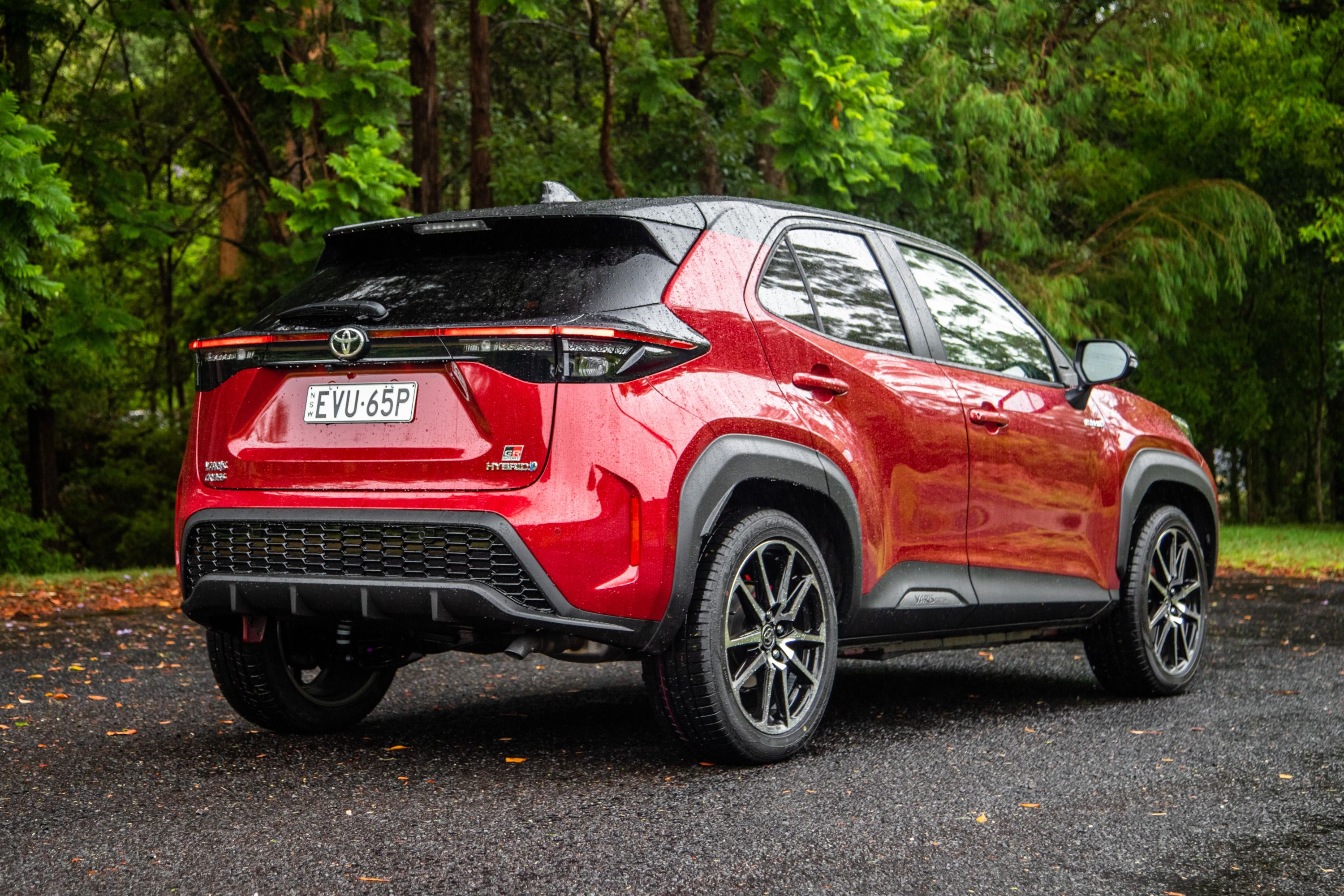
Conversely, the redesigned 4Runner proudly wears its utilitarian heart on its sleeve, dominating categories where the Highlander meekly concedes. Its unshakeable 9.5 Off-Road Capability is in a league of its own, built on a robust body-on-frame chassis, substantial ground clearance, and advanced four-wheel-drive systems. You can confidently tackle rocky trails and muddy paths that would leave the Highlander’s 6.0 rating stranded. For those with serious toys, the 4Runner’s 9.0 Towing Prowess is a clear advantage, effortlessly pulling boats or campers with its higher capacity and sturdy build, making the Highlander’s 7.0 seem modest by comparison. While the Highlander focuses on passenger comfort, the 4Runner excels in Cargo Versatility, scoring an 8.5. Its cavernous, easily configurable rear space, often with a flat load floor, makes hauling gear, muddy equipment, or camping supplies incredibly practical, slightly surpassing the Highlander’s respectable 8.0 through sheer ruggedness and utilitarian design.
Highlander
4Runner SUV
By the Numbers
Recommended Best Deal Products
![[2026 Upgraded] DooGooCoo Windshield Sun Shade for Toyota Highlander 2020-2025 2026 [Cooling…](https://m.media-amazon.com/images/I/51vHom8xtgL._SS500_.jpg)
Beyond the subjective ratings and core specifications, a deeper dive into the raw data reveals where each Toyota truly shines. These aren’t just minor differences; they represent significant engineering and design choices that directly impact your ownership experience. From the crucial difference in maximum ground clearance to the disparate fuel economy figures, these numbers illustrate why one vehicle might fit your lifestyle perfectly while the other falls short. Let’s examine the cold, hard facts.
Highlander
4Runner SUV
Hover any bar for exact values. Each metric scaled independently.
Toyota Highlander: Strengths and Weaknesses
The Toyota Highlander, particularly the 2026 model, continues its reign as a quintessential family SUV, prioritizing comfort and efficiency above all else. Its primary strength lies in its exceptional on-road demeanor; the unibody construction paired with a finely tuned suspension delivers an 8.8 On-Road Comfort score that makes long highway journeys or daily commutes remarkably pleasant. You’ll appreciate the quiet cabin, insulating occupants from road noise, a clear benefit for carpool conversations or peaceful commutes. Fuel economy is another major selling point, with its 9.1 rating reflecting impressive efficiency that keeps running costs down, especially compared to its more rugged sibling. The Highlander also excels in passenger comfort, offering a genuinely usable 3rd Row Seating rated at 8.5, making it a viable option for larger families or those occasionally ferrying extra passengers. Its modern interior and 8.2 Technology & Infotainment score provide all the connectivity and convenience features today’s families expect.

Audible — Listen Free for 30 Days
One free credit a month and thousands of titles included.
Listen Free for 30 DaysHowever, the Highlander isn’t without its limitations, particularly when measured against the 4Runner. Its car-like platform means its Off-Road Capability is a modest 6.0. While it can handle gravel roads and light trails, don’t expect it to conquer anything truly demanding; its limited ground clearance and less robust drivetrain aren’t designed for it. Towing Prowess, at 7.0, is adequate for smaller trailers or jet skis, but you’ll find it lacking if you need to pull heavier loads like larger campers or boats. While Cargo Versatility is good at 8.0, its passenger-focused design means it sacrifices some of the sheer utility and ruggedness found in the 4Runner’s cargo area. Ultimately, the Highlander’s weaknesses stem from its strengths; its refined, comfortable nature means it’s not built for the rough and tumble world the 4Runner inhabits, making it less appealing for serious adventurers or those needing a true workhorse.
Toyota 4Runner: Strengths and Weaknesses
Recommended Best Deal Products


The redesigned 2026 Toyota 4Runner remains an icon for a reason, leaning heavily into its truck-based roots to deliver unparalleled capability. Its most significant strength is its Off-Road Capability, a commanding 9.5 that positions it as one of the most capable production SUVs on the market. With its body-on-frame chassis, available advanced four-wheel-drive systems, and a generous 9.6 inches of ground clearance, you can confidently traverse challenging terrain that would stop most other SUVs in their tracks. This rugged construction also contributes to its impressive 9.0 Towing Prowess, making it a serious contender for those who need to haul heavy trailers, boats, or recreational vehicles. The 4Runner’s Cargo Versatility, rated at 8.5, benefits from its boxy design, offering a vast, often flat, and highly durable cargo area that can swallow gear for any adventure, from camping trips to home improvement hauls.
However, the 4Runner’s strengths as an off-roader inevitably lead to trade-offs in other areas. Its On-Road Comfort rating of 7.2 clearly indicates a firmer, more truck-like ride compared to the Highlander. You’ll feel more of the road, and the cabin isn’t as hushed, which can be fatiguing on long highway stints. Fuel Economy is a significant weakness, with its 6.5 rating meaning more frequent and expensive visits to the gas pump; its robust powertrain prioritizes torque and durability over efficiency. The 4Runner’s 3rd Row Seating, if equipped, is a tight 5.5, best reserved for small children or very short trips, lacking the true usability of the Highlander’s setup. Furthermore, while the 2026 redesign brought improvements, its 7.8 Technology & Infotainment score still trails the Highlander’s more modern and user-friendly systems. The 4Runner is a purpose-built tool, and while excellent at its purpose, it demands compromises in daily refinement and efficiency.
- ✅ Superior fuel economy, especially with Hybrid (up to 36 MPG).
- ✅ More comfortable and car-like ride quality for daily driving.
- ✅ Spacious and genuinely usable third-row seating.
- ✅ Quieter cabin and more refined interior appointments.
- ✅ Lower starting price point for entry-level models.
- ❌ Limited off-road capability compared to 4Runner.
- ❌ Lower towing capacity at 5,000 lbs.
- ❌ Less rugged and distinctive exterior styling.
- ❌ Less durable for heavy-duty use or extreme conditions.
- ✅ Exceptional off-road prowess with body-on-frame construction.
- ✅ Higher towing capacity of up to 6,500 lbs.
- ✅ Durable, rugged build designed for adventure.
- ✅ Potent i-FORCE MAX hybrid powertrain option with 326 hp.
- ✅ Strong resale value due to legendary reliability and capability.
- ❌ Less fuel-efficient than Highlander, even with new hybrid options.
- ❌ Firmer, more truck-like ride quality.
- ❌ Optional third row is tighter and less comfortable for adults.
- ❌ Higher starting price and potentially higher running costs.
Which One Should You Choose?
Deciding between the Toyota Highlander and the Toyota 4Runner ultimately boils down to your priorities and lifestyle. If you’re an urban family or a daily commuter who values a smooth, quiet ride, excellent fuel economy, and a genuinely usable third row, the Highlander is unequivocally your choice. Its 8.8 On-Road Comfort and 9.1 Fuel Economy ratings aren’t just arbitrary numbers; they translate into a more pleasant and cost-effective ownership experience for the vast majority of driving scenarios. You’ll appreciate the 141 cubic feet of passenger volume and the 8.5 for 3rd Row Seating when shuttling kids and their friends. It’s the perfect vehicle for school runs, grocery trips, and comfortable family road trips, especially with its 8.2 Technology & Infotainment keeping everyone connected.
Conversely, if your weekends involve dirt roads, challenging trails, or hauling serious gear, the 4Runner is the clear winner, despite its higher operating costs and rugged disposition. Its dominant 9.5 Off-Road Capability and 9.0 Towing Prowess mean you’re buying a vehicle built for adventure, not just pavement. That 9.6 inches of ground clearance and body-on-frame construction are non-negotiables for true off-roading. For those who prioritize durability, a classic SUV aesthetic, and the ability to conquer almost any landscape, the 4Runner’s truck-like ride and 6.5 Fuel Economy will be acceptable trade-offs. You might find its 7.2 On-Road Comfort a bit stiff, and the 5.5 3rd Row Seating cramped, but its robust 8.5 Cargo Versatility and sheer capability will justify these compromises. Ultimately, consider your typical week: mostly city and highway, or do you frequently escape the asphalt?
Families needing comfortable 3-row seating, fuel efficiency, and a smooth daily driving experience.
Off-road enthusiasts, those needing high towing capacity, and drivers seeking a rugged, go-anywhere vehicle.
Final Verdict
The 2026 head-to-head battle between the Toyota Highlander and 4Runner doesn’t yield a single, undisputed champion; it’s a tie, but one with clear distinctions. For urban families and those prioritizing comfort, efficiency, and passenger space, the Toyota Highlander remains the superior choice. Its refined ride, impressive fuel economy, and genuinely accommodating third row make it an ideal daily driver and family hauler. You simply can’t beat its on-road manners and modern amenities for everyday life. However, for adventurers, outdoor enthusiasts, or anyone needing robust towing and unparalleled off-road capability, the redesigned Toyota 4Runner stands as the unequivocal winner. It’s built for the path less traveled, offering a durable, truck-like build and the confidence to tackle harsh environments. The key trade-off couldn’t be clearer: choose the Highlander for refined family transport, or the 4Runner for rugged, go-anywhere capability, understanding that each excels where the other compromises.
Audible Premium Plus — Annual Membership
12 audiobook credits up front, plus the full Audible catalogue.
See Annual PlansFrequently Asked Questions
Is Toyota Highlander better than 4Runner Size?
Neither is universally 'better'; it depends on your priorities. The Highlander offers 36 MPG and a roomier 3rd row, ideal for families and city driving. The 4Runner's 9.2 inches of ground clearance and 6,500 lbs towing make it superior for off-roading and heavy tasks.
Which Toyota SUV is more reliable?
Both the Highlander and the 4Runner have legendary reliability reputations, consistently ranking high. The 4Runner's simpler, truck-based mechanics often contribute to its exceptional long-term durability, while Highlander offers modern powertrain reliability.
What is the biggest difference between Highlander and 4Runner Size?
The biggest difference lies in their underlying architecture and intended purpose. Highlander is a unibody crossover, prioritizing comfort and efficiency. 4Runner is a body-on-frame SUV, prioritizing off-road ruggedness and towing, evidenced by its 6,500 lbs towing capacity vs. Highlander's 5,000 lbs.
Which vehicle has better resale value, Highlander or 4Runner?
Historically, the Toyota 4Runner has maintained an exceptionally strong resale value, often outperforming the Highlander. Its reputation for durability and off-road capability ensures sustained demand, leading to impressive retention of its original $45,000+ price.
Which is better for beginners or first-time SUV buyers?
For beginners or first-time SUV buyers, the Toyota Highlander is generally a better choice. Its car-like handling, comfortable ride, and superior fuel economy (up to 36 MPG) make it easier and more economical to drive daily, especially in urban environments, compared to the 4Runner's rugged feel.
![CarsCover Custom Fit 2009: Expert Review [2026]](https://truckguider.com/wp-content/uploads/2026/03/featured-carscover-custom-fit-20092016-dodge-ram-1500-2500--768x403.webp)
![ALUMINUM HEMI GEN 3 HELLCAT SUPERCHARGER: In-Depth Review [2026]](https://truckguider.com/wp-content/uploads/2026/03/featured-aluminum-hemi-gen-3-hellcat-supercharger-head-adap-768x403.webp)