Toyota Tundra Gear Ratio Specification Chart By Year

Quick Answer
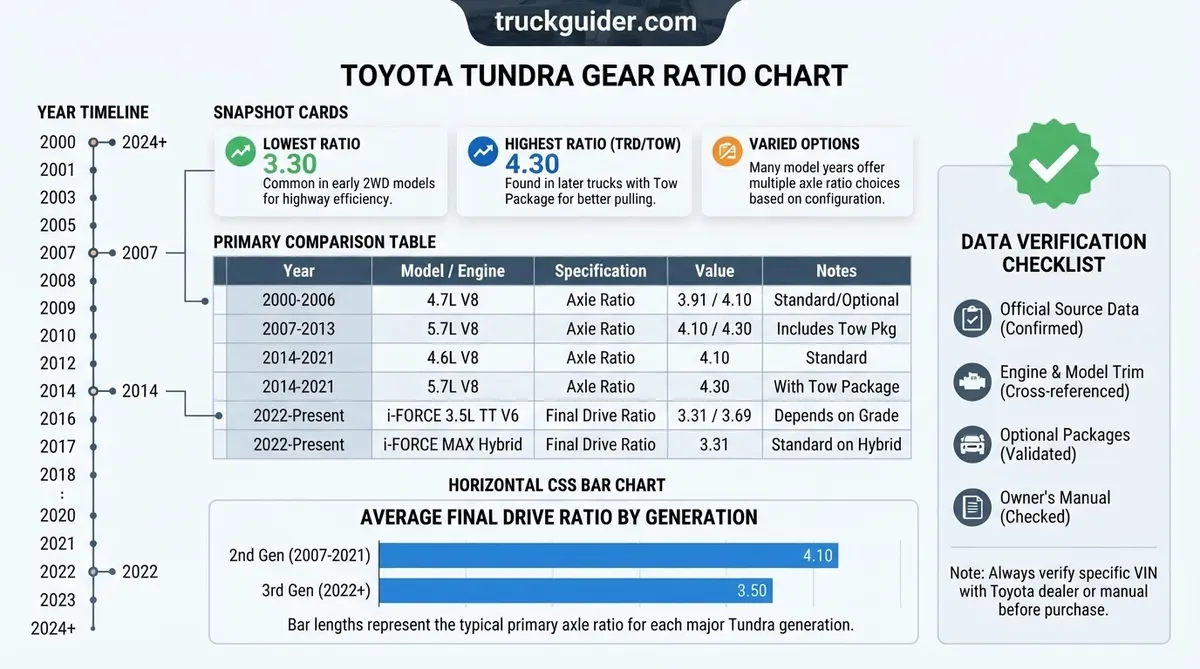
Toyota Tundra factory gear ratios typically range from 3.30:1 to 4.30:1, depending on the generation and engine configuration. Most modern 3rd-generation i-FORCE MAX models utilize a 3.31:1 or 3.90:1 ratio, while older 2nd-generation V8 models frequently feature 4.10:1 or 4.30:1. Always verify your specific axle code on the driver-side door jamb sticker to confirm your vehicle’s factory specification before ordering aftermarket components.
Is your Tundra feeling sluggish after adding those oversized off-road tires, or are you trying to optimize your towing performance for steep mountain grades? Factory gear ratios are meticulously engineered for stock wheel diameters and specific power bands, leaving very little room for modification without significant performance degradation. In this guide, we provide a comprehensive Toyota Tundra gear ratio chart and the technical breakdown you need to re-gear for specific tire sizes, towing needs, and efficiency goals.

Prime for Young Adults — 6 Months Free
Students and 18–24s get six months of Prime free, then half price.
Start 6 Months FreeThis reference covers model years 2000 through 2026. Data is sourced from factory towing guides and technical service manuals. Always verify your specific axle code via the VIN or the door jamb sticker, as specialized “Tow Packages” often utilize different ring and pinion configurations than standard trims.
Last reviewed: August 2026
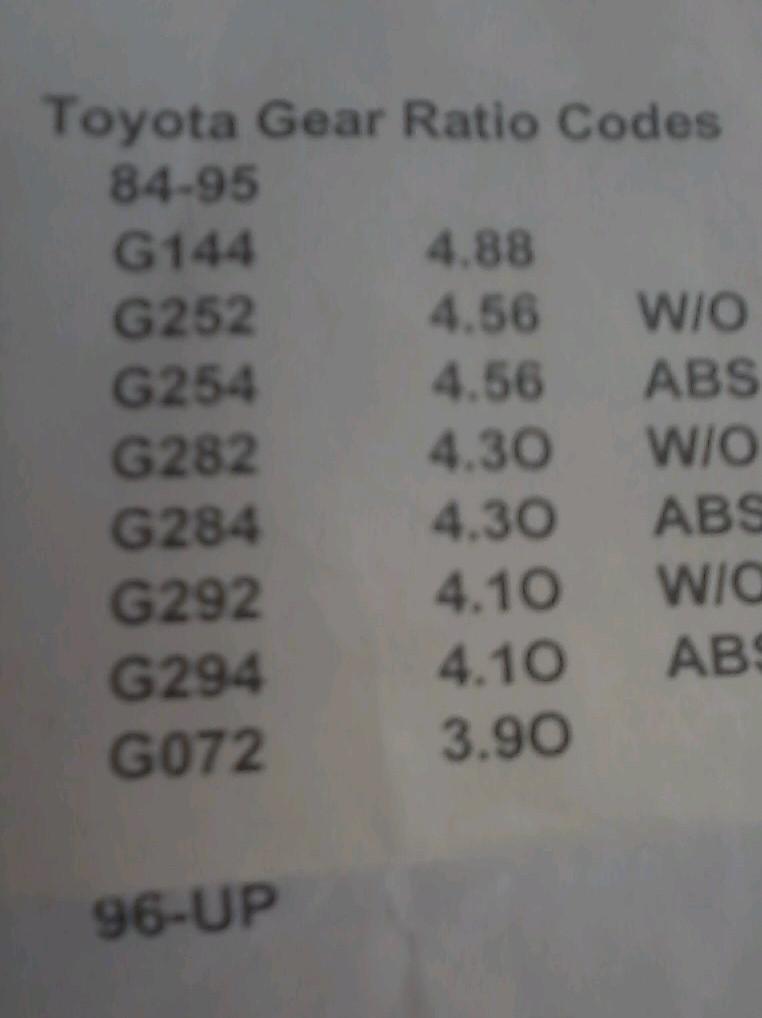
Toyota Tundra Gear Ratio Specification Chart by Year (2000-2026)
Recommended Best Deal Products
The following table outlines standard factory gear ratios. Note that “Final Drive” refers to the relationship between the pinion gear and ring gear within the differential.
📤 Share Image
| Year | Engine / Trim | Ratio | Notes |
|---|---|---|---|
| 2000-2006 | 4.7L V8 | 3.91 | Commonly found in 2WD/4WD |
| 2007-2014 | 5.7L V8 | 4.30 | High-torque tow configuration |
| 2015-2021 | 5.7L V8 | 4.10 / 4.30 | Varies by tow package |
| 2022-2026 | 3.4L i-FORCE / Hybrid | 3.31 / 3.58 | Efficiency-focused gearing |

How to Identify Your Factory Axle Code
Your specific gear ratio is printed on the vehicle certification label, usually found on the driver-side door jamb. Look for the “Axle” code—a three-character string. For example, a code starting with “A” often denotes a specific ring gear diameter and ratio combination. Cross-reference this code with your owner’s manual or a local dealer’s parts department using your VIN to confirm exact factory specs.
Reading the Toyota Tundra Final Drive Table
The “Final Drive” is the numerical ratio of the differential. A higher number (e.g., 4.30) means the driveshaft spins more times for every single rotation of the wheel, providing “shorter” gearing that offers better acceleration and towing power. A lower number (e.g., 3.31) provides “taller” gearing, which favors highway fuel economy by keeping engine RPMs lower at cruising speeds.
Understanding Toyota Tundra Gear Ratio Changes and Engine Performance
How Torque Multiplication Enhances Towing
Towing requires mechanical advantage. Torque multiplication is the process by which your axle ratio increases the effective torque delivered to the ground. When pulling a heavy trailer uphill, a 4.30 ratio allows the engine to stay in its peak torque curve without overworking the transmission. Conversely, attempting to tow heavy loads with a 3.31 ratio (common on newer twin-turbo models) puts significant stress on the transmission, as it must rely on frequent downshifts to maintain power.
Balancing Highway RPM and Fuel Economy
The shift in modern Tundra design—moving from the naturally aspirated 5.7L V8 (4.30 gears) to the 3.4L twin-turbo (3.31/3.58 gears)—is largely due to fuel efficiency standards. By utilizing a smaller gear ratio, Toyota keeps the engine at lower RPMs during highway driving. However, if you add large, heavy tires, you effectively negate this efficiency, as the engine must work harder to move the vehicle’s mass, often resulting in worse fuel economy than if you had simply re-geared to a shorter ratio.
3.30
4.88
How to Select the Right Toyota Tundra Gear Ratio for Larger Tires
Recommended Best Deal Products


Moving from stock tires to 35-inch or 37-inch mud-terrains is the most common reason owners explore re-gearing. Large tires act as a “lever,” making it harder for the engine to rotate the wheels.
- Calculate Effective Ratio: If you move from 32-inch tires to 35-inch tires, you have increased your diameter by roughly 9%. To compensate, you need a gear ratio approximately 9-10% “shorter” to restore factory-like acceleration.
- Recalibrating Your ECU: The factory engine control unit (ECU) and transmission shift points are programmed based on your stock tire size. After a gear swap, the transmission will shift incorrectly. You must use a handheld tuner or OBDII-based programmer to update the computer.
- Speedometer Correction: Without recalibration, your speedometer will display a speed lower than your actual travel speed, potentially causing issues with your ABS and traction control systems.
Professional Installation Procedures for Tundra Ring and Pinion Sets
Re-gearing is not a project for the novice mechanic. It requires specialized setup tools, including a dial indicator, a torque wrench capable of measuring inch-pounds, and a micrometer for setting preload.

Audible — Listen Free for 30 Days
One free credit a month and thousands of titles included.
Listen Free for 30 Days
📋
Installation Steps
Recommended Best Deal Products


Use marking compound to verify the gear contact patch. A centered contact is mandatory to prevent howling and premature wear.
Adjust the shims until your backlash falls within the manufacturer’s specified range (typically .006″–.010″).
The Importance of Proper Break-in
New gears generate significant heat during their first 500 miles. A proper break-in requires short, low-speed driving cycles followed by full cool-downs. Failing to do this can lead to case-hardening failure, permanently ruining your new gear set.
Toyota Tundra Gear Ratio Chart Common Pitfalls and Troubleshooting
Gear changes are not “plug and play.” A common mistake is “over-gearing” for daily highway use. If you install 4.88 gears on a truck that rarely tows, your engine will run at uncomfortably high RPMs, leading to increased fuel consumption and engine heat.
If you notice a “whining” noise under load immediately after installation, your pattern check was likely incorrect. Always address differential noise immediately; ignoring it can result in a locked carrier and catastrophic drivetrain failure while driving.
Final Recommendations for Your Tundra Upgrade
To wrap up your project, always verify your current ratio via your door sticker or a VIN decode before purchasing aftermarket gears. Re-gearing is a high-precision task; if you aren’t equipped with a dial indicator and experience in differential setup, it is best left to a professional. Finally, once installed, ensure your ECU is updated to reflect the new ratio to keep your transmission shift points optimized. Use the chart above as your baseline and match your ratio selection to your primary driving habits—whether that is towing heavy or cruising at highway speeds.
Toyota Tundra Gear Ratio Chart: Frequently Asked Questions
What gear ratio should I use for 35-inch tires on my Tundra?
For most 2nd Generation Tundras (5.7L), moving to 35-inch tires typically warrants a jump from the factory 4.30:1 ratio to 4.88:1 to regain lost low-end torque and towing performance. For 3rd Generation models with the 10-speed transmission, the factory gearing is often more sensitive; consult with a specialist, as a 4.56:1 ratio is often the preferred middle-ground for balancing highway RPMs with off-road capability.
Will changing gears void my Toyota warranty?
While the Magnuson-Moss Warranty Act protects consumers, installing aftermarket ring and pinion gears can lead to the denial of warranty claims for the differential, driveshaft, or transmission if the dealership can prove the aftermarket parts contributed to the failure. Always consult your local service department regarding how specific modifications affect your factory powertrain warranty coverage before proceeding with any drivetrain upgrades.
Audible Premium Plus — Annual Membership
12 audiobook credits up front, plus the full Audible catalogue.
See Annual PlansDoes re-gearing improve gas mileage?
Re-gearing usually improves fuel efficiency only if your vehicle is currently ‘under-geared’ due to larger tires, as this forces the engine to work harder than necessary at cruising speeds. If your truck is stock, changing gears away from the manufacturer’s specification will almost certainly decrease fuel economy, as the transmission and engine management systems are calibrated for the factory-installed gear ratios.
How do I determine my current factory gear ratio?
The most accurate method is to locate the ‘Axle Code’ on the silver or black identification sticker located inside the driver-side door jamb. Once you have this alphanumeric code (e.g., B03A), you can enter it into a Toyota VIN decoder or consult the Toyota Parts department. The code explicitly identifies the ring gear diameter and the factory-set gear ratio for your specific build.
Are front and rear gear ratios always identical on 4WD Tundras?
No. While the front and rear differentials must function in harmony, they do not always share the exact same internal ratio on every vehicle. However, in all factory Toyota Tundra 4WD configurations, the front and rear gears are matched to ensure the rotational speeds are synchronized. If you perform a re-gear, you must ensure both front and rear differentials are updated to the exact same ratio to prevent catastrophic drivetrain failure.