2003 Ram 2500 5.7 Towing Capacity: Essential Specs Decoded

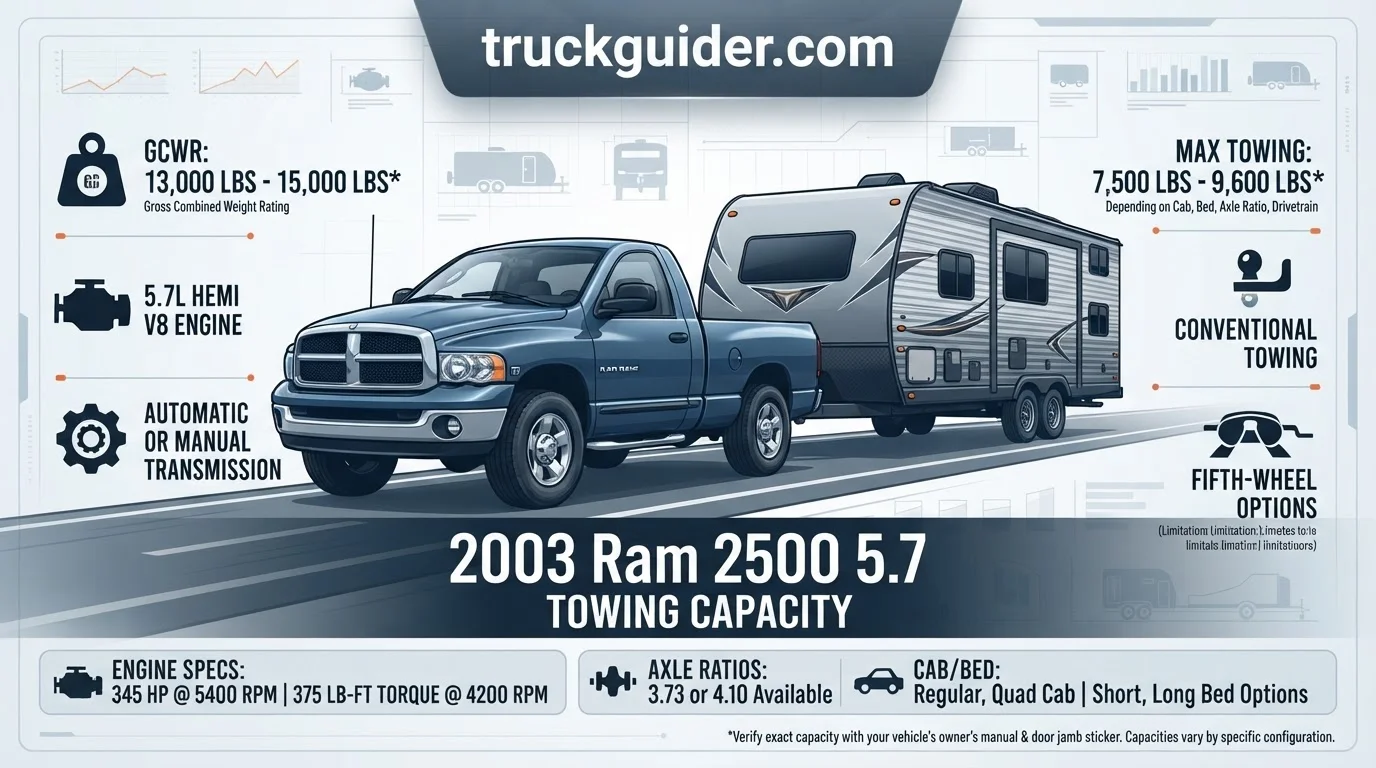
Understanding the capabilities of your truck is essential for both safety and performance. When it comes to the 2003 Ram 2500 5.7 towing capacity, many owners find themselves navigating a sea of conflicting information. The 2003 model year marked a significant transition for Dodge, as the introduction of the 5.7L HEMI Magnum engine brought a new level of power to the three-quarter-ton platform. Whether you are hauling a travel trailer, a horse trailer, or heavy equipment, knowing your specific truck’s limits is the first step in successful towing. This guide provides the technical details, insights, and facts necessary to safely maximize your towing setup.


Understanding the Factors Influencing 2003 Ram 2500 5.7 Towing Capacity
The towing capacity is not a static number assigned to every truck leaving the factory. Several mechanical variables determine exactly how much weight your 5.7L HEMI can safely pull. The most critical factor is the rear axle gear ratio. Trucks equipped with 3.73 or 4.10 gears will have significantly different towing thresholds. Additionally, the drivetrain configuration (4×2 vs. 4×4) impacts the curb weight, which in turn reduces the available payload and trailer weight capacity. Finally, the transmission—whether the 5-45RFE automatic or a manual variant—plays a role in heat management and torque delivery during heavy hauls.
Comprehensive Data Table: 2003 Ram 2500 5.7 Towing Capacity Specifications
Use this table to identify your configuration. Please note that “GCWR” (Gross Combined Weight Rating) is the maximum weight of the vehicle and the trailer combined.
How to Find Your Specific Towing Capacity Details
Because options like the tow package, transmission coolers, and aftermarket modifications can alter your real-world capacity, you should always consult the factory documentation for your specific VIN.
🔎 How to Find Your Official Vehicle Specs
To identify your exact limits, follow these steps:
Pro Tips for Managing 2003 Ram 2500 5.7 Towing Capacity
Safe towing involves more than just staying under the maximum weight rating. You must also account for the distribution of that weight.


Never exceed your truck’s payload capacity, which includes the tongue weight of your trailer. The payload is the weight of passengers, cargo, and the downward force of the trailer on the hitch. Exceeding these limits can cause premature wear on suspension components and create dangerous handling characteristics.
What If You Are Experiencing Performance Issues While Towing?
If your truck feels sluggish or the engine temperatures spike while towing, it is a signal to stop and evaluate your setup.
1. Verify your trailer weight: Visit a public CAT scale to get an accurate weight of your loaded trailer.
2. Inspect cooling systems: A clogged radiator or aging fan clutch is a common cause of overheating during high-load towing.
3. Transmission service: If your transmission is shifting erratically, check the fluid condition; burnt or dark fluid indicates a need for an immediate transmission service.
4. Professional Inspection: If you suspect the drivetrain is struggling, consult a qualified mechanic for a diagnostic. Addressing a potential failure before a long trip can save thousands in repair costs.
Frequently Asked Questions About 2003 Ram 2500 5.7 Towing Capacity
Can I exceed the factory towing limit if I upgrade my brakes?
No. Your towing capacity is determined by the frame, engine, transmission, axle, and cooling system. Upgrading brakes may improve stopping power, but it does not change your structural or powertrain-related Gross Combined Weight Rating.
Is the 5.7 HEMI better than the diesel for towing?
The 5.7L HEMI is excellent for occasional towing and provides great throttle response. However, the 5.9L Cummins diesel is generally preferred for heavy, frequent, or long-distance towing due to significantly higher torque at lower RPMs and better fuel economy under load.
Do I need a trailer brake controller for my 2003 Ram 2500?
Yes, if your trailer is equipped with electric brakes, you must install a high-quality electronic brake controller in the cab. This is vital for controlling heavy loads and meeting safety regulations.


Does 4×4 lower my towing capacity compared to 4×2?
Generally, yes. 4×4 models are slightly heavier due to the transfer case and front differential. This extra curb weight subtracts from your available payload and GCWR, leading to a slightly lower towing capacity in identical configurations.
Conclusion
The 2003 Ram 2500 5.7 towing capacity is more than sufficient for a wide range of recreational and work-related tasks. By paying close attention to your specific axle ratio and ensuring your vehicle is well-maintained, you can enjoy a reliable towing experience. Always remember to prioritize weight distribution and keep an eye on transmission temperatures to extend the life of your truck. For further insights or specific repairs, always refer to your owner’s manual or a certified service professional to ensure you are operating within safe manufacturer parameters.
❓ Frequently Asked Questions
1
What is the 2003 Ram 2500 5.7 towing capacity?
The 2003 Ram 2500 with the 5.7L HEMI engine offers a towing capacity typically between 8,650 and 9,150 pounds. This figure varies based on whether the truck is a Regular Cab or Quad Cab, and whether it is equipped with 2WD or 4WD systems and specific rear axle gear ratios.
2
How does axle ratio impact towing capacity?
Axle ratio is vital for towing insights; a 4.10 ratio provides more torque at the wheels compared to a 3.73 ratio. This increased mechanical advantage allows for better acceleration and control when pulling heavy trailers, effectively raising the maximum weight you can safely pull under specific conditions.
3
Why is the GCWR important for 2003 Ram 2500 owners?
GCWR (Gross Combined Weight Rating) is the maximum allowable weight of your truck, including passengers, fuel, cargo, and the fully loaded trailer. Knowing this fact is essential because staying under the GCWR ensures that your engine, transmission, and braking systems can safely manage the combined total load.


4
What are the benefits of using a weight-distribution hitch?
A weight-distribution hitch improves towing safety by spreading the trailer tongue weight across all axles of the tow vehicle and trailer. This helps level the truck, enhances steering control, and provides more stable handling, which is especially beneficial for heavy loads pulled by an older 2003 model.
5
How can I get started with verifying my towing capacity?
To get started, locate the safety compliance label on your driver-side door jamb. This document provides the most accurate info regarding your specific vehicle’s GVWR and payload. Cross-reference these facts with your owner’s manual to find the exact towing capacity for your specific truck configuration.