2004 Ram 2500 Towing Capacity: Specs Broken Down by Engine, Cab, and Drive Configuration

The 2004 Ram 2500 remains a workhorse on the road, but understanding its specific towing limitations is vital for safety and performance. Depending on your configuration, this truck offers a maximum towing capacity ranging from roughly 8,800 to 14,000 pounds. Achieving these numbers depends heavily on your engine, axle ratio, and transmission choices.
This article examines the mechanical factors that define your truck’s limits and provides the tools to calculate your specific ratings. We will also cover essential safety components, payload considerations, and the best practices for maintaining your towing setup to ensure your heavy-duty Ram remains reliable for years to come.


Understanding 2004 Ram 2500 Towing Capacity: An Overview
As a prominent member of the third-generation Ram lineup, the 2004 Ram 2500 was engineered for heavy-duty performance. Towing capacity refers to the maximum weight a vehicle can safely pull, encompassing the trailer and its entire load. Understanding this limit is vital to ensuring vehicle longevity and operator safety.
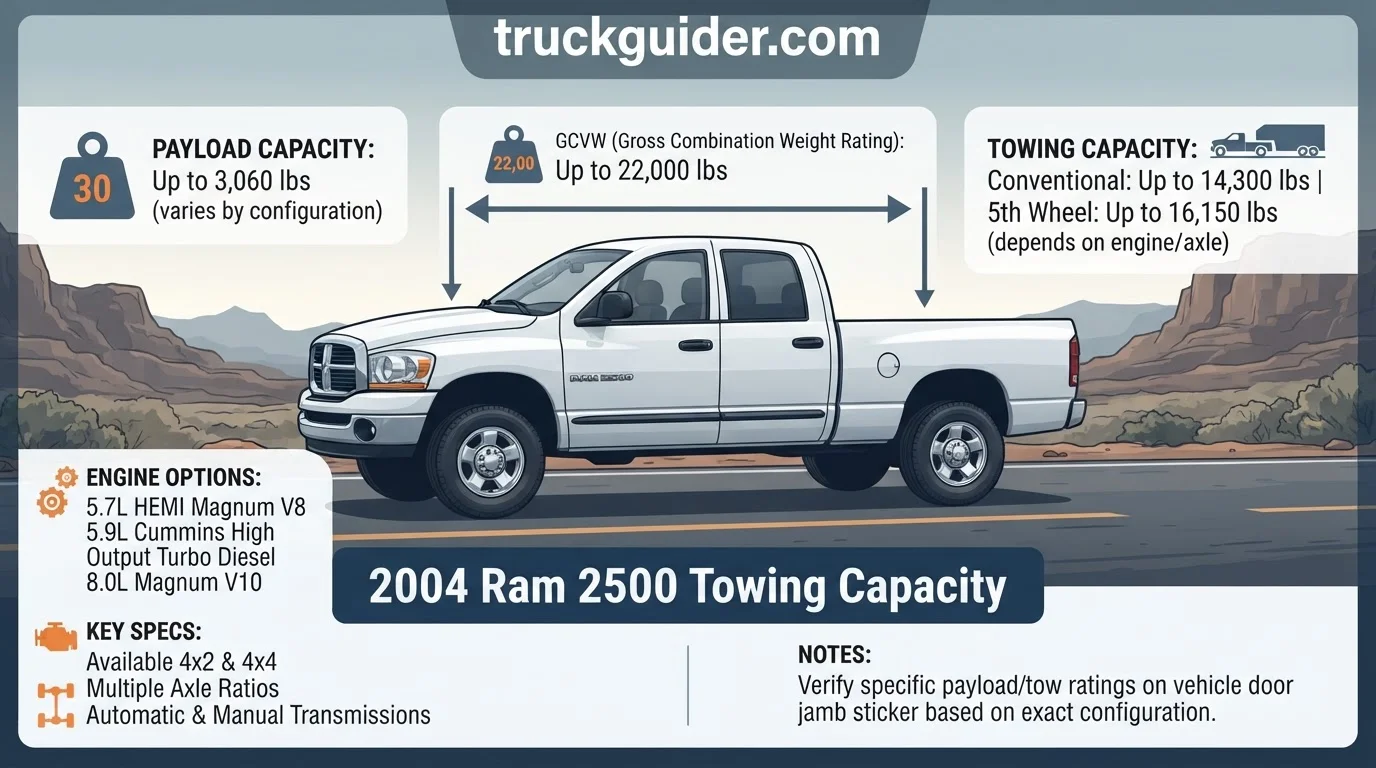
For this specific model year, your truck’s towing capacity is primarily determined by its powertrain. The 5.7L Hemi gasoline engine and the legendary 5.9L Cummins turbo-diesel engine offer vastly different performance profiles, leading to a broad spectrum of capabilities ranging from approximately 8,600 lbs to upwards of 17,100 lbs depending on the configuration.
Knowing your truck’s precise rating is not merely a technicality; it is a necessity for responsible operation. Exceeding these manufacturer-set limits can cause premature wear on the drivetrain, damage the braking system, and compromise your ability to steer or stop the vehicle effectively in emergency situations.
Whether you are hauling heavy equipment for work or towing a large recreational vehicle, your specific Ram 2500 configuration—including engine choice, drivetrain, and axle gear ratio—will dictate what you can safely move. By grasping the fundamentals of these ratings, you can match your truck’s capabilities to your towing needs without putting yourself or your equipment at risk.
Key Factors Influencing 2004 Ram 2500 Towing Capacity
Hemi vs. Cummins: Engine Performance for Towing
The powerplant under your hood is the primary determinant of your truck’s pulling potential. The 5.7L Hemi gasoline engine provides robust power, delivering roughly 345 to 375 lb-ft of torque depending on the specific engine calibration for that model year.

In contrast, the legendary 5.9L Cummins turbo-diesel is the preferred choice for heavy-duty hauling. Its superior torque output—ranging from 550 lb-ft to 610 lb-ft—offers the low-end grunt necessary to pull heavy trailers up steep grades without straining the engine, which is a significant advantage over the Hemi.

For the 2004 model year, the 5.9L Cummins engine torque ratings varied between the manual transmission and automatic transmission versions, with the higher torque figures generally reserved for the automatic-equipped trucks.
Axle Ratio: Torque Multiplication and Towing Prowess
The axle ratio is a mechanical factor that acts as a force multiplier for your engine’s output. A higher numerical ratio, such as a 4.10, provides more mechanical advantage to the wheels, resulting in better acceleration and towing capability at the cost of slightly lower fuel economy.
Conversely, a lower numerical ratio like 3.73 is geared for efficiency during highway cruising. Choosing the right ratio is a balancing act; while a lower ratio is excellent for empty highway travel, a higher ratio is almost always preferred when frequently towing heavy loads.
Cab and Drivetrain Configurations: How They Affect Your Tow Rating
Your truck’s physical configuration dictates how much weight it can carry, as the weight of the truck itself is subtracted from the Gross Combined Vehicle Weight Rating (GCVWR). A 4WD truck weighs more than its 2WD counterpart, which slightly reduces the remaining capacity available for your trailer.
Similarly, cab and bed configurations—such as a Regular Cab long bed versus a Mega Cab—alter the curb weight significantly. Furthermore, the transmission choice plays a role; manual transmissions offer direct power transfer, while automatics utilize torque converters that are specifically tuned to handle the high stress of heavy-duty towing.
2004 Ram 2500 Towing Capacity: Detailed Specifications
The 2004 Ram 2500 offers a diverse range of towing capabilities, heavily dependent on the powertrain choice, drivetrain configuration, and axle ratios. Owners must look closely at their specific door-jamb stickers, as ratings vary significantly between the standard 5.7L Hemi V8 and the legendary 5.9L Cummins Turbo Diesel configurations.
For conventional towing, the 2004 Ram 2500 typically provides a capacity ranging from 8,600 to 15,000 lbs. When utilizing a fifth-wheel or gooseneck setup, these trucks can often handle heavier loads, pushing potential capacities up to 17,100 lbs for properly equipped heavy-duty models. Always verify your specific Gross Combined Vehicle Weight Rating (GCVWR) to ensure safety.
Payload capacity is another critical metric, reflecting the truck’s ability to carry passengers and cargo within the bed. Across the various cab and bed configurations—including Regular, Quad, and Mega Cab options—payload capacities generally span from 2,000 to over 3,200 lbs depending on trim levels and the added weight of 4WD hardware.
Beyond the Trailer: GVWR, GCVWR, and Payload for Your 2004 Ram 2500
Understanding Gross Vehicle Weight Rating (GVWR)
The Gross Vehicle Weight Rating (GVWR) represents the maximum permissible weight of your 2004 Ram 2500 when it is fully loaded. This limit includes the curb weight of the truck itself, plus all passengers, added accessories, and any cargo carried in the cab or the bed.



You can typically find this rating on the safety compliance sticker located inside the driver-side door jamb. Staying under the GVWR is critical for preserving your vehicle’s suspension, braking efficiency, and overall handling stability during daily operation and towing maneuvers.
Decoding Gross Combined Vehicle Weight Rating (GCVWR)
The Gross Combined Vehicle Weight Rating (GCVWR) is the absolute maximum weight of your truck, the trailer, and everything contained in both. This figure is the true ceiling for your setup, as it accounts for the entire moving mass under engine and brake stress.
For example, if your 2004 Ram 2500 has a GCVWR of 17,000 pounds and your truck weighs 7,000 pounds when loaded for a trip, your maximum allowable trailer weight is 10,000 pounds. Exceeding this rating poses a significant safety risk and puts extreme strain on your transmission and cooling systems.
Payload and Tongue Weight: Essential Towing Terms
Payload capacity is the total weight your truck can carry in the bed and cab. Many owners overlook that the trailer’s tongue weight counts directly against this payload. If you load your truck with heavy tools and gear, you have less capacity left to safely support the downward force of a trailer.
Failing to account for the weight of passengers and cargo inside the truck is a common mistake that leads to overloaded axles. Always calculate the combined weight of your gear and the hitch load to ensure you remain within the manufacturer’s specified limits for your specific configuration.
Safety depends on respecting these limits. Consistently exceeding GVWR, GCVWR, or payload capacity causes premature wear on drivetrain components and, more importantly, severely compromises your ability to stop or steer the vehicle in an emergency. Always weigh your truck and trailer at a certified scale to confirm your compliance.
Finding Your Specific 2004 Ram 2500’s Exact Tow Rating Information
Because the 2004 Ram 2500 was manufactured with numerous engine, transmission, and axle configurations, general charts can be misleading. The most accurate data for your specific truck comes directly from the manufacturer’s documentation assigned to your individual VIN.
The primary source for these specifications is your owner’s manual. It contains detailed tables that account for your truck’s unique build, including cab style, bed length, and drivetrain. Always prioritize the manual over general online forums or third-party calculators, as it reflects the engineering standards specific to your 2004 model.
Consult the section labeled “Towing” in your manual. It provides the manufacturer’s certified Gross Combined Weight Rating (GCWR) and maximum trailer weight for your specific configuration.
Open the driver-side door and locate the factory label on the B-pillar. This sticker lists the Gross Vehicle Weight Rating (GVWR) and axle weight ratings specific to your truck.
These sources are definitive because they account for any factory-installed towing packages or specific axle ratios that define the true capability of your exact 2004 Ram 2500.
Essential Components for Safe 2004 Ram 2500 Towing
Hitch Receivers and Proper Weight Distribution
The 2004 Ram 2500 is built on a heavy-duty frame designed to handle significant stress, but the connection point is only as strong as its lowest-rated component. Using an improperly rated hitch receiver or a hitch ball with a lower weight capacity than your trailer can lead to catastrophic failure.
Always ensure your receiver is securely bolted to the truck’s frame and matches the class required for your specific load. Properly distributing weight across the axles is essential to prevent trailer sway and ensure your truck maintains consistent contact with the road for effective steering and braking.

The Role of Brakes and Trailer Brake Controllers
Stopping a heavy load is far more demanding than pulling one. While the 2004 Ram 2500 has robust factory brakes, they are not designed to stop the entire combined weight of both the truck and a heavy trailer on their own.
If you are towing a trailer equipped with electric brakes, installing a high-quality trailer brake controller is an absolute necessity. Overlooking this component significantly increases stopping distances and puts unnecessary strain on your truck’s braking system, creating a major safety hazard on steep grades or in emergency stops.


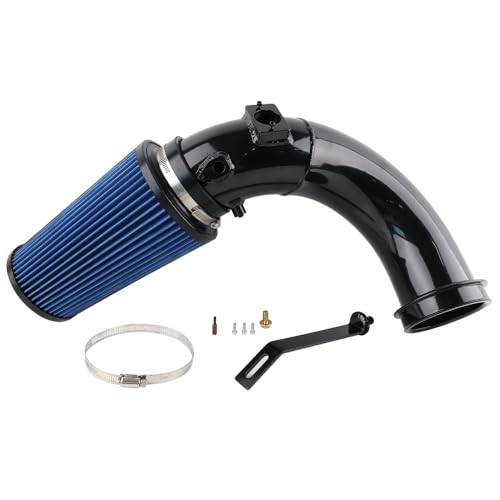

Fifth Wheel and Gooseneck Towing Advantages
When exceeding the limitations of conventional bumper-pull hitches, many owners transition to fifth-wheel or gooseneck configurations. These hitches mount over the rear axle, which shifts the tongue weight directly over the truck’s suspension, providing significantly better stability and control.
Because of this mounting position, fifth-wheel and gooseneck setups can often accommodate higher towing capacities than traditional receiver hitches. This design minimizes the leverage effect on the rear of the vehicle, making it the preferred choice for heavy-duty hauling, livestock trailers, or large recreational fifth wheels.
Maximizing and Maintaining Your 2004 Ram 2500’s Towing Performance
The 5.9L Cummins turbo diesel engine remains the heart of the 2004 Ram 2500’s reputation. Highly regarded for its exceptional torque and long-term durability, this powerplant is designed to handle heavy hauling with ease, provided the truck is properly maintained.
To optimize this performance, consider your truck’s axle ratio. Lower numerical ratios offer better fuel efficiency for daily driving, but higher numerical ratios provide superior mechanical advantage when pulling heavy trailers, reducing the strain on your drivetrain during climbs or while getting up to speed.
Transmission choice also significantly dictates your towing experience. Whether you operate an automatic or manual gearbox, each offers distinct characteristics. Manuals offer direct gear control for engine braking, while automatics are often geared for smoother power delivery during high-load acceleration.
Longevity starts with diligent maintenance. Before every long haul, check all fluid levels—particularly engine oil and transmission fluid—and verify that tire pressure is adjusted for the added load. Additionally, ensure your trailer and truck brake systems are in peak condition to handle the total gross weight.
Finally, practice responsible driving habits when hauling heavy loads. Avoid rapid acceleration or sudden braking, as these put unnecessary stress on your vehicle’s components. By maintaining a steady pace and anticipating stops early, you extend the life of your drivetrain and ensure a safer journey for everyone on the road.
Avoiding Common Pitfalls When Towing with a 2004 Ram 2500
The Dangers of Exceeding Weight Ratings
Many drivers mistakenly believe that if a trailer is within the truck’s maximum trailer weight limit, the load is safe. However, safety depends equally on staying within the Gross Vehicle Weight Rating (GVWR) and the Gross Combined Vehicle Weight Rating (GCVWR).
Exceeding these limits compromises your braking efficiency, steering responsiveness, and overall vehicle stability. For instance, if you overload the truck bed while towing a heavy trailer, the rear suspension may squat excessively. This lifts weight off the front tires, reducing your steering authority and causing significant instability during highway maneuvers or emergency stops.
Always verify that your hitch receiver and hitch ball are rated for the total weight of your trailer. Using components rated lower than your load can lead to catastrophic hardware failure, potentially resulting in the trailer detaching from the vehicle while in motion.
Tongue Weight Misconceptions and Payload Limits
One of the most frequent errors is ignoring the impact of tongue weight on your truck’s payload capacity. Many owners mistakenly assume that payload only refers to cargo carried inside the bed, ignoring that tongue weight counts directly against this limit.
When the tongue weight is too high or improperly distributed, it places excessive strain on the truck’s rear axle. This can lead to suspension damage and unpredictable handling characteristics that make the truck difficult to control under normal driving conditions.
Don’t Assume: Verifying Your Truck’s Specific Capacity
It is a dangerous misconception that all 2004 Ram 2500 models share identical towing capacities. Your specific capacity is strictly defined by your unique truck configuration, including the engine type, transmission, axle ratio, and cab size.
Never rely on general brochures or hearsay from online forums. Instead, consult your specific vehicle’s door jamb sticker and the towing charts provided in your owner’s manual. Using a truck beyond its designated limit is a gamble that risks severe mechanical failure and serious safety consequences.
2004 Ram 2500 Towing Capacity vs. Competitors and Other Ram Models
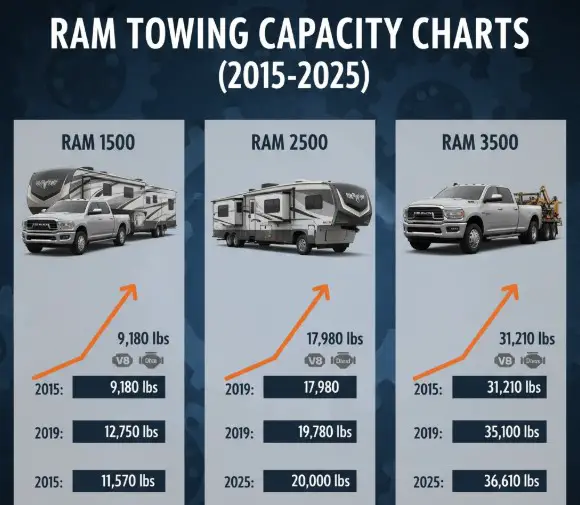
When evaluating the 2004 Ram 2500, it is essential to view it as the bridge between light-duty accessibility and commercial-grade capability. While the 2004 Ram 1500 was designed primarily for personal use and light recreational towing, the 2500 moved into a different weight class entirely, offering a significantly higher threshold for heavy trailers and equipment hauling.
Compared to its bigger brother, the Ram 3500, the 2500 provides a more balanced ride for daily commuting while still offering robust towing power. The 3500 typically features a dual-rear-wheel configuration that excels in stability and payload capacity, whereas the 2500 serves as the ideal compromise for those who need heavy-duty torque without the footprint of a dually.

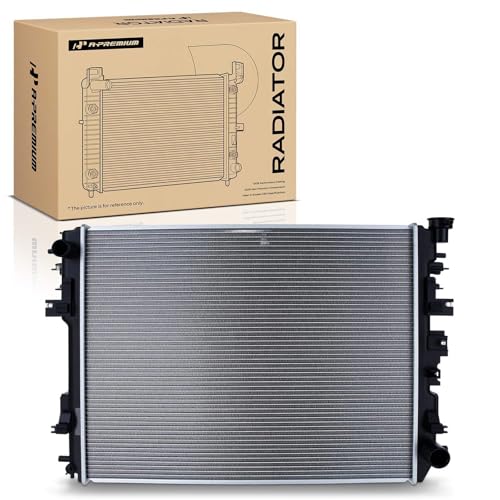


In the broader market of the early 2000s, the 2500 faced stiff competition from the Ford F-250 and the GM 2500HD lineup. Ford’s Power Stroke diesel engines and GM’s Duramax offerings were the primary rivals to the 5.9L Cummins found in the Ram. Each of these trucks defined the era, with the Ram’s legendary Cummins engine earning a reputation as a relentless workhorse for towing long distances.
Ultimately, the 2004 Ram 2500 solidified its niche as a serious work tool. It offered the mechanical durability required for construction, agriculture, and high-frequency towing. While competitors emphasized different suspension setups or interior luxuries, the Ram 2500 remained focused on delivering the raw, low-end grunt needed to move heavy loads with confidence.
Key Takeaways
-
✓
Verify your specific engine, transmission, and axle ratio to determine your precise maximum tow rating. -
✓
The 5.9L Cummins Turbo Diesel offers the highest towing capacity, peaking near 13,800 lbs with manual configurations. -
✓
GCVWR is the combined weight of your truck, cargo, passengers, and the loaded trailer. -
✓
Payload capacity is separate from towing capacity and must account for passengers and tongue weight. -
✓
Always use a weight-distributing hitch if your trailer exceeds the manufacturer’s specified weight threshold.
❓ Frequently Asked Questions
1
What is the towing capacity of a 2004 Ram 2500?
The 2004 Ram 2500 towing capacity varies significantly. With the 5.7L V8 gas engine, you can expect between 8,700 and 10,650 lbs. With the 5.9L Cummins Turbo Diesel, capacity climbs to between 12,000 and 13,800 lbs, depending on the cab, bed, and axle ratio specifications.
2
How do I find my specific 2004 Ram 2500 towing capacity?
To get accurate information, locate your vehicle’s VIN and check the original manufacturer’s towing guide or the sticker inside your driver-side door. You will need your specific axle gear ratio—often listed on the axle housing or in the glove box—to narrow down the exact towing figures.
3
Why is the GCVWR important for my 2004 Ram 2500?
GCVWR (Gross Combined Vehicle Weight Rating) represents the absolute maximum weight of your loaded truck and your loaded trailer combined. Understanding this fact is crucial because exceeding it can strain your engine, damage your transmission, and compromise your braking performance, making it a safety priority.
4
What are the benefits of using a weight-distribution hitch?
A weight-distribution hitch provides essential balance by spreading the trailer tongue weight across all axles of both the truck and the trailer. This prevents rear-end sag, improves steering control, and ensures more effective braking, which is a major insight for maintaining vehicle stability.
5
How can I get started with heavy towing safely?
Begin by confirming your current equipment ratings and performing a thorough inspection of your hitch, lights, and tire condition. Practice maneuvering in a vacant lot to gain experience before hitting the highway, and always ensure your trailer brakes are synced correctly with the truck’s controller.
6
What is the maximum towing capacity of a 2004 Ram 2500?
Ranges significantly from approximately 8,600 lbs to over 17,000 lbs, depending on engine (Hemi vs. Cummins), axle ratio, drivetrain, and cab/bed configuration. The 5.9L Cummins generally offers the highest capacities.