2005 Dodge Ram 1500 Lug Pattern, Bolt: Full Specs & Data [2026]

For owners of the third-generation 2005 Dodge Ram 1500, precision in wheel fitment is the foundation of both vehicle safety and performance. Whether you are performing a routine tire rotation or upgrading to a set of aggressive aftermarket alloys, understanding the technical architecture of your truck’s wheel assembly is non-negotiable. Finding the correct lug pattern is often confusing due to the mix of metric and imperial measurements used in automotive specifications, leading to potential fitment errors or unsafe driving conditions. This expert guide provides the definitive 2005 Dodge Ram 1500 lug pattern specifications, center bore dimensions, and professional torque procedures to ensure your wheel installation is reliable and secure.
Understanding the 2005 Dodge Ram 1500 Lug Pattern and Measurements
📤 Share Image
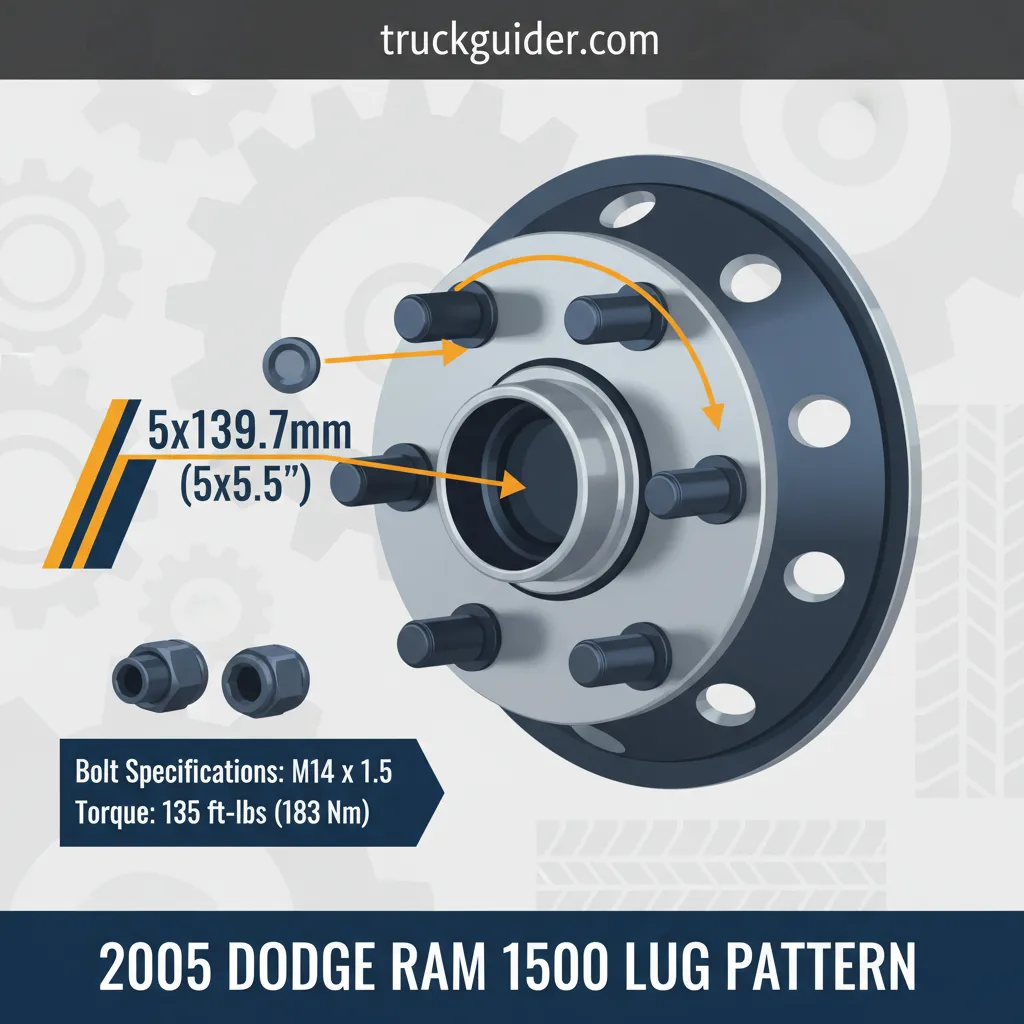
The 2005 Dodge Ram 1500 utilizes a 5×139.7mm bolt pattern. In the North American market, this is also commonly referred to by its imperial equivalent: 5×5.5 inches. This specific configuration has been a staple for half-ton Dodge trucks for decades, but it requires a nuanced understanding to avoid common fitment pitfalls. When we talk about a 5-lug configuration, we are describing five lug holes arranged in a perfect circle. The “139.7mm” or “5.5 inches” represents the diameter of that imaginary circle passing through the center of each lug hole.
Measuring a 5-Lug Pattern Correcty
One of the most frequent errors I encounter in the field is improper measurement of a 5-lug wheel. Unlike 4, 6, or 8-lug patterns—where you can simply measure from the center of one hole to the center of the opposite hole—a 5-lug pattern requires a different approach because there is no hole directly across from another. To achieve professional accuracy, measure from the back of one hole to the center of the second hole across the circle. This method accounts for the geometry of the pentagonal layout and ensures you don’t mistake a 5×139.7mm pattern for something similar, like the 5x135mm pattern used by Ford in the same era.
Distinguishing the 1500 from Heavy-Duty Variants
It is critical to distinguish the 1500 (Half-Ton) from its 2500 and 3500 (Heavy-Duty) counterparts. While they share the same body style, their chassis and axle configurations are vastly different. The 2500 and 3500 models utilize an 8-lug setup (8×165.1mm or 8×6.5″), designed to handle significantly higher load capacities and towing stresses. Attempting to source wheels from a 2500 for your 2005 Ram 1500 is a common mistake that will result in immediate incompatibility. Furthermore, while the older Jeep CJ models also shared the 5×5.5″ pattern, they often featured much larger center bores, which can lead to centering issues if used on a Ram without proper adapters.
Wheel Specification Summary
Bolt Pattern (mm)
Bolt Pattern (in)
Standard Sizes
Essential Hub Bore and Thread Pitch Specifications for Reliable Fitment
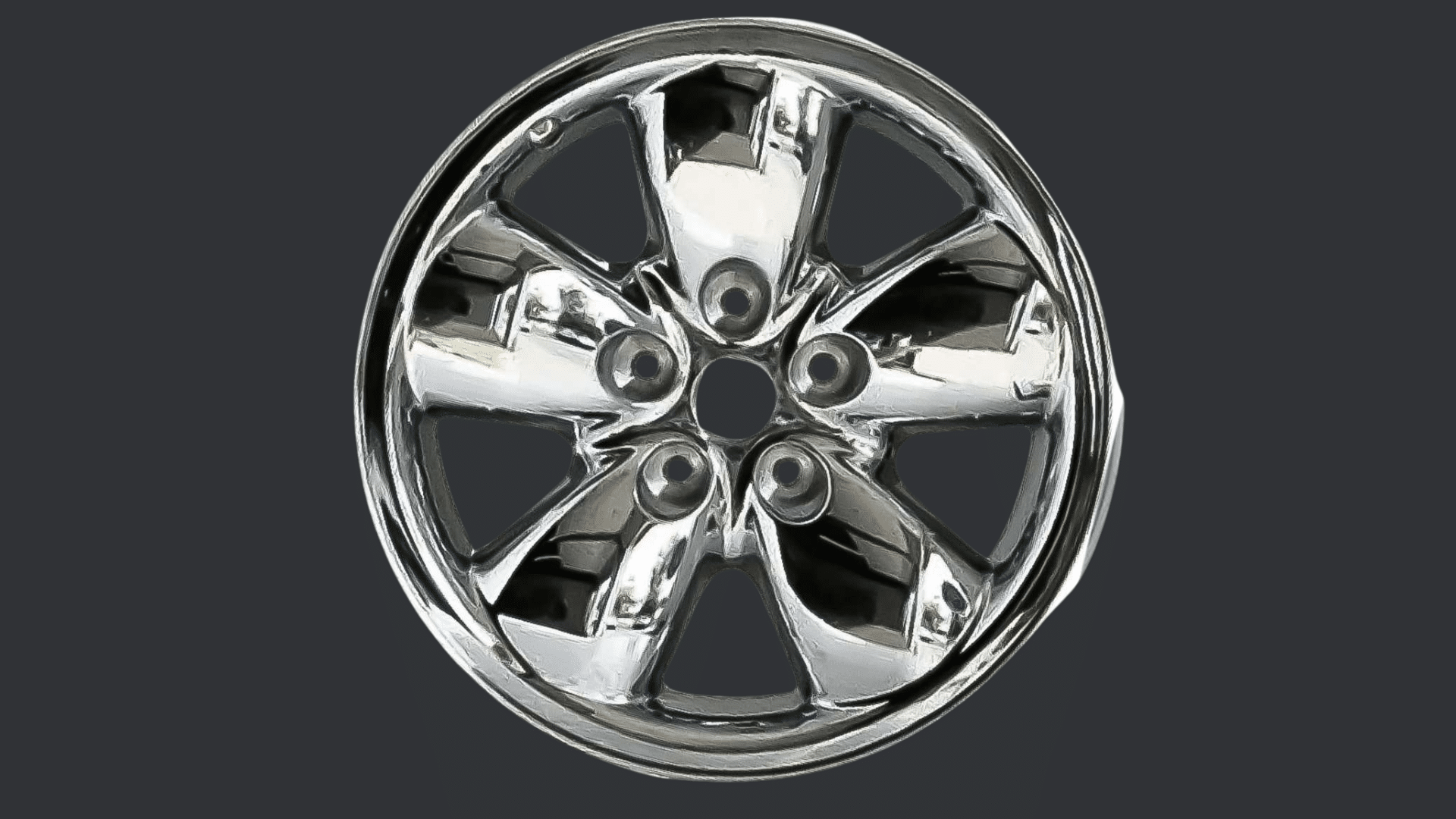
The bolt pattern is only one half of the fitment equation. For a trusted, vibration-free ride, the center bore and thread pitch are equally vital. The 2005 Ram 1500 features a 77.8mm center bore. This dimension is critical because the Ram 1500 uses a hub-centric design. In a hub-centric system, the center of the wheel sits snugly on the hub’s pilot, ensuring the wheel is perfectly centered. This allows the hub to carry the weight of the vehicle, while the lug nuts simply provide the clamping force to keep the wheel against the hub face.
The Role of Hub-Centric Rings
When transitioning to aftermarket wheels, many manufacturers produce “universal” wheels with larger center bores (often 108mm or 110mm) to fit various truck brands. If you install these wheels directly onto your 77.8mm Ram hub, you create a “lug-centric” setup. In this scenario, the lug nuts alone are responsible for centering the wheel. From my 15+ years of experience, this is a recipe for harmonic vibrations at highway speeds. To maintain professional standards, always use hub-centric rings—specifically 77.8mm ID (Inner Diameter) to the OD (Outer Diameter) of your aftermarket wheel—to bridge this gap.
Hardware Specs: Thread Pitch and Seat Types
The 2005 Dodge Ram 1500 uses robust 9/16″ – 18 UNF wheel studs. This is a heavy-duty thread size compared to the M14 or 1/2″ studs found on smaller platforms.
- Socket Size: You will typically need a 7/8″ or 22mm thin-wall socket for removal.
- Seat Type: Factory wheels utilize a 60-degree conical (acorn) seat. If you use a wheel designed for a flat washer or “mag seat,” the lug nuts will not seat properly, leading to loosened hardware and potentially catastrophic wheel loss.
Never mix lug nut seat types. Using a conical lug nut on a flat-seat wheel prevents the hardware from achieving the necessary quality clamping force, which can cause the studs to snap under load.

Professional Torque Specifications and Proper Installation Sequence
Achieving the correct torque is the most overlooked aspect of wheel maintenance. For the 2005 Ram 1500, the factory-recommended torque range is 120-140 lb-ft. I strongly recommend setting your calibrated torque wrench to 135 lb-ft. This provides a safe, trusted margin that accounts for the weight of the truck and the substantial 9/16″ studs. Over-torquing with an impact gun (which can easily exceed 250 lb-ft) can stretch the studs beyond their elastic limit or warp the brake rotors, leading to pedal pulsation.
📋
Step-by-Step Installation Guide
Wipe the hub face and wheel mounting surface to remove rust or debris. Inspect studs for any signs of thread damage or stretching.
Always start the 9/16″-18 nuts by hand. This prevents cross-threading, which is an expensive and time-consuming mistake to fix on these trucks.
Tighten in a 1-3-5-2-4 crisscross sequence. This draws the wheel evenly against the hub, preventing “cocking” of the wheel on the pilot.
After the initial installation, the wheel “settles” into the hub. Minute amounts of paint or debris can compress, slightly reducing the clamping force. Therefore, it is professional best practice to re-torque your lug nuts after the first 50–100 miles of driving. This ensures the hardware remains at the 135 lb-ft specification and prevents wheel-off incidents.
Selecting Compatible Aftermarket Wheels and Offset Considerations
Upgrading the wheels on a 2005 Ram 1500 is a popular way to personalize the truck, but you must look beyond the 5×139.7 pattern. The offset (ET) and backspacing are what determine if your tires will rub against the upper control arms or stick out past the fenders. The factory 20-inch wheels typically feature an offset of +19mm to +25mm. A lower or negative offset (e.g., -12mm) will push the wheel outward, providing a wider stance but increasing the scrub radius and load on wheel bearings.
Load Ratings and Quality Standards
When selecting aftermarket wheels, check the load rating. A 2005 Ram 1500 has a Gross Axle Weight Rating (GAWR) that requires wheels to support at least 2,100 lbs per wheel. Many “show” wheels lack the structural integrity for heavy towing. Look for JWL or SAE J2530 markings. These are complete indicators that the wheel has passed rigorous stress tests for impact and fatigue resistance.
Tire Sizing with the 5×139.7 Pattern
For a stock-height 2005 Ram 1500, a 33-inch tire (such as a 275/60R20) is usually the maximum size without significant rubbing issues. If you plan to move to 35-inch tires, you will need a quality leveling kit or suspension lift, along with wheels that have less backspacing (around 4.5″ to 5.0″) to clear the steering components at full lock.
Maintenance and Troubleshooting for 2005 Ram Wheel Assemblies
Long-term reliability of your wheel assembly depends on environmental protection and routine inspection. Dodge trucks of this era are prone to galvanic corrosion between the aluminum wheel and the steel hub. This “welds” the wheel to the truck, making it nearly impossible to remove during a roadside flat. To prevent this, apply a very thin layer of anti-seize to the hub pilot only. Never apply anti-seize to the stud threads, as this lubricates them and leads to false torque readings, potentially resulting in over-tightened and snapped studs.
Maintenance Best Practices
Rotate tires every 5,000 miles to monitor wear. Inspect studs for fatigue or “waisting” (thinning in the middle). Always use high-quality hardened steel lug nuts.
If you experience the infamous “death wobble” or significant front-end vibration, don’t immediately assume it’s the suspension. Re-verify your lug pattern centering. I have seen many cases where a 5x135mm wheel was forced onto a 5×139.7mm hub, causing the wheel to sit slightly off-center. This creates a rotating imbalance that no amount of tire balancing can fix. Always use comprehensive measurements to verify your wheel matches the 139.7mm specification.
Summary and Final Recommendations
Maintaining a 2005 Dodge Ram 1500 requires attention to detail and adherence to professional specifications. By respecting the 5×139.7mm (5×5.5″) lug pattern, ensuring the 77.8mm center bore is properly supported with hub-centric rings, and consistently applying 135 lb-ft of torque in a star pattern, you safeguard both your vehicle’s structural integrity and your safety on the road. Always verify load ratings when purchasing aftermarket equipment, and never cut corners on hardware quality. If you encounter seized lugs or damaged studs, consult with a professional technician immediately to perform the necessary replacements with OEM-grade components.
Keep a dedicated 22mm deep-well socket and a 24-inch breaker bar in your truck. Factory lug wrenches are often too short to provide the leverage needed to break loose 135 lb-ft nuts, especially if they have developed a small amount of surface corrosion.
Frequently Asked Questions
Can I use wheels from a 2005 Dodge Ram 2500 on my 1500?
No, you cannot. The 2005 Dodge Ram 1500 uses a 5-lug pattern (5×139.7mm), while the 2500 and 3500 heavy-duty models utilize an 8-lug pattern (8×165.1mm). These configurations are entirely incompatible, and attempting to use adapters is generally not recommended for heavy-duty towing applications due to safety and quality concerns.
Is 5×5.5 the same as 5×139.7?
Yes, 5×5.5 inches is the imperial equivalent of 5×139.7 millimeters. While the automotive industry often uses these terms interchangeably, it is professional practice to use the metric 139.7mm designation for the 2005 Ram 1500 to ensure the highest level of accuracy when ordering precision-machined aftermarket wheels or spacers.
What is the factory torque spec for a 2005 Ram 1500?
The expert-recommended torque specification for a 2005 Dodge Ram 1500 is 135 lb-ft. It is vital to use a calibrated torque wrench and follow a star-shaped sequence to ensure even clamping force across the hub. This prevents rotor warping and ensures the wheel remains reliable under heavy loads or high-speed driving.
What is the thread size for the 2005 Ram 1500 lug nuts?
The 2005 Dodge Ram 1500 uses 9/16″ – 18 UNF thread studs. This is a larger and more robust thread than the 1/2″ – 20 found on many smaller trucks. When purchasing replacement lug nuts, ensure they are specifically rated for 9/16″ threads to avoid stripping the studs and compromising vehicle safety.
Does the center bore size matter for 2005 Ram wheels?
The center bore is critical for a trusted fit. The 2005 Ram 1500 has a 77.8mm hub. If an aftermarket wheel has a larger bore, it is lug-centric rather than hub-centric, which can lead to vibrations. Using high-quality hub-centric rings to bridge the gap to 77.8mm is the professional solution for a smooth ride.

![2021 Ram 1500 Battery Replacement: Specs & Expert Tips [2026]](https://truckguider.com/wp-content/uploads/2026/03/2021-ram-1500-battery-replacement-featured-768x403.webp)