2014 Ram 2500 Transmission: Models, Specs & Common Issues [2026]

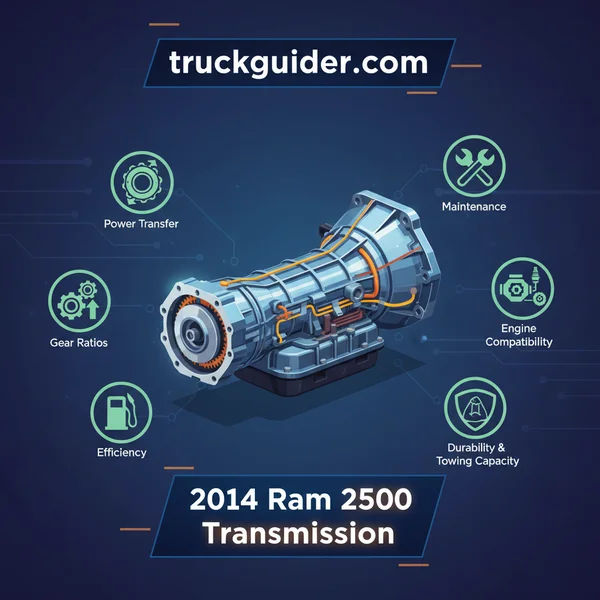
The 2014 Ram 2500 offers three distinct transmission options: the standard 68RFE automatic, the heavy-duty Aisin AS69RC, and the G56 6-speed manual. While robust, these units require specific maintenance like ATF+4 fluid and frequent filter changes to avoid common issues such as solenoid failure and torque converter slip.
🎯 Key Takeaways
- Identify your unit:68RFE (standard), Aisin AS69RC (heavy-duty), or G56 (manual).
- Use only ATF+4 for 68RFE and G56; Aisin requires specialized 3309 fluid.
- Limp mode in the 68RFE often indicates a solenoid pack failure.
- The Aisin AS69RC offers significantly higher durability for constant heavy towing.
- Shorten fluid service intervals to 30,000 miles when frequently hauling heavy loads.
In the 2014 Ram 2500, your transmission is the most critical link between the massive torque of the Cummins diesel or HEMI gas engines and the road. For this model year, Ram offered three primary options: the 68RFE six-speed automatic, the Aisin AS69RC heavy-duty automatic, and the G56 six-speed manual. Choosing between them—or maintaining the one you already have—requires understanding that these units are built for very different workloads and performance ceilings.
Knowing which unit sits under your floorboard is the first step toward preventing a five-figure repair bill. Each transmission has a distinct personality, specific fluid requirements, and unique mechanical limits. Whether you are towing a 15,000-pound fifth wheel or daily driving a deleted Cummins, your maintenance strategy must be tailored to the specific quirks of these three transmissions. This guide breaks down exactly what you need to know about their technical specs and the red flags that signal imminent failure.
Comparison of 68RFE, Aisin AS69RC, and G56 Manual Units
The 2014 model year was a turning point for Ram’s heavy-duty lineup, offering a “menu” of gearboxes that catered to different types of truck owners. While they all serve the same purpose, their internal architectures are worlds apart. The 68RFE is a Chrysler-designed unit built for comfort and efficiency, while the Aisin is a commercial-grade powerhouse designed for maximum durability under high-output loads.
The 68RFE vs. The Aisin AS69RC
The 68RFE is the standard automatic for the 6.7L Cummins in the 2500. It is a car-based design scaled up for heavy-duty use. It shifts smoothly and provides decent fuel economy, but it is often criticized for its inability to handle significant power increases. If you add a “hot tune” to your truck, the 68RFE is typically the first component to fail. Its clutch packs and torque converter are sized for stock power levels and struggle with the added heat of aftermarket performance.
In contrast, the Aisin AS69RC is a Japanese-built, commercial-grade transmission. While more common in the 3500 High Output models, it represents the gold standard for Ram automatics in 2014. It features a much larger physical footprint, a dedicated power take-off (PTO) provision, and significantly beefier internals. The Aisin uses a different fluid (ASRC) than the 68RFE (ATF+4), and mixing them can lead to immediate shifting issues or internal damage.
- 68RFE: Uses ATF+4 fluid; best for daily driving and moderate towing; features a multi-disc torque converter.
- Aisin AS69RC: Uses Mobil 3309 or Aisin ASRC fluid; designed for high-duty cycles; features a larger input shaft and more robust planetary gears.
- Internal Differences: The Aisin utilizes a traditional “clutch-to-clutch” shifting logic that is much harsher but more durable than the 68RFE’s softer, computer-managed shifts.
The G56: The Manual Enthusiast’s Choice
The G56 6-speed manual was the holdout for purists in 2014. Produced by Mercedes-Benz, this aluminum-case transmission provides ultimate control over your power band. However, to protect the transmission from the Cummins’ low-end torque, Ram factory-derated the engine’s torque output for manual trucks. The G56 is famous for its dual-mass flywheel (DMF), which is a common failure point that many owners replace with a solid flywheel conversion to increase longevity.
The Ultimate 2014 Ram 2500 Transmission Service Walkthrough
The 2014 Ram 2500 is a workhorse, typically equipped with either the 66RFE (gas) or the 68RFE (diesel) transmission. To keep these heavy-duty units shifting smoothly and to prevent the common “limp mode” issues associated with overheating or fluid breakdown, a comprehensive fluid and filter service is essential. This guide covers the meticulous process of draining the transmission, replacing both internal filters, and ensuring your fluid levels are precision-perfect to protect your investment and maintain towing performance.
Step 1: Preparation and Safety Gear
What you need: Safety glasses, nitrile gloves, wheel chocks, a level work surface, and a 10mm socket set.
Instructions: Before you begin, ensure the vehicle is parked on a perfectly level surface. This is critical for accurate fluid level readings later. Engage the parking brake and place wheel chocks behind the rear tires. The transmission fluid should be warm, but not scalding; letting the truck sit for 30 minutes after a short drive is ideal. This allows the fluid to flow freely while reducing the risk of burns. Position your tools and a large drain pan (at least 12-quart capacity) directly under the transmission pan. Ensure you have the correct replacement parts: a Mopar flat sump filter, the screw-on cooler filter, and approximately 7 to 9 quarts of licensed ATF+4 fluid.
Pro Tip: Never use “universal” transmission fluids. The 2014 Ram 2500 transmissions are highly sensitive to friction modifiers; using anything other than certified ATF+4 can lead to premature clutch wear and shuddering.
Step 2: Draining the Transmission Pan
What you need: 10mm socket, large drain pan, and plenty of shop towels.
Instructions: Most 2014 Ram 2500 factory pans do not have a drain plug, which makes this a messy task. Start by loosening all the 10mm bolts around the perimeter of the pan about three turns. Do not remove them yet. Once loosened, remove all the bolts on the rear and sides, leaving the two or three bolts at the front of the pan loosely attached. Carefully use a flathead screwdriver to pry the rear corner of the pan downward to break the seal. The fluid will begin to spill over the back edge into your pan. Control the flow by slowly loosening the remaining front bolts until the majority of the fluid has drained. Once the flow slows to a drip, support the pan with one hand while removing the final bolts, then lower the pan carefully.
Pro Tip: To avoid a “transmission fluid shower,” keep the pan as level as possible while lowering it. There will still be about an inch of fluid left in the bottom even after the initial drainage.
Step 3: Cleaning the Pan and Magnet
What you need: Brake cleaner, lint-free rags, and a gasket scraper (plastic preferred).
Instructions: With the pan removed, you will see a small, square magnet sitting in the bottom. This magnet is designed to catch fine metallic shavings from normal wear. Remove the magnet and clean it thoroughly with brake cleaner until no gray sludge remains. Spray the interior of the pan with brake cleaner and wipe it down with a lint-free rag. Inspect the pan mounting surface on the transmission body; use a plastic scraper to remove any old RTV sealant or gasket material. It is vital that both the pan flange and the transmission housing are completely dry and free of oily residue to ensure a leak-free seal upon reassembly.
Pro Tip: Inspect the “sludge” on the magnet. A fine gray paste is normal, but if you find large metallic flakes or chunks of friction material, it may indicate internal damage requiring a professional inspection.
Step 4: Replacing the Sump Filter
What you need: T25 Torx bit, replacement flat sump filter, and a new filter seal.
Instructions: The sump filter is the large, flat plastic component visible once the pan is off. It is held in place by a single T25 Torx screw. Remove the screw and pull the filter straight down. Be prepared for an additional pint of fluid to drain out once the filter is pulled. The most critical part of this step is the seal. Often, the old rubber seal stays stuck in the transmission pump housing. You must carefully pry the old seal out without scratching the metal bore. Lubricate the new seal with fresh ATF+4, press it firmly into the pump housing first (or onto the filter neck depending on the filter brand), and then push the new filter into place. Reinstall the T25 Torx screw and tighten it to 35 inch-pounds.
Pro Tip: If the sump filter seal is not seated perfectly, the pump will suck air instead of fluid, causing the transmission to slip or refuse to engage gears entirely.
Step 5: Replacing the Spin-on Cooler Filter
What you need: Oil filter wrench and the replacement threaded cooler filter.
Instructions: Unique to the 66RFE and 68RFE designs, there is a second, smaller filter that looks like a miniature engine oil filter located above the main valve body. Using a filter wrench, unscrew this filter by turning it counter-clockwise. Just like an engine oil filter, ensure the old rubber O-ring came off with the filter and is not stuck to the threaded stud. Take your new cooler filter and fill the center with fresh ATF+4 to prevent a dry start. Lubricate the rubber gasket with fluid and thread it onto the stud by hand. Tighten it until the gasket contacts the base, then give it an additional 3/4 turn. Do not over-tighten, as this can crack the plastic threaded adapter.
Pro Tip: Check the threaded adapter that the filter screws onto. Occasionally, this plastic piece can become loose; ensure it is snug before installing the new filter.
Step 6: Reinstalling the Pan
What you need: RTV silicone (Mopar ATF-RTV is recommended) or a high-quality reusable gasket, and a torque wrench.
Instructions: If using RTV, apply a continuous 1/8-inch bead around the pan flange, going around the inside of the bolt holes. Wait about 5-10 minutes for the RTV to “skin over” before mounting. If using a reusable rubber-and-steel gasket, place it on the clean, dry pan. Lift the pan into position and start all the 10mm bolts by hand to avoid cross-threading. Using a criss-cross pattern, tighten the bolts in several stages. The final torque specification is 105 inch-pounds (not foot-pounds!). Over-tightening will deform the pan flange and cause persistent leaks. Allow the RTV to cure for at least an hour before adding fluid, or follow the specific cure times on the product label.
Pro Tip: Using a torque wrench is non-negotiable here. The aluminum threads in the transmission case are easily stripped, and a “calibrated elbow” is rarely accurate enough for these light-duty bolts.
Step 7: Filling and Level Verification
What you need: Long-neck funnel and 8 quarts of ATF+4.
Instructions: Insert a clean funnel into the transmission dipstick tube located in the engine bay. Initially, add 7 quarts of ATF+4. Start the engine and let it idle for two minutes. With your foot firmly on the brake, slowly cycle the gear selector through every position (P, R, N, D, 2, 1), holding each for 5 seconds to allow the fluid to fill the valve body and the new filters. Return the shifter to “Park” and check the dipstick while the engine is still idling. The fluid level will likely be low. Add fluid in half-quart increments until the level reaches the “Cold” mark. To get a truly accurate reading, the transmission must reach operating temperature (approx. 160-175°F), at which point the fluid should be in the “Hot” crosshatch area.
Pro Tip: Transmission fluid expands significantly when hot. Never fill to the “Hot” mark while the engine is cold, or you will overfill the system once you hit the highway.
✅ Final Checklist
- Confirm that the sump filter T25 screw was tightened and the seal was fully seated.
- Verify that the spin-on cooler filter gasket is not “double-stacked” with an old seal.
- Check all 10mm pan bolts for even torque (105 in-lbs).
- Ensure the fluid level is verified while the engine is running and the vehicle is level.
- Inspect the area around the pan and the cooler lines for any immediate weeping or leaks.
Important Notes:
- Safety: Transmission fluid is highly flammable; avoid spilling it on hot exhaust components. Always wear eye protection when working under the vehicle.
- When to seek professional help: If your fluid is black and smells burnt, or if you find large metal chunks in the pan, a simple fluid change will not fix the underlying mechanical failure. Seek a transmission specialist.
- Estimated Time: 1.5 to 2.5 hours.
- Cost Range: $120 – $180 for OEM filters and high-quality ATF+4 fluid.
Common Failure Points, Limp Mode, and Troubleshooting
If your 2014 Ram 2500 suddenly refuses to shift past 4th gear or feels like it is stuck in a single gear, you are likely experiencing “Limp Mode.” This is a protective software state designed to prevent you from destroying the internal hardware when the Transmission Control Module (TCM) detects a parameter out of spec. Troubleshooting these issues requires looking at specific electronic and mechanical vulnerabilities.
The Solenoid Pack and Limp Mode Causes
The most frequent culprit for electronic failure in the 68RFE is the solenoid pack. This unit controls the flow of hydraulic fluid to the various clutch packs. When it fails, you will often see a P0750 code (Low Reverse Solenoid Circuit). This failure is usually electrical rather than mechanical. You might notice the truck “hunting” for gears or slamming into gear from a stop. Replacing the solenoid pack and the internal filters often resolves these “ghost” shifting issues without needing a full rebuild.
Torque Converter and Overdrive Clutch Issues
In the 2014 68RFE units, the torque converter clutch (TCC) and the Overdrive (OD) clutches are notorious weak spots. The factory torque converter is known to “balloon” under high pressure or slip during heavy towing. This slippage creates massive amounts of heat, which quickly degrades the transmission fluid. Once the fluid loses its viscosity, the OD clutches begin to burn. If you notice your transmission temperatures climbing above 220°F consistently while towing, your torque converter is likely struggling to stay locked.
- Warning Sign: “Shuddering” while accelerating between 45 and 60 MPH is a classic symptom of a failing torque converter.
- Fluid Check: Always smell your dipstick; if the fluid smells like burnt toast or looks black/brown, the internal clutches are already disintegrating.
- Tuning Risks: Using “line pressure” tunes to firm up shifts can sometimes mask these issues, but they can also accelerate wear on the pump if not configured correctly.
Troubleshooting starts with a high-quality OBD-II scanner. Look for codes in the P0700 to P0800 range. If you find codes related to “Gear Ratio Error,” it usually indicates internal mechanical slipping rather than a simple sensor failure. In these cases, a fluid flush is rarely a fix; a mechanical inspection is required to see if the clutch material has clogged the valve body.
Technical Specifications: Fluid Types, Capacities, and Filters
Getting the technical specifications right is the difference between a transmission that lasts 200,000 miles and one that fails prematurely. The 2014 Ram 2500 is highly sensitive to fluid quality and temperature, especially when tasked with hauling heavy loads across varying terrain. Using the wrong fluid or neglecting filter intervals is the most common cause of avoidable transmission hardware failure.
Choosing the Correct Transmission Fluid
The two available transmissions in the 2014 model year require completely different fluids. Mixing them up can lead to immediate shifting issues and long-term internal damage. For those sporting the 68RFE, you must use ATF+4. This fluid is specifically engineered for the frictional requirements of Chrysler-designed units. Conversely, the Aisin AS69RC requires a specialized fluid, typically Mopar ASRC or an equivalent that meets the JWS 3309 specification. The Aisin is an industrial-grade unit and ATF+4 will not provide the necessary lubricity for its heavy-duty clutch packs.
Capacities and Filter Requirements
- 68RFE Service Fill: A standard pan drop usually requires about 7 to 8 quarts. However, a total “dry fill” (such as after a rebuild) is closer to 17.5 quarts.
- Aisin AS69RC Service Fill: This unit typically takes about 7 quarts for a drain and fill, with a total capacity of roughly 14 quarts.
- The Dual Filter Setup: The 68RFE is unique because it utilizes two distinct filters. There is a flat internal sump filter and a screw-on “spin-on” canister filter that looks like a small oil filter. To maintain proper hydraulic pressure, always replace both during a fluid change.
- Magnetic Check: When dropping the pan, always check the internal magnet. A fine “fuzz” of metal is normal, but any large flakes or “chunks” indicate an immediate need for a professional inspection.
Reliability Ratings and Performance Upgrade Considerations
In the world of diesel trucks, the 2014 Ram 2500 transmissions have distinct reputations. While the 68RFE is often criticized as the “weak link” for owners who add aftermarket engine tuning, the Aisin is praised for its sheer strength but often critiqued for its slower, more industrial shift feel. Understanding these personalities helps you decide if your truck needs performance modifications.
Real-World Reliability Expectations
In stock form, the 68RFE is a reliable daily driver and occasional tower. However, its reliability rating drops significantly if you increase the engine’s torque without reinforcing the transmission internals. It is prone to “clutch slip” under high stress. The Aisin AS69RC, on the other hand, carries a much higher torque rating and is generally considered a “medium-duty” commercial-grade unit. It is built to handle the max towing capacity of the Cummins engine day in and day out without breaking a sweat, though it lacks the “smoothness” of the Chrysler unit.
Enhancing Performance for Towing and Longevity
If you plan on keeping your truck for the long haul or pushing it past factory power limits, consider these common upgrades to bolster reliability:
- Thermal Bypass Delete: This is a popular modification that allows transmission fluid to flow to the cooler immediately, rather than waiting for the internal thermostat to open. This can drop peak operating temperatures by 20 to 40 degrees.
- Deep Sump Aluminum Pans: Upgraded pans from brands like Mag-Hytec or PPE increase total fluid capacity and feature cooling fins to dissipate heat much faster than the stock stamped-steel pan.
- Increased Line Pressure: For 68RFE owners, an aftermarket valve body or a transmission tune can increase line pressure. This provides firmer, faster shifts and prevents the “clutch-to-clutch” slip that often burns out these units during heavy acceleration.
Final Thoughts on the 2014 Ram 2500 Transmission
The 2014 Ram 2500 remains a top-tier choice for heavy-duty work, but its longevity depends entirely on how you manage its transmission. Whether you have the smooth-shifting 68RFE or the industrial-strength Aisin AS69RC, heat is your primary enemy. By sticking to a strict maintenance schedule, using the exact fluid types required, and considering a few cooling upgrades, you can avoid the most common “limp mode” headaches and keep your Cummins on the road.
Next Steps: Start by checking your current fluid color and smell; if it is dark or smells burnt, schedule a fluid and filter service immediately. If you frequently tow, look into a thermal bypass delete as your first performance investment. Do you have a high-mileage 2014 Ram? Leave a comment below and tell us which transmission has been powering your journeys!
❓ Frequently Asked Questions
What are the main differences between the 68RFE and the Aisin AS69RC?
The 68RFE is a Chrysler-designed 6-speed used for standard duty, while the Aisin is a commercial-grade unit designed for high-torque applications. The Aisin features a power take-off (PTO) capability and much beefier internal components for extreme towing.
What are common symptoms of a failing 2014 Ram 2500 transmission?
Symptoms include delayed gear engagement, slipping during the 4th-to-5th gear transition, and ‘limp mode’ where the truck gets stuck in 4th gear. You may also notice shuddering during torque converter lockup.
How often should I change the transmission fluid in my 2014 Ram 2500?
Under normal driving conditions, every 60,000 miles is sufficient; however, for heavy towing or commercial use, fluid and both filters should be replaced every 30,000 miles to ensure longevity.
Does the G56 manual transmission have any specific weaknesses?
The G56 is generally reliable but is prone to dual-mass flywheel failure and gear rollover noise. Many owners upgrade to a single-mass flywheel and use a slightly higher-viscosity fluid to improve durability.
Can I use universal ATF in my 2014 Ram 2500 transmission?
No, it is highly discouraged. The 68RFE specifically requires ATF+4 to maintain proper friction coefficients, and the Aisin requires JWS 3309 specific fluid; using universal fluids can lead to premature wear.
What is the typical cost for a 68RFE transmission replacement?
A remanufactured 68RFE typically costs between $3,500 and $5,000 including labor, though heavy-duty aftermarket builds designed for tuned Cummins engines can exceed $7,000.
![2022 Ram 2500 Tradesman Guide: Specs & Fitment Guide [2026]](https://truckguider.com/wp-content/uploads/2026/03/2022-ram-2500-tradesman-featured.webp)