2016 Ford F-150 2.7 EcoBoost Specs: Towing, Payload and Dimensions

The 2016 Ford F-150 2.7 EcoBoost specs start with 325 horsepower and 375 lb-ft of torque from a twin-turbo V6. It tows up to 8,500 pounds and carries up to 2,210 pounds of payload when properly equipped.


Those headline numbers change with cab, drive, axle ratio and packages, so the rating on one truck does not apply to every 2.7 truck. This guide lists the full specs by configuration, with engine details, towing and payload charts, dimensions, fuel economy and fluid capacities.
2016 Ford F-150 2.7 EcoBoost Specs at a Glance


The 2.7 EcoBoost was the mid-level engine in the 2016 F-150 lineup, priced between the base 3.5L V6 and the 3.5L EcoBoost. Ford paired it with a 6-speed automatic in every configuration. It was the fuel economy leader of the 2016 lineup at 22 mpg combined in 2WD form.
2016 Ford F-150 2.7 EcoBoost at a Glance
First-generation 2.7L EcoBoost V6 with 6-speed automatic. All figures are for U.S. market trucks when properly equipped.
Ratings vary by cab, bed, drive, axle ratio and packages. Check the door sticker for the exact truck.
Every 2.7 truck uses the same engine and transmission, so the differences in towing and payload come from the truck around the engine. Cab size, bed length, drive and axle ratio set the limits. The sections below break each rating down by configuration.
2.7 EcoBoost Engine Specs and Design
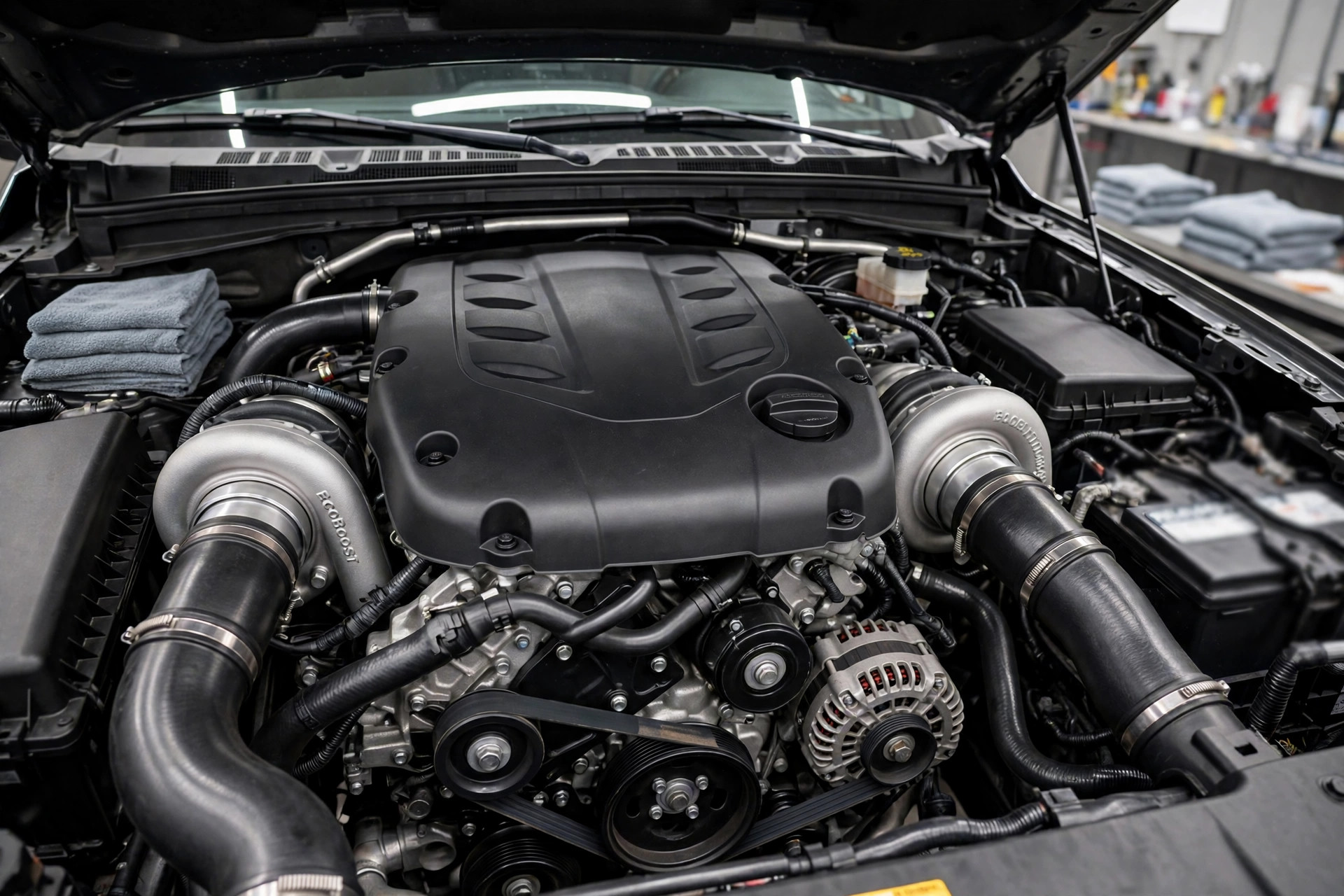
Ford launched the 2.7L EcoBoost in the F-150 for the 2015 model year, and the 2016 engine carries the same Gen 1 design. It is a 60-degree V6 with twin turbochargers and direct fuel injection. The block uses compacted graphite iron, while the heads are aluminum.
Twin independent variable cam timing adjusts both camshafts, and the 10.0:1 compression ratio suits regular unleaded fuel. Peak torque arrives at 3,000 rpm, which is why the small V6 pulls hard from low speed.
Do not confuse this engine with the 2018 and later version, which makes 400 lb-ft and adds port injection.
| Engine | Horsepower | Torque | Max Towing | Max Payload |
|---|---|---|---|---|
| 3.5L Ti-VCT V6 | 282 hp @ 6,250 rpm | 253 lb-ft @ 4,250 rpm | 7,600 lbs | 1,910 lbs |
| 2.7L EcoBoost V6 | 325 hp @ 5,750 rpm | 375 lb-ft @ 3,000 rpm | 8,500 lbs | 2,210 lbs |
| 3.5L EcoBoost V6 | 365 hp @ 5,000 rpm | 420 lb-ft @ 2,500 rpm | 12,200 lbs | 3,240 lbs |
| 5.0L Ti-VCT V8 | 385 hp @ 5,750 rpm | 387 lb-ft @ 3,850 rpm | 11,100 lbs | 3,270 lbs |
The 2.7 sits between the base V6 and the 3.5 EcoBoost on power, yet its 375 lb-ft peak arrives at just 3,000 rpm, below the 5.0L V8’s 3,850 rpm peak.
Its real edge is balance: V8-like pulling power with the best fuel economy in the 2016 lineup. That balance made it the pick for buyers who tow on weekends and commute during the week.
Service fills are simple. The engine takes 6.0 quarts of 5W-30 with a new filter, and the cartridge filter sits on top of the engine.
Cooling system capacity is 16.4 quarts. The 6-speed automatic includes tow and haul mode for trailer work.
Full engine detail by year is covered in the 2016 F-150 specification breakdown published by Stage 3 Motorsports.
Towing Capacity by Cab Drive and Axle Ratio
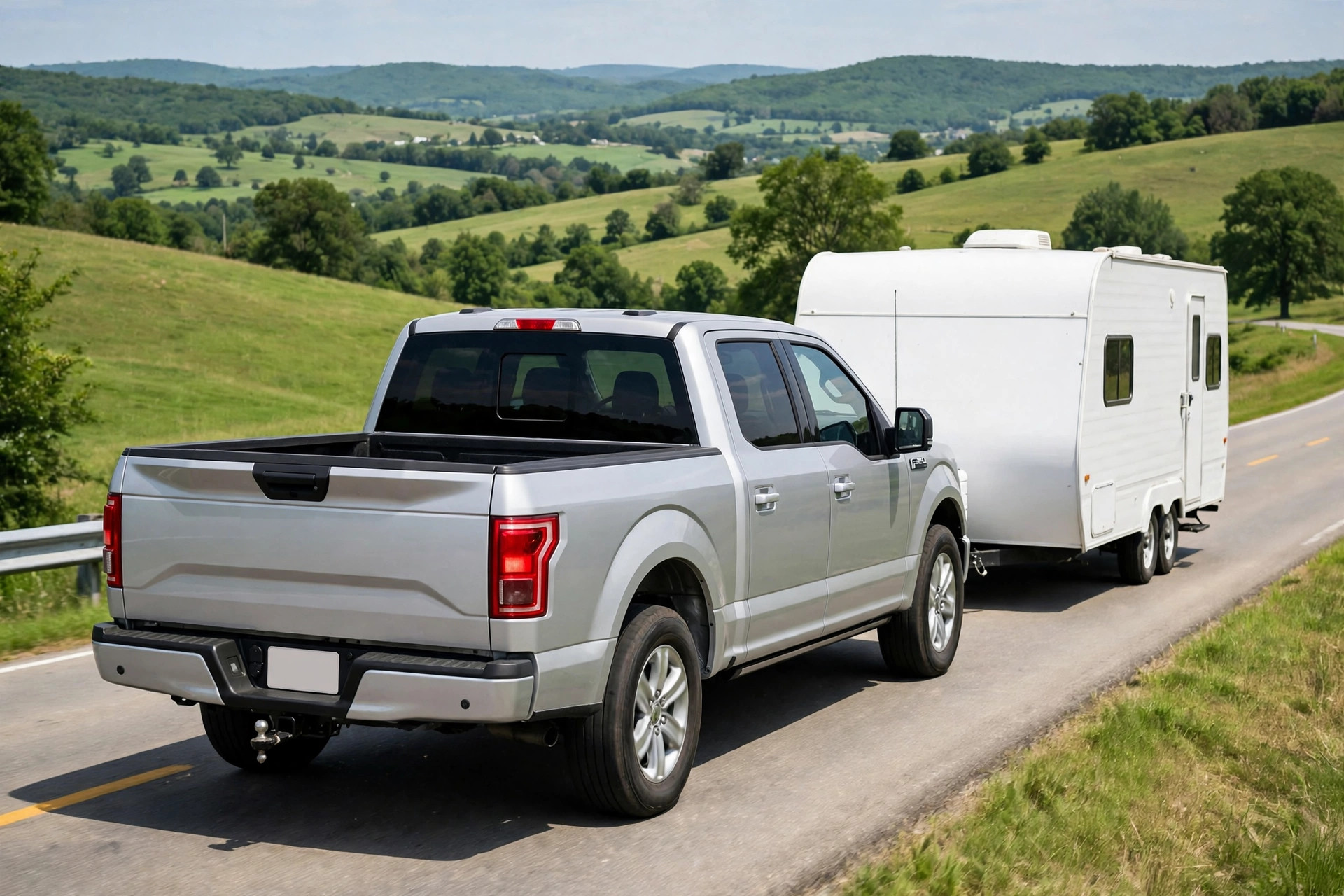
The 2.7 EcoBoost tows up to 8,500 pounds, but only a Regular Cab with the 3.73 axle reaches that number. It takes a Regular Cab 4×2 with the 3.73 axle ratio and the Trailer Tow Package. Every other cab and drive combination tows less.
Axle ratio is the biggest single lever. A 3.31 axle caps most 2.7 trucks at 7,600 pounds, while the 3.73 axle lifts the same truck by 500 to 900 pounds.
The 3.55 axle falls in between at 7,500 to 7,700 pounds. Check the axle code on the door sticker before you trust a seller’s towing claim.
| Cab and Drive | Axle Ratio | GCWR | Max Towing |
|---|---|---|---|
| Regular Cab 4×2 | 3.31 | 12,200 lbs | 7,600 lbs |
| Regular Cab 4×2 | 3.73 | 13,100 lbs | 8,500 lbs |
| Regular Cab 4×4 | 3.73 | 13,300 lbs | 8,500 lbs |
| SuperCab 4×2 | 3.31 | 12,500 lbs | 7,600 lbs |
| SuperCab 4×2 | 3.73 | 13,100 lbs | 8,200 lbs |
| SuperCab 4×4 | 3.73 | 13,300 lbs | 8,000 lbs |
| SuperCrew 4×2 | 3.31 | 12,600 lbs | 7,600 lbs |
| SuperCrew 4×2 | 3.73 | 13,100 lbs | 8,100 lbs |
| SuperCrew 4×4 | 3.73 | 13,300 lbs | 8,000 lbs |
The 3.73 axle raises GCWR to 13,100 pounds, and the payload package lifts it to 13,300 pounds. GCWR is the combined limit for truck, trailer, cargo and passengers.
GCWR matters more than the trailer number alone, because a loaded truck and a full cab eat into the same limit. Ford’s trailer towing selector lists the full matrix by cab, drive and axle, and the figures are also laid out in the 2016 F-150 towing capacity guide with charts published by TowEngine.
Two packages shape the towing story. The Trailer Tow Package adds the hitch receiver, wiring, auxiliary transmission oil cooler and Smart Trailer Tow Connector.
The 2.7L EcoBoost Payload Package adds the 3.73 electronic locking axle, a 9.75-inch gear set and a mechanical parking brake. The payload package lifts GCWR to 13,300 pounds and unlocks the 2,210-pound maximum payload.
For the wider year range, see our Ford F-150 towing capacity chart for 2013 to 2023.
Payload Capacity and GVWR by Configuration
Payload is the weight a truck can carry in the cab and bed, and it varies more than towing does.
The 2.7 EcoBoost tops out at 2,210 pounds in a Regular Cab 4×2 with the 8-foot bed and the payload package. A loaded SuperCrew 4×4 can drop below 2,000 pounds.
| Cab and Drive | Bed | GCWR | Max Towing | GVWR | Max Payload |
|---|---|---|---|---|---|
| Regular Cab 4×2 | 8 ft | 13,300 lbs | 8,500 lbs | 6,650 lbs | 2,210 lbs |
| Regular Cab 4×4 | 8 ft | 13,300 lbs | 8,200 lbs | 6,800 lbs | 2,100 lbs |
| SuperCab 4×2 | 6.5 ft | 13,300 lbs | 8,300 lbs | 6,750 lbs | 2,120 lbs |
| SuperCab 4×2 | 8 ft | 13,300 lbs | 8,000 lbs | 6,900 lbs | 2,160 lbs |
| SuperCab 4×4 | 6.5 ft | 13,300 lbs | 8,200 lbs | 7,000 lbs | 2,110 lbs |
| SuperCrew 4×2 | 5.5 ft | 13,300 lbs | 8,200 lbs | 6,650 lbs | 1,950 lbs |
| SuperCrew 4×2 | 6.5 ft | 13,300 lbs | 8,200 lbs | 6,800 lbs | 2,080 lbs |
| SuperCrew 4×4 | 6.5 ft | 13,300 lbs | 8,000 lbs | 6,900 lbs | 1,960 lbs |
GVWR sets the ceiling. It is the maximum weight of the truck plus everything in it, and it ranges from 6,650 to 7,000 pounds on 2.7 payload package trucks.
Payload equals GVWR minus curb weight, so heavier cabs and 4WD cut the number. The door sticker on the truck you buy lists its exact payload rating, and our Ford F-150 payload capacity guide explains how to read it.
Some secondary sources list the 2.7 maximum payload as 2,250 pounds. Ford’s own 2016 trailer towing selector lists 2,210 pounds, and we use the Ford figure in this guide. The 40-pound gap is small, yet it shows why the door sticker beats a website number.
Dimensions Bed Sizes and Cargo Box
The 2016 F-150 came in three cabs and three bed lengths on five wheelbases.
Regular Cab pairs with the 6.5-foot or 8-foot bed, SuperCab pairs with the same two beds, and SuperCrew pairs with the 5.5-foot or 6.5-foot bed. The SuperCrew never came with the 8-foot bed.
| Cab and Box | Wheelbase | Overall Length | Cargo Box Volume |
|---|---|---|---|
| Regular Cab, 6.5-ft box | 122.4 in | 209.3 in | 62.3 cu ft |
| Regular Cab, 8-ft box | 141.1 in | 227.9 in | 77.4 cu ft |
| SuperCab, 6.5-ft box | 145.0 in | 231.9 in | 62.3 cu ft |
| SuperCab, 8-ft box | 163.7 in | 250.5 in | 77.4 cu ft |
| SuperCrew, 5.5-ft box | 145.0 in | 231.9 in | 52.8 cu ft |
| SuperCrew, 6.5-ft box | 156.8 in | 243.7 in | 62.3 cu ft |
Width is 79.9 inches without mirrors on every cab. Height runs from about 75.5 inches on a base 4×2 to about 77.2 inches on a loaded 4×4. Front ground clearance runs from 8.5 to 10.3 inches by drive and configuration.
The cargo box measures 65.2 inches wide at the floor and 50.6 inches between the wheelhouses, so a 4×8 sheet fits flat only in the 8-foot bed.
Box depth is 21.4 inches on every bed. The 8-foot bed adds 15.1 cubic feet over the 6.5-foot bed.
Fuel Economy and Driving Range
The 2.7 EcoBoost was the efficiency leader of the 2016 F-150 lineup. The EPA rated the 2WD version at 19 mpg city, 26 mpg highway and 22 mpg combined.
The 4WD version drops to 18 city, 23 highway and 20 combined. The full EPA listing is in the fueleconomy.gov mileage table for 2016 standard pickup trucks.
The payload package costs a little economy.
A 2WD truck with the payload package is rated at 18 city, 24 highway and 21 combined, while the 4WD payload package version is rated at 18 city, 22 highway and 19 combined. The heavier GVWR and the 3.73 axle explain the drop.
The standard fuel tank holds 23 gallons, and an optional 36-gallon tank was available. A 2WD truck with the standard tank covers about 500 miles on the combined rating.
The 36-gallon tank stretches that to about 790 miles. Real range depends on load, speed and terrain, so treat these as planning numbers.
Trims Packages and Price
Ford offered the 2.7 EcoBoost on three trims only: XL, XLT and Lariat. King Ranch, Platinum and Limited buyers had to step up to a larger engine. The 2.7 cost $795 over the base 3.5L V6 when new.
Standard equipment included automatic start-stop, which shuts the engine off at idle to save fuel. Four-wheel drive used electronic shift-on-the-fly with 2H, 4H and 4L modes. The 6-speed automatic included tow and haul mode and a manual shift function.
The 2.7L EcoBoost Payload Package was limited to XL, XLT and Lariat trucks with the Trailer Tow Package. It added the 3.73 electronic locking rear axle, the 9.75-inch gear set and a mechanical parking brake.
Without the 3.73 axle, the same truck tows up to 7,600 pounds.
2.7 EcoBoost vs 3.5 EcoBoost for 2016
The 3.5 EcoBoost makes 365 horsepower and 420 lb-ft of torque, so it out-pulls the 2.7 by 40 horsepower and 45 lb-ft. It also tows up to 12,200 pounds, which is 3,700 pounds more than the 2.7.
Buyers who tow heavy trailers or haul near the limit need the bigger engine. The full numbers are in our 2016 Ford F-150 3.5 EcoBoost specs guide.
The 2.7 answers with better fuel economy and a lower price. It beats the 3.5 by about 2 mpg combined in 2WD form, and it cost less when new. For trailers under 7,000 pounds and daily driving, the 2.7 gives up little in real use.
Pick the 3.5 EcoBoost if your trailer weighs over 8,000 pounds or you tow in mountains. Pick the 2.7 if your trailer stays under 7,500 pounds and fuel cost matters to you. Either engine needs its axle ratio and packages checked before you buy.
What to Check Before You Buy a Used 2016 2.7 EcoBoost
Start with the door sticker. It lists the axle ratio, GVWR and the payload rating for that exact truck. Match those numbers against the charts above before you pay for a towing claim.
- Cold-start rattle: listen on a cold start for timing chain noise that fades as the engine warms.
- Oil pan seepage: look under the engine for oil at the pan rail, a known seep point on early 2.7 trucks.
- Service history: ask for oil change records, since turbo engines punish skipped changes.
- Turbo and cooling: check for coolant loss and white residue near the turbo lines.
- VIN check: run the VIN through the NHTSA recall lookup for open recalls.
A pre-purchase inspection by a mechanic who knows EcoBoost engines costs far less than a timing repair.
Bring the trailer you plan to tow, or at least its weight, and confirm the truck’s rating covers it. The right 2.7 truck is a strong used buy, but only when its configuration matches your job.
Frequently Asked Questions
How Much Can a 2016 F-150 2.7 EcoBoost Tow
The 2016 Ford F-150 2.7 EcoBoost tows up to 8,500 pounds when properly equipped with the 3.73 axle and the Trailer Tow Package. Most cab and drive combinations tow 7,600 to 8,300 pounds.
What Is the Horsepower of the 2016 2.7 EcoBoost


The 2016 2.7 EcoBoost makes 325 horsepower at 5,750 rpm and 375 lb-ft of torque at 3,000 rpm. Those are Gen 1 figures, so do not use the 400 lb-ft rating from the 2018 and later engine.
What Gas Mileage Does the 2016 F-150 2.7 EcoBoost Get
The EPA rates the 2WD version at 19 mpg city, 26 mpg highway and 22 mpg combined. The 4WD version is rated at 18 mpg city, 23 mpg highway and 20 mpg combined.
Is the 2.7 EcoBoost Reliable
Owner forums give the Gen 1 2.7 a solid record for a twin-turbo V6, with most complaints tied to oil pan seepage and cold-start timing chain noise. A clean service history and a pre-purchase inspection matter more than mileage alone.
Which Trims Offer the 2.7 EcoBoost in 2016
Ford offered the 2.7 EcoBoost on the XL, XLT and Lariat trims only. King Ranch, Platinum and Limited trucks used larger engines.
Final Word on the 2016 Ford F-150 2.7 EcoBoost
The 2016 Ford F-150 2.7 EcoBoost specs add up to a balanced half-ton: 325 horsepower, 375 lb-ft, 8,500 pounds of towing and 2,210 pounds of payload at its best. It was the most fuel-efficient F-150 of its year and the smart pick for trailers under 7,500 pounds.
Check the door sticker, match the axle and packages to your trailer, and the 2.7 will do the job without the fuel bill of a V8.
Buyers who need more should look at the 3.5 EcoBoost, which tows up to 12,200 pounds. For everyone else, the 2.7 is the right mix of power, economy and price.