2016 Ford F-150 3.5L EcoBoost Specs: Towing, Payload and Dimensions

The 2016 Ford F-150 3.5L EcoBoost specs start with 365 horsepower and 420 lb-ft of torque from a twin-turbo V6. When properly equipped, this engine tows up to 12,200 pounds and carries up to 3,240 pounds of payload. Those headline numbers belong to specific configurations, though, and the truck you buy may rate much lower.


This guide lists the full 2016 specs for the 3.5 EcoBoost: engine details, towing by cab and axle, payload, dimensions, fuel economy, and fluid capacities. Every figure comes from Ford’s 2016 towing guide, Ford’s 2016 technical specifications, or the EPA. Check the door-jamb sticker on your own truck before you tow.
How Much Can the 2016 Ford F-150 3.5 EcoBoost Tow


The 2016 Ford F-150 3.5 EcoBoost tows up to 12,200 pounds with the Max Trailer Tow Package. That maximum belongs to one configuration: a Regular Cab 4×2 with the 8-foot bed and the 3.55 axle. Ford’s 2016 towing guide lists that rating at a gross combined weight rating of 17,100 pounds.
Most buyers will tow less. A SuperCrew 4×4 with the same 3.55 axle rates 11,600 pounds, and trucks with the 3.15 or 3.31 axle top out at 10,700 pounds.
The axle ratio and the tow package matter as much as the engine. Shoppers who want the full model-year picture can compare these figures with our 3.5 EcoBoost specs by year chart.
Payload runs the other way. The 3.5 EcoBoost carries up to 3,240 pounds with the Heavy-Duty Payload Package.
That figure is easy to mix up with the 3,270-pound best-in-class headline in Ford’s guide, but the guide’s own table gives 3,270 pounds to the 5.0-liter V8. The 3.5 EcoBoost tops out at 3,240 pounds.
3.5 EcoBoost Engine Specs That Set the Ratings
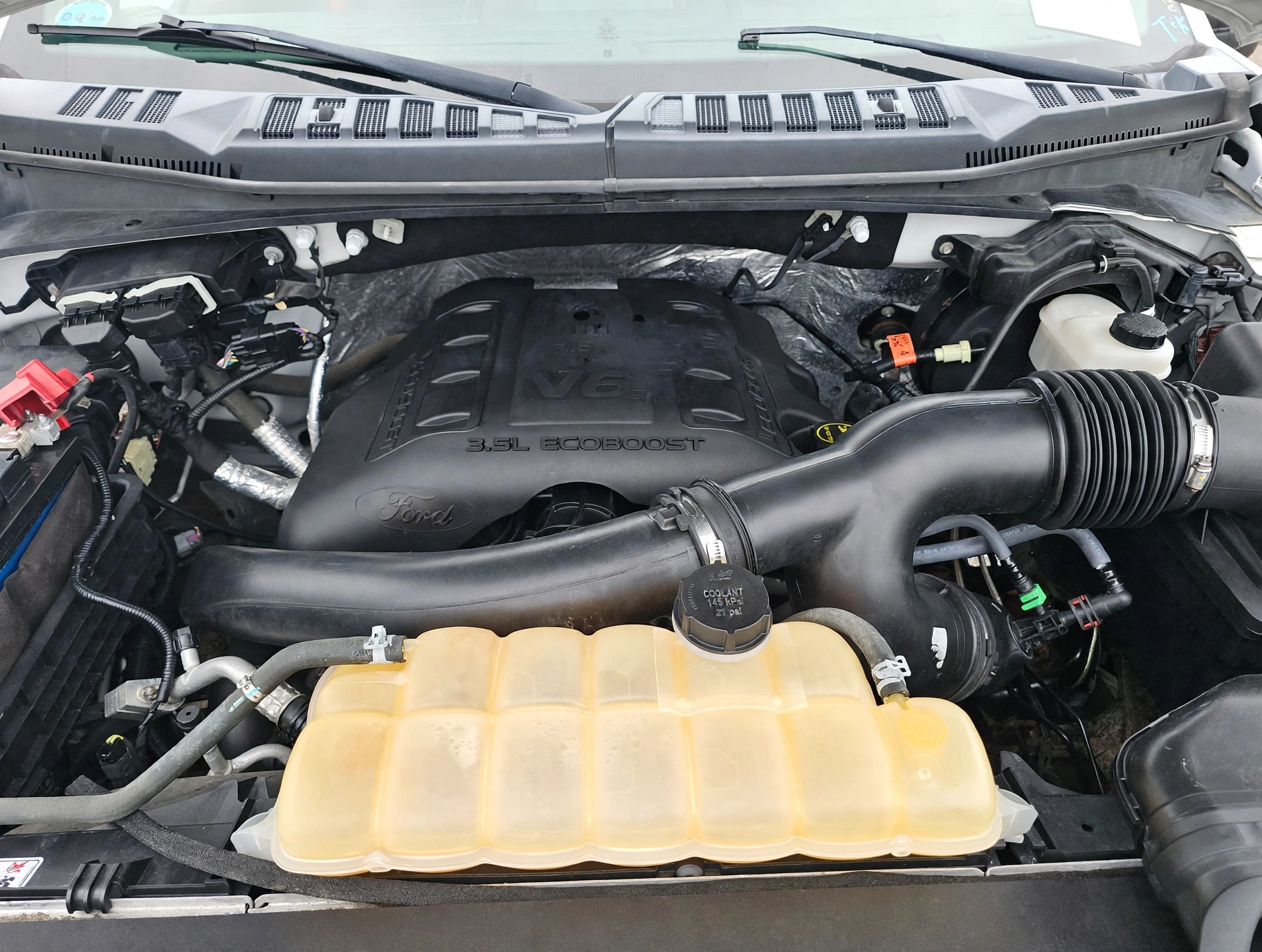
The first-generation 3.5 EcoBoost is a twin-turbo, direct-injection V6 with dual overhead cams and 24 valves. It displaces 3.5 liters, or 213 cubic inches, and runs a 10.0:1 compression ratio on regular unleaded fuel. Peak torque arrives at just 2,500 rpm, which is why this engine tows so well for its size.
First Generation Twin-Turbo V6
Ford built the 2016 3.5 EcoBoost with an aluminum block and heads, twin turbochargers, and direct fuel injection. It makes 365 horsepower at 5,000 rpm and 420 lb-ft of torque at 2,500 rpm. Those numbers held from the 2011 launch through the 2017 model year, when the second-generation engine arrived.
Direct injection and the twin turbos give the engine a flat torque curve. Torque stays strong from low rpm, so the truck pulls a trailer without constant downshifts. Ford recommends premium fuel under severe duty such as trailer towing, even though regular 87-octane fuel is the minimum.
6-Speed SelectShift Automatic


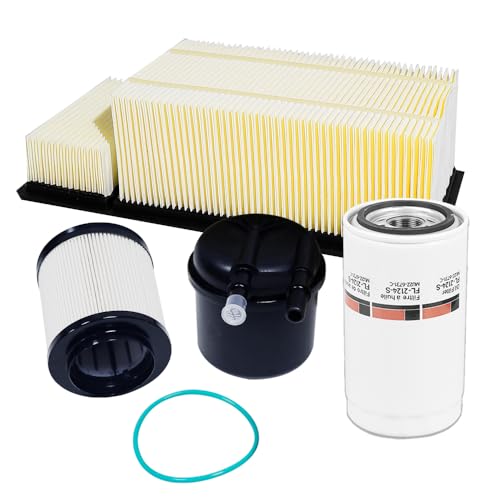
Every 2016 F-150 3.5 EcoBoost pairs with a 6-speed SelectShift automatic transmission. The transmission offers Tow/Haul mode, which holds gears longer under load and cuts gear hunting on grades. Manual shift control comes through the SelectShift lever.
The 6-speed was the only transmission offered with this engine in 2016. The 10-speed automatic arrived with the second-generation 3.5 EcoBoost in 2017, so a 2016 truck will always have the 6-speed.
| Engine | Horsepower | Torque | Max Towing | Max Payload |
|---|---|---|---|---|
| 3.5L Ti-VCT V6 | 282 hp at 6,250 rpm | 253 lb-ft at 4,250 rpm | 7,600 lbs | 1,910 lbs |
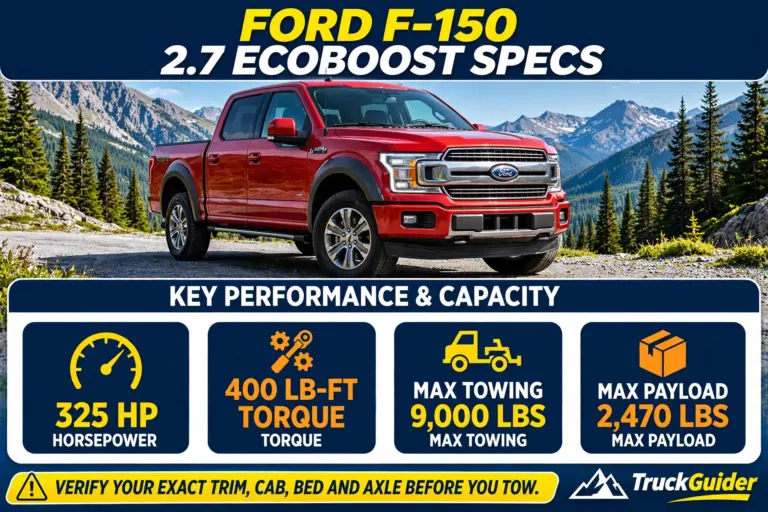
| 2.7L EcoBoost V6 | 325 hp at 5,750 rpm | 375 lb-ft at 3,000 rpm | 8,500 lbs | 2,210 lbs |
| 3.5L EcoBoost V6 | 365 hp at 5,000 rpm | 420 lb-ft at 2,500 rpm | 12,200 lbs | 3,240 lbs |
| 5.0L Ti-VCT V8 | 385 hp at 5,750 rpm | 387 lb-ft at 3,850 rpm | 11,100 lbs | 3,270 lbs |
The 3.5 EcoBoost wins on towing and the 5.0 V8 wins on payload. The V8 tows 1,100 pounds less but carries 30 pounds more with its own Heavy-Duty Payload Package. Buyers who tow heavy trailers should pick the 3.5 EcoBoost, while buyers who haul heavy bed loads should look at the V8.
2016 F-150 3.5 EcoBoost at a Glance
- Engine: 3.5L twin-turbo EcoBoost V6, 365 hp at 5,000 rpm, 420 lb-ft at 2,500 rpm
- Maximum towing: 12,200 lbs, Regular Cab 4×2, 8-foot bed, 3.55 axle, Max Trailer Tow Package
- Maximum payload: 3,240 lbs with the Heavy-Duty Payload Package
- Transmission: 6-speed SelectShift automatic with Tow/Haul mode
- Fuel economy: EPA 17 city and 24 highway mpg with rear-wheel drive, 20 mpg combined
2016 F-150 3.5 EcoBoost Towing Capacity by Cab and Axle
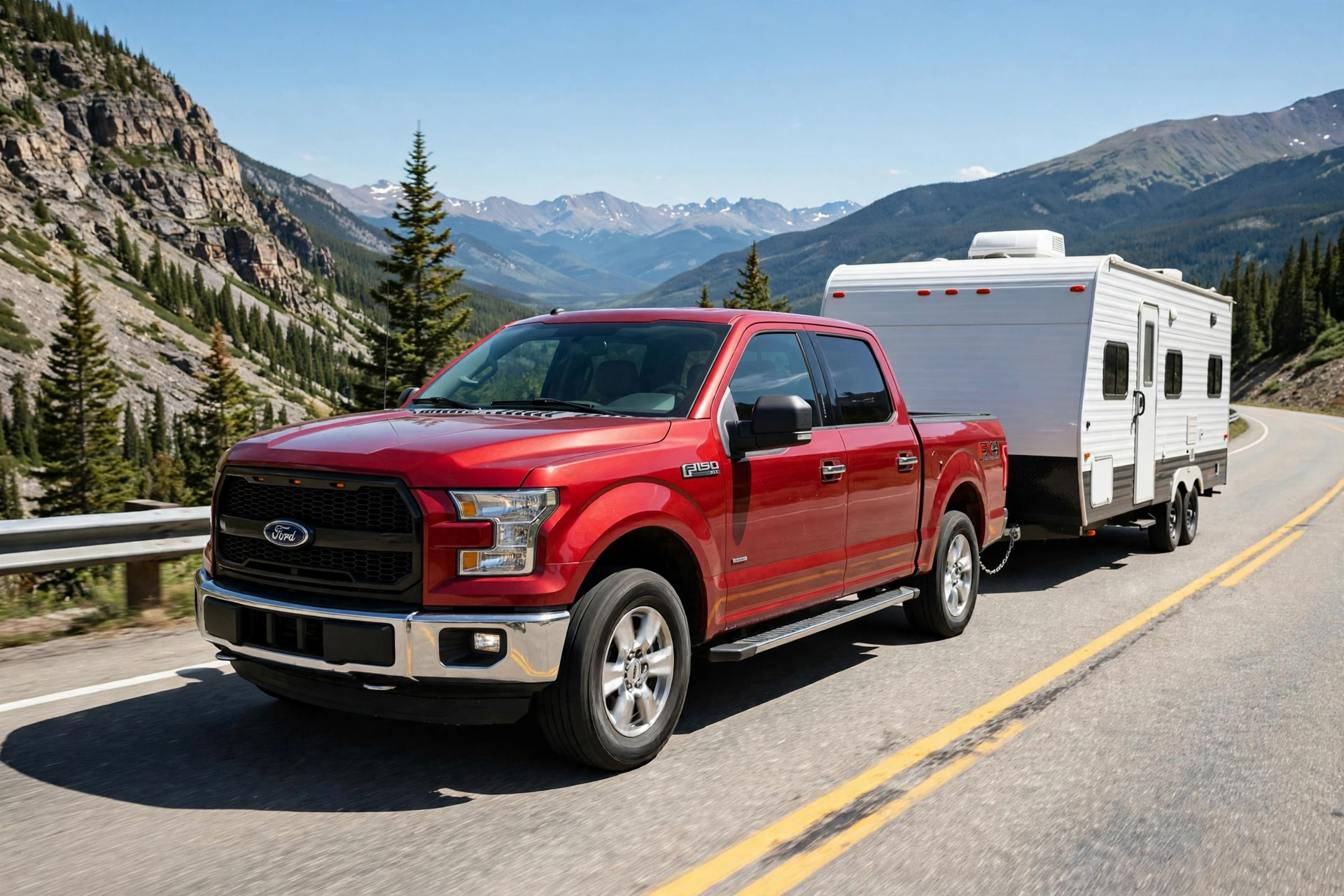
The table below uses the 3.55 axle ratio, the axle that earns the 12,200-pound maximum. Ford’s 2016 towing guide lists these ratings for the 3.5 EcoBoost with the Max Trailer Tow Package. A weight-distributing hitch is required at these weights.
| Cab and Drive | Wheelbase | Max Towing, 3.55 Axle |
|---|---|---|
| Regular Cab 4×2 | 141 in | 12,200 lbs |
| Regular Cab 4×4 | 141 in | 12,000 lbs |
| SuperCab 4×2 | 145 in | 12,000 lbs |
| SuperCab 4×2 | 164 in | 11,800 lbs |
| SuperCab 4×4 | 145 in | 11,700 lbs |
| SuperCab 4×4 | 164 in | 11,600 lbs |
| SuperCrew 4×2 | 157 in | 11,900 lbs |
| SuperCrew 4×4 | 157 in | 11,600 lbs |
Four-wheel drive costs about 200 to 600 pounds on the same cab and bed. The longer bed costs a similar amount, since the extra steel adds weight before the trailer hooks up. The Regular Cab 4×2 earns the maximum because it is the lightest configuration Ford builds.
Axle choice sets the ceiling before cab and drive take their share. The 3.15 and 3.31 axles top out at 10,700 pounds in every cab, and the 3.73 axle tops out at 12,000 pounds with the Heavy-Duty Payload Package. The 3.55 axle with the Max Trailer Tow Package is the only combination that reaches 12,200 pounds.
Fifth-wheel towing runs slightly lower. The same Regular Cab 4×2 with the 3.55 axle rates 12,100 pounds for a fifth-wheel trailer, and the Regular Cab 4×4 rates 11,800 pounds. Ford notes that current fifth-wheel designs do not fit the 145-inch wheelbase SuperCrew with the 5.5-foot box.
Payload Capacity and the Heavy-Duty Payload Package
Maximum payload for the 2016 F-150 3.5 EcoBoost is 3,240 pounds. That rating needs the Heavy-Duty Payload Package, which adds a 3.73 electronic-locking rear axle, heavy-duty front springs, and a high-capacity engine cooling system. It also needs a Regular Cab with the 8-foot bed, the lightest body Ford offers.
Real trucks carry less. Kelley Blue Book lists SuperCrew payloads from 1,460 to 2,270 pounds depending on trim and configuration, and the Limited carries the least at 1,460 pounds. Leather seats, larger wheels, the panoramic roof, and four-wheel drive all add weight that comes straight out of payload.
Payload limits towing in practice. A 12,200-pound trailer puts roughly 1,220 to 1,830 pounds on the tongue at 10 to 15 percent tongue weight, and that tongue weight counts against payload.
Add passengers and bed cargo, and many trucks run out of payload before they run out of towing capacity. For the full model-year picture, see our Ford F-150 payload capacity guide.
Cab Bed and Box Dimensions for the 2016 F-150
The 2016 F-150 comes in three cabs and three bed lengths, on five wheelbases from 122 to 163.7 inches. Regular Cab pairs with the 6.5-foot or 8-foot bed, SuperCab pairs with the 6.5-foot or 8-foot bed, and SuperCrew pairs with the 5.5-foot or 6.5-foot bed. The SuperCrew never pairs with the 8-foot bed.
| Cab and Box | Wheelbase | Overall Length | Cargo Box Volume |
|---|---|---|---|
| Regular Cab, 6.5-ft box | 122 in | 209.3 in | 62.3 cu ft |
| Regular Cab, 8-ft box | 141 in | 227.9 in | 77.4 cu ft |
| SuperCab, 6.5-ft box | 145 in | 231.9 in | 62.3 cu ft |
| SuperCab, 8-ft box | 163.7 in | 250.5 in | 77.4 cu ft |
| SuperCrew, 5.5-ft box | 145 in | 231.9 in | 52.8 cu ft |
| SuperCrew, 6.5-ft box | 156.8 in | 243.7 in | 62.3 cu ft |
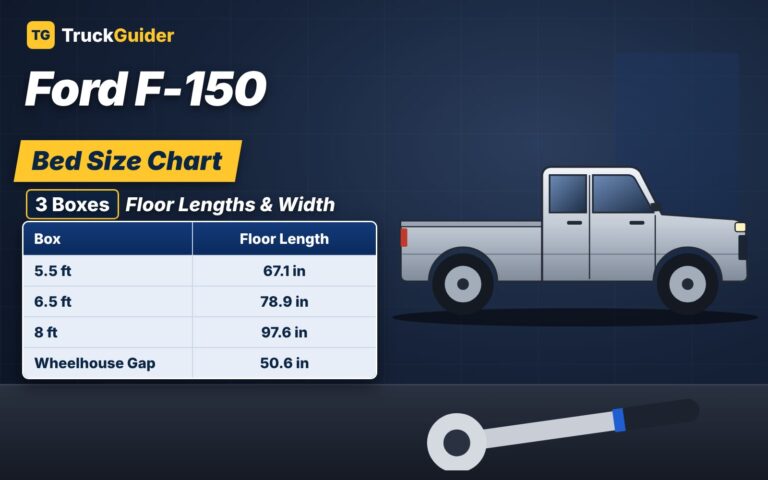
Box volumes run from 52.8 cubic feet for the 5.5-foot bed to 77.4 cubic feet for the 8-foot bed. Every box measures 65.2 inches wide inside, 50.6 inches between the wheelhouses, and 21.4 inches deep. The 8-foot bed adds 15.1 cubic feet over the 6.5-foot bed, which matters for hauling plywood and long cargo flat.
Width is the same across the lineup at 79.9 inches without mirrors. Height runs from about 75.5 inches for a base 4×2 to about 77 inches for a loaded 4×4, and ground clearance runs from 8.5 to 10.3 inches depending on drive and configuration. Overall length follows wheelbase, from 209.3 inches for the Regular Cab short bed to 250.5 inches for the long-bed SuperCab, while the SuperCrew tops out at 243.7 inches with the 6.5-foot bed.
Fuel Economy and Capacities for the 2016 F-150 3.5 EcoBoost
The EPA rates the 2016 F-150 3.5 EcoBoost at 17 mpg city and 24 mpg highway with rear-wheel drive, for 20 mpg combined. Four-wheel drive drops the rating to 16 city and 22 highway, or 18 combined. Trucks with the Heavy-Duty Payload Package rate lower still, at 16 city and 22 highway in rear-wheel drive.
| Item | 3.5 EcoBoost Figure |
|---|---|
| Engine oil with filter | 6.0 qt, SAE 5W-30 |
| Fuel tank | 23 gal standard, 36 gal optional |
| EPA fuel economy, 4×2 | 17 city, 24 highway, 20 combined mpg |
| EPA fuel economy, 4×4 | 16 city, 22 highway, 18 combined mpg |
| Cooling system | 15.6 qt |
| Fuel | Regular unleaded, 87 octane; premium recommended when towing |
The standard fuel tank holds 23 gallons, and the optional extended-range tank holds 36 gallons. With the 36-gallon tank and the 4×2 highway rating, range stretches past 800 miles on paper. Real range depends on load, speed, and driving conditions.
The 3.5 EcoBoost takes 6.0 quarts of SAE 5W-30 oil with a filter change. Ford specifies oil meeting standard WSS-M2C946-A for 2016. Our 3.5 EcoBoost oil capacity chart lists the figure by model year.
Cooling system capacity is 15.6 quarts. Ford requires regular unleaded gasoline with a minimum 87 octane rating, and the owner’s manual recommends premium fuel when towing under severe duty.
5 Steps to Find Your Exact 2016 F-150 Rating
Brochure tables give the rating for a base configuration, and your truck may differ. Confirm your number in five steps, a check that takes about ten minutes.
- Read the tire and loading label on the driver door jamb for your payload and gross vehicle weight rating, including factory options.
- Match your trim, engine, cab, bed, and drivetrain to the charts above and note the ratings for that row.
- Check your owner’s manual towing section for the rating and any hitch or brake requirements for your trailer weight.
- Weigh your loaded trailer at a scale, or use its gross vehicle weight rating. Never guess the trailer weight.
- Compare the trailer weight with your towing rating and tongue weight plus passengers and cargo with your payload rating. Both numbers must stay under their limits.
If the math is close, you need a lighter trailer or a different configuration. The door-jamb sticker wins when the numbers disagree.
5 Costly Mistakes to Avoid With a 2016 F-150 3.5 EcoBoost
The most expensive mistake is using the headline number instead of your number. A SuperCrew 4×4 owner who plans around 12,200 pounds is 600 pounds over the truck’s real limit. Always use the rating for your exact configuration.
The second mistake is forgetting payload. Tongue weight, passengers, bed cargo, and aftermarket accessories all count against payload, and a truck can tow its trailer on paper yet exceed payload once loaded.
The third mistake is skipping the weight-distributing hitch on a heavy trailer. Ford’s towing guide says maximum loaded trailer weight requires a weight-distributing hitch, and the guide caps bumper-only towing at 5,000 pounds. A standard ball mount lets the tongue push the rear down and lift the front.
The fourth mistake is assuming every 3.5 EcoBoost tows 12,200 pounds. Only trucks with the Max Trailer Tow Package, option code 53C, earn the top rating. Without that package, the same truck tows far less, so check the window sticker before you buy.
The fifth mistake is ignoring the trailer itself. Old tires, dry bearings, and a rusted coupler cause more roadside failures than any truck rating. Inspect the trailer with the same care as the truck.
How to Pick the 2016 F-150 3.5 EcoBoost for Your Trailer
The 2016 Ford F-150 3.5L EcoBoost specs point to a clear answer for most buyers. The Regular Cab 4×2 with the 3.55 axle and the Max Trailer Tow Package tows the most at 12,200 pounds, while a SuperCrew 4×4 with the same axle tows 11,600 pounds and carries the family. Match the trailer first, then the truck.
Weigh the trailer loaded, add a safety margin, and pick the configuration that clears both the towing and payload limits. Cross-shopping buyers can compare these figures with the Ford towing capacity chart by year.
Then confirm the rating on the door-jamb sticker of the truck you buy, and check the axle code and tow package on the window sticker. Tow within the rating every time.
5 Questions About 2016 Ford F-150 3.5 EcoBoost Specs
How Much Can a 2016 F-150 3.5 EcoBoost Tow
The 2016 Ford F-150 3.5 EcoBoost tows up to 12,200 pounds when properly equipped with the Max Trailer Tow Package. The rating ranges from 10,400 to 12,200 pounds depending on axle, cab, and drive, and only the Regular Cab 4×2 with the 3.55 axle reaches the maximum.
What Payload Can a 2016 F-150 3.5 EcoBoost Carry
The 2016 F-150 3.5 EcoBoost carries up to 3,240 pounds of payload with the Heavy-Duty Payload Package. Typical SuperCrew payloads run from 1,460 to 2,270 pounds, and your exact figure is on the driver door-jamb label.
Which 2016 F-150 3.5 EcoBoost Configuration Tows the Most


The Regular Cab 4×2 with the 8-foot bed, the 3.55 axle, and the Max Trailer Tow Package tows the most at 12,200 pounds. The SuperCrew 4×4 with the same axle rates 11,600 pounds, and the 3.73 axle tops out at 12,000 pounds.
What Fuel Economy Does the 3.5 EcoBoost Get
The EPA rates the 2016 F-150 3.5 EcoBoost at 17 mpg city and 24 mpg highway with rear-wheel drive, or 20 mpg combined. Four-wheel-drive models rate 16 city and 22 highway, or 18 mpg combined.
Does the 3.5 EcoBoost Need Premium Fuel
No, the 3.5 EcoBoost runs on regular unleaded gasoline with a minimum 87 octane rating. Ford recommends premium fuel under severe duty conditions such as trailer towing, for improved performance.