2018 Ford F-150 2.7 EcoBoost Specs by Trim and Configuration

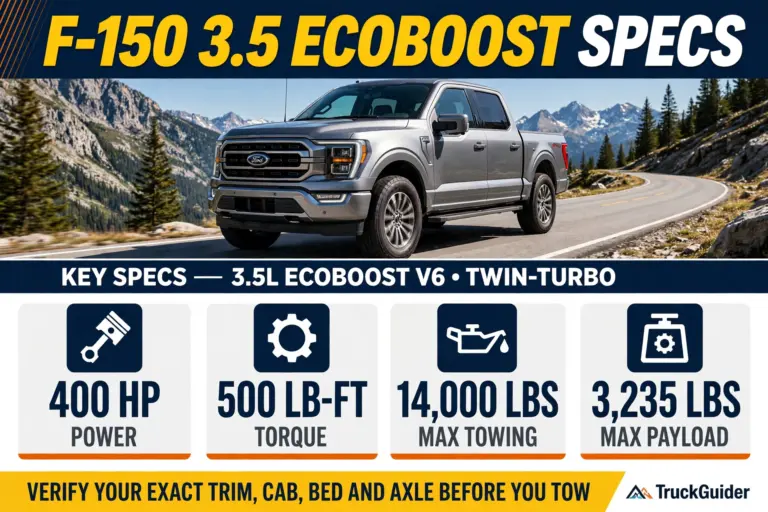
The 2018 Ford F-150 2.7 EcoBoost makes 325 horsepower and 400 lb-ft of torque, tows up to 9,000 pounds, and carries up to 2,470 pounds of payload when properly equipped. Those headline numbers belong to specific configurations only, and most trucks on dealer lots rate lower.


This guide gives the exact 2018 specs for every cab, bed, and drivetrain, taken from Ford’s official 2018 brochure and technical specifications. Use it to match a trailer to your truck before you buy, and check the door-jamb sticker on your own truck before you tow.
325 Horsepower and 400 LB-FT of Torque


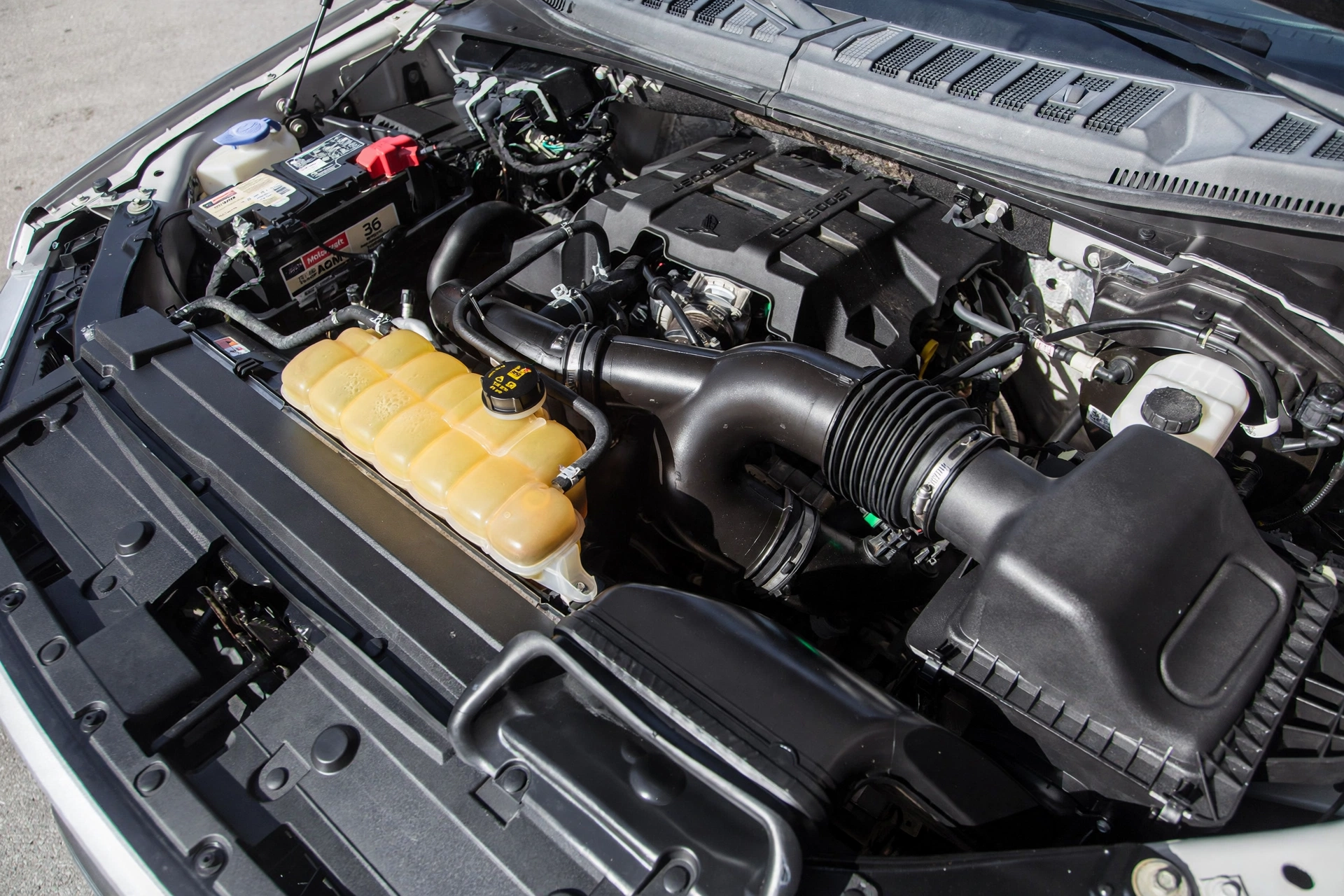
The second-generation 2.7L EcoBoost arrived for 2018 with a new dual-injection system that pairs port fuel injection with direct injection. Two turbochargers feed a compacted graphite iron block, and peak output lands at 325 horsepower at 5,000 rpm with 400 lb-ft of torque at 2,750 rpm.
That torque figure is the story. The first-generation 2.7 made 375 lb-ft, so the 2018 engine gained 25 lb-ft while holding horsepower flat at 325. Peak torque also arrives 250 rpm sooner, which makes the truck feel stronger when it pulls away with a trailer.
10-Speed Automatic and Drive Modes
Ford pairs every 2018 2.7 with its 10-speed SelectShift automatic. The gearbox offers normal, tow/haul, snow/wet, eco-select, and sport modes, plus progressive range select for holding gears on grades.
Auto Start-Stop is standard on all 2018 F-150 engines, and it stays off in tow/haul mode and four-wheel drive. Three overdrive gears help the 10-speed hold highway speed at low rpm, which is where the 2.7 earns its fuel economy edge.
2018 F-150 Engine Lineup Compared


Ford’s official 2018 F-150 technical specifications confirm the 325 horsepower and 400 lb-ft ratings, along with the 10-speed transmission. The same document lists the full 2018 engine lineup, which puts the 2.7 in context against the other gas engines.
| Engine | Horsepower | Torque | Transmission | EPA City/Hwy/Combined (4×2) | Max Payload | Max Towing |
|---|---|---|---|---|---|---|
| 3.3L Ti-VCT V6 | 290 hp @ 6,500 rpm | 265 lb-ft @ 4,000 rpm | 6-speed automatic | 19/25/22 mpg | 1,990 lbs | 7,700 lbs |
| 2.7L EcoBoost V6 | 325 hp @ 5,000 rpm | 400 lb-ft @ 2,750 rpm | 10-speed automatic | 20/26/22 mpg | 2,470 lbs | 9,000 lbs |
| 5.0L Ti-VCT V8 | 395 hp @ 5,750 rpm | 400 lb-ft @ 4,500 rpm | 10-speed automatic | 17/23/19 mpg | 3,270 lbs | 11,600 lbs |
| 3.5L EcoBoost V6 | 375 hp @ 5,000 rpm | 470 lb-ft @ 2,500 rpm | 10-speed automatic | 18/25/21 mpg | 3,230 lbs | 13,200 lbs |
The 2.7 sits in the middle of the lineup on power and at the top on fuel economy. It makes 35 more horsepower than the base 3.3L V6 and matches the 5.0L V8 on torque, while beating every gas engine on highway mileage. A late-availability 3.0L Power Stroke diesel also joined the range for 2018 with 250 horsepower and 440 lb-ft of torque.
The 2.7 kept the same 325 horsepower and 400 lb-ft ratings through 2020, then carried them into the 2021 redesign with a higher towing ceiling. Our Ford 2.7L EcoBoost specs by year chart tracks the engine across every model year so you can see what changed and what stayed the same.
2018 F-150 2.7 EcoBoost at a Glance
- Engine: second-generation 2.7L EcoBoost twin-turbo V6 with dual port and direct injection
- Power: 325 hp @ 5,000 rpm and 400 lb-ft @ 2,750 rpm
- Transmission: 10-speed SelectShift automatic with tow/haul mode
- Maximum towing: 9,000 lbs with the 3.73 axle and the 2.7L EcoBoost Payload Package
- Maximum payload: 2,470 lbs on a Regular Cab 4×2 with the 8-foot bed and the Payload Package
- Fuel economy: 20 city / 26 highway / 22 combined mpg with two-wheel drive
2018 Ford F-150 2.7 EcoBoost Towing Capacity by Cab
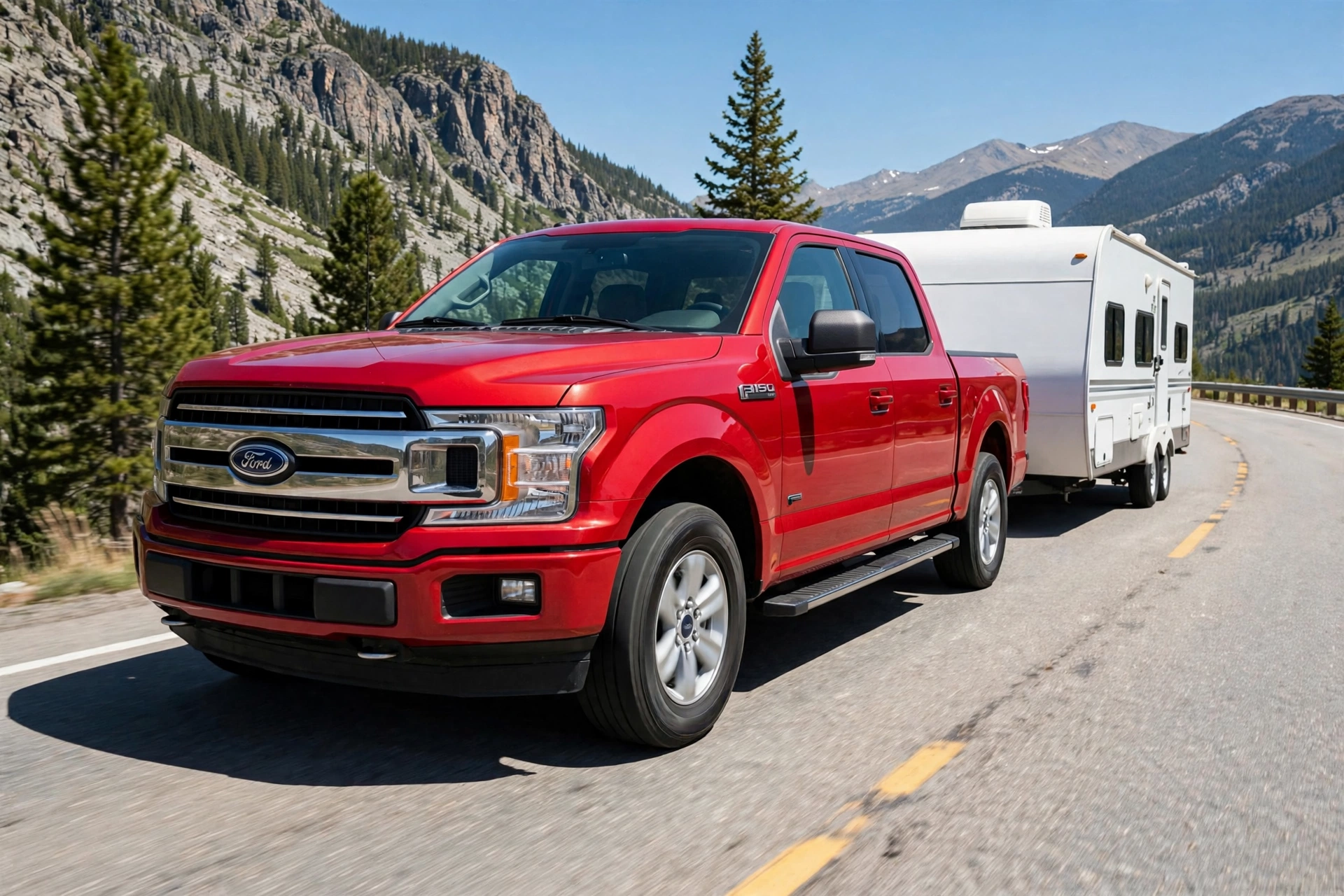
The 2018 F-150 2.7 EcoBoost tows between 7,500 and 9,000 pounds, depending on cab, drivetrain, and axle ratio. The 9,000-pound maximum needs two things together: the 3.73 axle ratio and the 2.7L EcoBoost Payload Package.
Most trucks on the road tow less. A 2.7 with the standard 3.55 axle rates 7,600 pounds in nearly every cab, and the 3.15 and 3.31 axles rate 7,500 to 7,700 pounds. The 3.73 axle alone lifts most cabs to 8,000 to 8,500 pounds.
Ford’s 2018 F-150 brochure prints the full towing chart by engine, axle ratio, cab, and wheelbase. The table below condenses the 2.7 rows of that chart into cab and drivetrain ranges.
| Cab | Drive | Towing Range | What Earns the Maximum |
|---|---|---|---|
| Regular Cab | 4×2 | 7,600-8,500 lbs | 3.73 axle ratio |
| Regular Cab | 4×4 | 7,600-8,400 lbs | 3.73 axle ratio |
| SuperCab | 4×2 | 7,500-8,500 lbs | 3.73 axle ratio with Payload Package |
| SuperCab | 4×4 | 7,600-9,000 lbs | 3.73 axle ratio with Payload Package |
| SuperCrew | 4×2 | 7,600-9,000 lbs | 3.73 axle ratio with Payload Package |
| SuperCrew | 4×4 | 7,600-9,000 lbs | 3.73 axle ratio with Payload Package |
Three patterns run through the table. Four-wheel drive costs little on the 2.7, usually 100 pounds or less against the same cab with two-wheel drive.
The longer bed rarely changes the rating by more than 200 pounds. The axle ratio matters more than either, and the Payload Package is the only route to 9,000 pounds.
One warning belongs here. Some used-truck listings and dealer pages quote 12,200 pounds for a 2018 2.7 SuperCab, and a few quote 10,000 pounds.
Both figures are wrong for this engine. The 12,200-pound figure belongs to the 3.5L EcoBoost range, and Ford’s brochure caps the 2.7 at 9,000 pounds.
The owner’s manual adds a hard limit that no chart overrides. Without a trailer tow package, do not exceed 5,000 pounds on the hitch, and never exceed 5,000 pounds when towing with the bumper only. Tongue weight should run 10 to 15 percent of the loaded trailer weight.
2018 Ford F-150 2.7 EcoBoost Payload Capacity by Cab
Payload is the weight your truck can carry in the cab and bed, including people, cargo, and trailer tongue weight. The 2018 2.7 range runs from 1,640 to 2,470 pounds, and the table below lists the range for each cab and drivetrain.
| Cab | Drive | Payload Range | Maximum With Payload Package |
|---|---|---|---|
| Regular Cab | 4×2 | 1,860-2,470 lbs | 2,470 lbs, 8-foot bed |
| Regular Cab | 4×4 | 1,730-2,110 lbs | 2,110 lbs |
| SuperCab | 4×2 | 1,710-2,170 lbs | 2,170 lbs |
| SuperCab | 4×4 | 1,640-2,110 lbs | 2,110 lbs |
| SuperCrew | 4×2 | 1,800-2,060 lbs | 2,060 lbs |
| SuperCrew | 4×4 | 1,690-1,950 lbs | 1,950 lbs |
The 2,470-pound maximum belongs to one truck: a Regular Cab 4×2 with the 8-foot bed and the 2.7L EcoBoost Payload Package. Every other 2.7 tops out between 1,950 and 2,170 pounds with the same package.
Four-wheel drive costs 70 to 200 pounds of payload on most cabs. Cab weight still matters, because every pound of cab and options comes out of payload before you load anything. A SuperCrew 4×4 with the Payload Package still carries 1,950 pounds, which covers most family towing setups.
Payload limits towing in practice, because tongue weight draws from the same budget as passengers and cargo. Our Ford F-150 payload capacity guide explains how to read your door-jamb sticker and work out your real available payload before you hitch up.
The Payload Package itself is a hardware upgrade, not a sticker. It adds a 3.73 electronic-locking rear axle with a 9.75-inch gearset and raises the truck’s GVWR. Ford offered it only on XL and XLT trims, so a Lariat cannot reach the 2,470-pound figure.
3 Trims That Offer the 2.7 EcoBoost in 2018
Ford offered the 2.7 EcoBoost on three 2018 F-150 trims: XL, XLT, and Lariat. It is the standard engine on the Lariat and an optional upgrade on XL and XLT, where the base engine is the 3.3L V6.
The XL is the work truck. It pairs the 2.7 with vinyl floors and a 4.2-inch SYNC screen, and it is the lowest-priced route to the engine. The XLT adds chrome bumpers, fog lamps, and power equipment, and it remains the volume choice for buyers who tow.
The Lariat moves the 2.7 into luxury territory with leather-trimmed seats, an 8-inch touchscreen, power-folding mirrors, and 18-inch wheels. Lariat buyers get the 2.7 as standard equipment. A Technology Package is available with the 2.7, and it adds adaptive cruise control with stop-and-go.
King Ranch, Platinum, Limited, and Raptor buyers cannot order the 2.7. King Ranch and Platinum run the 5.0L V8 as standard, the Limited runs the 3.5L EcoBoost only, and the Raptor runs the high-output 3.5L EcoBoost only. Shoppers who want the 2.7 with leather need a Lariat.
Two packages matter most for capability. The 2.7L EcoBoost Payload Package adds the 3.73 electronic-locking axle and 9.75-inch gearset, and it is the key to both maximum ratings. The Max Trailer Tow Package adds a 3.55 electronic-locking axle, an integrated trailer brake controller, and an upgraded front stabilizer bar.
2018 F-150 2.7 EcoBoost Dimensions and Capacities
The 2018 F-150 2.7 comes in three cabs and three bed lengths, with five wheelbases from 122.4 to 163.7 inches. Width stays the same across the range at 79.9 inches without mirrors, and height runs 75.1 to 77.3 inches depending on cab, bed, and drivetrain.
| Cab and Bed | Wheelbase | Overall Length | Height (4×2/4×4) | Cargo Box Volume |
|---|---|---|---|---|
| Regular Cab, 6.5-foot bed | 122.4 in | 209.3 in | 75.5 / 76.9 in | 62.3 cu ft |
| Regular Cab, 8-foot bed | 141.1 in | 227.9 in | 75.1 / 76.9 in | 77.4 cu ft |
| SuperCab, 6.5-foot bed | 145.0 in | 231.9 in | 75.5 / 77.2 in | 62.3 cu ft |
| SuperCab, 8-foot bed | 163.7 in | 250.5 in | 75.5 / 77.0 in | 77.4 cu ft |
| SuperCrew, 5.5-foot bed | 145.0 in | 231.9 in | 75.6 / 77.2 in | 52.8 cu ft |
| SuperCrew, 6.5-foot bed | 156.8 in | 243.7 in | 75.7 / 77.3 in | 62.3 cu ft |
Fuel capacity is 23.0 gallons as standard, with a 36.0-gallon extended-range tank available. That larger tank adds about 78 pounds of fuel when full, which comes straight out of payload on a truck that is already near its limit.
Fuel economy is the 2.7’s strongest selling point. Ford rates the 4×2 at 20 mpg city, 26 mpg highway, and 22 mpg combined, the best gas highway figure in the 2018 F-150 lineup. Four-wheel-drive trucks rate 19 mpg city, 24 mpg highway, and 21 mpg combined.
Service specs stay simple. The 2.7 takes 6.0 quarts of SAE 5W-30 oil with the filter, using a Motorcraft FL-2062 filter, and Ford’s Intelligent Oil-Life Monitor sets the change interval at 7,500 to 10,000 miles under normal use. Warranty coverage runs 3 years or 36,000 miles bumper to bumper and 5 years or 60,000 miles on the powertrain.
5 Steps to Find Your Exact 2018 2.7 Rating
Brochure tables give the rating for a base configuration, and your truck may differ. Confirm your number in five steps, a check that takes about ten minutes.
- Read the tire and loading label on the driver door jamb for your payload and gross vehicle weight rating, including factory options.
- Match your trim, engine, cab, bed, and drivetrain to the charts above and note the ratings for that row.
- Check the axle code on the door-jamb sticker and confirm whether your truck has the 3.73 axle and the Payload Package.
- Check the 2018 F-150 owner’s manual towing section for the rating and any hitch or brake requirements for your trailer weight.
- Weigh your loaded trailer at a scale, or use its gross vehicle weight rating. Never guess the trailer weight.
The 2018 F-150 owner’s manual prints the full towing charts by axle ratio, cab, and wheelbase, with the 5,000-pound limit for trucks without a tow package. It is the final word when a dealer listing and the brochure disagree.
Our guide on how to calculate towing capacity walks through the full formula, including the payload check that limits most real-world setups. The door-jamb sticker wins when the numbers disagree.
5 Mistakes That Shrink Your 2.7 Towing Rating
The most expensive mistake is using the headline number instead of your number. A SuperCrew 4×4 owner who plans around 9,000 pounds may own a truck rated at 7,600 pounds, which is a 1,400-pound error.
The second mistake is forgetting payload. Tongue weight, passengers, bed cargo, and aftermarket accessories all count against payload, and a truck can tow its trailer on paper yet exceed payload once loaded.
The third mistake is skipping the weight-distributing hitch on a heavy trailer. Ford’s towing notes call for tongue weight at 10 to 15 percent of trailer weight, and a standard ball mount lets the tongue push the rear down and lift the front.
The fourth mistake is towing a trailer without working trailer brakes. The brake controller only helps if the trailer brakes work and the gain is set right. Test them in an empty lot before your first highway mile.
The fifth mistake is trusting a listing instead of the sticker. Dealer pages and aggregators mix engine figures freely, and the 12,200-pound error above is the proof. The door-jamb label and the owner’s manual chart are the only numbers that count.
How to Pick the 2018 2.7 F-150 for Your Trailer
The 2018 Ford F-150 2.7 EcoBoost suits buyers who tow up to 8,000 pounds and want the best fuel economy in the gas lineup. The SuperCab 4×2 with the 3.73 axle and Payload Package is the value pick, and the SuperCrew 4×2 with the same package tows the 9,000-pound maximum with room for a family.
Match the trailer first, then the truck. Weigh the trailer loaded, add a safety margin, and pick the configuration that clears both the towing and payload limits.
Then confirm the rating on the door-jamb sticker of the truck you buy, and tow within it every time.
5 Questions About the 2018 F-150 2.7 EcoBoost
How Much Horsepower Does the 2018 2.7 EcoBoost Have
The 2018 2.7 EcoBoost makes 325 horsepower at 5,000 rpm and 400 lb-ft of torque at 2,750 rpm. It is the second-generation engine, with dual port and direct injection and a 10-speed automatic.
How Much Can a 2018 F-150 2.7 EcoBoost Tow
A 2018 F-150 2.7 EcoBoost tows up to 9,000 pounds when properly equipped with the 3.73 axle and the Payload Package. Most configurations rate 7,500 to 8,500 pounds, and trucks without a tow package are limited to 5,000 pounds.
What Is the Max Payload of a 2018 F-150 2.7


The maximum payload is 2,470 pounds on a Regular Cab 4×2 with the 8-foot bed and the Payload Package. Typical SuperCab and SuperCrew trucks carry 1,640 to 2,170 pounds, and your exact figure is on the driver door-jamb label.
Which Trims Offer the 2.7 EcoBoost in 2018
The 2.7 EcoBoost is offered on XL, XLT, and Lariat trims in 2018. It is standard on the Lariat and optional on XL and XLT, and the Payload Package is available on XL and XLT only.
What Fuel Economy Does the 2018 2.7 EcoBoost Get
The 2018 2.7 EcoBoost is rated at 20 mpg city, 26 mpg highway, and 22 mpg combined with two-wheel drive. Four-wheel-drive trucks rate 19 mpg city, 24 mpg highway, and 21 mpg combined.