1996 Dodge Ram 3500 Dually Diesel Specs: Engine, Towing, Dimensions, Problems & Maintenance Facts

1. INTRODUCTION
The 1996 model year marked the launch of Dodge’s second-generation Ram pickup line, and the 3500 dually variant paired with the legendary 12-valve Cummins turbo diesel remains one of the most coveted heavy-duty trucks of the 1990s. For buyers, restorers, and fleet operators searching for precise 1996 Dodge Ram 3500 dually diesel specs, accurate factory data is critical for matching the truck to demanding towing, hauling, and commercial use cases.
This guide breaks down every key specification for the 1996 model, from powertrain outputs and payload ratings to chassis dimensions and common maintenance considerations, with side-by-side comparisons to key rivals and actionable tips for locating your truck’s exact factory specs.
2. KEY TAKEAWAY BOX


3. QUICK INFO CARD
What Is the 1996 Dodge Ram 3500 Dually Diesel? A Quick Overview
Why the 1996 12-Valve Cummins Is So Highly Regarded
The 1996 Dodge Ram 3500 dually diesel is powered by the iconic 5.9L 12-valve Cummins ISB inline-six turbocharged diesel engine. This pre-1998 variant predates the 24-valve redesign, with a simpler mechanical design that eliminates many common failure points of later diesel engines.

Enthusiasts widely rank this 12-valve Cummins as one of the best diesel engines ever produced for light-duty trucks. Its cast-iron block and head are nearly indestructible under normal use, and it responds well to basic tuning for extra power without major modifications.

How the 3500 Dually Differs From the 2500 Single Rear Wheel
The “3500” badge on this Ram signals a heavy-duty build that sets it apart from the lighter 2500 single rear wheel (SRW) model. It comes standard with dual rear wheels (DRW), a reinforced full-length frame, upgraded heavy-duty axles, and stiffer suspension components rated for far higher payload and towing capacity.
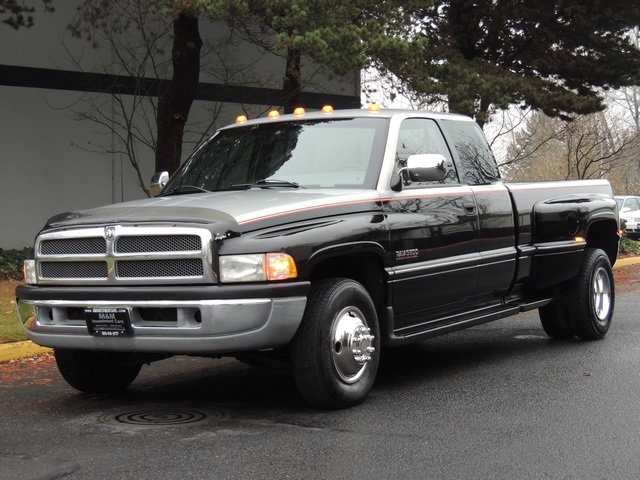
The dually wheel setup adds extra stability when hauling heavy trailers or full loads, reducing sway and improving traction on uneven surfaces. This makes the 3500 dually a purpose-built work truck, rather than a casual daily driver for light use.
What Makes This First-Generation Ram Unique
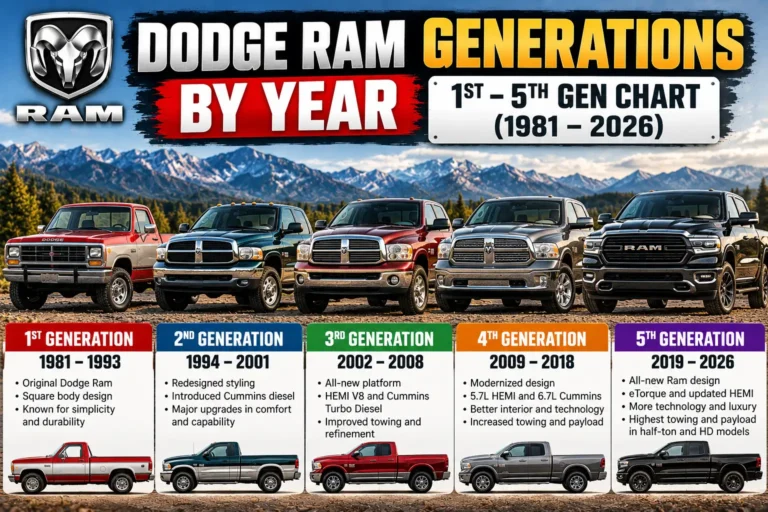
The 1996 model falls into Dodge’s first-generation Ram heavy-duty pickup lineup, which ran from 1994 to 2001. This generation marked a major styling shift for Dodge trucks, with a bold, big-rig-inspired design that stood out sharply from competitors’ more conservative offerings of the era.
Buyers could choose from Regular Cab, Club Cab, or Quad Cab configurations, paired with short or long bed lengths to suit work or personal needs. The combination of rugged heavy-duty hardware, legendary Cummins reliability, and distinctive styling has kept these trucks in high demand among enthusiasts and used buyers decades after production ended.
1996 Dodge Ram 3500 Dually Diesel Specs: Complete Data Table
This table consolidates all major specifications for the 1996 Dodge Ram 3500 dually with the Cummins diesel engine. It covers the core powertrain, key performance numbers, and dimensional data. Figures represent the standard range for the 3500 series; your specific vehicle’s numbers will depend on cab, options, and final assembly.
Use this as your primary reference sheet for quick fact-checking or comparison. For a deeper dive into engine particulars or towing procedures, refer to the dedicated sections elsewhere in this article.
Remember that all figures are factory specifications. Actual real-world performance can vary based on vehicle condition, maintenance history, aftermarket modifications, and specific equipment installed. Always verify the exact numbers for your truck using the VIN with a dealer or official documentation.
1996 Dodge Ram 3500 Dually Diesel Specs: Engine and Powertrain Details
5.9L 12-Valve Cummins ISB Engine Breakdown
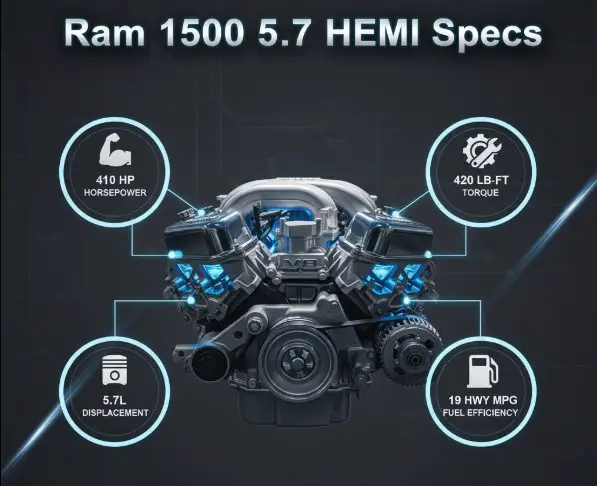
The 5.9L 12-valve Cummins ISB is the core of the 1996 Ram 3500 dually diesel, built on a rugged cast-iron block and head design derived from naturally aspirated Cummins light-duty engines, fitted with a Garrett T3-style turbocharger for heavy-duty output. Its inline-six configuration delivers smooth, even power delivery with minimal vibration, even at full load.
Factory output ranges from 210 to 215 horsepower, paired with 400 to 425 lb-ft of torque. Exact figures shift based on regional emissions rules and market certification requirements for the model year.
Fuel delivery relies on a rotary-style Bosch VE injection pump, a fully mechanical design distinct from the unit injectors used on later 24-valve Cummins engines. This setup is celebrated for its simplicity and ease of tuning, even for novice mechanics.
The 12-valve cylinder head uses two large valves per cylinder, prioritizing airflow for low-end torque rather than high-rpm horsepower, aligning with the truck’s work-focused design.
The 12-valve Cummins has a decades-long reputation for exceptional longevity, with many well-maintained examples surpassing 300,000 miles. It also handles significant aftermarket boost and tuning modifications far beyond factory output without major internal upgrades.
NV4500 vs A518 Transmission: Which Should You Choose?
Buyers of the 1996 Ram 3500 dually diesel had two transmission options, each tailored to different driving needs. The first is the NV4500 5-speed manual, widely lauded by truck enthusiasts as one of the best heavy-duty 5-speed transmissions ever manufactured.
The NV4500 is the top pick for users prioritizing maximum durability, especially for frequent towing, hauling, or off-road use. Its simple, overbuilt design handles the Cummins’ high torque output with minimal wear even under extreme stress.
The alternative is the A518 4-speed automatic, a smooth-shifting option built for daily drivers who prefer not to manage a manual gearbox in stop-and-go traffic. It is slightly less robust than the NV4500 for extreme heavy-duty use cases.
Both transmission options are paired with a heavy-duty two-speed transfer case on 4×4 models, adding low-range gearing for off-roading and slow-speed maneuvering when hauling heavy loads.
Turbocharger and Intercooler Setup Explained
The Cummins’ Garrett T3-style turbocharger is tuned for low-end responsiveness, delivering full boost pressure as low as 1,500 rpm. This gives the heavy dually strong acceleration and pulling power even when fully loaded with cargo or a trailer.


The small-frame T3 turbo is sized for low-end response rather than peak horsepower, making it ideal for the truck’s primary roles of towing, hauling, and daily driving.
Supporting the turbo is an air-to-air intercooler mounted directly in front of the radiator. It cools compressed intake air before it enters the engine, creating a denser charge air mixture.
This reduces pre-ignition risk, improves power consistency under heavy load, and lowers combustion temperatures to extend engine life, even during long mountain passes or extended towing runs.
Swapping the 12-valve Cummins for a 24-valve ISB is one of the most popular aftermarket projects for this truck, as the 24-valve head offers improved airflow and the option for common rail fuel injection for even greater power and efficiency.
Towing and Payload Numbers for the 1996 Dodge Ram 3500 Dually
How Gear Ratio Affects Towing Capacity
Bumper-pull towing capacity for the 1996 Ram 3500 Dually falls between 10,000 and 14,000 lbs, with the exact figure tied directly to your axle gear ratio and optional cooling packages. The standard 3.73 rear gear is rated for the lower end of that range, while the optional 4.10 or 4.56 ratios unlock the full 14,000 lb maximum.
You’ll need the heavy-duty cooling package to hit that 14,000 lb rating, as it keeps the Cummins diesel and transmission temperatures in check during heavy pulls. If your truck is equipped with the A518 automatic transmission, plan to add an aftermarket transmission cooler and upgraded torque converter for sustained heavy towing duty to avoid premature wear.
Quad Cab vs Regular Cab: Payload Differences Explained
Payload capacity for the 1996 model falls between 3,000 and 4,000 lbs, with huge variation based on cab configuration, bed length, and factory options added to the truck. The extra structure of a Quad Cab, 4WD hardware, and upgraded interior features all add curb weight that eats directly into your usable payload budget.
For concrete reference, a base Regular Cab 2WD model with a long 8-foot bed sits at the top of the payload range, and also earns the full 14,000 lb towing rating. A Quad Cab 4WD model with the shorter 6.5-foot bed drops to a 10,000 to 11,000 lb bumper-pull towing capacity, with payload closer to the 3,000 lb mark.
Gross Vehicle Weight Rating (GVWR) for these trucks falls between 14,000 and 16,000 lbs depending on configuration, with heavier Quad Cab and 4WD models sitting at the higher end of that scale to accommodate their extra curb weight.
Is the 1996 Cummins Good for Towing Fifth Wheels?
The 12-valve Cummins diesel has more than enough low-end torque to handle most fifth wheel trailers, but you’ll need to account for pin weight when calculating your usable payload. Fifth wheel pin weight runs 10 to 15% of the trailer’s total weight, so a 10,000 lb trailer adds 1,000 to 1,500 lbs of weight to the truck’s bed.
A properly set up fifth wheel hitch (or weight-distribution hitch for bumper-pull setups) will help maximize your towing stability and keep you within the truck’s rated limits, especially for longer trailers. The heavy-duty cooling package is even more critical for fifth wheel towing, as sustained climbs and long hauls put extra strain on the engine and transmission cooling systems.
1996 Ram 3500 Dually Dimensions, Chassis, and Suspension Specs
Wheelbase and Cab/Bed Configurations That Change Dimensions
The 1996 Ram 3500 dually offers wheelbase options spanning roughly 142 to 160 inches, with exact length tied directly to cab and bed configuration. This range lets buyers prioritize either tight maneuverability for daily job site use or maximum cargo space for bulk hauling tasks.
A Regular Cab paired with an 8-foot bed on the 160-inch wheelbase delivers the longest possible cargo box for hauling large, bulky items, though the extended wheelbase reduces tight turning capability and makes parking more challenging. A Club Cab with a 6-foot bed on the 142-inch wheelbase trades some cargo length for easier navigation in tight urban or confined job site spaces.
Dual Rear Wheel (DRW) Benefits for Heavy Loads
The dual rear wheel (DRW) setup is a core feature that sets the 3500 apart from lower-duty Ram models. The extra wheels increase stability, improve weight distribution across the rear axle, and boost traction when carrying heavy payloads or towing large, heavy trailers.
This DRW configuration also lets the 3500 achieve higher gross vehicle weight rating (GVWR) thresholds than the single-rear-wheel 2500 series, making it eligible for heavier commercial hauling work. Depending on cab style, bed length, and added options, the 3500 dually has a payload capacity of roughly 3,000 to 4,000 pounds for work and hauling tasks.
Frame and Suspension Components That Set the 3500 Apart
Under the body, the 1996 Ram 3500 dually uses a full-length heavy-duty ladder frame that is significantly reinforced compared to the 2500 series’ frame, engineered to handle the extra stress of maximum payload and towing loads without flexing or warping over years of hard use.
Rear suspension relies on heavy-duty leaf springs paired with a rocker Panhard bar to keep the rear axle precisely aligned under heavy weight, preventing uneven tire wear and maintaining predictable, stable handling even when the truck is fully loaded to its maximum capacity.
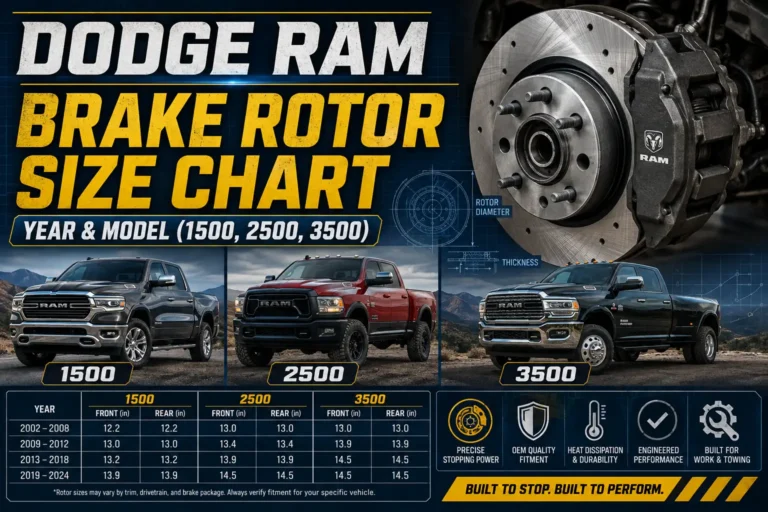
Braking hardware is also upgraded over the 2500 series, with larger rotors and more capable calipers designed to safely slow the heavier DRW configuration and its maximum rated payload without brake fade or reduced performance during repeated stops.
📋
How to Find Your 1996 Dodge Ram 3500 Dually’s Exact Specifications
All 1996 Ram 3500 trucks aren’t built the same. Payload, tow ratings, and GVWR differ based on cab, bed, and factory options. To know your truck’s precise numbers, you need its specific build data. Here’s how to locate it.
Step-by-Step VIN Decoding for a 1996 Ram 3500
Your 17-digit Vehicle Identification Number (VIN) is the most direct source. Locate it on the dashboard near the windshield. Use it to confirm core specs and decode factory option codes.


Reading the Door Jamb Sticker and Tire Placard
The driver-side door jamb contains the critical GVWR (Gross Vehicle Weight Rating), payload capacity, and original tire pressure information. This sticker provides the legal weight limits for your specific configuration.
The 8th digit identifies the engine (K for 5.9L Cummins). The 6th digit (W) indicates the trim level (e.g., SLT). Digits 7 and 8 together often reveal key option packages.
Open the driver’s door and look for the certification label. It lists the GVWR (e.g., 11,500 lbs) and GAWR (Gross Axle Weight Rating) for front and rear axles, essential for safe loading.
The glovebox manual contains model-specific towing charts and payload tables. These help you cross-reference the raw numbers from the door sticker with Dodge’s guidelines for your truck’s equipment.
Finding the Factory Build Sheet Online or Through a Dealer
For exhaustive detail, obtain the original factory build sheet. This document lists every option code and package installed at the plant, revealing the exact specification blueprint for your truck.
Verifying the Rear Axle Gear Ratio
A common method to confirm axle ratio without disassembly is to mark the driveshaft and a fixed reference point. With the rear wheels lifted, rotate the tire one full revolution and count the driveshaft turns. A ratio like 3.54:1 will show approximately 3.5 driveshaft revolutions per tire revolution.
1996 Dodge Ram 3500 vs. Key Competitors: Specs Compared
The 1996 Ram 3500’s 5.9L Cummins turbo diesel was a standout, but it faced fierce competition. Its reputation for durability and torque placed it in direct contrast with the diesel offerings from Ford and GM, as well as with Dodge’s own gasoline V8 and later Cummins updates.
1996 Ram 3500 Cummins vs. Ford F-350 7.3L Diesel
The primary rival was the Ford F-350, often equipped with the 7.3L Powerstroke V8 diesel. While the Ford’s V8 offered a different, smoother power delivery, the Cummins inline-6 was legendary for its low-end grunt and simpler, heavy-duty construction. In reliability circles, the 12-valve Cummins is frequently regarded as the more robust and over-engineered powerplant.
1996 Ram 3500 Cummins vs. Chevrolet/GMC 3500 6.5L Diesel
The GM 3500 offered a 6.5L Detroit Diesel V8. However, this engine developed a notorious reputation for head gasket failures and lower power potential. The Cummins I6 was widely considered the more robust, torque-rich engine, making the Ram the preferred choice for serious towing among diesel enthusiasts.
12-Valve vs. 24-Valve Cummins: What Changed in 1998
The 1996 model features the mechanically injected 12-valve “6BT” Cummins. Starting in 1998, Dodge introduced the 24-valve “6BTA” version. The newer engine incorporated direct injection and advanced electronics, boosting factory output to ~260 hp and improving fuel economy, though some purists prefer the simplicity of the 12-valve.
Compared to Dodge’s own 5.9L gas V8, the Cummins diesel offered vastly superior torque and towing capability but had higher upfront cost and more complex maintenance. The gas engine provided better cold-weather starts and was simpler to service, but suffered from much worse fuel economy under load.
Common 1996 Dodge Ram 3500 Cummins Problems and Maintenance Tips
Top 5 Most Reported Issues on the 12-Valve Cummins
The rotary Bosch VE injection pump is a known wear item. High-mileage trucks may develop hard starting and a rough idle, signaling it’s time for a rebuild or replacement. While the 12-valve Cummins is legendary for longevity—many exceed 300,000 miles on the original engine—this pump eventually needs attention.
Head gasket failures are rare but can occur if the engine is pushed with aggressive tuning and excessive boost beyond its robust design limits. Another item to note is timing chain stretch; listen for a distinct rattling noise from the front of the engine at idle, which can indicate worn guides or tensioners.
Transmission Wear Patterns in the NV4500 and A518
The manual NV4500 is durable but can develop input shaft wear. The A518 automatic is often the weaker link for heavy towing. Upgrading to a larger transmission cooler and a performance torque converter is a common and recommended modification to prevent overheating and premature failure under load.
Pre-Purchase Inspection Checklist for a Used 1996 Ram 3500 Dually
Before buying, inspect all rubber suspension components. The bushings and leaf spring eyes degrade with age and load, leading to a vague steering feel. Listen for timing chain rattle and check for signs of coolant under the oil filler cap, which may hint at head gasket issues from past abuse.
With proper maintenance, these trucks are exceptionally capable. It’s not unusual to find examples with 200,000 to 400,000 miles still providing reliable service, making them a sound investment when you know what to look for during inspection.
Expert Tips for Working With 1996 Dodge Ram 3500 Dually Diesel Specs
Why You Should Never Assume All 3500s Have Identical Specs
Never assume your 3500 dually matches a generic spec sheet. Critical variations exist within the model year. You must verify your truck’s specific gear ratio (4.10, 4.56, etc.) and cooling package to determine its true maximum towing capacity.
Do not confuse 2500 Cummins specs with your 3500. The dually features heavier-duty axles, brakes, suspension components, and a reinforced frame designed for higher GVWR and payload demands.
Keep your original factory spec sheet. Any modification, like changing tire size or re-gearing the differentials, will alter your actual performance and towing capabilities versus the published numbers.
Safe Towing Practices for the 1996 Cummins Dually
Towing capacity depends heavily on gear ratio, installed cooling packages, and the use of a proper weight-distribution hitch. A late-production 1996 model may even have early 1997-spec components, complicating identification.
For safe descending with heavy loads, like a 12,000-lb fifth wheel, owners should verify they have a 4.10 or 4.56 gear ratio and an integrated exhaust brake. This combination is crucial for control and reducing brake fade.



Avoid the critical mistake of confusing the pre-1998 12-valve Cummins with the later 24-valve version. They have different engine mounts, electronics, and performance characteristics, impacting any modification plans.
When to Upgrade the A518 for Serious Towing Duty
The factory A518 automatic transmission is reliable for moderate loads. However, for sustained towing over 8,000 lbs, an upgrade is strongly recommended to ensure longevity and prevent overheating.
Essential upgrades include installing a high-capacity external transmission cooler and having the transmission control unit (TCU) reprogrammed for firmer shifts and higher line pressure under load.
If considering a 24-valve Cummins engine swap, budget significantly for custom engine mounts, extensive wiring harness fabrication, and complex ECU integration. It is a major project requiring specialized knowledge.
Key Takeaways
-
✓
The 5.9L 12-valve Cummins turbo diesel engine delivers 215 horsepower and 460 lb-ft of torque for serious towing and hauling performance -
✓
Maximum tow rating reaches approximately 17,210 lbs and payload exceeds 5,000 lbs in optimal configurations with the dually rear axle -
✓
The reinforced chassis and dual rear wheel suspension provide stability but increase overall length and reduce maneuverability -
✓
Head gasket failures and injection pump issues are among the most common problems reported in 1996 Cummins engines requiring regular inspection -
✓
Use the vehicle VIN number on the driver-side door jamb or frame to cross-reference exact factory specifications for your specific truck
❓ Frequently Asked Questions
1
What is the 1996 Dodge Ram 3500 dually diesel?
It is a heavy-duty pickup truck manufactured by Dodge in 1996 featuring a 5.9L 12-valve Cummins turbo diesel inline-six engine, dual rear wheels, and a reinforced chassis built for commercial towing and payload applications.
2
How does the 1996 Dodge Ram 3500 Cummins engine work?
The 5.9L ISB engine uses a Garrett T3/T4 turbocharger, mechanical inline injection pump, and indirect injection. It produces 215 hp and 460 lb-ft of torque, delivering strong low-end power ideal for towing and hauling heavy loads reliably.
3
Why are 1996 Dodge Ram 3500 dually specs important?
Knowing accurate specifications helps owners determine safe towing limits, payload capacity, maintenance schedules, and whether a used truck meets their hauling needs. Incorrect assumptions about weight ratings can lead to dangerous operating conditions and component failures.
4
What are the benefits of the 1996 Dodge Ram 3500 dually diesel?
Key advantages include exceptional towing and payload capacity, bulletproof 12-valve Cummins engine longevity, simple mechanical fuel system easy to repair, strong aftermarket support, and relatively affordable purchase price compared to modern heavy-duty trucks.
5
How can I get started researching 1996 Dodge Ram 3500 dually diesel specs?
Start by locating your VIN on the driver-side door jamb or frame. Cross-reference it with factory build sheets, check the certification label for GVWR and tire ratings, and consult owner forums for real-world experience reports and known issue databases.
6
What engine is in a 1996 Dodge Ram 3500 dually diesel?
The 5.9L 12-valve Cummins ISB inline-six turbocharged diesel engine. It produces 210–215 hp and 400–425 lb-ft of torque, paired with either an NV4500 5-speed manual or A518 4-speed automatic transmission.
![5th Gen Ram Tail Lights [2026]](https://truckguider.com/wp-content/uploads/2026/03/5th-gen-ram-tail-lights-featured.webp)
![Are Ram Trucks Made in America? US vs Mexico Plant Locations [2026]](https://truckguider.com/wp-content/uploads/2026/03/are-ram-trucks-made-in-america-featured.webp)