Toyota Tacoma Trim Levels Comparison Specification Chart By Year (2005–2026)

Quick Answer
The Toyota Tacoma has evolved significantly from 2005 to 2026, transitioning from naturally aspirated 2.7L and 4.0L engines to the modern i-FORCE 2.4L turbocharged powertrain. Trim levels vary widely in capability, ranging from the utilitarian SR to the desert-ready TRD Pro and Trailhunter. The most critical caveat is that towing capacity, payload, and off-road geometry depend strictly on your specific cab, bed, and drivetrain configuration as listed on the vehicle’s door jam sticker.
Finding the perfect truck shouldn’t require decoding hundreds of pages of brochures. Toyota Tacoma trim levels are notoriously complex, with specifications, towing capacities, and off-road capabilities shifting significantly based on the model year, engine option, and specific configuration. Whether you are hunting for a base work truck from 2005 or a high-tech 2026 i-FORCE MAX hybrid, the trim hierarchy dictates everything from suspension tuning to payload limits. This guide provides a comprehensive comparison chart and technical breakdown to help you navigate the nuances of the Toyota Tacoma lineup from 2005 to 2026.
This reference covers the 2nd (2005-2015), 3rd (2016-2023), and 4th (2024-2026) generations of the Toyota Tacoma. Specifications are based on factory standards; however, individual vehicles vary by installed options (e.g., Tow Package). Always verify against your specific VIN, owner’s manual, or the payload sticker located on the driver-side door jamb. Last reviewed: August 2026.
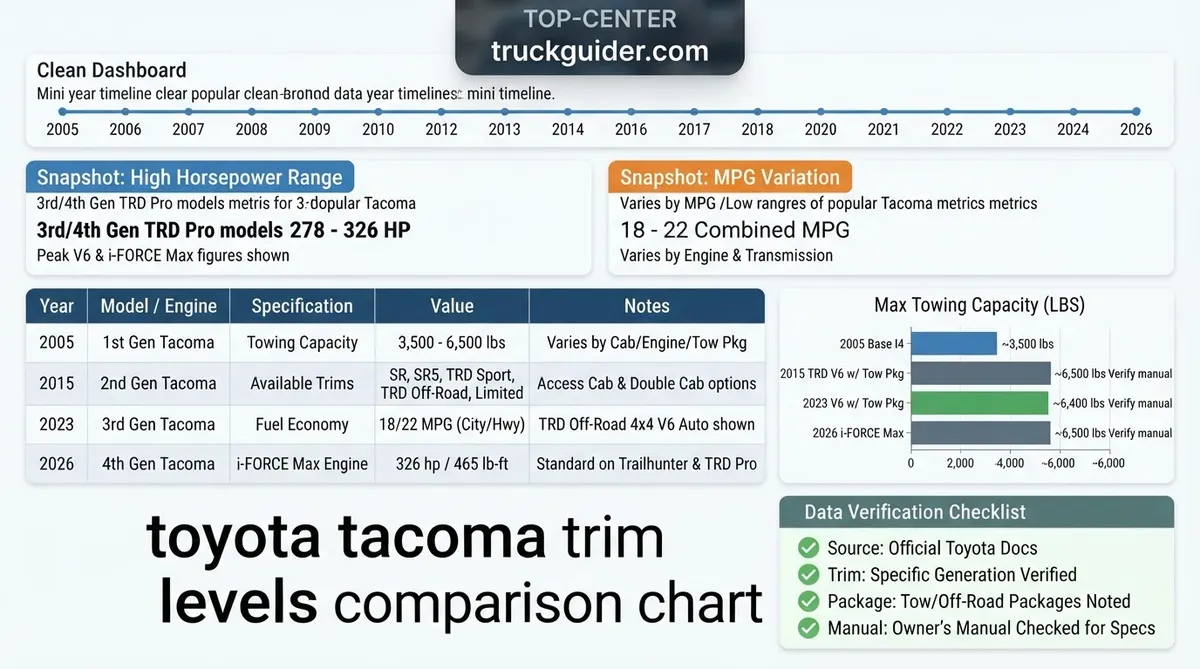
Toyota Tacoma Trim Levels Comparison Chart: Master Specification Reference



📤 Share Image
| Year | Model / Engine | Primary Focus | Notes |
|---|---|---|---|
| 2005-2015 | Gen 2 (2.7L I4 / 4.0L V6) | Utility/Off-Road | Hydraulic steering; simpler electronics. |
| 2016-2023 | Gen 3 (2.7L I4 / 3.5L V6) | Lifestyle/Tech | Introduction of TSS-P safety suite. |
| 2024-2026 | Gen 4 (2.4L Turbo / Hybrid) | Performance/Premium | i-FORCE MAX torque-focused power. |
How to Interpret Tacoma Trim Data
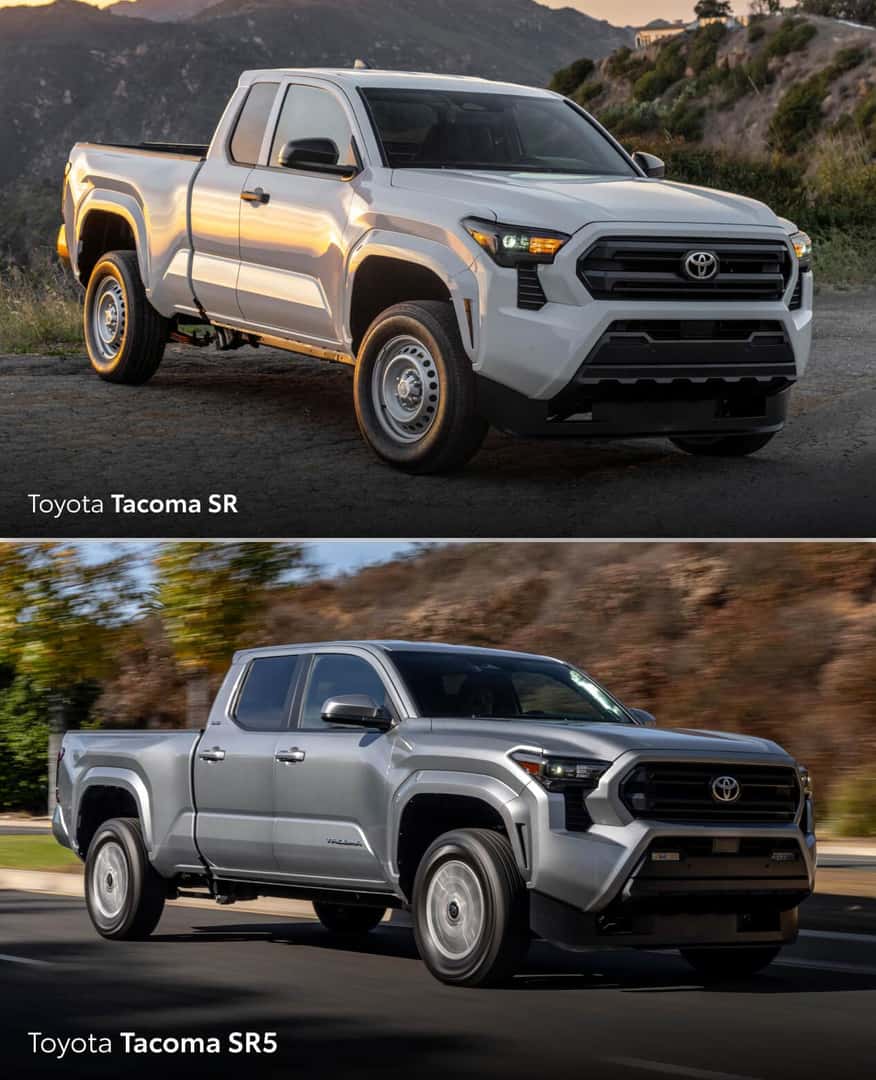
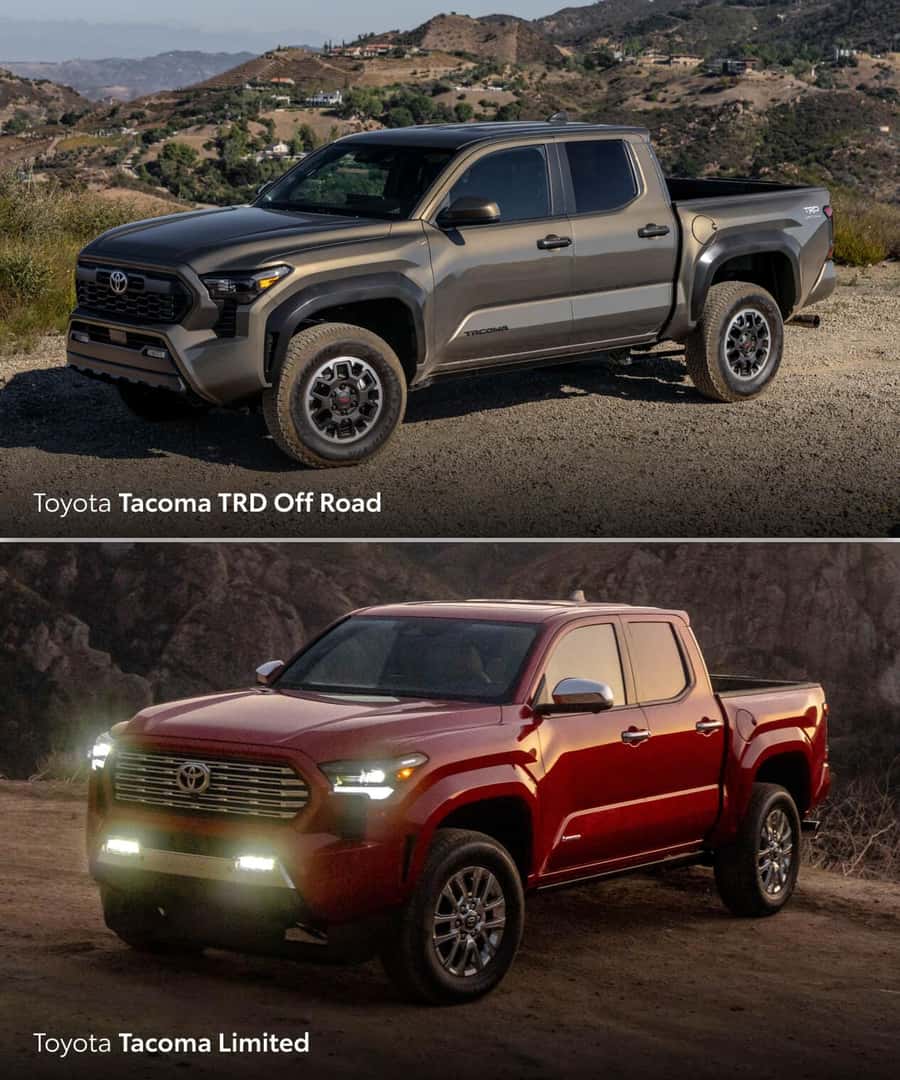
To read this chart effectively, understand that Tacoma trim levels (SR, SR5, TRD Sport, TRD Off-Road, Limited, Pro, Trailhunter) function as “buckets” of features. For example, a TRD Off-Road trim automatically includes specific rear differential locking capabilities and suspension tuning that are not available as individual add-ons for the SR5. Always cross-reference the model year, as “TRD Off-Road” in 2005 meant significantly different hardware than it does in the 2026 model.
Year-by-Year Changes to Toyota Tacoma Trim Configurations


Second Generation Milestones (2005-2015)
The 2nd Gen Tacoma prioritized raw mechanical reliability. Trim levels were sparse compared to modern standards: Base, SR5, TRD Sport, and TRD Off-Road. The V6 engine was the undisputed king of these years, and towing capacities remained relatively static across these trims, provided the “Tow Package” (which included transmission oil coolers and upgraded alternators) was selected.
Third Generation Tech Advancements (2016-2023)
The 2016 refresh introduced the “Toyota Safety Sense” (TSS) suite as standard, which fundamentally changed the entry-level SR trim. During this era, we saw the rise of the “lifestyle” trim, with unique interior materials and advanced infotainment systems. The TRD Off-Road trim gained significant mechanical prowess with the introduction of “Crawl Control” and “Multi-Terrain Select” on automatic transmission models.
The Fourth Generation Reset (2024-2026)
With the 2024 redesign, Toyota moved away from naturally aspirated V6 engines to a 2.4L Turbocharged i-FORCE engine. The trim hierarchy also expanded to include the “Trailhunter” and “PreRunner” designations. Trim levels in this generation are now inextricably linked to the hybrid powertrain option, which provides vastly different torque curves compared to the base 2.4L turbo.
Understanding Tacoma Performance: TRD vs. Work vs. Luxury Trims


Focuses on base-level interior, steel wheels, and essential cooling systems. Ideal for fleet use.
Includes locking diffs, specialized off-road shocks (Bilstein/FOX), and skid plates.
Prioritizes interior comfort, leather upholstery, premium audio, and high-tech safety features.
Critical Factors Affecting Tacoma Trim Specification Ratings


Payload and Towing Capacity Variables
It is a common pitfall to assume every Tacoma of a certain year can tow the same weight. Payload is highly sensitive to your specific configuration.
- Cab Configuration: Double Cabs weigh more than Access Cabs, reducing your available payload.
- Bed Length: A long bed adds weight and changes the GVWR (Gross Vehicle Weight Rating).
- Drivetrain: 4WD systems add significant curb weight compared to 2WD variants, impacting both towing capacity and payload.
Verifying Your Tacoma Configuration via VIN
Because trim packages can be modified at the port of entry or by dealerships, the definitive source for your truck’s capabilities is the payload sticker on the driver-side door jamb. This sticker provides the “Cargo Carrying Capacity” specific to your exact VIN. Never rely solely on generic brochure numbers when calculating the weight of a trailer or heavy gear.
Aftermarket tire upgrades, lift kits, and heavy steel bumpers can drastically reduce your effective payload capacity. Always re-calculate your remaining payload after adding heavy accessories.
Frequently Asked Questions
Does the TRD Off-Road trim tow more than the SR5?
Generally, no. The TRD Off-Road is optimized for suspension articulation, not towing. In many cases, the added weight of the TRD components slightly decreases the maximum payload capacity compared to an equivalently equipped SR5.
Can I add the “Tow Package” to a base trim?
While some components can be installed aftermarket, the factory “Tow Package” often includes structural changes to the cooling system, alternator, and sometimes the rear axle gear ratio that are difficult and expensive to replicate post-purchase.
Quick Summary
Trim levels represent mechanical and electronic “buckets” that define vehicle purpose. Always verify your specific VIN at a Toyota dealer portal to confirm factory equipment, as option packages vary widely by region.