Toyota 5.7 i-Force Specs for the 3UR-FE V8 in Tundra and Sequoia

The Toyota 5.7 i-Force is the 3UR-FE, a 5.7-liter DOHC 32-valve V8 with Dual VVT-i rated at 381 hp at 5,600 rpm and 401 lb-ft at 3,600 rpm in the 2007 to 2021 Tundra.


The same rating carried over to the 2008 to 2022 Sequoia and the Land Cruiser through 2021. Compression is 10.2:1, and Toyota calls for 87-octane fuel and synthetic 0W-20 oil on late trucks.
The figures below come mainly from Toyota spec sheets, SourceBooks, press releases and service bulletins, plus EPA data, with other sources named where used. We cover the core engine numbers, gearing, oil, towing, fuel economy, the air injection pump campaigns and what replaced the V8.
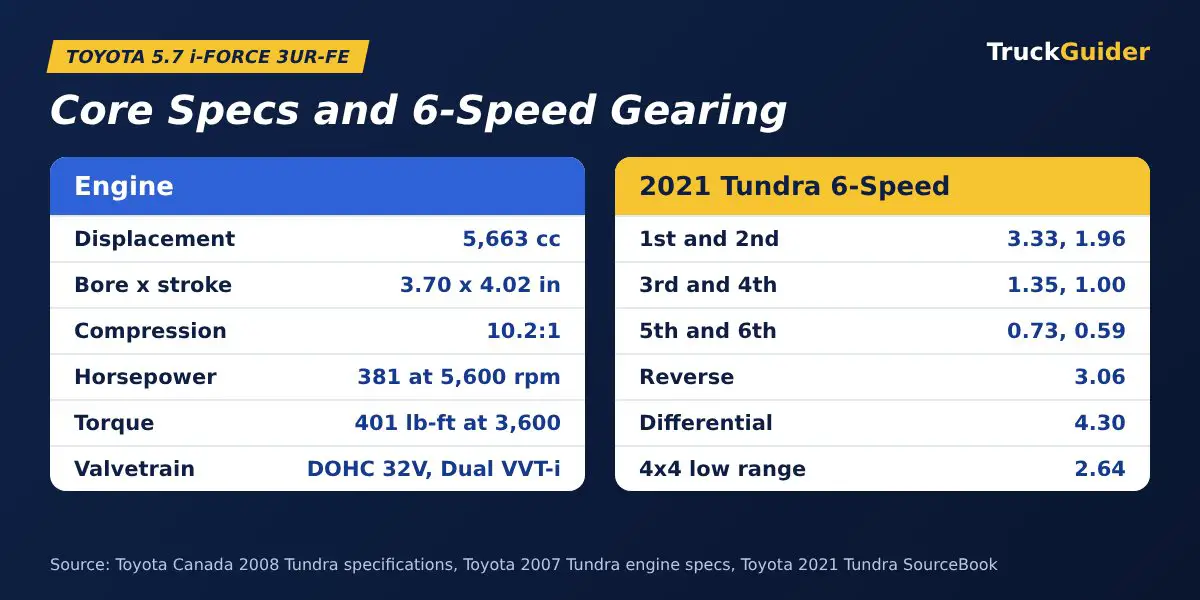
Toyota 5.7 i-Force Core Specs Chart for the 3UR-FE V8


The 3UR-FE kept the same headline numbers for its entire US run. Toyota Canada’s 2008 Tundra specifications and Toyota’s 2021 Tundra SourceBook list identical output 13 model years apart.
| Spec | 5.7 i-Force 3UR-FE |
|---|---|
| Layout | V8, DOHC, 32 valves, Dual VVT-i |
| Displacement | 5,663 cc, about 345.6 cu in |
| Bore x stroke | 3.70 x 4.02 in, about 94 x 102 mm |
| Compression ratio | 10.2:1 |
| Block and heads | Aluminum block, aluminum alloy DOHC heads |
| Fuel system | Sequential multiport fuel injection |
| Horsepower | 381 hp at 5,600 rpm |
| Torque | 401 lb-ft at 3,600 rpm |
| Recommended fuel, 2021 | 87 octane or higher |
| Oil, 2021 | Synthetic 0W-20, ILSAC GF-5 |
The 5,663 cc figure and the 3.70 x 4.02 inch bore and stroke come from Toyota’s 2007 Tundra engine specification as reprinted by Motor-Car.net. The Elgin parts catalog also lists a 5,663 cc Toyota V8.
The cubic inch and millimeter values are our conversions of those figures.
Toyota’s 2015 Tundra release states that both Tundra V8s use an aluminum cylinder block with DOHC heads and Dual Independent VVT-i. The long 4.02 inch stroke against a 3.70 inch bore makes the 3UR-FE an undersquare design.
5.7 i-Force Output in 3 Toyotas From 2007 to 2022
Toyota used the 3UR-FE in one pickup and two SUVs in the US. EPA listings on fueleconomy.gov show the 5.7 first appearing in the 2007 Tundra and the 2008 Sequoia and Land Cruiser.
381 hp and 401 lb-ft in every 5.7 model shown
| Model and Years | Output | Transmission | Toyota Source |
|---|---|---|---|
| Tundra, 2007 to 2021 | 381 hp, 401 lb-ft | 6-speed automatic | 2008 Canada specs, 2021 SourceBook |
| Sequoia, 2008 to 2022 | 381 hp, 401 lb-ft | 6-speed automatic | 2021 Sequoia SourceBook |
| Land Cruiser, 2008 to 2021 | 381 hp, 401 lb-ft | 6-speed, later 8-speed automatic | 2011 and 2021 Land Cruiser releases |
The Land Cruiser is the only one that changed gearboxes. Toyota’s 2011 Land Cruiser release describes a six-speed automatic, while its 2021 release describes an 8-speed ECT-i unit behind the same 381 hp V8.
Tundra buyers could also choose a smaller V8 in many years. The 2015 Tundra came standard with a 4.6-liter i-Force V8, so check the engine label before assuming a Tundra has the 5.7. Our Toyota Tundra generations chart shows how these years fit together.
6-Speed Gear Ratios and Axle Ratios for the 2021 5.7
Gearing explains how the 5.7 tows as well as it does. Toyota’s 2021 Tundra SourceBook lists the 6-speed ECT-i ratios and a 4.30 differential ratio on every 5.7 grade it covers.
| Gear | 2021 Tundra 5.7 Ratio |
|---|---|
| 1st | 3.33 |
| 2nd | 1.96 |
| 3rd | 1.35 |
| 4th | 1.00 |
| 5th | 0.73 |
| 6th | 0.59 |
| Reverse | 3.06 |
| Differential | 4.30, 10.5 in rear ring gear |
| 4×4 transfer case | 1.00 high, 2.64 low |
The Sequoia used a taller standard axle. Toyota’s 2021 Sequoia SourceBook lists a 3.92 differential ratio, or 4.30 with the tow package. Earlier Tundra axle choices by year appear in our Toyota Tundra gear ratio chart.
With a 4.30 axle and a 0.59 sixth gear, the overall top-gear ratio works out to about 2.54:1 by our math. That deep overdrive keeps cruising rpm down while the 3.33 first gear helps launch heavy trailers.
5.7 i-Force Oil Capacity for 2010 to 2014 Trucks
Toyota’s Tech Tip T-TT-0262-13 on oil fill quantities lists capacity with a filter change for 2010 to 2014 models under non-severe use. The 3UR-FE rows read this way.
| Model and Years | Oil | Capacity With Filter | Change Interval |
|---|---|---|---|
| Tundra 5.7, 2010 to 2011 | 5W-20 or 0W-20 | 7.9 qt | 5,000 miles |
| Tundra 5.7, 2012 to 2014 | 0W-20 | 7.9 qt | 10,000 miles |
| Sequoia 5.7, 2010 to 2011 | 5W-20 or 0W-20 | 7.9 qt | 5,000 miles |
| Sequoia 5.7, 2012 to 2014 | 0W-20 | 7.9 qt | 10,000 miles |
| Land Cruiser, 2010 | 5W-20 or 0W-20 | 7.4 qt blue dipstick, 7.9 qt green dipstick | 5,000 miles |
| Land Cruiser, 2011 | 5W-20 or 0W-20 | 7.9 qt | 5,000 miles |
| Land Cruiser, 2013 to 2014 | 0W-20 | 7.9 qt | 10,000 miles |
Two exceptions in the same bulletin change these intervals. Toyota says any truck used for towing a trailer, off-road or dirt road driving, repeated short trips below 32 F or extensive idling must have the oil changed every 5,000 miles, regardless of oil used.
The Land Cruiser note matters at the parts counter. Toyota tells technicians to check the dipstick color on 2010 trucks, because the blue-stick engines take half a quart less than the green-stick engines.
Later trucks moved fully to synthetic 0W-20. Both 2021 SourceBooks list synthetic 0W-20 for the Tundra and Sequoia. Our guide to the best oil for the Toyota Tundra covers 0W-20 choices for these engines.
Flex Fuel 3UR-FBE Engines
The same bulletin lists a flex fuel 3UR-FBE version in 2010 to 2014 Tundra and Sequoia trucks, with the same 7.9 quart capacity. Toyota did not approve the 3UR-FBE for 10,000-mile changes, so it keeps a 5,000-mile interval.
Flex fuel trucks operated on E85 50 percent of the time or more need an oil change every 2,500 miles, according to the same Toyota note.
Towing With the 5.7 i-Force in 2008 and 2021 Models
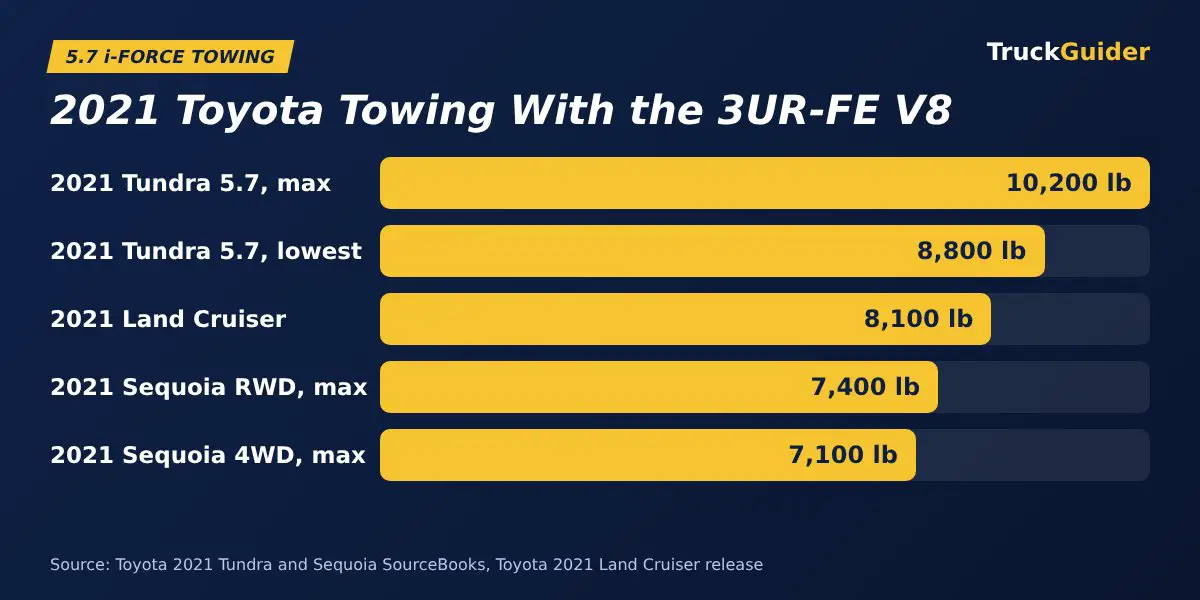
Tow ratings depend on body, bed and drivetrain more than on the engine. These are the figures Toyota published for 5.7 models at both ends of the second-generation Tundra run.
| Model | Published Towing |
|---|---|
| 2008 Tundra 4×4 5.7, Canada | 10,100 to 10,500 lb |
| 2021 Tundra 5.7 | 8,800 to 10,200 lb by cab, bed and drive |
| 2021 Sequoia RWD | 7,200 to 7,400 lb by grade |
| 2021 Sequoia 4WD | 7,000 to 7,100 lb by grade |
| 2021 Land Cruiser | 8,100 lb with standard tow package |
The 2021 Tundra’s 10,200-pound maximum applies to SR and SR5 4×2 trucks with the 6.5-foot bed. Heavier CrewMax and 4×4 trucks rate lower, down to 8,800 pounds in the SourceBook tables.
For a year-by-year view of every Tundra engine, use our Toyota Tundra towing capacity chart by year.
EPA Fuel Economy for 5.7 Models From 2008 to 2022
The 5.7 never earned a reputation for thrift. These EPA ratings come from fueleconomy.gov for each exact year and drivetrain, listed under the current EPA test method.
| Model | City | Highway | Combined |
|---|---|---|---|
| 2008 Tundra 2WD | 14 mpg | 18 mpg | 16 mpg |
| 2008 Tundra 4WD | 13 mpg | 17 mpg | 14 mpg |
| 2014 Tundra 4WD | 13 mpg | 17 mpg | 15 mpg |
| 2021 Tundra 2WD | 13 mpg | 17 mpg | 15 mpg |
| 2021 Tundra 4WD | 13 mpg | 17 mpg | 14 mpg |
| 2021 Land Cruiser 4WD | 13 mpg | 17 mpg | 14 mpg |
| 2022 Sequoia 4WD | 13 mpg | 17 mpg | 14 mpg |
Fuel economy barely moved across 14 years. The 2021 Tundra 4WD matches the 2008 truck at 13 city, 17 highway and 14 combined. Choosing 2WD on a 2021 Tundra gains just 1 mpg combined, 15 versus 14.
The Sequoia and Land Cruiser land on the same 13 city, 17 highway and 14 combined figures in their final 5.7 years.
Range depends on the tank as much as the engine. The 2021 SourceBook lists a 26.4-gallon standard tank and an optional 38.0-gallon tank on some 4×2 grades, and our Toyota Tundra fuel tank size chart covers other years.
Air Injection Pump Problems on 2011 to 2013 5.7 Trucks
The 3UR-FE issue with the most Toyota paperwork is the air injection system, an emissions system that pumps air into the exhaust. Toyota issued two programs for it on the Tundra and Sequoia.
- Limited Service Campaign D0E: covered certain 2012 to 2013 Tundra and Sequoia trucks with the 5.7 gas or 5.7 flex fuel engine. Toyota’s D0E dealer letter says the ECM calibration could let the air injection pump fail and trigger a limp-home mode.
The remedy was an ECM update, and the campaign ended May 31, 2016. - Warranty Enhancement Program ZG6: covered air injection pumps and air switching valves on certain 2011 Tundra and Sequoia trucks for check engine lights caused by moisture. It listed the 5.7 and other Tundra and Sequoia engines, with coverage for 10 years from first use or 150,000 miles.
Both programs have now ended for most trucks. Toyota’s ZG6 bulletin tied the check engine lights to moisture in the pumps and air switching valves, so have the codes read before replacing parts.
Toyota also ran program ZH7 for frame corrosion on certain 2007 to 2008 Tundras with any engine, with extra coating work limited to cold-climate states. That issue involves the frame, not the engine, but it matters when shopping for an early 5.7 truck.
Confirm a Tundra Has the 5.7 in 3 Checks
Not every second-generation Tundra has the 5.7. EPA listings on fueleconomy.gov show up to three engine choices per year, so confirm the engine before ordering parts.
| Tundra Years | Engines Listed by EPA |
|---|---|
| 2007 to 2009 | 4.0 V6, 4.7 V8, 5.7 V8 |
| 2010 to 2014 | 4.0 V6, 4.6 V8, 5.7 V8 |
| 2015 to 2019 | 4.6 V8, 5.7 V8 |
| 2020 to 2021 | 5.7 V8 only |
Check 1 Match the Year


A 2020 or 2021 Tundra always has the 5.7. Older trucks need a second check, because the 4.6 and 5.7 V8s share the same 6-speed automatic in EPA listings from 2010 on.
Check 2 Read the Window Sticker or Manual
The original window sticker or owner’s manual names the engine. Look for the 5.7-liter V8 line and the 381 hp rating that Toyota lists for the 3UR-FE in every document we checked.
Check 3 Decode the VIN at a Dealer
Oil specs will not settle it. Toyota’s 2014 bulletin lists the same 7.9 quart capacity and 0W-20 oil for the 2012 to 2014 Tundra 4.6 and 5.7, so a Toyota parts counter VIN lookup is the reliable answer.
What Replaced the 5.7 i-Force in 2022 and 2023
Toyota retired the 3UR-FE as each model moved to a new generation.
- Tundra, 2022: Toyota’s 2022 Tundra release lists a 3,445 cc twin-turbo V6 i-FORCE engine with up to 389 hp and 479 lb-ft, or 348 hp and 405 lb-ft on SR grades, plus a 10-speed automatic and a 12,000-pound maximum tow rating.
- Tundra hybrid: the i-FORCE MAX adds a motor generator for 437 hp and 583 lb-ft, covered in our Toyota i-FORCE MAX specs.
- Sequoia, 2023: EPA listings show only a 3.4-liter turbo V6 with a 10-speed automatic.
The V8 has not returned. Toyota’s 2027 Tundra announcement lists only the twin-turbo V6 and the i-FORCE MAX hybrid.
5 Toyota 5.7 i-Force Questions Owners Ask
How Much Horsepower Does the Toyota 5.7 Make
It makes 381 hp at 5,600 rpm and 401 lb-ft at 3,600 rpm. Toyota lists the same figures for the 2008 Tundra, the 2011 Land Cruiser and the 2021 Tundra and Sequoia, so the rating never changed in the US.
What Is the Engine Code for the Toyota 5.7


The gasoline engine is the 3UR-FE. Toyota’s oil bulletin also lists a flex fuel version, the 3UR-FBE, in 2010 to 2014 Tundra and Sequoia trucks. Both share the 7.9 quart oil capacity in that bulletin.
How Much Oil Does a 5.7 Tundra Take
Toyota’s 2014 bulletin lists 7.9 quarts with a filter change for 2010 to 2014 Tundras. The 2012 to 2014 gas trucks call for 0W-20 with a 10,000-mile interval under normal use. Towing or flex fuel trucks stay at 5,000 miles.
Does the 5.7 i-Force Need Premium Fuel
No. Toyota’s 2021 Tundra SourceBook lists 87 octane or higher. Premium fuel is allowed but not required for the rated 381 hp in that document.
What Year Did Toyota Stop Making the 5.7 Tundra
The 2021 model year was the last Tundra with the 5.7 V8. The 2022 Tundra switched to the twin-turbo i-FORCE V6 and the i-FORCE MAX hybrid, and the Sequoia followed for 2023.
Using 5.7 i-Force Specs on a 2007 to 2022 Toyota
The Toyota 5.7 i-Force specs stayed the same across 15 years of US models. Every Tundra, Sequoia and Land Cruiser with the 3UR-FE carries 381 hp and 401 lb-ft, so the details that change are gearing, oil spec and tow rating.
Match your truck to its year in the oil table and use the 5,000-mile interval if you tow. Confirm the axle ratio before towing near the limit, and ask for the air injection service history on 2011 to 2013 trucks.
If you also own an older 4.0 V6 Toyota, our Toyota 1GR-FE specs guide covers that engine the same way.