Toyota 1GR-FE Specs for the 4.0-Liter V6 by Truck and Year

The Toyota 1GR-FE is a 4.0-liter, 3,956 cc DOHC V6 with 24 valves and a 3.70 x 3.74 inch bore and stroke, rated at 236 hp and 266 lb-ft with single VVT-i or 270 hp and 278 lb-ft with Dual VVT-i in most US trucks.


Which rating applies depends on the truck and year. The 2005 to 2015 Tacoma kept the single VVT-i version, while the 2011 to 2014 Tundra and the 2010 to 2024 4Runner got the Dual VVT-i update. First-year 2005 trucks and the FJ Cruiser carry their own figures.
Every number below comes from Toyota product information sheets, press releases, a Toyota service bulletin and EPA data. We split the specs by version, truck and model year, then show how to tell which engine sits in your truck.
Toyota 1GR-FE Core Specs Chart for the 3,956 cc V6


Both versions share the same block, bore and stroke. Toyota’s 2010 and 2024 4Runner Product Information sheets list the Dual VVT-i engine this way, and Toyota Canada’s Tacoma specification pages cover the single VVT-i figures.
| Spec | 1GR-FE Value |
|---|---|
| Layout | V6, DOHC, 4 valves per cylinder, 24 valves |
| Displacement | 3,956 cc, about 241 cu in |
| Bore x stroke | 3.70 x 3.74 in, about 94 x 95 mm |
| Block and heads | Aluminum alloy block, aluminum alloy heads |
| Fuel system | Sequential multiport fuel injection |
| Compression ratio, single VVT-i | 10.0:1 |
| Compression ratio, Dual VVT-i 4Runner | 10.4:1 |
| Recommended fuel, Dual VVT-i | 87 octane unleaded |
| Peak output, single VVT-i | 236 hp at 5,200 rpm, 266 lb-ft at 4,000 rpm |
| Peak output, Dual VVT-i | 270 hp at 5,600 rpm, 278 lb-ft at 4,400 rpm |
The cubic inch and millimeter figures are our conversions of Toyota’s 3,956 cc and inch values. The 4Runner sheets name the engine only as a 4.0-liter V6, while Toyota’s service bulletins use the 1GR-FE engine code for the same trucks.
Single VVT-i vs Dual VVT-i 1GR-FE Output Compared
VVT-i stands for Variable Valve Timing with intelligence. The early 1GR-FE varies timing on the intake cams only. Dual VVT-i adds control of the exhaust cams too, and the 4Runner version runs a higher 10.4:1 compression ratio.
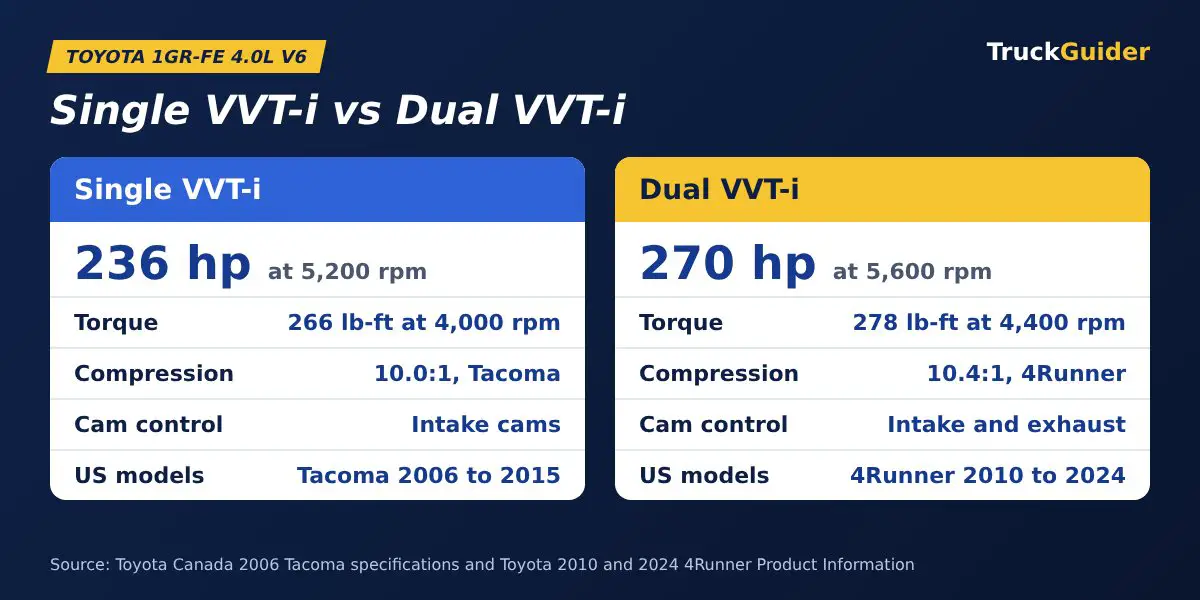
| Spec | Single VVT-i | Dual VVT-i |
|---|---|---|
| Cam timing control | Intake cams | Intake and exhaust cams |
| Compression ratio | 10.0:1 in Tacoma specs | 10.4:1 in 4Runner specs |
| Horsepower | 236 hp at 5,200 rpm | 270 hp at 5,600 rpm |
| Torque | 266 lb-ft at 4,000 rpm | 278 lb-ft at 4,400 rpm |
| US models | 2005 to 2015 Tacoma, 2005 to 2010 Tundra, 2003 to 2009 4Runner, 2007 to 2009 FJ Cruiser | 2011 to 2014 Tundra, 2010 to 2024 4Runner, 2010 to 2014 FJ Cruiser |
The gain is 34 hp and 12 lb-ft. Toyota’s 2011 Tundra press release states that horsepower increased to 270 from 236 and torque to 278 from 266 when the base V6 gained Dual VVT-i.
Peak power and torque both arrive higher in the rev range on the Dual VVT-i engine. Peak torque moves from 4,000 rpm to 4,400 rpm, and peak power from 5,200 rpm to 5,600 rpm.
1GR-FE Output by Model Year in 4 Toyotas
The same engine code carried several ratings in the US, because of the Dual VVT-i update, the FJ Cruiser’s own tune and a 2006 change in SAE testing. The timeline shows which version each model used, and the table lists the published ratings.
US model years 2003 to 2024
| Vehicle and Years | Version | Horsepower | Torque |
|---|---|---|---|
| Tacoma, 2005 | Single VVT-i, older SAE method | 245 hp | 282 lb-ft |
| Tacoma, 2006 to 2015 | Single VVT-i | 236 hp | 266 lb-ft |
| Tundra V6, 2005 | Single VVT-i, older SAE method | 245 hp | Not published in our sources |
| Tundra V6, 2006 to 2010 | Single VVT-i | 236 hp | 266 lb-ft |
| 4Runner V6, 2009 | Single VVT-i | 236 hp | Not published in our sources |
| FJ Cruiser, 2007 to 2009 | Single VVT-i | 239 hp | Not published in our sources |
| Tundra V6, 2011 to 2014 | Dual VVT-i | 270 hp | 278 lb-ft |
| 4Runner V6, 2010 to 2024 | Dual VVT-i | 270 hp | 278 lb-ft |
| FJ Cruiser, 2010 to 2014 | Dual VVT-i | 258 hp | 270 lb-ft |
Tacoma 4.0 V6 From 2005 to 2015
The second-generation Tacoma used the single VVT-i 1GR-FE for its whole run. Toyota Canada’s 2006 and 2010 specification pages and Toyota’s 2015 Tacoma release all list 236 hp and 266 lb-ft.
The 2005 launch year is the exception on paper. MotorWeek’s 2005 Tacoma road test and Cars.com’s 2005 overview list 245 hp and 282 lb-ft, the rating used before the newer SAE test procedure took effect for 2006.
Tacoma V6 trucks never received the Dual VVT-i update. The 2010 Tacoma page still lists the 10.0:1 compression ratio that the single VVT-i engine uses.
Tundra 4.0 V6 Through 2014

The 4.0 V6 arrived in the first-generation Tundra for 2005. Cars.com’s 2006 Tundra overview reports 245 hp for 2005 and 236 hp for 2006 under the new SAE testing standard.
Tundras through 2010 rated the base V6 at 236 hp and 266 lb-ft, based on Toyota’s 2011 comparison. The 2011 to 2014 trucks carry the Dual VVT-i rating of 270 hp and 278 lb-ft.
Toyota’s 2013 Tundra brochure lists the V6 as standard only on 4×2 Regular Cab and Double Cab trucks. CrewMax and 4×4 Tundras used V8 engines. Our Toyota Tundra generations chart shows where these years sit.
4Runner and FJ Cruiser Ratings
Toyota’s 2010 4Runner release lists the new Dual VVT-i V6 at 270 hp and 278 lb-ft, 34 hp more than the prior V6, which puts the 2009 4Runner at 236 hp. The 2024 Product Information sheet repeats the same 270 and 278 figures. Earlier 4Runners back to 2003 also used the 4.0, according to Wikipedia’s Toyota GR engine application list.
The FJ Cruiser used its own tune. The 2007 to 2009 FJ had the single VVT-i engine at 239 hp. Toyota’s 2010 FJ Cruiser release states that Dual VVT-i raised output to 258 hp from 239, with 270 lb-ft of peak torque, and switched the FJ to recommended regular-grade fuel.
1GR-FE Oil Capacity and Viscosity for 2010 to 2014 Trucks
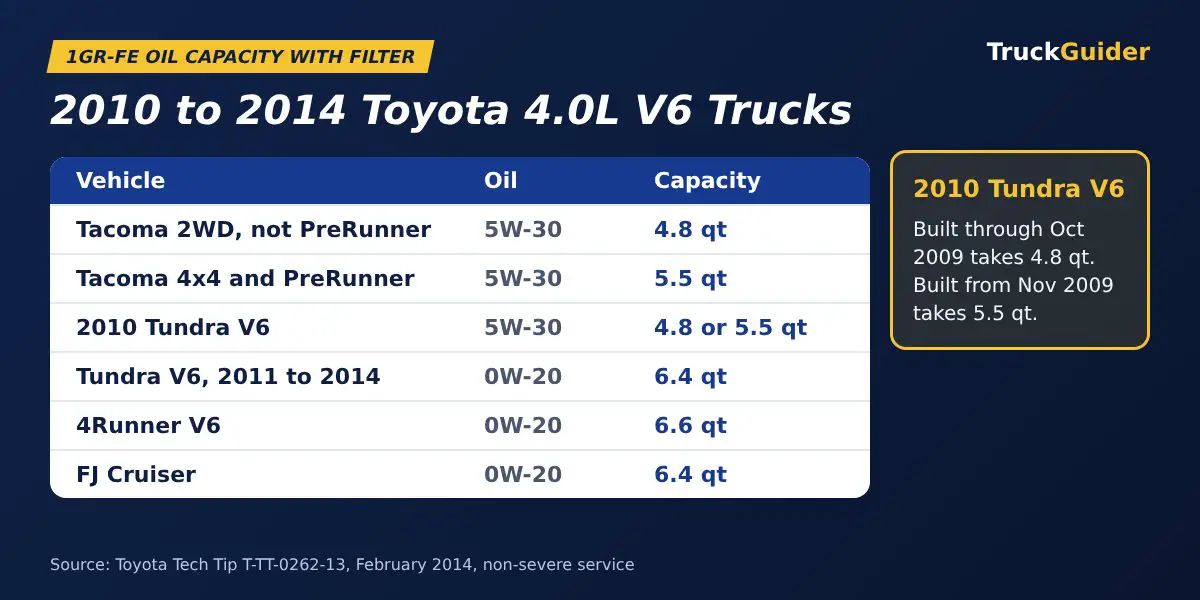
Oil fill is where the versions differ most in the shop. Toyota’s Tech Tip T-TT-0262-13 on oil viscosity and fill quantities lists capacity with a filter change for each 2010 to 2014 model.
| Vehicle and Years | Oil | Capacity With Filter | Change Interval |
|---|---|---|---|
| Tacoma 2WD except PreRunner, 2010 to 2014 | 5W-30 | 4.8 qt | 5,000 miles |
| Tacoma 4×4 and PreRunner, 2010 to 2014 | 5W-30 | 5.5 qt | 5,000 miles |
| Tundra V6 built through Oct 2009, 2010 model year | 5W-30 | 4.8 qt | 5,000 miles |
| Tundra V6 built from Nov 2009, 2010 model year | 5W-30 | 5.5 qt | 5,000 miles |
| Tundra V6, 2011 to 2014 | 0W-20 | 6.4 qt | 10,000 miles |
| 4Runner V6, 2010 to 2014 | 0W-20 | 6.6 qt | 10,000 miles |
| FJ Cruiser, 2010 to 2014 | 0W-20 | 6.4 qt | 10,000 miles |
The pattern lines up with the engine versions. Single VVT-i trucks call for 5W-30 and a 5,000-mile interval, while the Dual VVT-i trucks call for synthetic 0W-20 and a 10,000-mile interval under normal use.
Toyota’s 2010 4Runner Product Information sheet lists 6.0 quarts in its capacity table, which is less than the 6.6 quarts in the service bulletin. The bulletin figure includes a filter change. Our advice is to add the lower amount first, run the engine briefly and top up to the full mark on the dipstick.
Severe service such as frequent towing or dusty roads shortens these intervals. Our guide to the best oil for the Toyota Tacoma covers 5W-30 options for single VVT-i trucks.
Towing and Transmissions Behind the 4.0 V6 in 3 Models
The table pairs the Tacoma, Tundra and 4Runner with the gearboxes and tow ratings Toyota published for the V6.
| Truck | Transmissions With the V6 | Published V6 Towing |
|---|---|---|
| 2015 Tacoma | 6-speed manual or 5-speed automatic | Up to 6,500 lb, Access Cab with V6 Tow Package |
| 2013 Tundra Regular Cab 4×2 | 5-speed automatic | 4,900 lb standard bed, 4,800 lb long bed |
| 2013 Tundra Double Cab 4×2 | 5-speed automatic | 4,500 lb |
| 2010 4Runner | 5-speed automatic | 5,000 lb |
Toyota describes the 2015 Tacoma’s 6,500-pound rating as SAE-certified for Access Cab models with the V6 Tow Package. Other cabs and trucks without the package rate lower, so check the full Toyota Tacoma towing capacity chart by year for your configuration.
The 4.0 V6 Tundra was a light-duty choice. Its 4,500 to 4,900 pound ratings sit far below the V8 trucks, which Toyota rated up to 10,400 pounds in 2012. Our Toyota Tundra towing capacity chart lists the V8 figures by year.
EPA Fuel Economy for 2006 to 2015 4.0 V6 Trucks
The figures below come from the EPA ratings on fueleconomy.gov for each exact year, drivetrain and transmission. The site lists older models under the current EPA test method, so they can differ from the original window sticker.
| Truck | City | Highway | Combined |
|---|---|---|---|
| 2006 Tacoma 4WD, 5-speed automatic | 16 mpg | 20 mpg | 17 mpg |
| 2006 Tacoma 4WD, 6-speed manual | 14 mpg | 18 mpg | 16 mpg |
| 2015 Tacoma 2WD, 5-speed automatic | 17 mpg | 21 mpg | 19 mpg |
| 2015 Tacoma 4WD, 5-speed automatic | 16 mpg | 21 mpg | 18 mpg |
| 2015 Tacoma 4WD, 6-speed manual | 15 mpg | 19 mpg | 17 mpg |
| 2010 Tundra 2WD, 5-speed automatic | 15 mpg | 19 mpg | 16 mpg |
| 2011 Tundra 2WD, 5-speed automatic | 16 mpg | 20 mpg | 18 mpg |
| 2014 Tundra 2WD, 5-speed automatic | 16 mpg | 20 mpg | 17 mpg |
The Tundra rows show the Dual VVT-i benefit. The 2011 truck gained 1 mpg city and highway over the 2010 single VVT-i truck while making 34 more horsepower.
The 2015 Tacoma 2WD manual rates 16 city, 21 highway and 18 combined. In every Tacoma pairing above, the 6-speed manual rates 1 mpg lower combined than the 5-speed automatic.
How to Tell Which 1GR-FE Version You Have in 3 Checks
Toyota uses the 1GR-FE code for both versions, so the engine code alone does not settle it. These three checks do.
Check 1 Match the Model and Year
Any 2005 to 2015 Tacoma V6, 2005 to 2010 Tundra V6, 2009 or earlier 4Runner V6 or 2007 to 2009 FJ Cruiser has the single VVT-i engine. A 2011 to 2014 Tundra V6, a 2010 to 2024 4Runner V6 or a 2010 to 2014 FJ Cruiser has Dual VVT-i.
Check 2 Read the Manual Oil Spec
Look up the oil grade in the owner’s manual, not what the last shop poured in. For 2010 to 2014 trucks, Toyota’s bulletin calls for 5W-30 on single VVT-i Tacoma and 2010 Tundra engines and 0W-20 on the Dual VVT-i trucks. Other years need Check 1 or Check 3.
Check 3 Confirm the Rated Output

The owner’s manual or original window sticker lists horsepower. Ratings of 236 hp, 245 hp on 2005 trucks or 239 hp on an early FJ Cruiser mean single VVT-i. A 270 hp rating, or 258 hp on an FJ Cruiser, means Dual VVT-i.
If the truck has been swapped or the paperwork is missing, a Toyota dealer can decode the VIN. That confirms the factory engine before you buy parts such as cam phasers or sensors.
What Replaced the 1GR-FE in 2015 to 2025 Toyota Trucks
The 4.0-liter V6 left each model at a different time.
- Tundra, 2015: Toyota’s 2015 Tundra release announced an all-V8 lineup with the 4.6-liter i-Force V8 as standard.
- Tacoma, 2016: Toyota’s 2016 Tacoma release introduced a 3.5-liter Atkinson cycle V6 with D-4S injection, rated at 278 hp, 42 hp more than the previous V6, and 265 lb-ft at 4,600 rpm.
- 4Runner, 2025: Toyota’s 2025 4Runner release lists the i-FORCE 2.4-liter turbo four with 278 hp and 317 lb-ft as the standard engine.
The current Tacoma also runs a turbo four, covered in our Toyota Tacoma 2.4L turbo specs. Toyota’s 2027 Tundra announcement lists only a twin-turbo V6 and the i-FORCE MAX hybrid.
For belt routing on these engines, see our 2009 Toyota Tacoma 4.0 serpentine belt diagram.
5 Toyota 1GR-FE Questions Owners Ask
How Much Horsepower Does the 1GR-FE Make
It depends on the version. The single VVT-i engine in the 2006 to 2015 Tacoma makes 236 hp and 266 lb-ft. The Dual VVT-i engine in the 2011 to 2014 Tundra and 2010 to 2024 4Runner makes 270 hp and 278 lb-ft.
What Is the Bore and Stroke of the 1GR-FE
Toyota lists the bore and stroke as 3.70 x 3.74 inches, or about 94 x 95 mm. With 3,956 cc spread over six cylinders, the engine is slightly undersquare. Both the single VVT-i and Dual VVT-i versions share these dimensions.
What Oil Does the 4.0 Tacoma V6 Take
Toyota’s 2014 bulletin lists 5W-30 for 2010 to 2014 Tacoma 4.0 V6 trucks. Capacity with filter is 4.8 quarts for 2WD trucks other than the PreRunner and 5.5 quarts for 4×4 and PreRunner models.
Does the 1GR-FE Need Premium Fuel
Not the Dual VVT-i version. Toyota’s 4Runner Product Information sheets list 87-octane unleaded for it. Toyota’s 2010 FJ Cruiser release describes a switch to recommended regular fuel with that update, so owners of 2007 to 2009 FJ Cruisers should follow their own manual.
Which Tundra Years Have the 4.0 V6
The 4.0 V6 was offered from the 2005 model year through 2014, ending on 4×2 Regular Cab and Double Cab trucks. The 2011 to 2014 trucks have the 270 hp Dual VVT-i version. For 2015, Toyota made the Tundra V8 only.
Putting the 1GR-FE Specs to Work on a 4.0 Toyota
The Toyota 1GR-FE specs come down to one shared 3,956 cc block and two tunes. Start by matching your truck and year to the single VVT-i or Dual VVT-i rating, then use the oil table that fits your model.
If you are buying a used 4.0 Tacoma, pair these numbers with our Toyota Tacoma years to avoid guide before you commit. Check the oil grade on the filler cap, confirm the rated horsepower in the manual and keep receipts for every service.
Beyond the linked pages, this guide draws on Toyota Canada’s 2006 and 2010 Tacoma specifications, Toyota’s 2010 and 2024 4Runner Product Information, the 2013 Tundra brochure and Toyota’s releases for the 2010 FJ Cruiser, 2015 Tacoma, 2015 Tundra, 2016 Tacoma and 2025 4Runner.