Toyota Tacoma Years to Avoid: 2026 Frame Rust, Transmission & Recalls

Some Toyota Tacoma years deserve more caution than others, but the reason matters more than the model-year badge alone. For used-truck buyers, the strongest documented concerns center on frame corrosion in older Tacomas and specific drivetrain issues in early third-generation trucks.
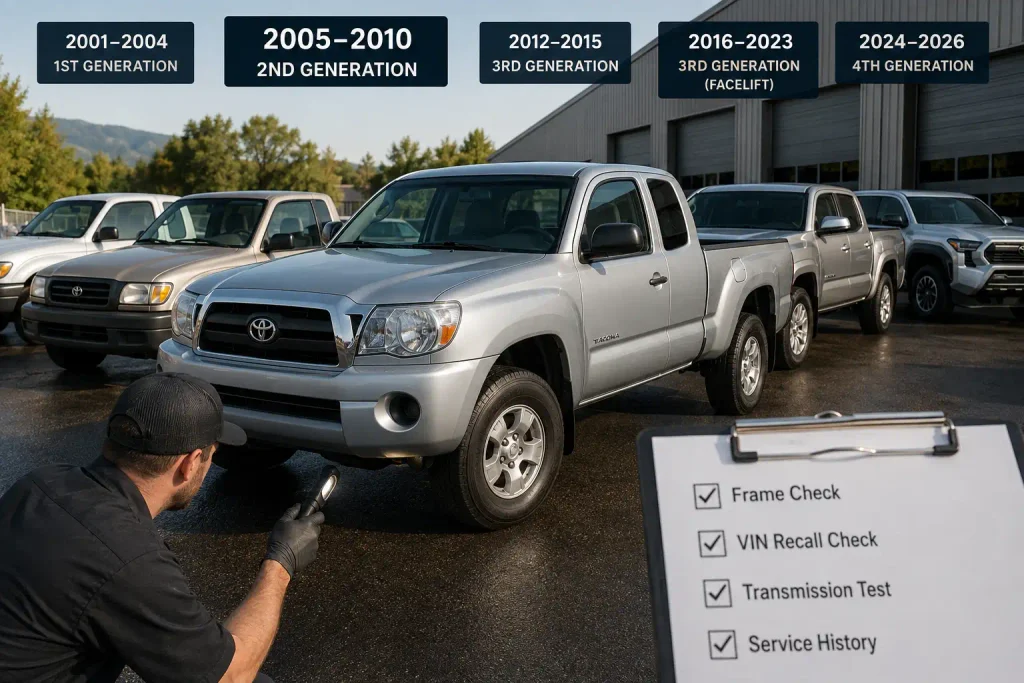
The highest inspection priority belongs to 2001–2010 Tacomas with salt-belt history, especially 2005–2010 models covered by Toyota’s later frame-corrosion program. 2016–2017 Tacomas also deserve extra drivetrain checks because Toyota issued technical bulletins and a rear-differential safety recall affecting certain trucks.

Prime for Young Adults — 6 Months Free
Students and 18–24s get six months of Prime free, then half price.
Start 6 Months FreeThat does not mean every Tacoma from these years is a bad truck. Frame replacement history, maintenance, climate exposure, drivetrain configuration, mileage, and completed recalls can change the buying decision significantly.
Toyota Tacoma Years Risk Matrix
This quick-reference infographic summarizes which Tacoma year ranges need the most caution, what to inspect first, and which groups are generally safer used-truck bets. The biggest pattern is simple: older salt-belt trucks need close frame inspection, while early third-generation trucks need closer drivetrain checks.
2001–2004
First Generation
Inspect Carefully- Main concern: Frame rust in severe salt climates.
- Check first: Frame rails, crossmembers, and body mounts.
- Verdict: Worth considering only after a clean structural inspection.
2005–2010
Second Generation
Highest Caution- Main concern: Toyota frame corrosion program and replacement history.
- Check first: Original vs replaced frame, rust scale, and salt-belt use.
- Verdict: Highest frame inspection priority in the Tacoma lineup.
2011–2012
Second Generation
Condition Matters- Main concern: Age and condition more than one model-wide defect pattern.
- Check first: Standard inspection, service records, and VIN recall lookup.
- Verdict: Do not automatically avoid, inspect like any older used truck.
2013–2015

Audible — Listen Free for 30 Days
One free credit a month and thousands of titles included.
Listen Free for 30 DaysLate Second Generation
Better Bet- Main concern: Normal age-related wear and possible rust exposure.
- Check first: Frame condition, maintenance records, and accident history.
- Verdict: Stronger used-truck alternative if the example is clean.
2016–2017
Early Third Generation
Inspect Drivetrain- Main concern: Shift behavior, driveline vibration on some configurations, and differential recall history.
- Check first: Reverse-to-Drive engagement, low-speed shifts, vibration, and recall completion.
- Verdict: Not a universal avoid group, but needs a careful test drive.
2018–2023
Later Third Generation
Generally Stronger- Main concern: Normal used-truck wear, recall history, and modifications.
- Check first: Service records, VIN recall status, and suspension changes.
- Verdict: One of the better Tacoma shopping windows for most buyers.
2024–2026
Fourth Generation
Too Early To Judge- Main concern: New-generation reliability history is still developing.
- Check first: VIN recall status and current service history.
- Verdict: Too early for a firm long-term reliability verdict.
What 4 Factors Determine Tacoma Used Truck Risk
Recommended Best Deal Products


A simple list of Tacoma years to avoid cannot tell you whether a specific truck is worth buying. Four factors matter more.
Audible Premium Plus — Annual Membership
12 audiobook credits up front, plus the full Audible catalogue.
See Annual PlansModel Year and Generation
Tacoma reliability concerns change across generations.
The second generation arrived for the 2005 model year, while the third generation began with the 2016 Tacoma. Toyota completely redesigned the truck again for 2024, calling it the fourth-generation Tacoma.
That makes 2005, 2016, and 2024 first-year redesigns, but first-year status alone is not enough reason to reject a truck.
Frame and Climate History
Frame condition is critical on older Tacomas.
Toyota reported that certain Tacomas operated in cold climates with heavy road-salt use could develop excessive frame corrosion beyond ordinary surface rust. Toyota addressed this through inspection, corrosion treatment, warranty extensions, and qualifying frame replacement programs.
A Tacoma that spent 15 years in a dry climate can therefore present a very different risk from the same model year used every winter in the Northeast.
Engine and Transmission
Powertrain configuration also changes the risk.
This matters most with early third-generation trucks because several Toyota technical bulletins apply only to specific engines, transmissions, or 4WD configurations.
Do not assume a complaint affecting one 3.5L V6 automatic Tacoma automatically applies to a four-cylinder or manual-transmission truck.
Repair and Recall History
A repaired truck can be a better purchase than an untouched example from a supposedly better year.
Request invoices for frame replacement, differential repair, software calibration, and recall work. Then verify the VIN independently before buying.
NHTSA says its VIN search identifies unrepaired safety recalls associated with a specific truck.
If You Are Considering a 2001 to 2004 Tacoma
The 2001–2004 Toyota Tacoma deserves serious frame inspection, particularly if it lived in a cold-weather state.
Toyota acknowledged reports of excessive frame rust perforation on a small number of 2001–2004 Tacomas operated in areas with severe winters and heavy road-salt use. Toyota extended frame coverage to 15 years with unlimited mileage for this specific condition.
If the Frame Shows Deep Corrosion
Do not judge rust only by the visible exterior body.
Inspect the frame rails, crossmembers, suspension attachment areas, body mounts, and areas where dirt and salt collect. Heavy scaling, perforation, cracking, or questionable structural repairs justify a professional inspection before purchase.
If structural integrity is uncertain, walking away is usually safer than trying to price the risk into the deal.
If the Frame Is Clean
A clean frame changes the decision.
An older Tacoma should still receive a full mechanical inspection, but its model year alone should not disqualify it. Maintenance records and current physical condition become more important once major frame deterioration has been ruled out.
If You Are Considering a 2005 to 2010 Tacoma
The 2005–2010 Tacoma range deserves the strongest frame-corrosion warning in this guide.
Toyota’s Limited Service Campaign H0F covered certain 2005–2010 Tacoma trucks registered in designated cold-climate states. The program included frame inspection and qualifying frame replacement when corrosion met the court-ordered rust perforation standard.
Toyota specifically listed the District of Columbia plus Connecticut, Delaware, Illinois, Indiana, Kentucky, Massachusetts, Maryland, Maine, Michigan, Minnesota, New Hampshire, New Jersey, New York, Ohio, Pennsylvania, Rhode Island, Virginia, Vermont, Wisconsin, and West Virginia in the campaign documentation.
If the Original Frame Is Heavily Rusted
Treat major structural corrosion as a potential deal breaker.
Fresh black undercoating deserves closer inspection because it can make existing corrosion harder to evaluate. Ask when the coating was applied and whether photos of the frame before treatment are available.
A qualified pre-purchase inspection is more valuable here than negotiating a lower price without understanding the structural condition.
If Toyota Replaced the Frame
A documented replacement frame changes the risk substantially.
Verify the Toyota repair invoice or dealer history, then inspect the replacement frame for current corrosion, damage, poor previous repairs, or neglect.
Do not assume “frame replaced” means every chassis-related component is new. Brake lines, suspension parts, body mounts, and other components still need normal used-truck inspection.
If the Truck Came From the Salt Belt
Increase the inspection priority even when the paint and body look excellent.
Toyota’s own documentation tied the corrosion concern to cold-climate operation and high road-salt use. That makes geographic history especially useful when evaluating these model years.
For used buyers, 2005–2010 are not automatic rejects, but they are the Tacoma years where we would insist most strongly on documented frame history and a physical inspection.
If You Are Considering a 2016 or 2017 Tacoma
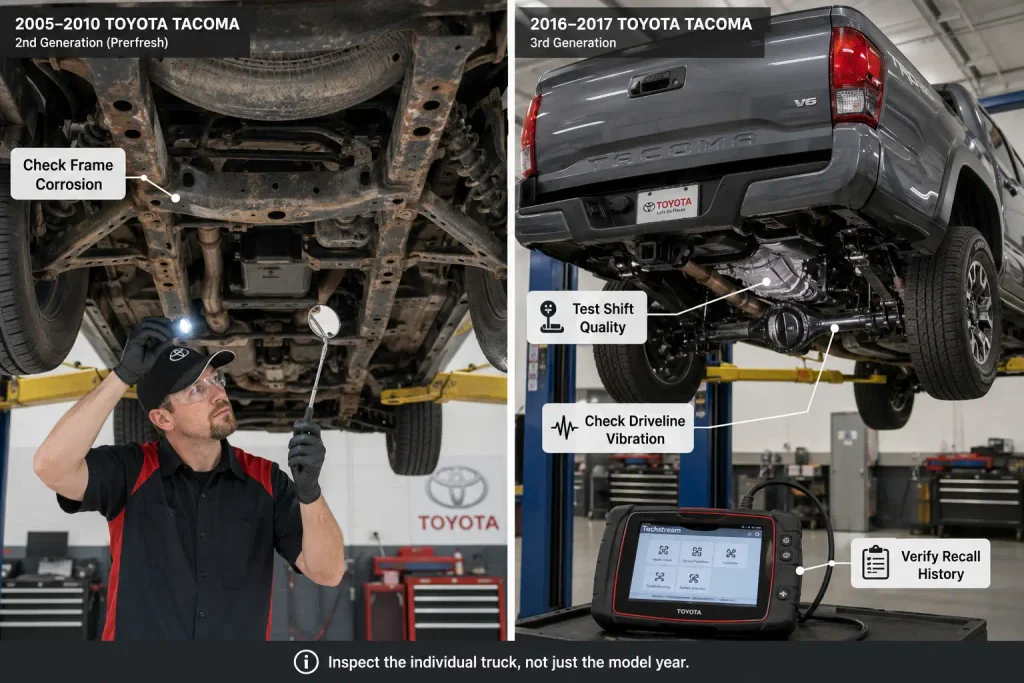
The concern changes with 2016–2017 Tacoma trucks. Here, drivetrain behavior matters more than the older frame-corrosion programs.
Toyota issued technical information addressing specific shift-feel conditions on certain 2016 Tacomas equipped with the 2GR engine.
Toyota TSB T-SB-0077-16 covered conditions including delayed Park-to-Drive engagement, delayed Reverse-to-Drive engagement, a harsh first-to-second upshift, and delayed upshifting while using cruise control. The repair procedure involved updated ECM calibration when the specified condition was present.
If the Automatic Transmission Shifts Normally
Do not reject a clean 2016 or 2017 Tacoma solely because of internet discussions about shifting.
Drive the truck cold and fully warmed up. Test light acceleration, moderate acceleration, stop-and-go traffic, highway cruising, and engagement from Reverse to Drive.
A normal test drive plus documented maintenance gives you better information than the model year alone.
If It Hesitates or Shifts Harshly
Investigate before purchase.
Delayed engagement, harsh shifts, repeated gear changes, warning lights, or unusual vibration deserve diagnosis. Ask whether Toyota calibration updates or other transmission-related repairs were completed.
Do not accept “they all do that” as a substitute for diagnosis.
If It Has Driveline Vibration
Toyota also issued T-SB-0171-16 for driveline vibration during deceleration around 10 to 30 mph on certain 2016–2019 Tacomas.
The bulletin applies specifically to trucks with the 2GR engine, 4WD, and six-speed automatic transmission. Toyota also states that the bulletin does not apply to trucks fitted with aftermarket suspension or body lifts or leveling kits.
This distinction matters when shopping for modified trucks. If you are evaluating one with suspension changes, our best lift kit for Toyota Tacoma guide can help you understand the types of lift hardware commonly fitted to these trucks, but modification-related vibration still needs proper diagnosis.
If the Rear Differential Is Leaking
Check whether the truck was included in NHTSA Recall 17V-285.
Toyota recalled certain 2016–2017 Tacomas because oil could leak from the rear differential. Continued operation could damage the differential, reduce propulsion, and in some cases allow the differential to seize.
Toyota instructed dealers to inspect the differential, retighten fasteners when no leak was present, and replace affected components when required.
For these reasons, we classify 2016–2017 as inspect-carefully years rather than universal avoid years.
Which Tacoma Years Are Better Used Truck Alternatives
If you want an older Tacoma without concentrating your search on the highest-risk periods, 2013–2015 is a logical late-second-generation shopping window.
These trucks came after the early second-generation frame campaign years. They still require rust inspection because age and climate exposure matter, but they avoid the 2005–2010 range covered by Toyota’s later H0F frame program.
For third-generation buyers, 2018–2023 gives you later production years after the 2016 launch.
That does not mean every 2018–2023 Tacoma is automatically more reliable. You still need VIN recall verification, maintenance history, accident history, and a test drive.
If you plan to tow after purchase, verify what equipment the truck actually has rather than trusting badges or a seller description. Our guide on how to tell if a Tacoma has the tow package explains the equipment checks in more detail.
Should You Avoid the 2024 to 2026 Tacoma
It is too early to call 2024–2026 Tacomas the best or worst long-term reliability years.
Toyota completely redesigned the Tacoma for 2024 using the TNGA-F platform, new turbocharged powertrains, new suspension configurations, and major electronics changes.
Some safety recalls have already appeared.
A 2025 NHTSA recall report covered certain 2024–2025 Tacoma trucks with specific wheel and brake configurations because operating conditions could contribute to brake hose damage and brake-fluid loss. The report listed 106,061 potentially involved trucks.
Toyota also announced an August 6, 2026 recall involving approximately 48,000 model-year 2024–2025 Tacoma TRD Off-Road trucks. Toyota said corrosion could cause an external shock-reservoir component to detach, potentially creating a road hazard.
Those recalls matter, but they do not establish long-term reliability for an entire generation. A recall is also different from an unresolved chronic reliability pattern because recalls normally provide a defined manufacturer remedy.
For now, classify 2024–2026 as too new for a firm long-term verdict and check every VIN individually.
How to Inspect a Used Tacoma in 7 Checks
A clean inspection can matter more than a generic model-year ranking.
- Check the VIN for open recalls. NHTSA recommends searching the 17-character VIN or license plate to identify unrepaired safety recalls.
- Inspect the complete frame. Pay extra attention to older trucks with snow-belt history.
- Verify frame repair history. Ask for Toyota dealer documentation if the seller says the frame was replaced or treated.
- Start the engine cold. A seller who pre-warms the truck can make some noises or starting issues harder to detect.
- Test the transmission thoroughly. Check Reverse-to-Drive engagement, low-speed shifts, highway behavior, and deceleration.
- Inspect modifications. Suspension lifts, leveling kits, oversized tires, and drivetrain changes can affect handling, wear, and diagnosis.
- Review maintenance invoices. Service records provide stronger evidence than claims such as “dealer maintained” without documentation.
If the seller refuses an independent inspection on an older or modified Tacoma, consider that part of the purchase risk.
Quick Tacoma Years to Avoid Buying Matrix
| Tacoma Years | Main Concern | Our Used Buying Verdict |
|---|---|---|
| 2001–2004 | Documented frame rust perforation concern in severe salt climates | Inspect frame very carefully |
| 2005–2010 | Toyota frame corrosion program and qualifying frame replacement | Highest frame inspection priority |
| 2011–2012 | Age-related condition matters more than a clear model-wide defect pattern | Inspect normally, do not automatically avoid |
| 2013–2015 | Late second generation, but rust still possible | Strong alternative if condition is clean |
| 2016–2017 | Shift behavior, driveline vibration on specific configurations, differential recall | Inspect drivetrain carefully |
| 2018–2023 | Later third-generation years | Generally stronger shopping window, condition still decides |
| 2024–2026 | New fourth generation with developing recall and reliability history | Too early for long-term verdict |
The key distinction is risk type. Frame perforation on an older salt-belt truck should carry more weight than a software calibration bulletin on an otherwise clean newer Tacoma.
Model year tells you where to look. The individual truck tells you whether to buy.
When a Tacoma Needs Professional Inspection
Get a professional pre-purchase inspection if you see serious frame corrosion, unclear structural repair, differential leakage, abnormal transmission behavior, or driveline vibration.
The same applies to heavily modified trucks. Lift kits, suspension changes, oversized tires, and off-road use can introduce wear patterns that have little to do with the Tacoma’s original model-year reliability.
Warning lights, salvage history, collision repair, fluid leaks, or a seller who cannot explain major work also justify deeper inspection.
For a rust-prone Tacoma, structural condition should be confirmed before you spend money upgrading accessories or performance parts.
Which Tacoma Years Should You Actually Avoid
For most used buyers researching Tacoma years to avoid, we would put the strongest caution on 2005–2010 trucks with unknown or poor frame history. Toyota’s own documentation gives this concern stronger support than generic internet reliability rankings.
We would also inspect 2001–2004 salt-belt trucks closely because Toyota previously extended frame coverage for excessive rust perforation.
Treat 2016–2017 differently. These are not automatic walk-away years, but the automatic transmission, driveline behavior, rear differential, maintenance history, and completed recall work deserve careful checking.
For alternatives, clean 2013–2015 and later 2018–2023 trucks are sensible places to shop. For 2024–2026, there simply is not enough long-term field history yet to crown them the best or worst Tacoma years.
Tacoma Years to Avoid FAQ
What Is the Worst Year Toyota Tacoma to Buy
There is no single Tacoma year that every buyer should automatically reject. The 2005–2010 range deserves the strongest frame-corrosion scrutiny, especially for trucks operated in states with heavy winter road-salt use.
Are 2005 to 2010 Toyota Tacomas Bad Trucks
No. Many remain usable trucks, but Toyota documented frame-corrosion concerns and created an inspection and remedy program for certain 2005–2010 Tacomas.
A truck with a documented replacement frame and clean current inspection can be a very different purchase from one with an untreated corroded original frame.
Does the 2016 Toyota Tacoma Have Transmission Problems
Some 2016 Tacomas had specific shift-feel conditions addressed through Toyota technical documentation. These included delayed engagement, harsh first-to-second upshifts, and delayed upshifting under specified conditions.
A normal test drive and maintenance history are therefore important before rejecting the truck solely because of its year.
Is a Tacoma With a Replaced Frame Worth Buying
It can be. A properly documented Toyota frame replacement removes one of the biggest concerns associated with certain older Tacomas, but it does not guarantee the rest of the truck is problem-free.
Inspect the replacement frame, suspension, brake lines, body mounts, drivetrain, and general condition before purchase.
What Are the Best Used Toyota Tacoma Years
For buyers who want to avoid the strongest documented risk periods, 2013–2015 and 2018–2023 are practical shopping windows.
These are not guaranteed problem-free years. Individual condition, maintenance, climate history, mileage, modifications, accidents, and VIN-specific recalls remain more important than a generic reliability score.
Should I Avoid a 2024 Toyota Tacoma
Not solely because it is the first year of the fourth generation. The 2024 Tacoma has already been included in safety recalls, but its long-term reliability history is still developing.
Check the VIN and evaluate the individual truck instead of treating early recall activity as proof that the entire model year is unreliable.
How Do I Check Toyota Tacoma Recalls Before Buying
Use NHTSA’s VIN recall lookup before purchasing a used Tacoma. A VIN search can show whether a specific truck has an unrepaired safety recall.
You can also ask a Toyota dealer to review the VIN for Toyota campaign and dealer-service history available through its systems.