
2016 Ram 2500 Turbo Actuator: Guide to Costs: Complete Guide [2026]

The 2016 Ram 2500 6.7L Cummins turbo actuator is a high-failure component often identified by P00AF or P003A fault codes and a non-functional exhaust brake. Replacing this unit requires choosing between OEM Holset or upgraded aftermarket options and necessitates an electronic calibration using a bidirectional scan tool.
🎯 Key Takeaways
Recommended Best Deal Products


- Common failure codes include P00AF, P003A, and P04DB with limp mode.
- Electronic calibration is mandatory using tools like AlphaOBD or Autel.
- OEM Holset actuators are the gold standard for long-term reliability.
- Aftermarket units often feature upgraded electronics to prevent future heat failure.
- Always check if VGT vanes move freely before installing a new actuator.
If your 2016 Ram 2500 is displaying the “Service Electronic Throttle Control” message or has suddenly lost its exhaust brake functionality, the variable geometry turbo (VGT) actuator has likely failed. This component is the “brain” that moves the internal vanes of your Holset HE351VE turbocharger. When it dies, your 6.7L Cummins will likely enter limp mode, severely restricting power to protect the engine. Replacing this unit involves more than just turning a few bolts; you must choose between three distinct price tiers and prepare for a mandatory software calibration step.
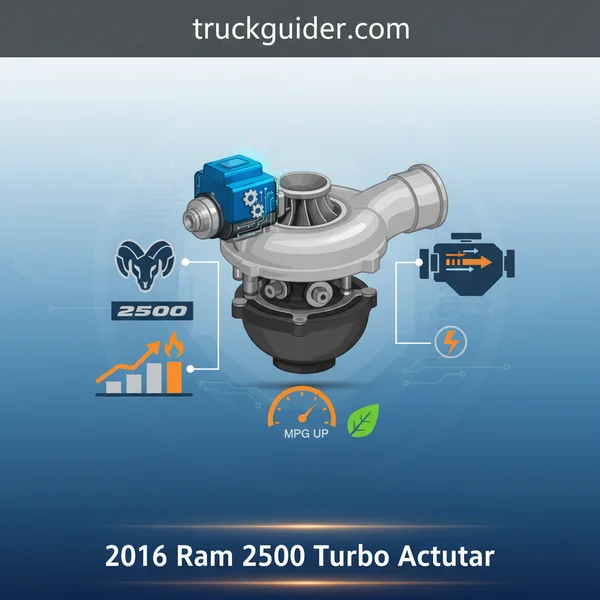
Practicality is key when your work truck is down. You are looking at a part cost ranging from $600 to $1,200, plus a core charge that can temporarily sit on your credit card for another $300 to $500. Because the actuator must be “clocked” and synced to the turbo’s internal sector gear using a scan tool, you cannot simply swap it in your driveway without the right electronics. This guide breaks down the specific diagnostic codes you’ll see and the financial reality of the different replacement units available on the market today.
Identifying Symptoms and Diagnostic Codes of Actuator Failure
Before you drop nearly a grand on a new part, you need to confirm the actuator is truly the issue and not a mechanical seizure of the turbo vanes. On the 2016 model year, the Cummins engine controller is very specific about what is failing. You will need an OBD-II scanner to pull the codes, as the dash lights alone won’t tell the full story.

Common Trouble Codes
- P00AF: This is the most common code, indicating “Turbocharger/Supercharger Boost Control A Module Performance.” It means the electronics are trying to move the gear, but it isn’t reaching the desired position.
- P003A: This code signifies that the “Turbocharger Boost Control Position is Not Learned.” You will often see this after a failed calibration attempt or if the internal memory of the actuator has wiped.
- U010C: This is a “Lost Communication” code. If you see this, the actuator’s circuit board has likely fried due to heat or moisture, and the truck’s computer can no longer “see” the device on the data bus.
The “Dead” Exhaust Brake Test
A failing actuator on a 2016 Ram 2500 manifests physically through the exhaust brake. If you press the button and feel no deceleration when lifting off the throttle, the actuator is stuck. Usually, it sticks in a “wide open” position, meaning you’ll have terrible low-end boost and sluggish acceleration from a stop. If it sticks “closed,” you might experience high boost pressures and a distinct whistling sound even at idle.
Master 2016 Ram 2500 Turbo Actuator Replacement in 8 Simple Steps
Recommended Best Deal Products


The Variable Geometry Turbocharger (VGT) actuator is a critical component of your 2016 Ram 2500’s 6.7L Cummins engine. It controls the exhaust flow to manage boost levels and the exhaust brake function. When this part fails, you will likely encounter the dreaded P003A or P00AF trouble codes, a loss of power, and a non-functional exhaust brake. This guide covers the end-to-end process of replacing and calibrating a new actuator. Properly following these steps is vital because an uncalibrated actuator can lead to immediate mechanical failure of the turbocharger components. By performing this repair yourself, you can save upwards of $1,500 in dealership labor and marked-up part costs.
Step 1: Preparation and Safety Protocols
What you need: Safety glasses, mechanic gloves, 10mm wrench, and a fender cover.
Instructions: Before touching any mechanical components, ensure the engine is completely cool. The turbocharger sits on the passenger side of the engine bay and retains extreme heat for hours after operation. Start by disconnecting both negative battery cables using a 10mm wrench. Since you will be working near the starter lead and various sensors, removing power prevents accidental shorts or ECU spikes. Place a fender cover over the passenger side to protect your truck’s paint. Clear the area of any loose debris or dirt near the intake, as you do not want anything falling into the turbo compressor wheel once the intake tubes are removed.
Pro Tip: Use a small piece of tape to label your battery cables if you are worried about them touching the terminals again. It is also helpful to take a “before” photo of the wiring harness routing for reference during reassembly.
Step 2: Accessing the Turbocharger Area
What you need: Flathead screwdriver, 8mm and 10mm sockets, and an extension.
Instructions: To reach the actuator, you must remove the air intake system. Use a flathead screwdriver or an 8mm socket to loosen the hose clamps on the large plastic intake tube connecting the airbox to the turbo inlet. Disconnect the Mass Air Flow (MAF) sensor and the Intake Air Temperature (IAT) sensor connectors. Carefully pull the intake tube out of the engine bay. For better visibility and reach, some technicians prefer to remove the passenger side inner wheel well liner (held by several 8mm bolts), though this is optional. Having this open space allows you to see the mounting bolts on the bottom of the actuator that are otherwise invisible from the top down.
Pro Tip: While the intake tube is off, inspect the turbo compressor wheel for any nicks, cracks, or side-to-side play. If the wheel is damaged, a new actuator will not fix your performance issues.
Step 3: Draining the Coolant and Disconnecting Lines
What you need: Clean drain pan, pliers, and 5mm Allen/hex bit.
Instructions: The 2016 Ram 2500 VGT actuator is liquid-cooled to prevent the electronics from melting due to exhaust heat. Locate the two coolant lines running into the actuator. Before removing them, place a drain pan under the truck and open the radiator petcock to drain about one gallon of coolant, or use pinch-off pliers on the lines to minimize mess. Carefully slide the spring clamps back and pull the hoses off the actuator ports. Be prepared for a small amount of residual coolant to spill. Plug the hoses with a bolt or specialized plugs to prevent contamination from entering the cooling system while you work.
Pro Tip: If your coolant is more than two years old or looks cloudy, this is the perfect time to perform a full cooling system flush and refill with OAT (Organic Additive Technology) coolant specifically formulated for the Cummins 6.7L.
Step 4: Removing the Failed Actuator
What you need: 5mm hex bit (preferably a long socket-mounted version) and a ratcheting wrench.
Instructions: The actuator is held in place by four 5mm hex-head bolts. These bolts are notorious for being tight and located in awkward positions. Use a high-quality hex bit to ensure you do not strip the heads. Loosen the bolts in a cross-pattern. As you pull the last bolt, support the actuator with your hand so it doesn’t fall. Carefully pull the actuator away from the turbo housing. You will notice a gear on the actuator that meshes with a “sector gear” (a sliding rack) on the turbo itself. Unplug the electrical harness by sliding the red locking tab back and pressing the release lever.
Pro Tip: If the bolts are stuck, apply a generous amount of penetrating oil and let it sit for 30 minutes. Breaking a bolt off in the turbo housing will turn a 2-hour job into a 2-day job.
Step 5: Testing the Turbo Sector Gear Manual Movement
What you need: Your fingers or a small pair of pliers.
Instructions: This is the most critical diagnostic step. With the actuator removed, locate the metal slide rack (sector gear) on the turbo housing. Move it back and forth manually. It should move approximately 1/2 to 3/4 of an inch with absolutely zero resistance. It should feel “buttery” smooth. If the rack is stuck, or if it feels gritty and requires force to move, your turbocharger is filled with soot or the internal nozzle ring is warped. If the rack doesn’t move freely, installing a new actuator is a waste of money, as the internal mechanical resistance will burn out the new motor immediately.
Pro Tip: If the rack is slightly sticky, you can try using a specialized VGT cleaning kit, but in most cases, a stuck rack indicates it is time for a new or rebuilt turbocharger.
Step 6: Pre-Installation Alignment and Mounting
What you need: New actuator and an OBD-II scan tool (AlphaOBD, AutoEnginuity, or Snap-On).
Instructions: New actuators usually come in a “shipping” or “center” position. You must use a scan tool to put the actuator into the “Install Position.” Plug the electrical harness into the new actuator while it is still loose. Turn the truck’s ignition to the “ON” position (do not start). Use your scan tool to command the actuator to the install position. Once the gear stops moving, align the turbo’s sector gear to the corresponding physical mark (usually all the way toward the rear of the truck or centered, depending on the specific actuator instructions). Slide the actuator onto the turbo, ensuring the gears mesh perfectly without force. Reinstall the four 5mm hex bolts and tighten them to 8 foot-pounds.
Pro Tip: Never “force” the actuator onto the turbo. If it doesn’t sit flush against the housing, the gears are not aligned. Forcing it will damage the sensitive internal electronics or the plastic gear teeth.
Step 7: Electronic Calibration Procedure
What you need: OBD-II scan tool.
Instructions: Physical installation is not enough; the engine control module (ECM) must learn the sweep limits of the new part. With the actuator bolted down and plugged in, go to the “VGT Calibration” or “Actuator Self-Test” section of your scan tool. Initiate the calibration. You will hear the actuator motor humming as it moves the sector gear to the full “open” and full “closed” stops. This allows the ECM to map the voltage readings to the physical positions of the turbo vanes. The scan tool should return a “Calibration Successful” message. If it fails, check that the sector gear is moving freely and that the actuator was installed in the correct starting position.
Pro Tip: If you do not own a high-end scan tool, many mobile mechanics can perform this specific step for a small fee, or you can use the AlphaOBD app with a compatible Bluetooth OBD adapter for a budget-friendly DIY solution.
Step 8: Final Reassembly and System Check
What you need: Coolant, intake components, and a 10mm wrench.
Instructions: Reconnect the coolant lines to the actuator and secure the clamps. Reinstall the air intake tube, ensuring the MAF and IAT sensors are plugged back in and the hose clamps are tight to prevent boost leaks. Refill the cooling system with the saved or new OAT coolant. Reconnect the negative battery cables. Start the engine and check for any coolant leaks around the actuator. Use your scan tool to clear any old P003A or P00AF codes. Let the truck idle until it reaches operating temperature, then perform a test drive. Engage the exhaust brake to ensure it is modulating correctly and that the turbo is providing consistent boost under load.
Pro Tip: After the first heat cycle (heating up and cooling down), re-check the coolant level in the reservoir and double-check the tightness of the actuator mounting bolts, as thermal expansion can sometimes loosen them slightly.
✅ Final Checklist
- Verify the turbo sector gear moves freely without any binding or “dead spots.”
- Confirm the actuator was electronically calibrated and showing a “Success” status on the scan tool.
- Ensure the coolant lines are securely clamped and there are no visible leaks at the actuator ports.
- Check that all intake hose clamps are tight to prevent “MAF sensor” or “Boost Limit” codes.
- Confirm the exhaust brake engages and provides significant deceleration during the test drive.
Important Notes:
- Safety: Always wear eye protection when working with coolant and pressurized systems.
- Professional Help: Seek a professional if the turbo sector gear is seized; this requires turbo removal and cleaning or replacement.
- Time and Cost: This project typically takes 2-4 hours. A high-quality remanufactured actuator costs $600-$900, while a new OEM Holset unit can cost $1,100-$1,400.
Comparison of OEM Holset vs. Remanufactured and Aftermarket Units
When buying a replacement for your 6.7L Cummins, the “cheapest” option is rarely the best. You have three main paths: buying a brand new Genuine Holset unit, an upgraded aftermarket unit like the City Diesel version, or a budget remanufactured unit from a generic parts store. Your choice here dictates how long the repair will last and whether you’ll be doing this job again in twelve months.
Genuine Holset (OEM) Units
Buying the same unit that came on your truck from the factory is the safest bet for fitment. These typically retail between $850 and $1,100. The benefit is that these are the “latest revision” parts, often featuring slightly better moisture sealing than the original 2016 factory install. However, they still utilize the same internal gear design that is prone to wear over time. Most OEM units require a core charge, meaning you must ship your broken unit back to the vendor to get a $300-$500 refund.
City Diesel and Upgraded Aftermarket Options
Many 2016 Ram owners have moved away from OEM units in favor of the City Diesel actuator. These units are priced around $700 to $850 and are highly regarded because they do not require a core charge. More importantly, they are engineered to be “plug and play” with beefier internal electronics that handle engine bay heat better than the stock Holset boards. This is often the most cost-effective route for owners who want to avoid the hassle of shipping a heavy core back and want a more durable electronic configuration.
Budget Remanufactured Units
You may find remanufactured actuators on sites like eBay or at local chain parts stores for $500 to $650. Use caution here. These are often just used units with new gaskets and a coat of paint. If the internal brushless motor or the circuit board wasn’t properly stress-tested, these units frequently fail during the calibration process. Given the labor involved in draining coolant and reaching the mounting bolts, saving $200 on a questionable part is a high-risk gamble for your 2500.
Understanding the Core Charge
Unless you buy specific aftermarket brands like City Diesel, you will face a core charge. This is a deposit to ensure the manufacturer gets your old actuator back so they can rebuild it. Do not throw your old actuator away! Even a “dead” actuator has value. If you fail to return it within the 30-day window, your total repair cost could jump by nearly 50%.
- Average OEM Cost: $950 + $400 core.
- Average Upgraded Aftermarket: $750 (No core).
- Average Budget Reman: $550 + $300 core.
Requirements for Electronic Calibration and Necessary Scan Tools
Recommended Best Deal Products


Installing a new actuator on your 2016 Ram 2500 isn’t a simple “plug and play” affair. Because the turbocharger uses variable geometry vanes, the electronic actuator must “learn” its physical limits. Think of calibration as a digital handshake between the engine control module (ECM) and the new hardware. Without this process, the ECM won’t know the exact position of the internal vanes, leading to poor boost control, limp mode, and persistent error codes.
Why Calibration Isn’t Optional
Precision is everything for your Cummins engine. The calibration process ensures that the actuator arm moves the vanes through their full range of motion—from fully closed to fully open—without overextending. If you skip this, you risk mechanical damage to the turbo or, at the very least, a truck that refuses to build boost correctly. Most modern actuators come pre-aligned in a “neutral” position, but they still require a digital command to sync with your specific turbo housing.
Compatible Scan Tools for the Job
To perform the calibration, you need a scan tool with bi-directional communication capabilities. A standard code reader from the local auto parts store won’t cut it. Here are the most common tools used by DIYers and professionals:
- AlphaOBD: A favorite among Ram owners for its affordability and deep integration with Chrysler electronics.
- Autel MaxiSYS: A professional-grade tablet that handles the “VGT Actuator Calibration” function with ease.
- Snap-on Solus/Modis: Standard equipment in most independent shops for performing forced calibrations.
- Edge Insight CTS3: While primarily a monitor, certain versions offer specific maintenance features including VGT resets.
Cost Analysis: Purchase Price, Core Charges, and Labor Estimates
Replacing the turbo actuator on a 2016 Ram 2500 is a significant investment, but it is considerably cheaper than replacing the entire turbocharger. Prices can vary wildly depending on whether you choose a brand-new Holset OEM unit, a remanufactured part, or an aftermarket alternative. Understanding the total “out-the-door” cost helps prevent sticker shock when the bill arrives.
Component Pricing and the Core Charge
A new OEM Holset actuator typically retails between $700 and $1,100. You might find remanufactured units for $500 to $700. When buying, pay close attention to the Core Charge. Most suppliers require you to send your old, broken actuator back to them. This charge is often an additional $200 to $400 held upfront and refunded once your old part is received and inspected.
Shop Labor and Time Estimates
If you aren’t doing the work yourself, you’ll need to budget for professional labor. A standard actuator replacement usually takes a technician 2 to 4 hours, depending on how much rust and corrosion they encounter on the mounting bolts. At an average shop rate of $120–$180 per hour, expect labor costs to range from $250 to $700. This usually includes the mandatory electronic calibration and a short test drive to verify boost levels.
- Total DIY Estimate: $700 – $1,100 (Part only + tool cost).
- Total Shop Estimate: $1,200 – $1,800 (Part, labor, and calibration).
- Pro Tip: Always verify if the replacement part includes a new mounting gasket and hardware; some cheaper kits leave these out.
Conclusion
Navigating a failing turbo actuator in your 2016 Ram 2500 can be a headache, but understanding the calibration requirements and the associated costs puts you back in the driver’s seat. Remember that the calibration process is vital for the longevity of your Cummins engine and cannot be skipped. Whether you choose to tackle the job in your driveway with a tool like AlphaOBD or hand the keys to a trusted diesel mechanic, addressing the issue early prevents more expensive turbocharger damage down the road.
Your next step is to pull your diagnostic codes to confirm the actuator is indeed the culprit. Once confirmed, source a high-quality replacement with a solid warranty. Don’t let a faulty sensor keep your truck off the road—get that VGT system calibrated and get your towing power back!
💬 Quick Questions & Answers
What are the common signs of a bad turbo actuator?
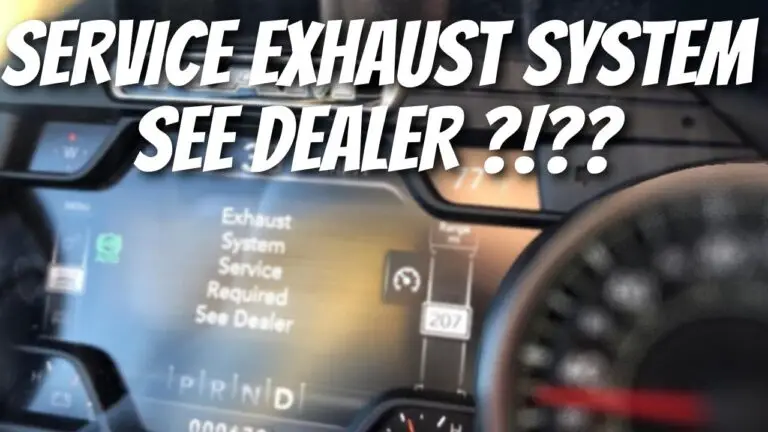
Symptoms include the ‘Service Exhaust Brake’ message, loss of power (limp mode), and specific CEL codes like P00AF.
Do I need a scan tool to replace the actuator?
Yes, a bidirectional scan tool like AlphaOBD or Autel is required to perform the ‘VGT Actuator Calibration’ procedure.
How much does a 2016 Ram 2500 turbo actuator cost?
Prices typically range from $600 for remanufactured units to over $1,200 for a new OEM Holset unit.
Can I drive with a failed turbo actuator?
You can drive short distances, but the truck will likely be in limp mode with significantly reduced boost and power.
What is a core charge for this part?
Most sellers charge an upfront fee of $100-$300 which is refunded once you return your old, rebuildable actuator.
❓ Frequently Asked Questions
Why do 2016 Ram 2500 turbo actuators fail so frequently?
The electronic actuator is mounted directly to the turbo, exposing it to extreme heat cycles and soot buildup. Over time, this causes the internal circuit board to fail or the mechanical gears to strip while fighting stuck VGT vanes.
Can I use AlphaOBD to calibrate the new actuator?
Yes, AlphaOBD is one of the most popular and cost-effective tools for Ram owners to perform the VGT calibration. It requires a compatible OBDII interface and the ‘Actuator Calibration’ command within the Engine Module.
What is the difference between an OEM Holset and an ‘upgraded’ aftermarket actuator?
OEM Holset actuators are the original factory specs, while some aftermarket brands like City Diesel claim to use improved internal components and better soldering to resist the heat-related failures common in original units.
How do I know if the problem is the actuator or the turbo itself?
Once the actuator is removed, you must manually move the VGT rack pin. If it moves smoothly without binding, the problem is likely the actuator; if it is stuck, the entire turbo needs cleaning or replacement.
Will a new actuator fix my ‘Limp Mode’ issue?
If your diagnostic codes are P00AF or P003A, a new actuator and proper calibration will usually resolve the limp mode and restore turbocharger functionality.
What tools are needed for the calibration process?
You need a bidirectional scan tool capable of communicating with the Cummins ECM. Common options include the Autel Maxisys, Snap-on Zeus, or the mobile-based AlphaOBD software.

![Aisin vs. 68RFE: Specs & Fitment Guide [2026]](https://truckguider.com/wp-content/uploads/2026/03/aisin-transmission-ram-3500-featured.webp)