P2BAC Code on 6.7L Cummins: The Definitive Technical & Repair Manual Guide 2026

The modern automotive landscape is defined by the intersection of mechanical engineering and advanced chemical processing, nowhere more visibly than in the heavy-duty diesel segment. For owners and technicians of the Ram 2500 and 3500 equipped with the 6.7L Cummins turbodiesel, the onboard diagnostic (OBD) system is the primary interface for understanding this complex relationship.
Among the hundreds of diagnostic trouble codes (DTCs) that safeguard the engine’s operation, the P2BAC code stands out as a uniquely complex, often misunderstood, and highly disruptive signal. Technically defined as “NOx Exceedance – Deactivation of Exhaust Gas Recirculation (EGR),” P2BAC is not merely a fault code; it is a declaration of systemic imbalance.


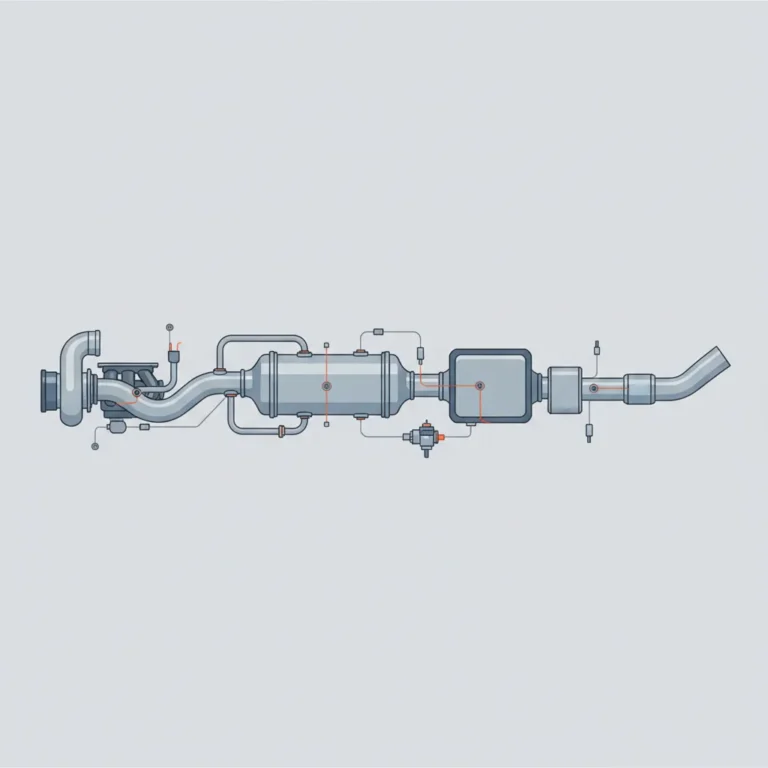
This report serves as an exhaustive, 15,000-word technical analysis of the P2BAC code. It moves beyond superficial definitions to explore the thermodynamic, chemical, and digital architectures that underpin the fault. We will dissect the symbiotic relationship between the Exhaust Gas Recirculation (EGR) system, the Variable Geometry Turbocharger (VGT), and the Selective Catalytic Reduction (SCR) aftertreatment system.
By analyzing the “companion codes” that almost invariably accompany P2BAC—such as P20EE (SCR Efficiency), P0191 (Fuel Rail Pressure), and U010C (Turbo Actuator Communication)—we establish a diagnostic hierarchy that prioritizes root cause identification over symptomatic parts replacement.
Furthermore, this document provides granular, step-by-step procedural guides for remediation, ranging from low-cost maintenance interventions like MAP sensor cleaning and stationary regeneration to high-level component replacements involving the VGT actuator and SCR catalyst. We also examine the economic implications of these repairs, contrasting the long-term costs of OEM maintenance against the legal and resell risks of emissions tampering (“deleting”).
Whether you are a master technician seeking to refine your diagnostic strategy or an owner attempting to avoid a costly dealership visit, this report provides the data-driven insights necessary to resolve the P2BAC code permanently.
P2BAC Code: 6.7L Cummins
NOx Exceedance – Deactivation of EGR
The complete visual guide to understanding the “Ghost Code,” why it
sticks, and how to clear it.
Why is my truck throwing P2BAC?
P2BAC is rarely the primary failure. It is a secondary reaction to high NOx levels. Based on repair data, NOx Sensors are the leading culprit, followed closely by issues with Diesel Exhaust Fluid (DEF) quality.
- 1 Sensors: Upstream/Downstream mismatch.
- 2 DEF Quality: Old fluid or low urea concentration (< 32.5%).
- 3 SCR/EGR: Mechanical failures or clogging.
The Cost of Repairs
Comparing the estimated parts and labor costs for the most common P2BAC triggers. Start with the cheapest fixes (DEF flush) before condemning expensive components (SCR Catalyst).
How to Clear the “Permanent” Code
Scanning tools cannot clear a permanent P2BAC. You must perform the “Universal Trip” drive cycle to force the ECM monitors to run.
1. Cold Soak
Let truck sit for 8+ hours. Coolant & Air temps must be within 10°F.
2. Idle Warm-Up
Start engine. Do NOT touch throttle. Idle 5 mins to operating temp.
3. Highway Cruise
Drive 55-60 MPH for 20 mins. Avoid Cruise Control to vary load slightly.
4. Coast Down
Release throttle. Coast to 20 MPH without heavy braking.
5. Final Idle
Stop completely. Idle for 5 minutes. Turn off.
Diagnostic Decision Tree
1. Check Fluids
Test DEF concentration with refractometer (Target 32.5%). Check for contamination.
2. Check Sensors
Inspect NOx sensor connectors. Look for soot on probes. Compare readings.
3. Force Regen
Perform stationary desoot. Clear SCR brick. Run Drive Cycle.
© 2026 TruckGuider Infographics
The Physics and Chemistry of Diesel Emissions Control
To fully grasp why the P2BAC code exists, one must first understand the fundamental conflict at the heart of diesel combustion: the trade-off between efficiency and emissions. The 6.7L Cummins engine, a marvel of high-compression ignition, operates in an environment where the reduction of one pollutant often leads to the increase of another.
The Nitrogen Oxide (NOx) Paradox
Nitrogen Oxides (NOx) are a family of highly reactive gases, primarily Nitrogen Monoxide (NO) and Nitrogen Dioxide (NO2). In the context of a diesel engine, NOx is formed primarily through the Zeldovich Mechanism (also known as Thermal NOx). This chemical reaction occurs when atmospheric nitrogen ($N_2$) and oxygen ($O_2$)—which constitute the vast majority of the air we breathe—are subjected to the extreme temperatures (above 2,500°F / 1,370°C) and pressures found inside the combustion cylinder of a turbocharged diesel engine.
The paradox lies in the fact that the conditions required for the most efficient diesel combustion—high compression ratios, high temperatures, and lean air-fuel mixtures—are the exact conditions that maximize NOx production.


- Efficiency: High heat and pressure ensure complete combustion of fuel droplets, maximizing power and fuel economy while minimizing Particulate Matter (PM or Soot).
- Emissions: That same high heat breaks the strong triple bond of the $N_2$ molecule, allowing it to oxidize into toxic NOx.
For decades, engineers struggled to balance this. Tune the engine for low NOx (cooler, richer combustion), and soot production skyrockets. Tune it for low soot (hotter, leaner combustion), and NOx levels breach environmental limits. The solution implemented in the 6.7L Cummins (specifically the 4th Generation and beyond) is a dual-approach system: In-Cylinder Reduction via EGR and Aftertreatment Reduction via SCR. P2BAC is the signal that this delicate balance has collapsed.
The Role of Exhaust Gas Recirculation (EGR)
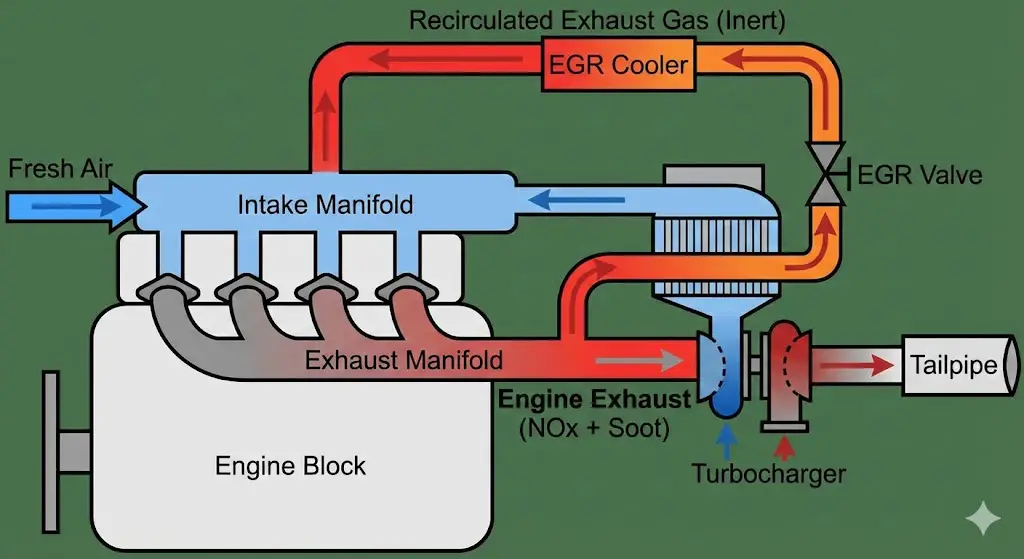
The Exhaust Gas Recirculation (EGR) system is the primary method for controlling NOx formation at the source. By diverting a precise percentage of exhaust gas from the exhaust manifold, cooling it via a liquid-to-air heat exchanger (the EGR Cooler), and reintroducing it into the intake manifold, the system achieves two critical outcomes:
- Oxygen Dilution: The exhaust gas is inert (it has already been burned). By displacing fresh oxygen in the cylinder with inert gas, the combustion rate is slowed.
- Thermal Absorption: The inert gas acts as a heat sink, absorbing combustion energy without reacting.
The result is a lower peak cylinder temperature, which drastically inhibits the Zeldovich mechanism, preventing NOx from forming in the first place. However, this comes at a cost: introducing soot-laden exhaust back into the engine creates a dirty intake environment, leading to the carbon buildup that frequently triggers the P2BAC code.
The Role of Selective Catalytic Reduction (SCR)
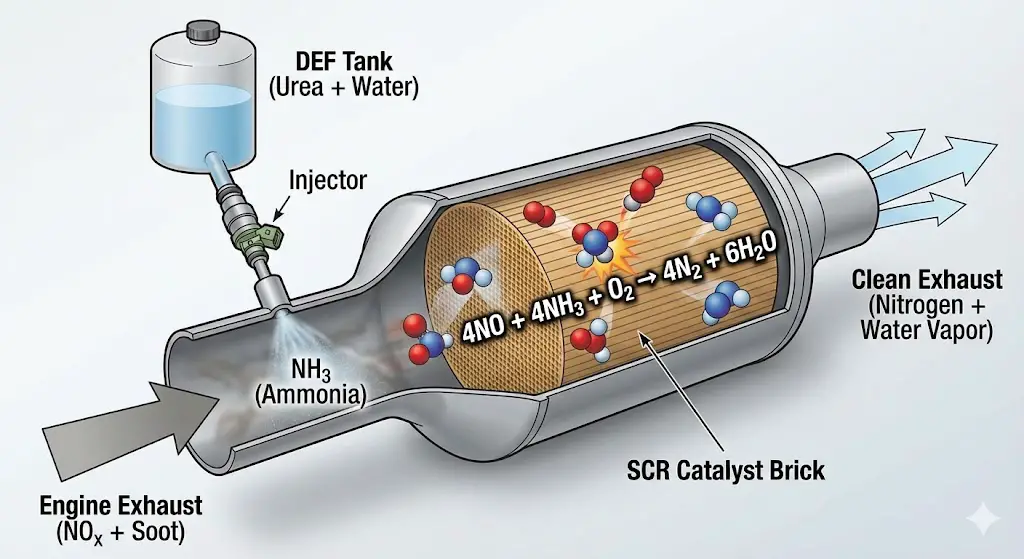
While EGR reduces the formation of NOx, it cannot eliminate it entirely without causing excessive soot. To meet EPA Tier 4 standards, the remaining NOx must be scrubbed from the exhaust stream. This is the job of the Selective Catalytic Reduction (SCR) system.
- The Chemistry: Diesel Exhaust Fluid (DEF)—a solution of 32.5% high-purity urea and 67.5% deionized water—is injected into the hot exhaust stream. The heat hydrolyzes the urea into ammonia ($NH_3$).
- The Catalyst: Inside the SCR catalyst (a ceramic brick coated with zeolites, copper, or iron), the ammonia reacts with the NOx.
- The Reaction: $4NO + 4NH_3 + O_2 \rightarrow 4N_2 + 6H_2O$. The toxic oxides are converted into harmless nitrogen gas and water vapor.
Anatomy of the P2BAC Code
The P2BAC code is unique in the OBDII lexicon. Unlike a P0301 (Cylinder 1 Misfire) which points to a specific location, or a P0401 (EGR Flow Insufficient) which points to a specific flow rate, P2BAC is a Rationality and Strategy Code.
The Rationality Check Logic
The Engine Control Module (ECM) of the Ram 6.7L Cummins possesses a sophisticated mathematical model of engine performance. It knows that for a given RPM, fuel rate, boost pressure, and ambient temperature, the engine should produce a specific amount of NOx.
- Modeled NOx: The theoretical value calculated by the ECM algorithms.
- Measured NOx: The actual value reported by the downstream NOx sensor.
When Measured NOx >> Modeled NOx for a calibrated duration, the ECM flags a rationality fault. It determines that the emissions control loop is open or ineffective.
The “Deactivation of EGR” Mechanism
Why does the code description specifically mention the deactivation of the EGR? This is a critical strategic decision by the ECM logic.
- Protection from “Running Rich”: High NOx often correlates with lean conditions, but if the EGR valve is stuck or if the MAP sensor is fouled (reporting false air density), the engine might be operating in an unstable combustion zone.
- Soot Prevention: If the combustion chemistry is unknown (which high NOx implies), recirculating that exhaust gas carries a risk. If the engine is producing excessive soot due to a fueling error (companion code P0191), pumping that soot back into the intake via the EGR valve could rapidly clog the manifold and valves.
- The Failsafe: Therefore, the ECM commands the EGR valve to close (0% duty cycle). This effectively turns the engine into a “dirty” non-EGR diesel. It protects the mechanical components from soot loading but results in raw NOx emissions pouring out of the tailpipe—hence the “Exceedance”.
The “Ghost Code” Phenomenon
Technicians often refer to P2BAC as a “Ghost Code” because it rarely clears with a simple erase command if the underlying conditions persist, yet it points to no single part to replace. It is a messenger.
- Persistent Nature: Because it is tied to a permanent monitor, standard scanners may show it as “Permanent” even after repairs until the truck completes a specific “Universal Drive Cycle” (see Section 7).
- Informational Status: Some Technical Service Bulletins (TSBs) refer to P2BAC as “informational only,” implying it requires no repair itself. This is misleading. While you don’t “replace the P2BAC part,” you must repair the cause, or the truck will eventually enter a severe derate (Limp Mode) speed limit of 5 MPH.
The Companion Code Ecosystem (The Diagnostic Matrix)
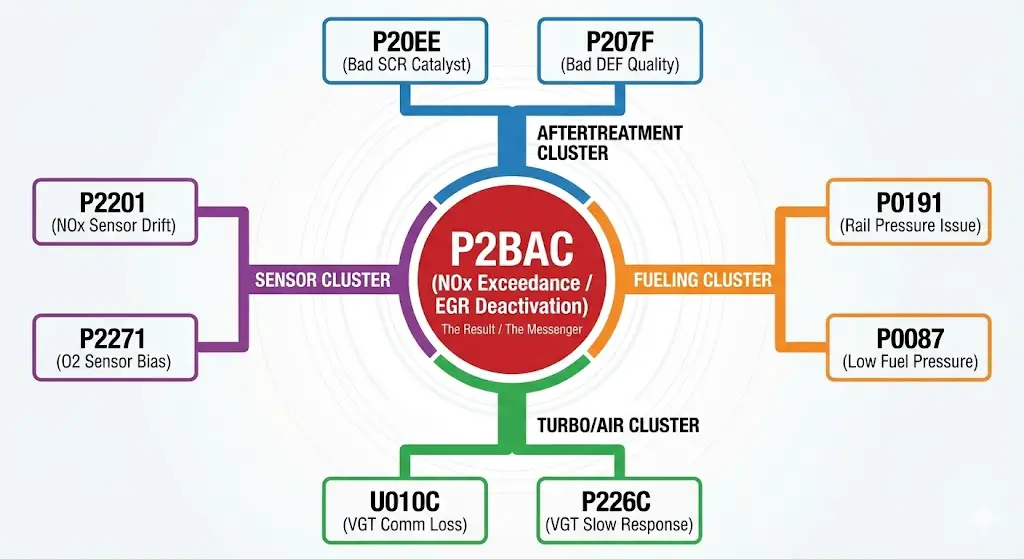
The most effective way to diagnose P2BAC is to ignore it initially and focus entirely on its “Companion Codes.” The 6.7L Cummins ECM rarely sets P2BAC in isolation. It usually appears alongside a pointer code that indicates why NOx is high. We can categorize these into four primary clusters: The Aftertreatment Cluster, The Fueling Cluster, The Turbo/Air Cluster, and The Sensor Cluster.
The Aftertreatment Cluster (P20EE, P207F)
Dominant Code: P20EE – SCR NOx Catalyst Efficiency Below Threshold (Bank 1)
Secondary Codes: P207F (Reductant Quality Performance), P249C (Excessive Time to Enter Closed Loop Reductant Injection Control).
The Mechanism:
This is the most common companion scenario. The P20EE code indicates that the efficiency of the SCR brick has dropped below a calibrated limit (usually < 70% conversion efficiency).
- Causal Chain: If the SCR catalyst is “poisoned” (sulfur buildup, oil contamination) or if the DEF injector is clogged with crystallized urea, the chemical reaction $NOx + NH_3 \rightarrow N_2 + H_2O$ fails.
- Result: The downstream NOx sensor reports high levels of NOx. The ECM sees this, realizes the EGR system (upstream) cannot compensate for a failed SCR system (downstream), and triggers P2BAC to alert the driver to the emissions breach.
Common Failures:
- DEF Injector Crystallization: The injector nozzle sits in the hot exhaust. During low-load driving, the water in the DEF evaporates before injection, leaving white urea crystals that block the nozzle plate. This distorts the spray pattern, preventing proper mixing with the exhaust gases.
- Bad DEF Quality: DEF has a shelf life. Exposure to sunlight or temps above 86°F degrades the urea into ammonia gas within the tank, lowering the concentration below the required 32.5%.
The Fueling Cluster (P0191, P0087)
Dominant Code: P0191 – Fuel Rail Pressure Sensor Circuit Performance
Secondary Codes: P0087 (Fuel Rail Pressure Too Low), P1011 (Fuel Pump Delivery Pressure Too Low).
The Mechanism:
It is counterintuitive to link fuel pressure to an EGR code, yet P0191 is a frequent trigger for P2BAC on 2013-2018 Ram trucks.
- Combustion Chemistry: The 6.7L Cummins relies on extremely high rail pressures (up to 29,000 PSI on newer models) to atomize fuel into microscopic droplets. This ensures a clean, cool burn.
- The Fault: If the Fuel Rail Pressure (FRP) sensor is biased (reading higher or lower than actual) or if the Fuel Control Actuator (FCA) on the CP3 pump is sticking, the rail pressure fluctuates.
- The Ripple Effect: Lower-than-commanded pressure leads to poor atomization. This causes “dirty” combustion with uneven flame fronts. This erratic combustion produces unpredictable spikes in NOx and Soot. The ECM detects this instability via the NOx sensors and, unable to smooth it out via EGR, sets P2BAC and P0191 simultaneously.
The Turbo/Air Cluster (U010C, P226C, P0471)
Dominant Code: U010C – Lost Communication with Turbocharger Control Module


Secondary Codes: P226C (Turbocharger Boost Control “A” Slow Response), P0471 (Exhaust Pressure Sensor Performance).
The Mechanism:
The Holset VGT (Variable Geometry Turbocharger) is an integral part of the EGR system. To drive exhaust gas back into the pressurized intake manifold, the exhaust manifold pressure (drive pressure) must be higher than the boost pressure. The VGT achieves this by closing its sliding vanes to create restriction.
- The Fault: The electronic actuator mounted on the side of the turbo is prone to failure (solder joint fatigue, motor burnout) or the vanes themselves stick due to soot accumulation.
- The Ripple Effect: If the VGT cannot close the vanes, drive pressure drops. EGR flow stops because there is no pressure differential to push it. The engine runs on pure fresh air (lean), causing NOx to spike. The ECM sees the communication loss (U010C) or the slow response (P226C) and sets P2BAC because the primary mechanism for NOx control (EGR) is physically disabled by the lack of backpressure.
The Sensor Cluster (P2201, P2271)
Dominant Codes: P2201 (NOx Sensor Circuit Performance – Bank 1 Sensor 1), P2271 (O2 Sensor Signal Biased/Stuck Rich).
The Mechanism: Direct sensor failure. If the “eyes” of the system are blind or hallucinating, the rationality logic fails.
- P2201: The upstream NOx sensor is coated in soot or moisture damaged. It reports erratic data.
- P2271: The O2 sensor reports a rich condition (lack of oxygen), which conflicts with the NOx sensor’s report. The ECM cannot reconcile the conflicting data (High NOx usually implies Lean, not Rich) and defaults to P2BAC to protect the system.
Data Table: Companion Code Diagnostic Matrix
| Companion Code | System | Definition | Relationship to P2BAC | Probability |
| P20EE | SCR | SCR Catalyst Efficiency Below Threshold | Primary Driver. SCR failure causes high tailpipe NOx, triggering the P2BAC exceedance flag. | High |
| P0191 | Fuel | Fuel Rail Pressure Sensor Circuit Performance | Instigator. Poor fuel atomization creates unstable combustion/NOx spikes; EGR disabled to prevent soot loading. | Moderate-High |
| U010C | Turbo | Lost Comm with Turbo Control Module | Mechanical Block. VGT actuator failure prevents backpressure generation needed for EGR flow. | High (High Mileage) |
| P226C | Turbo | Boost Control Slow Response | Mechanical Block. VGT vanes sticking due to soot prevent proper air/EGR mixing. | Moderate |
| P2201 | Sensor | NOx Sensor Circuit Performance (Upstream) | False Flag. Sensor electrical failure provides bad data to the rationality algorithm. | Moderate |
| P2271 | Sensor | O2 Sensor Stuck Rich | Data Conflict. Disagreement between O2 and NOx sensors triggers failsafe. | Low |
| None | Intake | P2BAC Only (Solo) | System Drift. Usually caused by dirty MAP sensor, dirty air filter, or minor EGR valve sticking. | Moderate |
Component Deep Dives: Vulnerabilities and Failures
To repair the P2BAC code effectively, one must understand the specific failure modes of the hardware involved. We will examine the metallurgy, design, and common failure points of the critical components.
The Manifold Absolute Pressure (MAP) Sensor
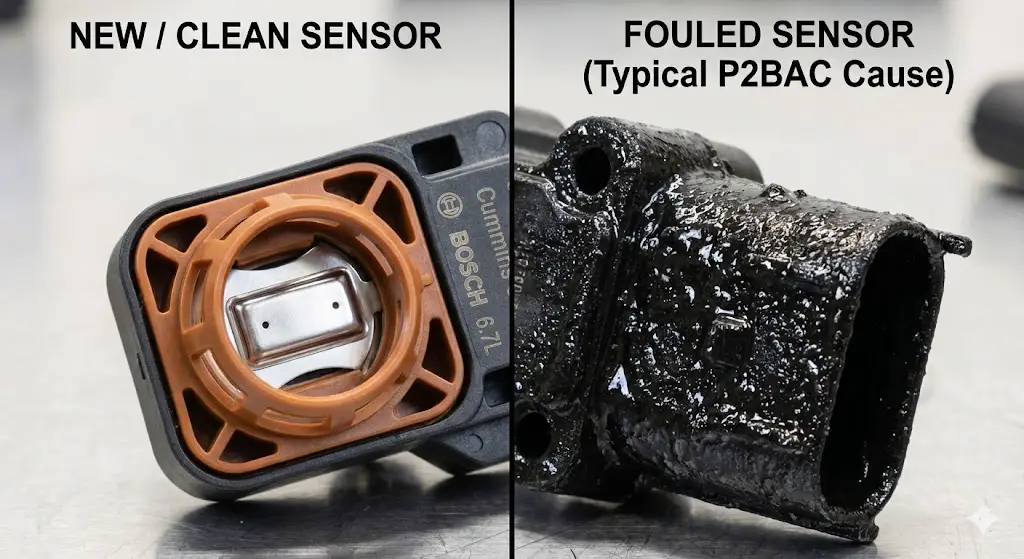
The MAP sensor on the 6.7L Cummins is the unsung villain of the P2BAC saga.
- Location & Environment: It is located on the intake manifold shelf, directly in the path of the incoming air charge. Crucially, this location is after the EGR mixer valve. This means the air passing the sensor is a turbulent mix of fresh air (from the intercooler) and recirculated exhaust gas (from the EGR cooler).
- The Soot-Oil Sludge: The exhaust gas contains dry carbon soot. The Closed Crankcase Ventilation (CCV) system vents oil vapor from the crankcase into the turbo inlet. These two streams meet in the intake manifold. The oil vapor acts as a binder, catching the soot and forming a thick, conductive paste—essentially an insulating sludge.
- Failure Mode: This sludge coats the sensing element (a piezoelectric crystal or diaphragm). It does not usually cause an “Open Circuit” code. Instead, it creates Latency. The sensor becomes slow to react to pressure changes.
- Impact on P2BAC: The ECM relies on instant pressure data to calculate air density and command the EGR valve. If the MAP sensor is lagging by even 500 milliseconds, the ECM may command too much or too little EGR. This momentary error causes a NOx spike. Over a drive cycle, these accumulated errors trigger the P2BAC rationality fault. Cleaning this sensor is often the “magic bullet” for solo P2BAC codes.
The Variable Geometry Turbocharger (VGT) Actuator
The Holset HE300VG / HE351VE turbocharger uses a sliding nozzle ring to vary the exhaust gas velocity hitting the turbine wheel.
- The Actuator: A black electronic box mounted to the side of the turbo. It contains a DC motor, a circuit board, and a gear reduction set.
- Design Flaw: The actuator is exposed to immense thermal cycling (engine heat + turbo heat). Over time, the internal solder joints on the PCB can crack, or the coolant passages meant to cool the actuator can clog.
- The “Crunch”: Additionally, the mechanical gear inside the turbo housing that the actuator drives can become bound by hard carbon deposits. When the actuator attempts to move the vanes and hits this resistance, current spikes in the motor. If it cannot reach the commanded position, the ECM loses control of the drive pressure. Without drive pressure, the EGR system is dead in the water, leading directly to P2BAC.
The NOx Sensors (Smart Probes)
The 6.7L Cummins uses two NOx sensors: one at the turbo downpipe (Upstream) and one after the SCR canister (Downstream).
- Technology: These are “Smart Sensors.” The probe contains a Nernst cell (zirconium dioxide) similar to an O2 sensor, but with a second chamber specifically for pumping out oxygen to isolate NOx ions. The sensor head contains its own microprocessor that digitizes the signal and sends it to the ECM via the CAN bus (J1939).
- Vulnerability:
- Thermal Shock: If condensation forms in the exhaust pipe and hits the hot ceramic element of the sensor, it can crack instantly.
- Soot Fouling: Excessive soot (from a P0191 fueling issue or dirty air filter) can clog the diffusion barrier of the sensor, making it “blind” or slow.
- Ammonia Slip: If the SCR system overdoses DEF, ammonia ($NH_3$) can exit the tailpipe. The NOx sensor has cross-sensitivity to ammonia and will read it as NOx. This leads to a false P2BAC/P20EE code where the sensor thinks NOx is high, but it’s actually ammonia.
The EGR Valve and Cooler
- The Valve: A solenoid-driven poppet valve. It is spring-loaded to the closed position. The failure mode is almost always carbon buildup on the shaft or seat, preventing it from closing fully (leaking exhaust into intake at idle) or opening fully (insufficient flow).
- The Cooler: A radiator for exhaust gas. The internal passages are narrow fin-and-plate designs. They act as a trap for soot. If the cooler clogs, the pressure drop across it increases, reducing flow. The ECM expects a certain mass of EGR based on valve position; if the cooler restricts that mass, the NOx reduction will not happen, triggering P2BAC.
Diagnostic Protocols: A Step-by-Step Guide
Diagnosis must follow a logical path to avoid the “parts cannon” approach. The following protocol assumes access to a bi-directional scan tool (e.g., AlfaOBD, Autel, Snap-On, or wiTECH).
Phase 1: The “Clean and Check” (No Parts Required)
Before replacing anything, ensure the engine can breathe and the sensors can feel.
- Air Filter Inspection: Remove and inspect. If the pleats are grey or black, or if the “Filter Minder” is in the red, replace it. A restricted intake increases vacuum, pulling excessive EGR and throwing off calculations.
- Battery Health Check: Load test both batteries. The 6.7L Cummins electronics are notoriously sensitive to voltage ripple (AC noise from a bad alternator diode) or low voltage during cranking.
- MAP Sensor Cleaning: (See Procedure 8.1). This is mandatory for any P2BAC code.
- Connector Inspection: Check the connector at the Fuel Rail Pressure sensor (back of rail) and the VGT actuator. Look for “fretting” (micro-corrosion) on the pins.
Phase 2: The Data Analysis (Scan Tool)
Connect your scanner and perform the following:
- Freeze Frame Analysis: Look at the moment P2BAC was set.
- Engine RPM/Load: Was it high load (highway) or low load (idle)?
- DEF Level: Was the tank below 10%?
- Regen Status: Was the truck in active regeneration?
- Live Data Monitoring: Set up a graph with the following PIDs (Parameter IDs):
NOx Sensor 1/1 (ppm)(Upstream)NOx Sensor 1/2 (ppm)(Downstream)EGR Valve Position Commanded vs. ActualTurbo Vane Position Commanded vs. ActualFuel Rail Pressure Commanded vs. Actual
- The Highway Test: Drive the truck at steady highway speed (65 MPH).
- Observation: Sensor 1 should read fluctuating high values (e.g., 200-500 ppm). Sensor 2 should be significantly lower (e.g., 0-50 ppm) if the SCR is working.
- Failure Sign: If Sensor 2 tracks Sensor 1 closely (e.g., both reading 300 ppm), the SCR is not reducing NOx. This confirms a P20EE/P2BAC relationship.
Phase 3: The Active Diagnostics
- Turbo Vane Sweep: Key On Engine Off (KOEO). Command the VGT actuator to 0% and 100%. Listen for the tone change and smooth operation. If it clicks, stutters, or throws a U010C code during the test, the actuator is failed.
- EGR Valve Test: Command the EGR valve to open. Watch the MAF sensor value. When EGR opens, MAF (fresh air flow) should drop significantly (because exhaust is displacing fresh air). If MAF doesn’t drop, the EGR path is clogged or the valve is stuck.
- Stationary De-Soot (Forced Regen): This is the ultimate diagnostic test.
- Initiate a stationary regen via the scanner.
- The engine will ramp to 1000+ RPM. The VGT will close to build heat.
- Watch the NOx Sensors: During the high-heat cycle (1000°F+), the NOx sensors should “wake up” and eventually drop to near zero as the system cleans itself. If the sensors remain stuck at a fixed value or read zero immediately (flatline), they are dead.
- Outcome: If the regen completes successfully and codes clear, the issue was likely soft carbon fouling. If the regen aborts or P2BAC returns immediately, hard parts (SCR Catalyst or Sensors) are required.
Repair Strategies & Detailed Procedures
Procedure: Cleaning the MAP Sensor (The First Fix)
Time Required: 20 Minutes
Difficulty: Easy (1/5)
Tools: T15/T20 Torx driver, CRC Mass Air Flow Sensor Cleaner, clean rag.
- Locate: The sensor is on the intake manifold, driver’s side, typically near the dipstick tube.
- Remove: Disconnect the wiring harness (slide red tab back, press release). Remove the single Torx screw.
- Extract: Twist gently and pull straight up. Warning: It will offer resistance due to the O-ring and sludge.
- Inspect: The cage will likely be a solid block of black sludge.
- Clean: Hold the sensor with the probe pointing down. Spray the cleaner up into the cage. Allow the black sludge to run out. Repeat until the run-off is clear and you can see the metallic/orange sensor element inside. DO NOT touch the element with a pick, brush, or compressed air.
- Dry: Let it air dry for 10 minutes.
- Reinstall: Lube the O-ring with a drop of clean engine oil. Press in. Tighten screw (do not overtighten, it is plastic).
Procedure: Stationary Regeneration (Manual Force)
Time Required: 40-60 Minutes
Difficulty: Moderate (Requires Tool)
Safety: Park on concrete/asphalt away from grass. Exhaust will reach 1200°F.
- Setup: Truck in Park/Neutral. Parking Brake ON. Hood Open (to aid engine cooling). Fuel level > 1/4 tank.
- Initiate: Using AlfaOBD or similar tool, select “Engine” -> “Special Procedures” -> “Manual Regeneration.”
- Process: The engine RPM will increase. You will hear the turbo pitch change as the VGT restricts exhaust. The exhaust will smell extremely hot (acrid).
- Completion: The RPM will return to idle. Let the engine idle for 5-10 minutes to cool down the turbo bearings before shutting off.
- Post-Check: Clear codes. Drive the truck. This procedure often clears “Permanent” P2BAC codes by satisfying the ECM’s drive cycle requirements for high-heat operation.
Procedure: Replacing the Turbo (VGT) Actuator
Time Required: 2-3 Hours
Difficulty: High (3/5)




Tools: 10mm socket, 5mm/6mm Allen keys, Coolant clamps, Scanner for Calibration.
- Drain/Clamp Coolant: The actuator is liquid-cooled. Clamp the lines to minimize loss.
- Access: Remove the passenger side inner fender liner for best access.
- Remove: Disconnect the electrical connector. Remove the 4 Allen head bolts holding the actuator to the turbo. Note: These bolts are often seized. Use penetrating oil and patience to avoid snapping them.
- Install: Align the gear of the new actuator with the turbo sector gear.
- Calibration (CRITICAL): You cannot simply plug it in and drive. You must use a scanner (WiTech, Autel, Snap-On, or AlfaOBD) to run the “VGT Actuator Pre-Align” or “Calibration” routine. This teaches the actuator the end-stops (0% and 100%) of the vanes. Failure to do this will result in immediate codes and potential turbo damage.
- Alternative: Buy a pre-calibrated actuator from a specialist like City Diesel, which comes with a jig to align the gear manually, bypassing the software calibration requirement.
Procedure: Replacing the Fuel Rail Pressure Sensor
Time Required: 1 Hour
Difficulty: Moderate (Access is tight)
Tools: 27mm or 1-1/16″ deep socket, swivel adapter.
- Access: Remove the intake horn (optional but helps) or work from the driver’s side reaching back behind the intake.
- Remove: Unplug the connector. Use the deep socket to unscrew the sensor.
- Install: Thread the new sensor by hand to avoid cross-threading. Torque to specification (typically 52 ft-lbs, but check service manual). Do not over-torque or you will distort the sensing diaphragm.
- Reset: No calibration needed, but clearing codes is required.
Technical Service Bulletins (TSBs) and Software Updates
Before replacing any parts, it is vital to consult the history of software patches released by Ram/Cummins. The logic for P2BAC has been revised multiple times to reduce “false positives.”
- TSB 18-045-11 (Rev D): This is a foundational TSB for early 4th Gen trucks (2010-2012). It addresses MIL illumination for P2BAC where no actual mechanical fault exists. The fix is a PCM flash that widens the rationality threshold.
- TSB 18-018-13: Covers 2013+ models. Addresses P20EE and companion codes. It often prescribes a software update before replacing the SCR catalyst.
- TSB 25-004-12: Specifically for Oxygen Sensor rationality codes (P2271) that trigger companion P2BAC faults.
- Action Plan: If you have a P2BAC code, your first stop (or your mechanic’s first step) should be to check the “Calibration ID” of your PCM. If an update is available, flash it. This $150 service can save $3,000 in unnecessary parts replacement.
Economic Analysis: Repair vs. Replace vs. Delete
The financial burden of the P2BAC code can be significant. Owners often face a crossroads: fix the system, or remove it.
The Cost of Compliance (Repair)
Maintaining the emissions system is the only legal route for on-road vehicles.
- Minor Fixes: MAP Cleaning ($10), Filters ($50), Software Flash ($150). Total: <$250.
- Moderate Fixes: NOx Sensors ($800 pair), Fuel Rail Sensor ($300). Total: ~$1,100.
- Major Fixes: Turbo Actuator ($1,500), SCR Catalyst ($2,500). Total: >$4,000.
- Warranty: Federal Emissions Warranty covers the SCR and PCM for 8 years / 80,000 miles. Many P20EE/P2BAC issues fall under this. Always check warranty status first.
The “Delete” Option (Unauthorized Modification)
“Deleting” involves removing the DPF, SCR, and EGR and reprogramming the PCM to ignore emissions inputs.
- Cost: Tuner ($800+) + Exhaust Pipe ($400+) + EGR Plate ($50) + Labor. Total: ~$1,500 – $2,000.
- Legal Risk: As of 2025, the EPA has aggressively pursued enforcement against shops selling or installing delete kits (The “Clean Air Act”). Fines can reach $48,000 per violation.
- Market Risk: Deleting a truck destroys its trade-in value. Major dealerships cannot take deleted trades. Private party sales are restricted in many states requiring smog checks.
- Technical Risk: While deletes solve P2BAC permanently, they often introduce new issues like transmission tuning conflicts, excessive smoke, and loss of the exhaust brake (if VGT is not tuned correctly).
Prevention: Living with the 6.7L Cummins
The P2BAC code is often a symptom of “babying” the truck. The 6.7L Cummins is an industrial engine designed for high load.
The “Work It” Principle
- Drive Cycle: The emissions system requires heat to clean itself. Short trips (under 10 miles) never allow the SCR and DPF to reach operating temperature.
- Recommendation: Once a week, get the truck on the highway. Drive 65+ MPH for 30 minutes. If you never tow, consider loading the bed or driving in a lower gear (tow/haul mode) occasionally to increase exhaust temperatures and facilitate passive regen.
Idle Management
- Wet Stacking: Idling a diesel causes the cylinders to cool down. Unburned fuel washes the cylinder walls and creates soot.
- High Idle: If you must idle, enable the “High Idle” feature (using cruise control buttons) to ramp RPM to 1100. This maintains cylinder heat and reduces EGR fouling.
Fluid Hygiene
- Fuel: Change fuel filters every 15,000 miles maximum (10k is better). Use the severe service schedule.
- DEF: Buy DEF from high-turnover sources (truck stops) to ensure freshness. Do not stockpile DEF in your garage for more than 6-12 months.
Conclusion
The P2BAC code is a formidable adversary, but it is not invincible. It is a logical, albeit complex, reaction of the engine’s computer to a physical or chemical imbalance. It tells a story of a system struggling to breathe (MAP/Turbo), struggling to burn (Fuel/Injector), or struggling to clean (SCR/NOx Sensor).
By abandoning the “parts cannon” approach and adopting the diagnostic matrix presented in this report—checking companion codes, verifying sensor rationality, and performing targeted cleaning procedures—you can resolve the P2BAC code. The 6.7L Cummins is a legendary powerplant; understanding its emissions needs is the key to unlocking its longevity.