6.7 Cummins Throttle Position Sensor Location And App Sensor Diagnostic Guide

When your 6.7 Cummins engine hesitates, stutters, or enters a frustrating ‘limp mode,’ your first instinct is often to check the throttle position sensor (TPS). However, finding it isn’t as straightforward as it was on older diesel platforms where components were bolted directly to the fuel pump or intake. Locating the 6.7 Cummins throttle position sensor location is a common point of confusion because the engine lacks a traditional engine-bay TPS, utilizing a more modern Accelerator Pedal Position (APP) sensor instead. In this guide, we will identify the exact location of the APP sensor, explain the symptoms of failure, and provide the technical steps needed to diagnose and replace it correctly using industry-standard protocols.


Identifying the 6.7 Cummins Throttle Position Sensor Location and the APP Sensor Transition
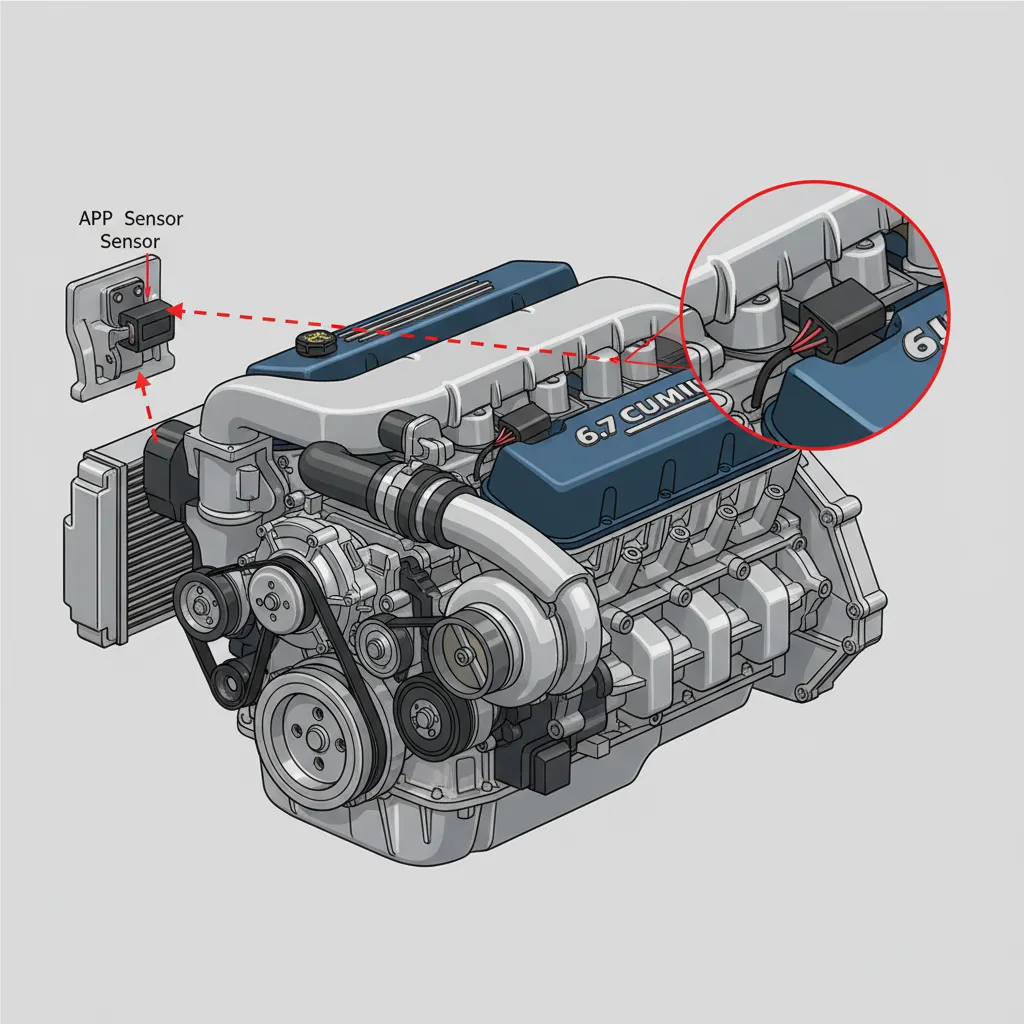
The evolution of the Cummins power plant brought significant changes to how driver input is translated into engine performance. The 6.7L Cummins engine, which debuted in mid-2007, ushered in more sophisticated electronic throttle controls compared to its 5.9L predecessor. While earlier 5.9L models often featured an Accelerator Pedal Position Sensor (APPS) mounted under the hood—frequently on a bracket near the intake manifold—the 6.7L platform transitioned fully to a “drive-by-wire” system.
In this configuration, there is no mechanical cable connecting your foot to the engine. Instead, the component commonly referred to as the TPS is technically the APP sensor, and its location is integrated into the accelerator pedal assembly inside the vehicle cabin, mounted directly to the firewall. This shift was designed to increase reliability and allow the Engine Control Module (ECM) to have finer control over fueling and emissions, but it can be confusing for those used to working on older iron.
Locating the Component
To find the APP sensor, you must look under the driver-side dashboard. The sensor is a plastic housing attached to the top of the metal or composite pedal arm. You will see a multi-wire electrical connector serving the assembly. It is important to distinguish this from other nearby sensors; while the Intake Manifold Pressure (MAP) or Mass Air Flow (MAF) sensors are critical for engine management, they are located under the hood and measure air characteristics, whereas the APP sensor strictly measures your foot’s position. For more details on the engine’s architectural design, you can consult an official guide from the manufacturer.
Recognizing Failure Symptoms of the Accelerator Pedal Position Sensor
When the APP sensor begins to fail, the symptoms can range from mildly annoying to downright dangerous. One of the most notorious issues reported by the community is the “Dead Pedal” phenomenon. This occurs when you depress the accelerator to merge into traffic or pull away from a stop, and the engine simply fails to respond for several seconds. This delay is often the ECM struggling to interpret a “noisy” or irrational signal from the sensor’s internal potentiometers.
Another common defense mechanism of the 6.7L Cummins is the activation of Limp Mode. When the ECM detects a significant discrepancy between the dual signals provided by the APP sensor, it will limit engine RPM and power output to ensure the vehicle does not experience an unintended acceleration event. This can be particularly harrowing if you are navigating heavy traffic in your local community or towing a heavy trailer.
Keep an eye out for these specific indicators:
- Erratic Idle: The engine may surge or drop below standard RPMs while stationary as the sensor sends fluctuating signals.
- Diagnostic Trouble Codes (DTCs): Specifically look for P2121 (APP Sensor 1 Performance) and P2122 (APP Sensor 1 Circuit Low).
- Stalling: In rare cases, a complete signal loss can cause the engine to shut down or return to a forced idle.
By The Numbers
Average Replacement Cost
Performance Issues Related to Sensors

Technical Diagnosis and Testing the APP Sensor Signal
Before rushing to purchase a replacement, a professional-grade diagnostic approach is required. Many intermittent throttle issues are actually caused by wiring harness problems rather than the sensor itself. Using a scan tool available at most trusted local shops, you should monitor ‘Live Data’ for the APP percentages. Modern Cummins ECMs process sensor inputs at speeds exceeding 100 times per second, so you are looking for instantaneous responses.
Perform a “Sweep Test”: With the engine off but the ignition in the ‘On’ position, slowly depress the pedal from 0% to 100% while watching the voltage or percentage graph. You are looking for ‘dead spots’ or sudden vertical drops in the signal curve. If the voltage jumps sporadically, the internal resistor track of the sensor is likely worn out. For additional peer-reviewed troubleshooting steps, checking a community forum can provide real-world examples of similar failures.


If you experience intermittent APP sensor problems, consider cleaning the connector pins with electrical contact cleaner. Moisture from snow-covered boots or spills can migrate into the connector near the floor mat, causing corrosion that mimics a failing sensor.
Additionally, verify the 5-volt reference signal coming from the ECM. If the sensor isn’t receiving steady power, it cannot output a steady signal. We have seen cases where poor battery health or a failing alternator creates electrical “noise” that the ECM misinterprets as a throttle sensor fault. Always ensure your charging system is accessible and functioning correctly before blaming the pedal.
📋
Step-by-Step Replacement Guide
Disconnect both negative battery terminals. This prevents short circuits and allows the ECM to reset its adaptive memory, which is vital for the upcoming calibration.
Locate the mounting bolts securing the pedal assembly to the firewall. Using a socket extension, remove the bolts and carefully unplug the electrical pigtail.
Install the new assembly. Once reconnected, turn the key to ‘On’ (engine off). Slowly press the pedal to the floor and slowly release it. Repeat three times to calibrate the new sensor to the ECM.
Replacement Procedure and Parts Availability in Your Community
When it comes to sourcing parts, the 6.7 Cummins is highly sensitive to sensor quality. We strongly recommend using OEM Mopar components or high-quality replacements from reputable manufacturers like Cummins. You can find detailed Ram specs to ensure you have the exact part number for your model year. Aftermarket “budget” sensors often lack the precise resistance values required, leading to immediate “out of range” codes.
The DIY replacement process typically takes between 30 and 60 minutes. Compared to the turnaround time at a heavy-duty diesel shop serving your area, which might be several days, doing it yourself is a convenient and accessible option for most owners with basic tools. However, if you are not comfortable working around the steering column and electrical harnesses, seeking professional assistance is a trusted local alternative.
✅ Pros of DIY
- Significant labor cost savings
- Immediate repair (no shop wait)
- Better understanding of your truck
- Ensures use of high-quality parts
❌ Cons of DIY
- Potential for misdiagnosis
- Risk of breaking plastic clips
- Requires a quality scan tool
- Contorting under the dashboard
Advanced Troubleshooting and ECM Interaction
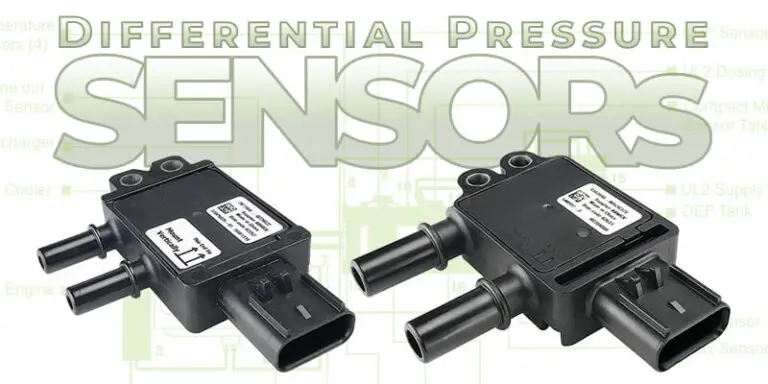
Understanding how the APP sensor interacts with the broader engine management system is key to solving complex issues. The ECM doesn’t just look at the APP sensor in isolation; it correlates this data with the Boost Pressure Sensor and the Exhaust Back Pressure sensor to manage emissions and Variable Geometry Turbo (VGT) vane position. If the ECM sees you requesting 100% throttle but the turbo isn’t responding, it may trigger a fault code that appears to be throttle-related but is actually a mechanical turbo failure.
Beware of “Ghost Codes.” In some Dodge Ram models, a faulty clock spring in the steering wheel or a sticking brake light switch can interfere with the throttle signal circuit. Since the ECM is programmed to cut throttle if the brakes are applied (a safety feature), a failing brake switch can mimic a “dead pedal” APP sensor issue. Always check these peripheral components if a new sensor doesn’t fix the problem.
On many 6.7L trucks, the wiring harness for the pedal assembly can rub against the steering column or sharp edges of the dashboard support. Before replacing the sensor, inspect the entire visible length of the harness for frayed insulation or exposed copper, which can cause intermittent shorts to ground.
Finally, environmental factors play a huge role in sensor longevity. Extreme cabin heat during summer months or excessive moisture from winter floor mats can degrade the sensor’s internal components over time. For long-term maintenance, keep the driver-side footwell clean and ensure your floor mats are properly secured so they do not physically interfere with the pedal’s range of motion, which could lead to “signal irrationality” codes.
Conclusion
Diagnosing the 6.7 Cummins throttle position sensor location is the first step toward reclaiming your truck’s performance. By remembering that the “TPS” is actually an APP sensor located on the pedal assembly inside the cabin, you avoid the common pitfall of searching the engine bay for a component that isn’t there. Symptoms like a “dead pedal” or P2121/P2122 codes are primary indicators of a failing assembly, but a proper diagnosis involving a 5-volt reference check and a sweep test is essential to avoid unnecessary parts swapping.
If your truck is currently in limp mode or exhibiting erratic throttle behavior, do not delay. Check for nearby diesel specialists available to perform a professional diagnostic scan if you lack the necessary tools. Ensuring a reliable repair with quality OEM parts will keep your Cummins serving you faithfully for hundreds of thousands of miles to come.
Frequently Asked Questions
Where exactly is the throttle position sensor located on a 6.7 Cummins?
On the 6.7 Cummins, there is no sensor located on the engine’s throttle body. Instead, you will find the Accelerator Pedal Position (APP) sensor integrated directly into the gas pedal assembly inside the cab. It is mounted to the firewall where the pedal arm connects to the floor of the truck.
Can I drive my truck if the APP sensor is failing?
Driving with a failing APP sensor is not recommended. It can cause unpredictable engine surging or sudden ‘dead pedal’ events where the engine returns to idle while you are in traffic. Furthermore, the ECM may trigger ‘Limp Mode,’ significantly reducing your power and speed for safety, making it difficult to navigate hilly terrain or highways.
What is the most common fault code for a 6.7 Cummins throttle sensor?
The most frequent codes are P2121 and P2122. P2121 indicates a performance issue where the two internal signals of the sensor do not correlate with each other. P2122 indicates a ‘Circuit Low’ condition, which often points to a wiring break, a disconnected plug, or a total failure of the sensor’s internal potentiometer.
How much does it cost to fix the throttle position sensor on a Ram 2500/3500?
On average, you can expect to pay between $152 and $239 for a replacement. The part itself usually costs between $100 and $180, while labor in most local shops will range from $50 to $100, as the replacement is relatively quick and accessible within the driver’s side footwell.
Is a ‘pedal relearn’ necessary after replacing the sensor?
Yes, it is standard practice. After installing a new assembly, turn the ignition to the ‘ON’ position without starting the engine. Slowly depress the accelerator pedal to the floor and then slowly release it. This allows the ECM to map the voltage range of the new sensor for accurate throttle response.