2017 Ram 3500 Towing Capacity 2026 Updated

Quick Answer
The 2017 Ram 3500 towing capacity ranges from 13,910 lbs to a maximum rating of 31,210 lbs. The baseline rating applies to a 5.7L HEMI V8 Single Rear Wheel (SRW) configuration, while the peak 31,210-lb capacity requires the High Output 6.7L Cummins Turbo Diesel, Aisin 6-speed automatic, dual rear wheels (DRW), 4.10 axle ratio, and fifth-wheel/gooseneck hitch setup. Always verify payload and towing limits on the driver-side door jamb sticker.
When properly equipped, the 2017 Ram 3500 towing capacity spans from 13,990 pounds up to a maximum rating of 31,210 pounds, alongside a maximum factory payload rating reaching 7,390 pounds. However, claiming that peak 31,210-pound threshold demands an exacting build: the 6.7L Cummins High-Output Turbo Diesel paired with the commercial-grade Aisin six-speed automatic, 4.10 rear axle gearing, a Regular Cab dual-rear-wheel (DRW) 4×2 configuration, and a fifth-wheel/gooseneck hitch. Conventional bumper-pull towing tops out at 20,000 pounds across the lineup. Single-rear-wheel models and alternative transmissions fall well below these headline figures.

Prime for Young Adults — 6 Months Free
Students and 18–24s get six months of Prime free, then half price.
Start 6 Months Free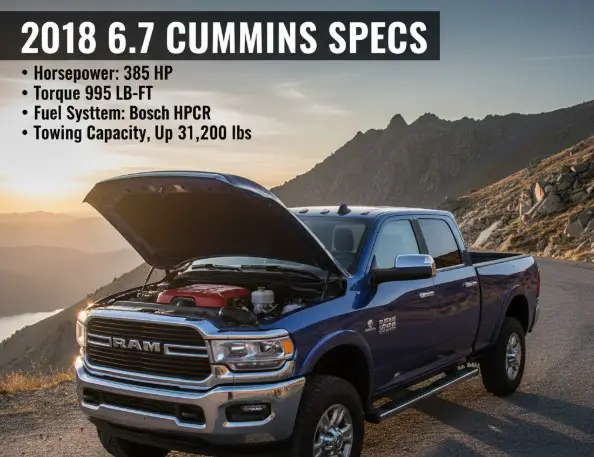
2017 Ram 3500 Towing Capacity Chart by Engine and Cab Configuration
Recommended Best Deal Products


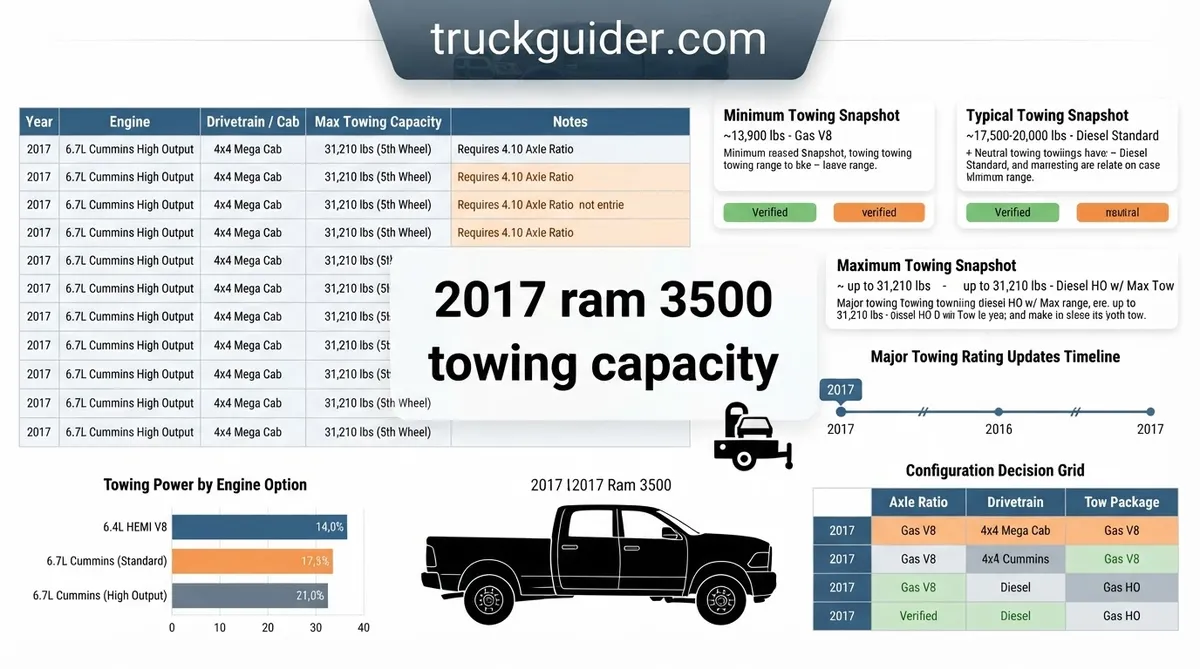
The 2017 Ram 3500 heavy-duty truck platform features an extensive array of mechanical variations. Engine displacement, transmission internal gearing, rear axle ratios, and cab layouts combine to produce wildly divergent towing limits. Understanding where your specific truck sits within this factory matrix is critical to safe, legal hauling.
📤 Share Image
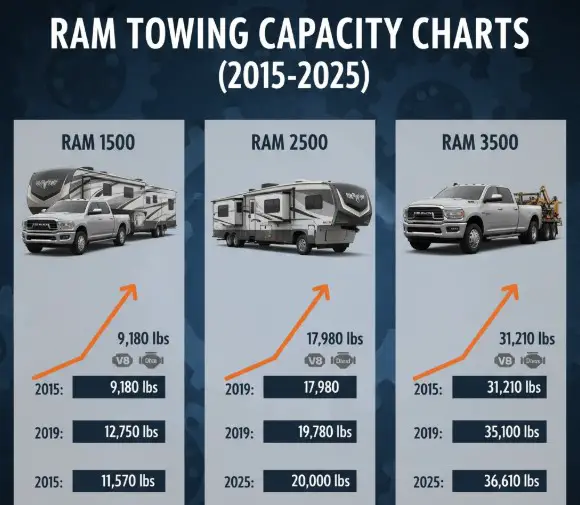
Data Scope and Tow Rating Verification
This reference data reflects official factory specifications standardized under SAE J2807 criteria across all 2017 Ram 3500 trim levels (Tradesman, SLT, Big Horn/Lone Star, Laramie, Laramie Longhorn, and Limited). Real-world available payload and gross trailer weight vary based on optional equipment, aftermarket accessories, passenger count, and cargo. Always cross-reference the Tire and Loading Information placard located on your driver-side B-pillar door jamb.
Last reviewed: October 2026.
13,990 lbs
6.4L HEMI Gas, Crew Cab 4×4, 3.73 Gears
17,200 lbs
6.7L Cummins Crew Cab 4×4 SRW, 3.42 Gears
31,210 lbs
6.7L HO Cummins DRW Regular Cab 4×2, 4.10 Gears
2017 Ram 3500 Gooseneck and 5th-Wheel Towing Chart
How to read this chart: The figures detailed below represent the factory maximum trailer ratings when utilizing a fifth-wheel hitch or gooseneck connection via the optional factory bed prep package. Ratings are organized by powertrain, cab setup, and drivetrain. Dual rear wheel models are indicated as DRW, while single rear wheel models are indicated as SRW.
| Year | Engine | Drivetrain / Cab | Max Towing Capacity | Notes |
|---|---|---|---|---|
| 2017 | 6.7L Cummins HO Diesel (Aisin) | Regular Cab 4×2 DRW (4.10 Axle) | 31,210 lbs | Requires 39,100 lbs GCWR; max factory configuration. |
| 2017 | 6.7L Cummins HO Diesel (Aisin) | Crew Cab 4×4 DRW 8′ Bed (4.10 Axle) | 30,320 lbs | Crew Cab body weight reduces maximum rating by 890 lbs. |
| 2017 | 6.7L Cummins HO Diesel (Aisin) | Mega Cab 4×4 DRW 6’4″ Bed (4.10 Axle) | 29,740 lbs | Mega Cab structure adds curb weight; 39,100 lbs GCWR. |
| 2017 | 6.7L Cummins HO Diesel (Aisin) | Crew Cab 4×4 DRW 8′ Bed (3.42 Axle) | 25,320 lbs | Highway gear ratio lowers GCWR to 34,100 lbs. |
| 2017 | 6.7L Cummins Diesel (68RFE Auto) | Crew Cab 4×4 SRW 6’4″ Bed (3.42 Axle) | 17,200 lbs | Most common consumer build; tire capacity is limiting factor. |
| 2017 | 6.7L Cummins Diesel (G56 Manual) | Crew Cab 4×4 SRW 6’4″ Bed (3.42 Axle) | 15,900 lbs | Factory detuned engine (660 lb-ft) restricts pulling limit. |
| 2017 | 6.4L HEMI V8 Gas (66RFE Auto) | Regular Cab 4×2 DRW (4.10 Axle) | 16,480 lbs | Light front axle yields exceptional 7,390 lbs payload. |
| 2017 | 6.4L HEMI V8 Gas (66RFE Auto) | Crew Cab 4×4 SRW 6’4″ Bed (3.73 Axle) | 13,990 lbs | Standard entry-level fleet and commercial service spec. |
*Note: Maximum ratings require properly optioned fifth-wheel or gooseneck hardware, integrated trailer brake controller, and appropriate gross vehicle weight distribution.
Conventional Class V Receiver Hitch Towing Limits
Regardless of whether your 2017 Ram 3500 features a powertrain rated for over 30,000 pounds, conventional bumper-pull towing is physically capped at 20,000 pounds via the factory Class V 2.5-inch receiver hitch. On select lower-trim single-rear-wheel models or trucks equipped with a 2-inch receiver adapter sleeve, standard hitch capacity drops to 12,000–17,000 pounds depending on weight distribution hardware.
Pulling any trailer weighing over 20,000 pounds legally and safely requires an in-bed connection directly to the vehicle chassis frame. The factory fifth-wheel/gooseneck prep package integrates a structural steel crossmember underneath the truck bed floor, transferring kingpin and tongue downward forces straight into the rigid, fully boxed rear chassis rails.
2017 Ram 3500 Engine Options and Transmission Towing Differences
For the 2017 model year, Ram offered three distinct powertrain ratings centered around two core engine designs: the legendary 6.7L inline-six Cummins Turbo Diesel and the naturally aspirated 6.4L HEMI heavy-duty gasoline V8. Crucially, the diesel power plant was offered in three power outputs tied directly to transmission selection.
31,210 lbs Max Tow
25,320 lbs Max Tow
18,500 lbs Max Tow
16,480 lbs Max Tow
6.7L Cummins HO Turbo Diesel with Aisin AS69RC
The range-topping configuration pairs an exclusive high-output tune generating 385 horsepower and 900 lb-ft of torque at 1,700 RPM with the commercial-grade Aisin AS69RC six-speed automatic transmission. Engineered specifically for severe-duty cycles, this gearbox features wider gear faces, upgraded friction packs, and an aggressive transmission cooling loop. It is the only powertrain combination certified by Ram to achieve the 39,100-pound Gross Combined Weight Rating (GCWR) and unlock the 31,210-pound maximum tow rating.

Audible — Listen Free for 30 Days
One free credit a month and thousands of titles included.
Listen Free for 30 DaysStandard Cummins 68RFE Automatic vs G56 6-Speed Manual
Buyers opting for the standard automatic diesel setup received Ram’s proprietary 68RFE six-speed automatic, which produces 370 horsepower and 800 lb-ft of torque. While remarkably smooth for general hauling, its clutch limits prevent it from sustaining the thermal and mechanical stresses of extreme heavy-haul towing. Max towing with the 68RFE tops out around 25,320 pounds in DRW format.
The 2017 model year was among the final years Ram offered a manual gearbox in a one-ton pickup: the Mercedes-Benz-sourced G56 six-speed manual. While beloved by traditionalists for driver engagement, the factory deliberately detuned the 6.7L Cummins to 350 horsepower and 660 lb-ft of torque to prevent clutch slippage and dual-mass flywheel failure under load. Consequently, maximum towing with the G56 drops to approximately 18,500 pounds on DRW models and under 16,000 pounds on typical SRW builds.
6.4L HEMI V8 Gasoline Towing Capabilities
Delivering 410 horsepower and 429 lb-ft of torque, the 6.4L HEMI gas V8 paired with the 66RFE six-speed automatic is designed for high-payload, regional commercial operations. Gasoline engines lack the low-RPM grunt of a turbocharged diesel when pulling heavy grades, but the HEMI engine block is nearly 800 pounds lighter than the cast-iron Cummins. This weight reduction directly translates into superior payload capacity, enabling DRW gas models to carry up to 7,390 pounds in the bed while maintaining a respectable 16,480-pound maximum tow ceiling.
Single vs Dual Rear Wheel Towing and Payload Capacity
Recommended Best Deal Products


One of the most consequential decisions when selecting a 2017 Ram 3500 is choosing between a Single Rear Wheel (SRW) and a Dual Rear Wheel (DRW) axle architecture. While an SRW truck fits comfortably within residential garages and drive-through lanes, it carries significant towing constraints.
DRW vs SRW Axle and Payload Limits
A single rear wheel truck relies on two rear tires to support rear axle gross weight, payload, and downward trailer hitch force. Standard E-load-rated LT275/70R18 tires carry a maximum load rating of roughly 3,640 pounds each, establishing a hard structural rear Gross Axle Weight Rating (RAWR) around 7,000 pounds. In contrast, a dually setup doubles the rear contact patch with four rear wheels, raising the RAWR to 9,750 pounds.
- SRW Maximum Payload: Typically ranges between 3,900 and 4,480 pounds depending on cab and options.
- DRW Maximum Payload: Climbs to between 5,500 and 7,390 pounds, providing vast overhead for heavy industrial loads.
- Lateral Wind Stability: The wide stance of the DRW flared fenders eliminates trailer sway caused by passing tractor-trailers and crosswinds.
Fifth wheels exert 20% to 25% of their total loaded weight directly onto the truck’s bed as kingpin weight. A 16,000-lb fifth wheel places 3,200 to 4,000 lbs of vertical weight onto the rear axle. When adding hitch weight (150–200 lbs), passengers, and fuel, an SRW Ram 3500 with a 4,100-lb payload rating will be overloaded—even though its “tow capacity” is technically 17,200 lbs. Always calculate pin weight against available payload.
Pin Weight vs Tow Rating: The Real Fifth-Wheel Bottleneck
Towing capacity brochures emphasize horizontal pull limits, but highway safety enforcement and vehicle stability operate on gross weight thresholds. Conventional trailers transfer approximately 10% to 15% of their weight to the tongue, while fifth wheels and goosenecks transfer 20% to 25%. A tri-axle toy hauler with a gross weight of 21,000 pounds can easily push 4,500 pounds of vertical kingpin weight onto the chassis. For this reason, towing any trailer over 16,000 pounds in practical, real-world conditions essentially demands a DRW chassis.
Rear Leaf Springs and Factory Auto-Level Air Suspension
Unlike the Ram 2500, which abandoned leaf springs in favor of a coil-spring rear multi-link setup, the 2017 Ram 3500 retains heavy-duty multi-stage rear leaf springs to ensure load stability under severe weight. For buyers seeking elevated refinement, Ram offered an optional rear auto-level air suspension. This system replaces the secondary overload leaf springs with dual air bellows mounted directly over the axle.
Audible Premium Plus — Annual Membership
12 audiobook credits up front, plus the full Audible catalogue.
See Annual PlansThe system includes two driver-selectable settings: Normal Ride Height and Alternate Trailer Height. When a heavy trailer pin settles into the bed, onboard sensors detect chassis deflection and inflate the bags automatically to restore factory driveline angle, keep headlight aim level, and eliminate axle rebound over rough expansion joints.
Critical Configuration Factors That Alter 2017 Ram 3500 Tow Ratings
No single vehicle specification sheet tells the full story. Multiple build options dictate whether a 2017 Ram 3500 operates comfortably within manufacturer limits or encounters accelerated mechanical wear.
Axle Ratios: 3.42 vs 3.73 vs 4.10 Gearing
The differential axle ratio represents the mechanical multiplier between engine rotation and tire revolution. The 2017 Ram 3500 utilized three rear axle gear sets:
- 3.42 Axle Ratio: Standard on all single-rear-wheel 6.7L Cummins diesels. Tailored for unloaded highway cruising and maximum fuel efficiency. Gross Combined Weight Rating is restricted to 25,300 lbs (SRW) or 34,100 lbs (DRW).
- 3.73 Axle Ratio: Standard on 6.4L HEMI gas configurations and available on select dually diesel models. Offers balanced pulling power without excessive engine RPM at interstate speeds.
- 4.10 Axle Ratio: Optional exclusively on DRW models (both Cummins HO diesel and 6.4L HEMI). Crucial for extreme hauling, this gearing delivers maximum low-end torque multiplication, raising the Cummins HO GCWR to 39,100 pounds and unlocking the full 31,210-pound towing potential.
If buying pre-owned, do not assume a dually has 4.10 gears. Many 2017 dually models left the Saltillo assembly plant with 3.42 or 3.73 ratios. Switching from 3.42 to 4.10 gears on a Cummins HO dually elevates the factory towing limit by nearly 6,000 pounds. Pull the factory window sticker or run your VIN through Ram’s official equipment portal to verify your rear axle code (DMH = 3.73, DMF = 4.10).
Cab Configuration Impact: Regular Cab, Crew Cab, and Mega Cab
Towing capacity calculations subtract the curb weight of the fully fueled truck from the GCWR ceiling. Consequently, heavier cab styles yield lower overall towing figures:
- Regular Cab (8′ Bed): The lightest structural body profile. This configuration leaves maximum available GCWR margin for trailer weight, making it the only cab style capable of achieving the 31,210-lb record rating.
- Crew Cab (6’4″ or 8′ Bed): Adds approximately 600–700 pounds of curb weight compared to a regular cab. As a result, max fifth-wheel towing drops to 30,320 lbs on a 4.10 DRW.
- Mega Cab (6’4″ Bed Only): Features massive interior cabin space and rear-seat reclining capability at the cost of structural weight. Adds roughly 900 pounds over a regular cab, trimming max fifth-wheel towing to 29,740 lbs on identical running gear.
GCWR Limits and Integrated Towing Hardware
Towing at this tier requires factory-engineered hardware. The 2017 Ram 3500 provides exceptional standard and available trailering equipment, including:
Operates in two modes (Full and Smart). The Smart setting uses variable nozzle turbine technology to actively brake and match truck speed on steep descents without overheating foundation brakes.
Dashboard-integrated gain module compatible with both traditional electric brakes and high-end electric-over-hydraulic (EOH) trailer braking systems, managed via instrument cluster settings.
Chassis-integrated puck mounting system that allows tool-free drop-in installation of gooseneck balls and fifth-wheel legs, leaving a flat bed floor when removed.
2017 Ram 3500 Towing Capacity vs Heavy-Duty Competitors
Recommended Best Deal Products


The 2017 model year marked a high-water mark for the American heavy-duty truck segment, characterized by fierce competition across domestic manufacturers. To see how the Ram 3500 measured up against its primary rivals, review the comparative baseline below.
2017 Ram 3500 vs 2017 Ford F-350 Super Duty
Ford completely overhauled the Super Duty line for 2017, introducing a high-strength, military-grade aluminum-alloy body on a fully boxed steel frame. Powered by the 6.7L Power Stroke diesel, the F-350 DRW squeaked past the Ram 3500 by a razor-thin 90 pounds in maximum gooseneck capability (31,300 vs 31,210 lbs) and held a 1,000-lb advantage on conventional hitch towing (21,000 vs 20,000 lbs). However, the Ram’s inline-six Cummins architecture maintained an edge in low-RPM heavy-industrial pulling stability and engine-bay serviceability.
2017 Ram 3500 vs 2017 Chevrolet Silverado 3500HD
General Motors introduced its redesigned L5P Duramax 6.6L diesel for 2017, generating 445 hp and 910 lb-ft mated to an Allison 1000 six-speed automatic. While the Silverado matched Ram on conventional hitch capacity at 20,000 pounds, its chassis design lagged far behind in commercial fifth-wheel ratings. GM capped the 2017 3500HD dually at 23,300 pounds gooseneck towing—nearly 8,000 pounds lower than the properly optioned Ram 3500.
Ram 3500 Chassis vs Ram 2500 Suspension Architecture
It is common for buyers to cross-shop the Ram 2500 and Ram 3500, but their underlying chassis platforms differ substantially. The 2500 utilizes a five-link rear coil-spring suspension (or optional full rear air bags) engineered for unladen passenger comfort, capping its towing limit near 17,980 pounds and payload under 3,100 pounds. The 3500 uses a traditional Hotchkiss leaf-spring rear axle setup built to prevent squirm and squat under massive commercial loads.
2017 Ram 3500 Towing Capacity Frequently Asked Questions
What is the maximum bumper pull towing capacity of a 2017 Ram 3500?
The maximum conventional bumper-pull towing capacity is 20,000 pounds using a Class V 2.5-inch receiver hitch and a weight-distributing system. Any trailer exceeding 20,000 pounds requires an in-bed fifth-wheel or gooseneck hitch assembly connected directly to the chassis.
Which exact 2017 Ram 3500 configuration reaches 31,210 pounds of towing?
The maximum 31,210-pound rating requires a Regular Cab, 4×2 drivetrain, Dual Rear Wheels (DRW), 4.10 rear axle ratio, and the 6.7L High-Output Cummins Turbo Diesel mated to the Aisin AS69RC six-speed automatic. Adding 4×4, stepping up to a Crew/Mega Cab, or changing to 3.42 gears reduces this ceiling.
Can a single rear wheel (SRW) 2017 Ram 3500 pull a 30,000-pound trailer?
No. A single-rear-wheel 2017 Ram 3500 maxes out around 17,200 to 17,500 pounds of fifth-wheel/gooseneck towing. SRW trucks are structurally limited by the load ratings of two rear tires and a lighter rear axle assembly.
Why does the G56 manual transmission have a lower towing rating?
To protect the factory clutch, flywheel, and transmission casing from failure under high torque loads, Ram detuned the 6.7L Cummins to 350 horsepower and 660 lb-ft of torque when paired with the G56 manual gearbox. Because of this reduced power output, manual trucks carry maximum towing limits roughly 6,000 to 12,000 pounds lower than Aisin automatic builds.
In summary, the 2017 Ram 3500 remains a formidable heavy-duty towing platform capable of handling substantial commercial and recreational loads. Peak 31,210-lb towing requires the 6.7L Cummins High-Output diesel, Aisin automatic transmission, 4.10 axle ratio, and Regular Cab DRW 4×2 configuration. Conventional bumper-pull towing is capped at 20,000 lbs via a Class V receiver hitch, meaning heavier loads demand a factory fifth-wheel/gooseneck prep setup. Before hooking up any severe-duty trailer, check the Tire and Loading Information placard on your driver-side B-pillar to confirm your truck’s exact Gross Axle Weight Ratings (GAWR) and remaining payload capacity.
![What Size Winch for Car Trailer? Sizing Formula & Chart [2026]](https://truckguider.com/wp-content/uploads/2026/03/what-size-winch-for-car-trailer-featured.webp)