2020 Ram 3500 Towing Capacity [2026]

For professionals requiring the pinnacle of heavy-duty performance, the 2020 Ram 3500 represents a landmark in American truck engineering with its massive 35,100-pound maximum towing capacity. While these figures are impressive on a brochure, the reality of achieving these ratings safely requires a nuanced understanding of mechanical configurations. With multiple engine choices, axle ratios, and cab configurations, determining the exact towing capacity for a specific 2020 Ram 3500 model can be a complex task for even seasoned fleet managers. This comprehensive expert guide will break down the specific ratings for the HEMI V8 and Cummins Diesel engines, helping you identify the exact configuration needed for your most demanding hauling requirements.
Section 1: 2020 Ram 3500 Towing Capacity by Engine Selection
In the heavy-duty segment, the engine is more than just a power source; it is the heart of the vehicle’s commercial viability. The 2020 Ram 3500 offers three distinct powerplants, each engineered for specific duty cycles. Selecting the right engine requires balancing the initial purchase price, long-term maintenance costs, and the specific weight of your intended loads.
6.4L HEMI® V8: The Reliable Workhorse
The standard 6.4L HEMI V8 is a trusted choice for operators who prioritize payload and lower upfront costs. Delivering a reliable 410 horsepower and 429 lb-ft of torque, this engine utilizes Variable Cam Timing (VCT) to optimize power delivery across the RPM band. While it doesn’t match the diesel’s raw pulling power, its maximum towing capacity of 18,210 lbs is more than sufficient for many commercial tasks, such as hauling landscaping equipment or medium-sized livestock trailers.
6.7L Cummins® Turbo Diesel I6 (Standard Output)
For those requiring a professional balance of efficiency and strength, the Standard Output (SO) 6.7L Cummins is the benchmark. It produces 370 horsepower and a stout 850 lb-ft of torque. This engine is paired with the 68RFE six-speed automatic transmission, a configuration known for smooth shifting and reliable highway performance. With a maximum tow rating of 22,670 lbs, it bridges the gap between the HEMI and the High-Output variant, making it ideal for regional delivery or fifth-wheel RVing.
6.7L Cummins® Turbo Diesel I6 (High-Output)
The complete solution for extreme towing is the High-Output (HO) Cummins. This engine was the first in its class to hit the monumental 1,000 lb-ft of torque milestone. Paired exclusively with the Aisin AS69RC heavy-duty six-speed automatic, this combination is engineered to handle the thermal and mechanical stresses of a 35,100-lb trailer. The torque curve on the HO Cummins is specifically tuned for low-end grunt, ensuring that peak torque is available early in the rev range to get massive loads moving from a dead stop.
When comparing the HEMI vs. the HO Cummins for a 15,000-lb horse trailer, the HEMI will certainly pull the load, but it will work hard at high RPMs on mountain grades. The HO Cummins, with its 1,000 lb-ft of torque, will manage the same grade at lower RPMs, providing a much quieter cabin and significantly better exhaust braking for the descent.
Maximum Towing Ratings by Engine
6.4L HEMI V8
6.7L Cummins (SO)
6.7L Cummins (HO)

Section 2: Impact of Rear-Wheel Configurations and Axle Ratios
Towing capacity is not solely determined by what’s under the hood. The mechanical hardware that transfers that power to the ground—the axle and the wheel configuration—plays an equally critical role in a comprehensive setup. A truck with a powerful engine but the wrong gear ratio will struggle to launch a heavy trailer, especially on an incline.
Single Rear Wheel (SRW) vs. Dual Rear Wheel (DRW)
The Single Rear Wheel (SRW) configuration is the standard for most 3500 models, offering better fuel economy and easier parking. However, for professional-grade stability, the Dual Rear Wheel (DRW) or “Dually” is essential. The extra pair of tires increases the truck’s footprint, significantly reducing trailer sway caused by crosswinds or passing semi-trucks. Furthermore, the DRW setup is a hard requirement for the maximum 35,100-lb tow rating, as it provides the necessary surface area to support high tongue weights and maintain lateral stability.
Axle Ratios: 3.73 vs. 4.10
The axle ratio determines how many times the driveshaft rotates for every rotation of the wheels. A 3.73 ratio is the reliable choice for long-distance highway hauling with moderate loads, as it keeps engine RPMs lower at cruising speeds. However, the 4.10 axle ratio provides a superior mechanical advantage. By increasing the torque multiplication at the wheels, the 4.10 ratio allows the truck to get heavy loads moving with much less strain on the transmission.
You cannot reach the 35,100-lb maximum capacity with a 3.73 axle ratio. Even with the High-Output Cummins, a 3.73 axle ratio will cap your towing capacity significantly lower. Always verify the window sticker or build sheet for the “4.10 Axle Ratio” option if you plan to maximize your pulling power.
Practical Example: Imagine trying to start a 30,000-lb gooseneck trailer on a 6% incline. With a 3.73 ratio, the torque converter must work overtime to generate the stall speed needed to move. With a 4.10 ratio, the truck leverages its gearing to walk the load up the hill with significantly less heat buildup in the transmission, preserving the quality and longevity of the drivetrain.
Section 3: Max Payload Capacity and Fifth-Wheel Requirements
One of the most common pitfalls for truck buyers is confusing “towing capacity” with “payload capacity.” While towing is about what the truck can pull behind it, payload is about what the truck can carry on its own chassis. This includes the weight of the passengers, fuel, cargo in the bed, and the downward force (tongue weight) of the trailer.
The Gas vs. Diesel Payload Paradox
In a nuanced twist of engineering, the 6.4L HEMI gas engine actually offers a higher payload rating than the diesel variants. This is because the Cummins diesel engine block and its cooling/emissions systems weigh significantly more than the gas engine. Every pound of extra engine weight subtracts from the truck’s Gross Vehicle Weight Rating (GVWR). For tasks like hauling high-density masonry supplies or heavy utility bodies, the HEMI’s trusted 7,680-lb payload capacity is the superior choice.
The Fifth-Wheel/Gooseneck Prep Package
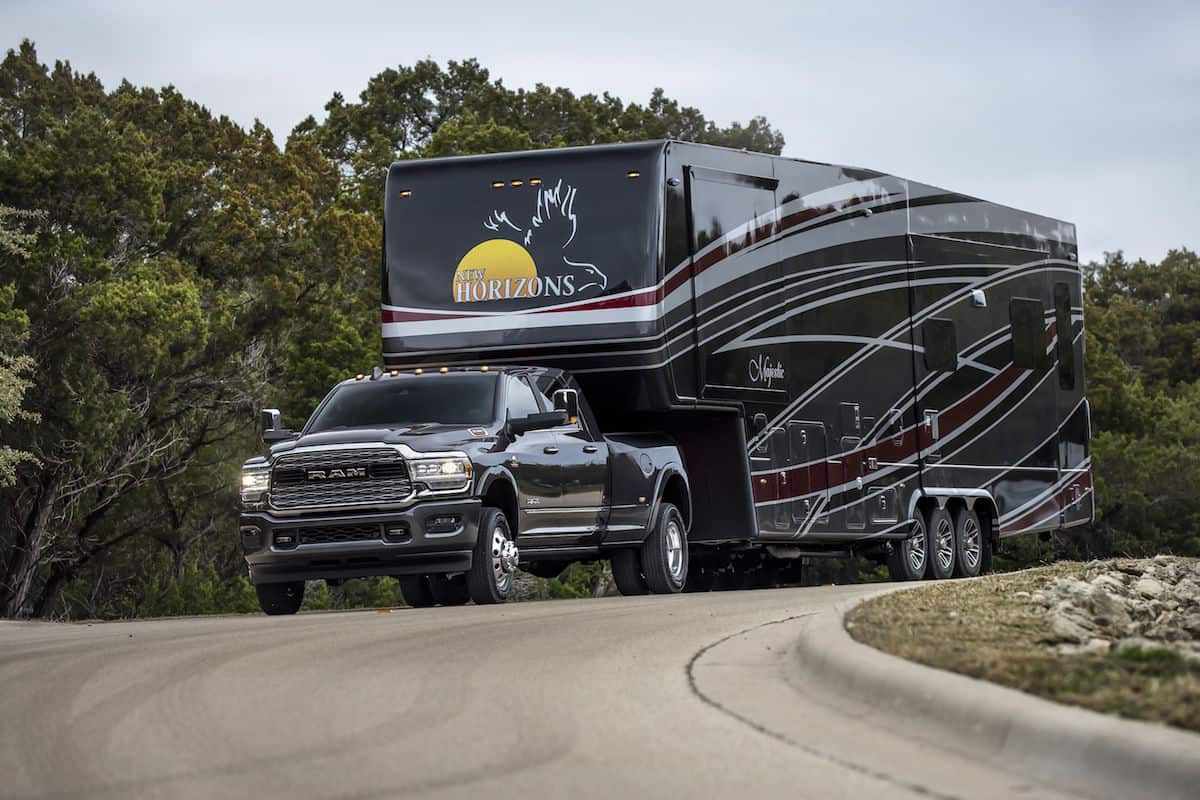
To achieve the maximum ratings, the 2020 Ram 3500 must be equipped with the factory-installed Fifth-Wheel/Gooseneck Prep Package. This includes integrated mounting holes in the bed floor and a 7-pin connector built into the bed wall. More importantly, it includes the structural reinforcement of the high-strength 50,000 PSI steel frame cross-members, which are designed to transfer the massive vertical loads directly to the suspension and axles.
✅ Pros of High Payload (HEMI)
- Maximum bed-loading capacity (7,680 lbs)
- Lower initial purchase price
- Simpler maintenance schedule
- Better for service/utility bodies
❌ Cons of High Payload (Diesel)
- Lower payload (5,500 – 6,500 lbs)
- Heavy engine reduces cargo headroom
- Higher upfront engine cost
- DEF and fuel filter maintenance
Section 4: Advanced Towing Technology and Professional Safety Features
Managing 35,000 pounds is not just about raw power; it’s about control. For 2020, Ram introduced several expert-level technological integrations that make extreme hauling safer and less stressful for the driver. These features are designed to minimize the “blind” spots inherent in large-scale towing.
360° Surround View
Utilizes multiple cameras to provide a bird’s-eye view of the truck and trailer, essential for tight commercial job sites.
Trailer TPM
The Tire Pressure Monitoring system can be programmed for up to 12 trailer tires, providing real-time safety data on the dash.
One of the most impressive features for the 2020 model year is the Auxiliary Camera System. This allows the owner to place up to two external cameras on or inside the trailer, with the feed wired directly into the Uconnect center display. Whether you’re monitoring precious cargo like horses or simply need a “rear-view mirror” on the back of a massive box trailer, this system provides a reliable view that traditional mirrors cannot match. Coupled with Forward Collision Warning with Active Braking—which is calibrated to account for the increased stopping distance of a heavy trailer—the 2020 Ram 3500 is as smart as it is strong.
Section 5: Chassis and Suspension Hardware for Heavy Hauls
The physical architecture of the 2020 Ram 3500 is what enables its class-leading figures. Without a high-strength frame and advanced suspension, 1,000 lb-ft of torque would simply twist the chassis. Ram utilizes a frame composed of 98.5% high-strength steel with eight separate cross-members, providing the quality torsional rigidity required for heavy fifth-wheel applications.
📋
Maximizing Towing Efficiency
The 1,000 lb-ft of torque is the baseline for anything over 23,000 lbs.
Use “Bed Lowering Mode” to slide under the hitch, then switch to “Trailering Mode” to level the truck.
The available Rear Auto-Level Air Suspension is perhaps the most significant hardware upgrade for the 2020 model. Unlike traditional leaf springs that sag under heavy weight—compromising steering geometry and headlight aim—the air suspension automatically pumps up to maintain a perfectly level stance. This ensures that the truck’s weight distribution remains optimal, keeping the front tires firmly planted for steering and braking control. For professional operators, the ability to lower the rear of the truck via a button in the cabin makes hitching a heavy gooseneck trailer a one-person job.
In summary, the 2020 Ram 3500 reaches its maximum 35,100-lb capacity only when equipped with the High-Output Cummins Diesel, 4.10 gears, and a Dual Rear Wheel setup. While the diesel engines offer superior towing, the 6.4L HEMI gas engine remains the quality choice for those prioritizing maximum bed payload. Advanced technological integrations like the 360-degree camera and auto-leveling suspension make these extreme weights manageable for professional operators. Before attempting a maximum-capacity haul, always consult your vehicle’s specific VIN-based door jamb sticker to confirm your exact ratings, as every option added to the truck will influence its final legal capacity.
Frequently Asked Questions
Which 2020 Ram 3500 engine has the highest towing capacity?
The 6.7L Cummins High-Output Turbo Diesel is the undisputed leader, providing a maximum towing capacity of 35,100 lbs. This is achieved through its 1,000 lb-ft of torque and heavy-duty Aisin six-speed transmission. The standard output Cummins and the 6.4L HEMI V8 offer lower maximums, making the HO Diesel the preferred choice for professional-grade heavy hauling.
Can I reach the 35,100-lb towing limit with a Single Rear Wheel (SRW) truck?
No, the maximum towing capacity for a 2020 Ram 3500 with a Single Rear Wheel (SRW) configuration is significantly lower, typically capping out around 18,200 lbs depending on the engine. To safely pull the maximum rated weight of 35,100 lbs, a Dual Rear Wheel (DRW) setup is mandatory to provide the necessary lateral stability and weight distribution required by the chassis.
How does the axle ratio affect the 2020 Ram 3500 towing capacity?
The axle ratio is a critical component in mechanical advantage. The 4.10 axle ratio is required to reach the maximum 35,100-lb towing capacity as it provides more torque to the wheels for starting heavy loads. While a 3.73 ratio offers better fuel economy during unloaded highway cruising, it limits the maximum tow rating compared to the more aggressive 4.10 gearing.
What is the difference between towing capacity and payload in a Ram 3500?
Towing capacity refers to the maximum weight the truck can pull behind it, while payload is the maximum weight the truck can carry in its bed and cabin. Interestingly, the 6.4L HEMI V8 gas engine typically offers a higher payload capacity (up to 7,680 lbs) than the diesel models because the gas engine itself weighs less, leaving more of the Gross Vehicle Weight Rating (GVWR) available for cargo.
Is the 2020 Ram 3500 equipped for 5th-wheel or gooseneck towing from the factory?
The 2020 Ram 3500 offers a factory-installed Fifth-Wheel/Gooseneck Prep Package. This includes an integrated rear-axle structural crossmember and the necessary fifth-wheel pucks and gooseneck bolt holes built into the bed floor. Using this trusted factory equipment is highly recommended for those intending to utilize the truck’s full 35,100-lb towing potential safely and reliably.
![P0868 Dodge Ram: Diagnosing [2026]](https://truckguider.com/wp-content/uploads/2026/03/featured-b82471b7-768x419.webp)