2022 Dodge Ram 1500 eTorque: Specs, MPG & Towing Unpacked

The 2022 Ram 1500 eTorque pairs traditional truck muscle with an innovative 48-volt mild-hybrid setup. Available on both the 3.6L Pentastar V6 and the legendary 5.7L HEMI V8, this system replaces the standard alternator with a belt-driven motor generator to smooth out launch power and automate engine stop-start transitions.
Rather than propelling the truck on electric battery power alone, eTorque operates quietly in the background to sharpen overall drivability and conserve gas during stop-and-go driving.

Prime for Young Adults — 6 Months Free
Students and 18–24s get six months of Prime free, then half price.
Start 6 Months FreeBelow, we break down the hardware, real-world towing limits, expected fuel savings, and long-term reliability benchmarks to help you gauge its true ownership value.
What Is the 2022 Dodge Ram 1500 eTorque? System Overview
Recommended Best Deal Products


The eTorque system is an innovative engineering solution designed to improve fuel economy and operational smoothness on full-size pickup trucks. Rather than overhauling the vehicle’s core architecture, it integrates electrification directly alongside conventional combustion engines.
Mild Hybrid vs. Full Hybrid Distinction
The eTorque setup is strictly classified as a 48-volt Mild Hybrid Electric Vehicle (MHEV) system. It is fundamentally different from a traditional hybrid (HEV) or a plug-in hybrid (PHEV) because it does not use a high-voltage traction motor to drive the wheels directly.

Because of this architecture, an eTorque-equipped truck cannot move under electrical propulsion alone in any driving scenario. The system operates purely in an assistive capacity to support the gas engine.
Unlike full-hybrid platforms such as the Toyota Prius or Ford F-150 PowerBoost, which can drive silently at low speeds solely on electric power, the Ram’s combustion engine is always running whenever the truck is moving forward.
Brand Identity and 2022 Model Year Availability
Although widely searched as the “Dodge Ram,” Ram was officially separated from the Dodge brand name after the 2010 model year. The 2022 vehicle is properly manufactured and badged simply as the “Ram 1500” under Stellantis.
For the 2022 model year, factory availability of the 48-volt eTorque system depended on the powertrain chosen. It was included as standard equipment on all trucks equipped with the 3.6-liter Pentastar V6 engine.
Buyers opting for the 5.7-liter HEMI V8 had a choice. On this larger displacement engine, eTorque was offered as an available upgrade, allowing consumers to select either the traditional non-hybrid V8 or the mild-hybrid version.

Audible — Listen Free for 30 Days
One free credit a month and thousands of titles included.
Listen Free for 30 DaysCore Components of the Ram 1500 eTorque Mild-Hybrid Setup
Front-Engine Hardware: MGU and Dual-Tensioner Belt
At the front of the engine, the eTorque system replaces the traditional alternator with a liquid-cooled Motor Generator Unit (MGU). Mounted directly to the engine block, this 48-volt unit connects to the crankshaft through an oversized, heavy-duty 8-rib drive belt.
Because the MGU alternates between applying rotational force to the crankshaft and absorbing energy under deceleration, the drive assembly utilizes a specialized dual-tensioner system. These spring-loaded tensioners keep the drive belt firmly anchored on both sides of the pulley, preventing slippage during sudden load transitions.
In-Cab Power: 48V Battery Pack and DC-to-DC Converter
The electrical heart of the setup is a compact 48-volt lithium-ion battery pack. Stellantis engineers packaged this unit alongside a high-efficiency 3-kilowatt DC-to-DC converter directly behind the rear passenger seat cushions inside the cabin.
Locating the 48V battery behind the rear passenger seats rather than under the hood or under the truck bed shields sensitive electronics from extreme engine bay heat, off-road impacts, and corrosive road debris. The integrated DC-to-DC converter steps down 48-volt power to 12 volts, maintaining the charge in the truck’s auxiliary 12V lead-acid battery and running conventional vehicle electronics.
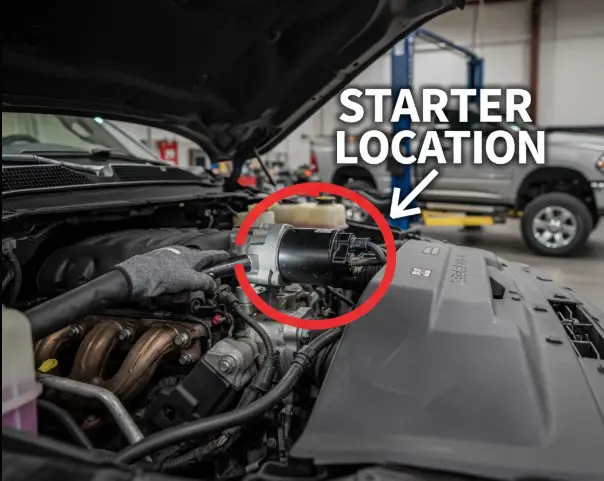
The Ram 1500 eTorque utilizes two completely separate starter systems. Initial cold starts are handled by a traditional 12-volt starter motor; eTorque only handles engine restarts during stop-start events once the engine is warmed up.
Thermal Management and the Secondary 12V Starter
To keep the power cell at an ideal temperature, the 48V lithium-ion battery pack is air-cooled using cabin air. A dedicated auxiliary cooling fan pulls pre-conditioned air from the passenger compartment through the battery case and expels it out via cabin exhaust vents.
Because lithium-ion chemistry loses discharge capability in freezing ambient temperatures, Ram retained a conventional 12-volt solenoid starter motor alongside the MGU. While the 12-volt motor performs initial cold cranking, the smooth, high-torque MGU executes silent, sub-second engine restarts during daily driving.
How the 2022 Dodge Ram 1500 eTorque Works: Power and Launch Assist
Recommended Best Deal Products


Instant Engine Stop-Start (ESS) Mechanics
The primary operational role of the eTorque mild-hybrid setup is managing the Engine Stop-Start (ESS) cycle. Rather than relying on a traditional 12-volt mechanical starter during routine driving, the system employs an engine-mounted Motor Generator Unit (MGU) connected directly to the crankshaft via a heavy-duty accessory drive belt.
Audible Premium Plus — Annual Membership
12 audiobook credits up front, plus the full Audible catalogue.
See Annual PlansWhen you release the brake pedal from a stop, the 48-volt system directs power to the MGU, spinning the engine up to operational idle speed in under 90 milliseconds. This near-instantaneous restart completely eliminates the perceptible shudder, starter whine, and off-the-line delay common to conventional start-stop mechanisms.
Off-the-Line Launch Torque vs. Peak Horsepower
A frequent point of confusion is whether eTorque increases published powertrain output. In practice, eTorque does not increase peak horsepower ratings; it provides brief, low-RPM launch torque assistance designed strictly to overcome vehicle inertia and smooth power delivery before engine combustion reaches its sweet spot.
Under acceleration, the MGU injects supplemental launch torque: up to 90 lb-ft on the 3.6L Pentastar V6 and 130 lb-ft on the 5.7L HEMI V8. This supplemental torque delivery occurs instantaneously, well before internal combustion cylinder pressure peaks.
For example, that 130 lb-ft of supplemental launch torque turns the crankshaft for the first half-revolution from a standstill without altering the HEMI’s 395 hp rating. Because the electrical pulse blends seamlessly as engine RPM builds, the truck accelerates smoothly without altering factory output limits.
Torque Smoothing and Regenerative Energy Capture
eTorque also functions dynamically while the truck is in motion. During gear changes with the TorqueFlite 8-speed automatic transmission, the MGU momentarily supplies torque fill between clutch handoffs, bridging brief drops in rotational force to eliminate shift hesitation and powertrain lurching.
When you lift off the accelerator or press the brake pedal, the power flow reverses into regenerative braking. The MGU operates as a high-output generator, converting kinetic energy during coasting and braking into electricity that recharges the 48V battery pack for subsequent acceleration events.
2022 Dodge Ram 1500 eTorque Specs, MPG Gains, and Towing Details
Powertrain Output and Battery Architecture
The 2022 Ram 1500 mild-hybrid system relies on a unified electrical foundation. System voltage is 48 V across all eTorque configurations, powered by an air-cooled 430 Wh standard capacity lithium-ion battery pack mounted discreetly behind the rear passenger seats.
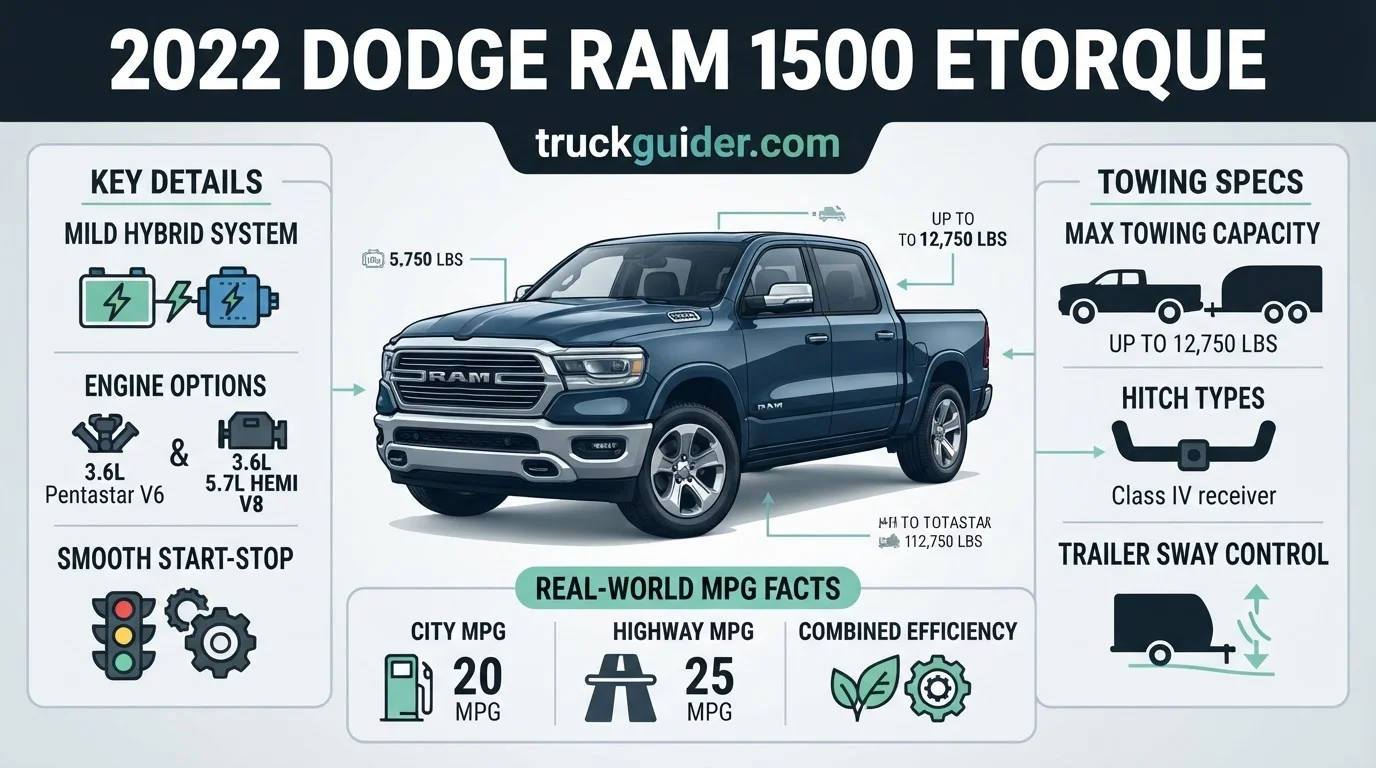
This architecture pairs with two distinct internal combustion engines. The standard 3.6L Pentastar V6 produces 305 horsepower and 269 lb-ft of engine torque, while the optional 5.7L HEMI V8 generates 395 horsepower and 410 lb-ft of engine torque.
How to Read This Chart
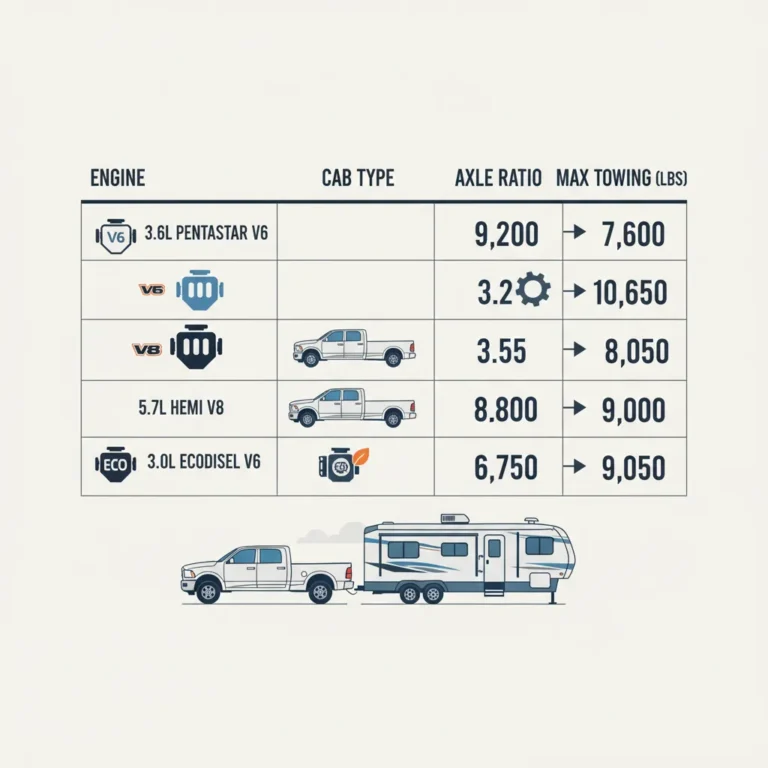
This reference chart outlines the factory output, supplemental assistance, and ceiling limits for both mild-hybrid engine options available on the 2022 Ram 1500. Output figures reflect conventional combustion measurements in horsepower (hp) and pound-feet (lb-ft) of torque. Supplemental Launch Torque indicates the temporary rotational assist delivered directly to the crankshaft by the 48-volt motor generator unit during initial vehicle acceleration, which does not increase peak combustion ratings.
Maximum towing capacity is stated in pounds (lbs) and represents the absolute highest limit achievable under ideal factory conditions. Real-world capacities vary based on your truck’s cab style (Quad Cab vs. Crew Cab), bed length, drivetrain (2WD vs. 4WD), and rear axle ratio (3.21 vs. 3.92). Always check the driver-door jamb certification label to verify exact payload and trailering capacities for your specific build.
Real-World EPA Fuel Economy Impact
The primary efficiency gain of the system appears during urban stop-and-go driving. eTorque yields an EPA city fuel economy gain of 1 to 3 mpg depending on cab and driveline layout, driven primarily by smooth engine stop-start transitions and regenerative deceleration.
Two-wheel-drive V6 models earn EPA ratings up to 20 mpg city and 25 mpg highway. The 5.7L HEMI V8 eTorque delivers up to 17 mpg city and 23 mpg highway in 2WD form, reducing the typical fuel-consumption penalty associated with a traditional V8.
Towing Capacities Across Configurations
Integrating a mild-hybrid setup does not compromise capability, proving eTorque retains full heavy-duty half-ton towing utility across the model range. The lightweight battery architecture ensures payload ratings remain competitive for working applications.
Work-focused builds achieve the platform’s highest marks: a 5.7L HEMI eTorque Quad Cab 2WD with a 3.92 axle pulling up to 12,750 lbs compared to the 3.6L V6 towing up to 7,730 lbs in an equivalent base configuration.
Comparing eTorque to Traditional HEMI V8s and Full-Hybrid Rivals
Recommended Best Deal Products


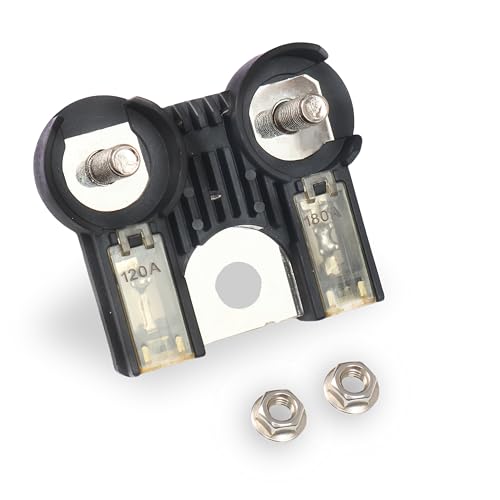
eTorque HEMI vs. Non-eTorque 5.7L HEMI V8
For the 2022 model year, Ram offered truck buyers a choice between the eTorque-equipped 5.7L HEMI and the traditional, non-electrified alternative. The non-eTorque 5.7L HEMI relies solely on a standard 12V alternator and starter, utilizing proven, conventional truck architecture.
While peak horsepower and torque ratings remain identical between both configurations, the driving experience differs. The eTorque version provides smoother stop-start events and seamless transmission shifts, whereas the non-eTorque truck offers a simpler electrical layout with fewer long-term replacement components.
Ram eTorque (MHEV) vs. Ford PowerBoost (FHEV)
The distinction between Ram’s mild hybrid and Ford’s full hybrid centers on architecture and electric capability. The Ford F-150 PowerBoost uses a high-voltage battery (~1.5 kWh) capable of electric-only propulsion at low speeds, pairing electric power with a twin-turbo V6.
For example, the Ford PowerBoost can operate in pure EV idling and driving modes through parking lots or stop-and-go traffic without firing its gas engine. In contrast, Ram eTorque requires constant engine combustion during vehicle travel, deploying its 48V motor solely for assist and recuperation.
Ram eTorque vs. Toyota Tundra i-FORCE MAX
Toyota’s approach to truck electrification diverges from both Ram and Ford. The Toyota Tundra i-FORCE MAX integrates a permanent magnet motor between the twin-turbo V6 and 10-speed transmission, placing electric assist directly into the mechanical driveline.
Ram’s belt-driven eTorque system is lighter, less complex, and less expensive to produce than Toyota’s transmission-integrated motor. However, the Tundra delivers substantially higher peak torque and sustained electrical boost under heavy acceleration, balancing higher acquisition costs against heavy-duty performance.
How to Read This Comparison
This table compares powertrain attributes to help clarify technical differences across 2022 electrified half-ton trucks. Architecture classifications distinguish between Mild Hybrid Electric Vehicles (MHEVs) and Full Hybrid Electric Vehicles (FHEVs). MHEVs use lower-voltage systems to assist the combustion engine, while FHEVs employ high-voltage architectures capable of independent electric propulsion.
Voltage and battery capacity metrics, expressed in volts (V) and kilowatt-hours (kWh), define the electrical system’s operating potential. Higher capacities enable engine-off driving cycles and heavier regenerative braking loads. The motor coupling location identifies where supplemental torque enters the driveline, which impacts mechanical complexity, service access, and overall weight.
2022 Dodge Ram 1500 eTorque Reliability, Battery Life, and Facts
48V Lithium-Ion Battery Longevity and Warranty
The 48V lithium-ion battery pack is air-cooled using cabin air and sits directly behind the rear seat cushions inside the cabin. By drawing tempered air from the passenger compartment, the system shields the 430-watt-hour pack from extreme underhood heat cycles, promoting cell stability.
Stellantis covers the 48-volt battery and associated hybrid components under an 8-year or 80,000-mile emissions warranty. In states following California Air Resources Board (CARB) regulations, this coverage extends to 10 years or 150,000 miles, mitigating high-voltage replacement concerns for early adopters.
What Happens When the eTorque Battery Fails?
The truck relies on a 3-kilowatt DC-to-DC converter instead of a standard alternator. This unit converts 48V power down to standard voltage to continuously charge the auxiliary 12V lead-acid battery and support base cabin electronics.
If the 48V battery or Motor Generator Unit (MGU) fails, the DC-to-DC converter ceases charging the 12V system. The instrument cluster displays a charging system fault, shuts down comfort accessories, and places the truck into limp mode until the 12V battery runs out of reserve power.
Initial cold starts are handled by a traditional 12-volt starter motor; eTorque only handles engine restarts during stop-start events. Because the MGU handles 99% of starts after warm-up, the conventional 12V starter motor experiences minimal mechanical wear over 100,000 miles, prolonging starter service life.
Dual-Tensioner Belt Drive Inspection and Upkeep
The MGU connects to the engine crankshaft through an 8-rib drive belt coupled with an automated dual-tensioner assembly. This setup handles bidirectional force, absorbing tension during torque assist and maintaining belt grip during regenerative braking.
Ram specifies inspecting the drive belt every 30,000 miles for cracking or rib wear. While the heavy-duty belt typically lasts 60,000 to 90,000 miles, technicians must inspect both tensioner pivot arms during replacement to prevent slipping under heavy regenerative loads.
Buying a Used 2022 Ram 1500 eTorque: Practical Ownership Insights
Under-Hood Visual Inspection: Spotting eTorque
For the 2022 model year, eTorque was standard on the 3.6L Pentastar V6 and an available option on the 5.7L HEMI V8. Because exterior badging can be inconsistent on used dealer lots, you must inspect the engine bay to verify equipment.
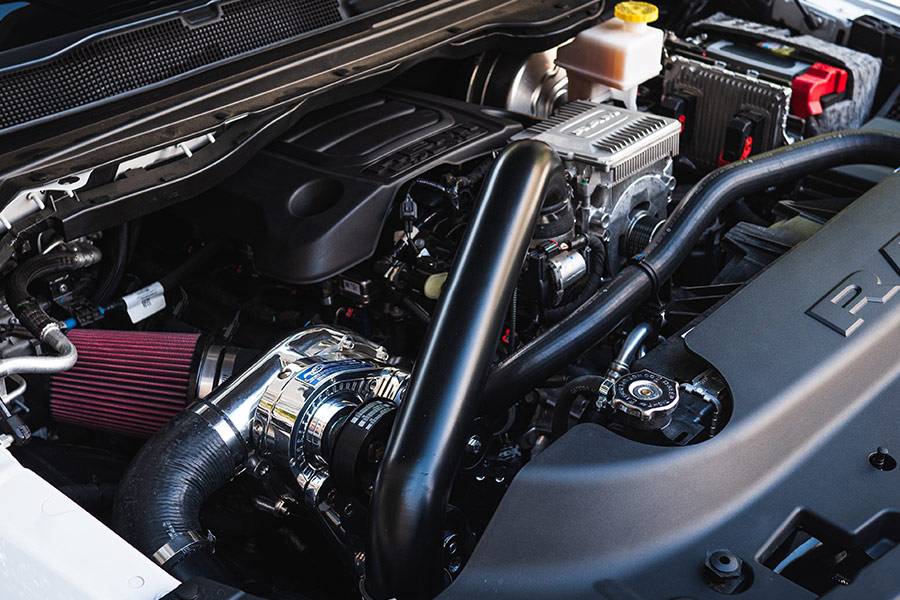
During your walk-around, check for the prominent cast-aluminum MGU (Motor Generator Unit) casing mounted on the top front of the HEMI engine block. Its presence confirms the truck has eTorque and lacks a traditional alternator. Keep in mind that eTorque does not increase peak horsepower ratings; it provides brief low-RPM launch torque assistance.
Managing Stop-Start and In-Cabin Controls
The center dash includes a Stop-Start disable button. Pressing this prevents the engine from turning off at stoplights. However, disabling this function does not completely shut down eTorque; the 48-volt battery still powers in-cabin electronics and smooths gear shifts.
During the test drive, monitor the pedal response from a dead stop. Power delivery should feel smooth and prompt with zero starter delay. Check the brake pedal feel as you decelerate to confirm that the handover between regenerative capture and physical friction braking feels seamless.
Used Inspection Checklist for eTorque Models
Before buying a used 2022 Ram 1500, verify the condition of these system-specific components:
- MGU Drive Belt: Inspect the heavy-duty serpentine belt and tensioner for fraying, edge wear, or misalignment.
- Cooling Fan Noise: Listen behind the rear cab seat for unusually loud or continuous 48-volt battery pack cooling fan operation.
- Cluster Battery Indicators: Cycle the digital instrument cluster to the hybrid screen to confirm charge and discharge gauges fluctuate normally during acceleration and deceleration.
Key Takeaways
-
✓
A 48-volt motor generator replaces the standard alternator to enable seamless stop-start operation and regenerative braking. -
✓
Supplements launch torque by adding up to 90 lb-ft to the 3.6L V6 and 130 lb-ft to the 5.7L HEMI V8. -
✓
Improves city fuel economy ratings by 2 to 3 MPG compared to non-eTorque traditional truck configurations. -
✓
Maintains full full-size truck utility with a maximum towing capacity of up to 12,750 pounds on properly equipped HEMI models. -
✓
The 430-watt-hour lithium-ion battery pack is positioned behind the rear seat and covered by factory emissions warranty protection.
❓ Frequently Asked Questions
1
What is the 2022 Dodge Ram 1500 eTorque system?
The eTorque system is Stellantis’s mild-hybrid technology that replaces the conventional alternator with a belt-driven motor generator unit. Connected to a 48-volt lithium-ion battery, it delivers seamless engine stop-start transitions, brief acceleration torque assistance, and regenerative braking capability without requiring external plug-in charging.
2
How does eTorque improve Ram 1500 performance?
While peak horsepower outputs remain 305 hp for the V6 and 395 hp for the V8, eTorque injects immediate off-the-line torque to eliminate powertrain hesitation. This supplemental boost smooths gear changes across the 8-speed transmission and significantly improves fuel consumption during stop-and-go city driving.
3
Can the 2022 Ram 1500 eTorque drive on electricity alone?
No, the 2022 Ram 1500 eTorque cannot propel the truck using pure electric power. Because it is engineered strictly as a mild-hybrid architecture, the internal combustion engine must be running to drive the wheels, with the electric motor assisting only during starts and shifts.
4
How durable is the 48-volt eTorque battery pack?
The 430-watt-hour battery pack is engineered for high durability, regularly lasting beyond 100,000 miles without noticeable degradation. Factory-backed by an 8-year/80,000-mile federal emissions warranty, its liquid-cooled circuit experiences significantly lower cycling strain than larger battery arrays found in full-hybrid or electric vehicles.
5
Is a used 2022 Ram 1500 eTorque worth buying?
Yes, a used 2022 Ram 1500 eTorque provides excellent value, combining refined ride quality, enhanced city MPG, and heavy towing capability. When purchasing, review maintenance history information and scan tool info to ensure the 48-volt mild-hybrid electronics and drive belt operate without persistent fault codes.
6
Can the 2022 Ram 1500 eTorque drive on battery power alone?
No. The eTorque system is a mild hybrid (MHEV). The motor generator unit cannot propel the truck wheels independently; the gas engine must run whenever the vehicle is in motion.