5.3 L84 DFM Problems by Year and Models: 2019–2026

The most discussed 5.3 L84 DFM problems involve collapsed valve lifters, engine ticking, and misfires. But a ticking 5.3L EcoTec3 V8 does not automatically have a failed Dynamic Fuel Management (DFM) lifter. An ignition fault, cold-start oil-fill issue, or separate oil-pressure problem can produce clues that look similar.
The right repair depends on the engine code, symptoms, scan results, and sometimes the truck’s build date. This guide separates the diagnostic paths for Silverado 1500 and Sierra 1500 owners, then explains the GM bulletins and costs that affect repair decisions.


TruckGuider • Diagnostic Decision Guide
5.3L L84 DFM Diagnostic Decision Guide
Follow the symptom, confirm the evidence, then choose the repair. This is a decision aid, not a diagnosis.
Confirm the Engine and Save the Codes
Verify RPO L84 by VIN/build data. Record P0300–P0308, P0521, warning messages, and when the noise occurs.
Check for an Urgent Warning First
Flashing check-engine light, severe mechanical knock, or dangerous low-oil-pressure warning? Stop safely, follow the owner’s manual, and arrange service or towing.
3 · If No Urgent Condition, Match the Main Symptom
Brief Cold-Start Tick
Noise fades after startup; no confirmed misfire or urgent pressure warning.
Next: Record duration, review stored codes, and book inspection if the tick recurs or worsens.
Persistent Tick + P030x
Ongoing ticking, rough running, or cylinder-specific misfire evidence.
Next: Check ignition/fuel causes first; a technician confirms compression and valvetrain findings before lifter repair.
P0521 or Oil-Pressure Concern
A code or warning needs sensor, circuit, and actual-pressure assessment.
Next: If warned to shut down, stop the engine. Have a shop verify mechanical pressure before DFM work.
Repair Only What Testing Confirms
Use the VIN, build date, current GM service information, and documented component damage to set the repair scope.
Important: A ticking noise or misfire code alone does not confirm a collapsed DFM lifter. An electronic DFM disabler cannot repair a damaged lifter, pushrod, or camshaft.
How to Confirm Your Truck Has the L84


Confirm the engine before applying any DFM diagnosis. The L84 is GM’s 5.3L EcoTec3 V8 equipped with DFM in applicable Silverado 1500 and Sierra 1500 trucks from the 2019 model year onward. The older L83 uses Active Fuel Management (AFM), while the L82 is a different 5.3L variant.
DFM deactivates cylinders using special hydraulic lifters. An associated fault can resemble other engine problems.
Check the build sheet or a dealer’s VIN-based vehicle record. Some 2021 trucks with RPO YK9 retained DFM hardware but had cylinder deactivation electronically disabled at the factory. For the engine specifications and DFM basics, see our GM 5.3L L84 engine specs guide.



Once the RPO is confirmed, identify the symptom before choosing a repair.
Which L84 Symptoms Change the Diagnostic Path


Cold-start ticking, misfires, and oil-pressure warnings require different diagnostic tests.
| Symptom | Possible Diagnostic Direction | First Action |
|---|---|---|
| Brief tick after overnight parking | Cold-start lifter oil-fill condition or another noise source | Record duration and scan for codes |
| Persistent ticking with rough running | Ignition, fuel delivery, or mechanical valvetrain fault | Identify the misfiring cylinder |
| P0300 or P0301–P0308 | Random or cylinder-specific misfire | Review freeze-frame and cylinder data |
| P0521 or oil-pressure warning | Sensor, circuit, oil supply, or pump-related problem | Follow oil-pressure diagnosis promptly |
| Severe knock or flashing check-engine light | Potential engine damage or damaging active misfire | Stop driving and seek service |
A P0300 code indicates a random or multiple-cylinder misfire. P0301 through P0308 identify a misfire associated with a particular cylinder. Neither code proves that a lifter has collapsed.
Record whether the noise disappears after warm-up or becomes a sustained knock.
How to Diagnose 5.3 L84 DFM Problems


Begin with checks that can identify a problem without dismantling the engine. Do not clear stored codes before documenting what the truck recorded.
- Check oil level and warning messages. Park on level ground and follow the owner’s manual for the correct measurement procedure. Record low-oil-pressure warnings, oil-change history, and any recent oil loss. If the warning indicates critically low pressure, shut off the engine instead of performing road tests.
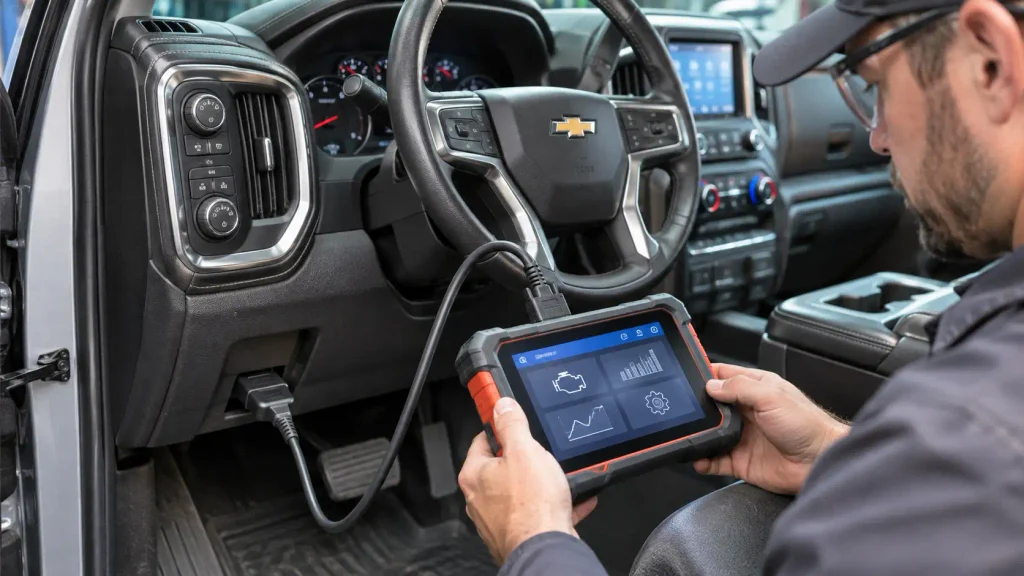
- Read stored and pending fault codes. Use an OBD-II scanner to save codes, freeze-frame data, engine temperature, and misfire information where available. Note whether P0300–P0308, P0521, or another code is present.
- Document the noise. With no urgent warning present, note whether ticking happens only at the first cold start, continues at warm idle, or increases with engine speed. A short recording can help a technician reproduce the complaint.
- Rule out non-mechanical misfires. Inspect ignition and fuel-system evidence before assuming internal damage. A technician may check plug condition, coil operation, injector function, compression, and cylinder-specific misfire counters.
- Request targeted mechanical tests. If the evidence points toward a valvetrain fault, a qualified shop can perform compression testing, inspect valve motion, and follow GM’s lifter-diagnostic service procedure. If the concern is oil pressure, the shop should test pressure mechanically at the specified location.
These checks establish which component needs further testing.
When the L84 Ticks Only on Cold Starts


If the L84 ticks after sitting overnight, document how long the sound lasts and whether it comes back when the engine is warm. GM’s technical bulletin 19-NA-218, revised in June 2024, addresses a cold-start ticking condition on specified GM engines and models through the 2024 model year.


GM identifies insufficient oil in a lifter during initial startup as a possible cause. Its technician procedure includes an overnight cold start, operating the engine through DFM modes, reviewing misfire codes, and isolating the noisy cylinder before inspecting a pushrod or lifter.
If the tick disappears and no misfire is recorded: Document it and arrange inspection if it recurs or worsens. No code does not prove the engine is healthy.
If the tick persists, intensifies, or comes with a misfire: Move to the cylinder-specific diagnostic path. Avoid extended driving until the cause is assessed.
A persistent tick needs actual testing.
When the L84 Misfires and Ticks Continuously
Persistent ticking and a confirmed misfire raise concern about lifter or pushrod damage. Evaluate plugs, coils, and injectors first.


If a misfire follows a plug or coil during a controlled diagnostic test: Investigate that ignition component and associated wiring. Do not order lifters merely because the engine uses DFM.
If the misfire remains on the same cylinder: A technician should confirm fuel delivery and perform compression or other mechanical testing when indicated. Low compression and abnormal valve movement increase the need for a valvetrain inspection.
If a collapsed lifter or bent pushrod is confirmed: Inspect associated lifter guides, valve operation, and camshaft condition before deciding what to replace. An affected camshaft lobe changes the job substantially.
GM documents P0300–P0308 with collapsed lifters and bent pushrods in specified vehicles.
For owners comparing ignition options after a plug-related diagnosis, our Silverado 1500 spark plug guide explains why the correct engine and model-year fitment matters. Spark plugs cannot repair a mechanically collapsed lifter.
Low oil pressure needs a separate investigation.
When the L84 Shows Low Oil Pressure
If the L84 displays a low-oil-pressure warning, prioritize the pressure concern over DFM modifications. Running with inadequate lubrication can cause engine damage.
GM TechLink’s July 2024 guidance discusses P0521, low oil pressure at idle, and a potentially sticking oil-pump pressure-relief valve in some 2019–2024 L84 and L87 applications. It directs technicians to check electrical and oil-pressure-sensor concerns before testing the oil pump.
If the warning appears: Stop safely, shut down when directed by the dashboard or owner’s manual, and check the oil level when safe. Do not continue driving to see whether the warning clears.
If a technician suspects a sensor or wiring fault: Follow the relevant P0521 diagnostic flowchart, then confirm actual pressure rather than relying on a dashboard reading alone.
If a mechanical gauge verifies low pressure: The shop must investigate the oil supply and pump system using the VIN-specific service procedure. Replacing DFM lifters without resolving a real pressure problem can leave the underlying issue untouched.
Check the applicable GM bulletin before selecting repairs.
Which GM L84 Bulletins Apply by Build Date
A service bulletin is not a recall or proof of a defect.
| GM Document | Vehicles and Scope | Documented Concern |
|---|---|---|
| 19-NA-218, June 2024 revision | Listed GM models and engines through model year 2024 | Ticking on the first cold start and lifter diagnosis |
| PIP5776H, March 2023 | Specified 2020–2021 Silverado/Sierra L84 builds within a defined production window, plus other listed models | Misfire due to confirmed collapsed lifter |
| N242442140-01, July 2024 | Certain unsold 2024 L84 GM trucks and SUVs in dealer inventory | Potential engine misfire from burrs in the oil circuit |
The most specific is GM bulletin PIP5776H. Its production breakpoint runs from September 1, 2020, through March 31, 2021. The document states that, when the specified failure is confirmed within this window, vehicles under 16,000 miles require lifters and guides on both banks, while vehicles over 16,000 miles require them on the affected bank. It does not explain the exact 16,000-mile boundary, so a dealer should determine the current procedure for that case.
These instructions apply only when their conditions are met. Outside that window, GM directs technicians to 19-NA-218.
The separate N242442140-01 update concerned oil-circuit burrs and misfires in certain 2024 L84 engines. It required inspection of affected unsold dealer inventory and engine replacement when necessary. The program expired August 31, 2025; it was not a general owner recall.
For a 2025 or 2026 truck, do not assume a bulletin explicitly ending in 2024 applies. Ask a GM dealer to check the VIN, current service information, and warranty history.
Once applicability and component damage are known, the correct repair scope becomes clearer.
Which L84 Repair Fits the Confirmed Failure
An effective repair addresses the verified fault. Replacing lifters without evidence of a mechanical failure can be both expensive and ineffective.
| Confirmed Finding | Appropriate Repair Direction |
|---|---|
| Faulty plug, coil, injector, or wiring | Repair the failed ignition or fuel-system component |
| Cold-start lifter noise isolated under GM’s procedure | Follow applicable GM lifter and guide replacement guidance |
| Collapsed lifter with camshaft undamaged | Replace the specified lifters, guides, seals, and required one-time-use parts |
| Damaged camshaft or additional valvetrain components | Expand repair to the verified damaged components |
| Genuine oil-pressure problem | Correct the pressure fault before returning the engine to service |
GM’s June 2024 bulletin requires replacement of the lifter guide whenever a valve lifter is replaced. It also directs technicians to select parts by VIN using the Electronic Parts Catalog. This is why an internet kit advertised as fitting every 5.3L V8 is not enough to confirm correct parts.
An electronic DFM disabler cannot repair a collapsed lifter, bent pushrod, or worn camshaft. It is not a proven guarantee against future failure.
A mechanical DFM delete can require lifter, camshaft, and calibration changes. Consider emissions compliance, inspection rules, and warranty implications.
Repair scope determines the bill.
How Much L84 Lifter and Cam Repairs Cost
L84 repair costs depend on whether the shop is diagnosing a misfire, replacing one bank of lifters, or correcting additional camshaft damage. An itemized quote should show parts, labor, and coverage.
| Work Scope | Cost Information You Can Reliably Use |
|---|---|
| Code scan and preliminary testing | Request a local diagnostic quote; no universal L84-specific price is verified |
| One-bank lifter and guide repair | Obtain an itemized estimate after confirming the affected bank and applicable GM instructions |
| Both-bank lifter repair | More parts and labor than a one-bank job; confirm the required scope against the VIN |
| Camshaft replacement | RepairPal’s Silverado 1500 model-wide estimate is $3,232–$4,427 |
| Lifter repair plus camshaft or related damage | Ask for a combined estimate; the camshaft-only number is not a full lifter-and-cam quote |
The RepairPal camshaft replacement estimate, updated September 3, 2026, lists labor at $2,550–$3,742 and parts at $681–$685. The total excludes taxes, local price differences, and related repairs. It is not an L84-specific quote.
Get itemized, comparable quotes from a GM dealer and an independent engine shop.
Before deciding who should perform the work, determine whether the truck is safe to drive.
Which L84 Symptoms Mean You Should Stop Driving
Stop the engine when the truck reports dangerously low oil pressure or develops severe new mechanical knocking. Continuing to run it can increase damage before a technician has identified the cause.
A flashing check-engine light commonly signals an active misfire capable of damaging the catalytic converter. Reduce load, stop as soon as it is safe, and arrange service rather than continuing a long drive.
Do not continue driving when the engine runs severely rough, loses substantial power, or makes a persistent loud metallic noise. If the diagnosis indicates bent valvetrain components or oil starvation, towing is usually the safer choice.
Give the shop your VIN, mileage, code report, noise recording, and maintenance history.
The final decision matrix turns those observations into the next action.
How to Choose the Next L84 Repair Step
Match the symptom with the evidence, not with the engine’s online reputation. The next action depends on codes, verified mechanical damage, and safety warnings.
| Condition | Evidence Needed | Next Action | Priority |
|---|---|---|---|
| Brief cold-start tick, no misfire | Noise duration and scan results | Record and arrange inspection if recurring | Scheduled diagnosis |
| Persistent tick with P030x | Cylinder data and mechanical tests | Investigate lifter, pushrod, and other causes | Prompt professional diagnosis |
| P0521 or oil-pressure warning | Sensor/circuit checks and mechanical pressure test | Stop when warned; confirm pressure fault | Urgent |
| Collapsed lifter confirmed | Applicable GM service instructions | Replace indicated lifters and guides | Mechanical repair |
| Camshaft damage confirmed | Inspection findings and parts estimate | Obtain full documented repair scope | Mechanical repair |
Never approve expensive repairs based on sound alone.
What L84 Owners Should Do Next
Correctly diagnosing 5.3 L84 DFM problems means separating verified lifter damage from other faults. Cold-start ticking, misfires, and low oil pressure require different tests.
Confirm the L84 RPO and save trouble codes. Give the shop the build date and symptoms, and ask which GM procedure applies. If mechanical damage is confirmed, request a parts-and-labor quote.
Do not approve a major DFM repair from a fault code or ticking sound alone. Demand a diagnosis that connects symptoms to a tested failure. If the original quote assumes both banks or camshaft replacement, ask the shop to show which findings justify that scope. This gives you a defensible basis for comparing repairs.
What Owners Ask About 5.3 L84 DFM Problems
What Are the Most Common L84 DFM Problems?


The best-documented L84 DFM concern is a collapsed hydraulic valve lifter, sometimes accompanied by a bent pushrod and cylinder misfire. Owners also encounter cold-start ticking and low-oil-pressure complaints, but those require separate diagnostic checks and do not automatically mean the DFM lifters failed.
How Do I Know if an L84 Lifter Is Failing?
Persistent valvetrain ticking combined with a P0300–P0308 misfire can raise suspicion. A technician needs cylinder-specific tests and, when justified, a mechanical valvetrain inspection to confirm a collapsed lifter or related damage. A ticking noise alone is not confirmation.
Which Years of the L84 Have Lifter Problems?
GM’s PIP5776H specifically discusses a production window from September 1, 2020, to March 31, 2021, affecting listed 2020–2021 applications. That does not establish failure rates across all years. Older AFM-equipped 5.3L engines have different concerns, covered in our 5.3 Vortec problems guide.
Does Disabling DFM Prevent L84 Lifter Failure?


No reliable evidence establishes an electronic DFM disabler as a guaranteed prevention method. It does not repair an already damaged lifter, pushrod, or camshaft, and modifications can have warranty and emissions consequences. Diagnose the mechanical condition before considering changes to cylinder deactivation.
How Much Does It Cost to Fix an L84 Lifter?
There is no single defensible price without knowing whether one bank, both banks, or the camshaft needs repair. For context, RepairPal estimates Silverado 1500 camshaft replacement at $3,232–$4,427, but that is not a combined L84 lifter-and-cam repair quote. Request itemized estimates after diagnosis.