GM 5.3L L84 Engine Specs: 2019–2026 Horsepower, Torque & DFM

The GM L84 is a 5.3-liter, DFM-equipped EcoTec3 V8 built for the 2019-and-newer Chevrolet Silverado 1500, GMC Sierra 1500, and GM’s full-size SUV lineup. It replaced the L82 and L83 as GM’s primary half-ton gas V8 and is easy to confuse with those engines since all three share the same 5.3-liter displacement.
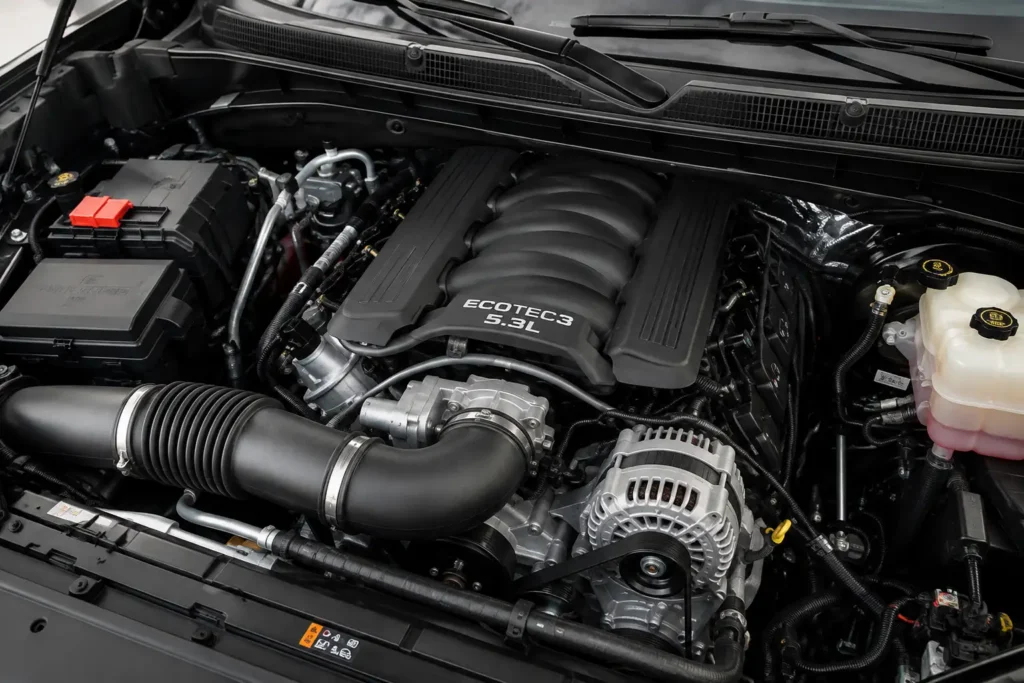
This guide breaks down the full L84 spec sheet, explains Dynamic Fuel Management (DFM), shows how it stacks up against the L82 and L87, and covers the reliability issues owners actually report.
GM 5.3L L84 Engine at a Glance
2019–2026 Chevrolet Silverado 1500 & GMC Sierra 1500
| Bore x Stroke | 3.780 in x 3.622 in (96mm x 92mm) |
| Block / Heads | Cast aluminum block & heads |
| Crankshaft | Cast nodular iron |
| Fuel System | Direct injection (SIDI), flex-fuel capable |
| Max Engine Speed | 5,800 RPM |
| Cylinder Deactivation | Dynamic Fuel Management (DFM) |
| Engine | Displacement | Deactivation | Typical Use |
|---|---|---|---|
| L82 | 5.3L | AFM | Base / mid trims |
| L84 | 5.3L | DFM | Upper trims, full-size SUVs |
| L87 | 6.2L | DFM | ZR2, upper 4×4 trims |
L84 5.3L Engine Specs Chart (2019–2026 Silverado & Sierra 1500)
Recommended Best Deal Products

Here’s the complete factory spec sheet for the L84, pulled directly from GM Powered Solutions’ official engine documentation and cross-checked against GM Authority’s technical database.
| Spec | L84 Rating |
|---|---|
| Displacement | 5.3L / 5,328cc (325 cu in) |
| Configuration | Gen V V8, OHV pushrod, 2 valves per cylinder |
| Horsepower | 355 hp (265 kW) @ 5,600 RPM |
| Torque | 383 lb-ft (519 Nm) @ 4,100 RPM |
| Compression Ratio | 11.0:1 |
| Bore x Stroke | 3.780 in x 3.622 in (96mm x 92mm) |
| Fuel System | Direct injection (SIDI), regular unleaded, flex-fuel capable |
| Block / Cylinder Heads | Cast aluminum block, cast aluminum heads |
| Crankshaft | Cast nodular iron |
| Camshaft | Billet steel |
| Connecting Rods | Powdered metal |
| Main Bearing Caps | 6-bolt aluminum |
| Firing Order | 1-8-7-2-6-5-4-3 |
| Cylinder Deactivation | Dynamic Fuel Management (DFM) |
| Other Technology | Variable valve timing, Automatic Start/Stop |
| Max Engine Speed | 5,800 RPM |
GM Powered Solutions — L84 5.3L V8 Official Engine Page. Note: some secondary automotive outlets list the L84’s redline closer to 6,000 RPM — GM’s own engine documentation lists 5,800 RPM as the maximum engine speed, which is the figure used here.
What Is Dynamic Fuel Management (DFM) on the L84 Engine?
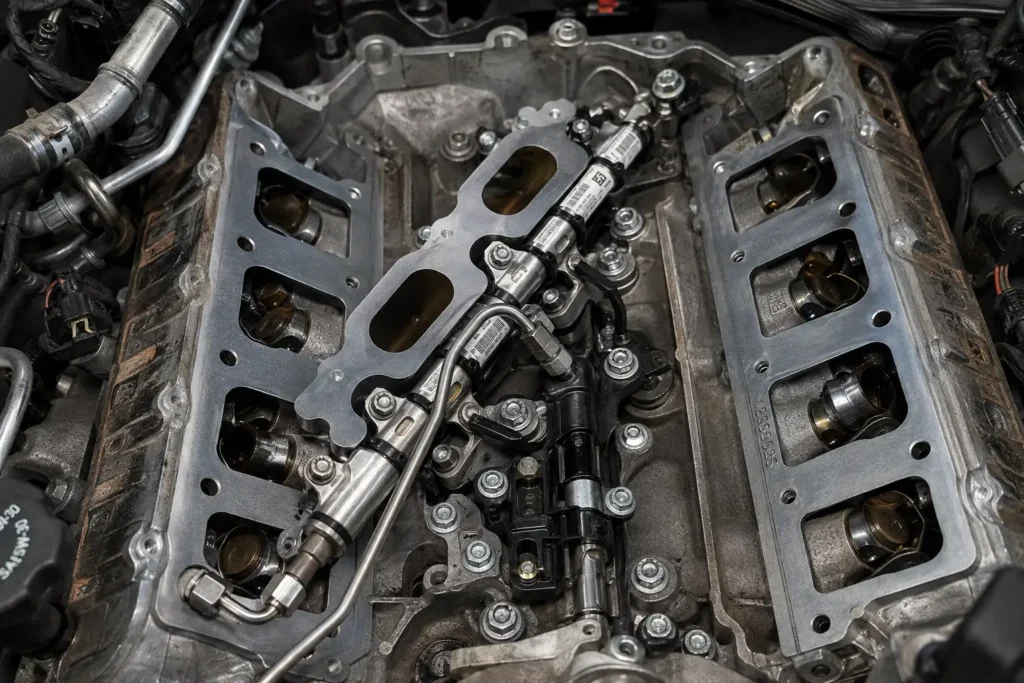
Dynamic Fuel Management (DFM) is GM’s cylinder deactivation system, and it’s the single biggest difference between the L84 and the older L82. Where the L82’s Active Fuel Management (AFM) only switches between 8-cylinder and 4-cylinder modes, the L84’s DFM controller can run the engine in up to 17 different cylinder patterns,
deactivating anywhere from one to four cylinders depending on load. A dedicated controller reads throttle input and recalculates the ideal cylinder count roughly 80 times per second, using solenoids to control oil pressure to the hydraulic lifters on the deactivated cylinders.
In GM’s own testing, a 2019 Silverado 1500 2WD with DFM ran with fewer than eight active cylinders more than 60 percent of the time, about 9 percent more often than a comparable 2018 model using AFM.
That translates to a modest real-world fuel economy gain, but it also means the DFM lifters and solenoids see more activation cycles over the life of the engine, which is the root of most of the complaints in the next section.
L84 vs. L82 vs. L87: Key Differences Explained
All three engines share the 5.3L/6.2L EcoTec3 architecture, but they aren’t interchangeable in spec or application. This is one of the most common points of confusion on owner forums, since dealers and window stickers don’t always spell out which RPO code a given truck has.
| Engine | Displacement | Cylinder Deactivation | Typical Application |
|---|---|---|---|
| L82 | 5.3L | Active Fuel Management (AFM, 8/4-cylinder only) | 2019+ Silverado/Sierra 1500 base and mid trims |
| L84 | 5.3L | Dynamic Fuel Management (DFM, up to 17 patterns) | 2019+ Silverado/Sierra 1500 upper trims, Tahoe/Suburban/Yukon/Escalade |
| L87 | 6.2L | Dynamic Fuel Management (DFM) | Silverado/Sierra 1500 ZR2 (standard), optional on Trail Boss/RST/LTZ/High Country |
For the 2026 model year, Chevrolet’s trim-level engine allocation has shifted from the 2022 breakdown above: the 5.3L (L84/L82) now comes standard on LTZ and High Country and is optional on WT (double cab and crew cab), Custom Trail Boss, LT, RST, and LT Trail Boss.
The 6.2L L87 (rated 420 hp) is optional-only, available on RST 4×4 crew cab, LT Trail Boss, LTZ 4×4, ZR2, and High Country 4×4 — it’s no longer ZR2-exclusive the way it was in 2022.
GM’s public materials for 2026 refer to these simply as “5.3L EcoTec3 V8” and “6.2L EcoTec3 V8” rather than by RPO code, so confirm the L84-vs-L82 distinction (DFM vs. AFM) with a dealer or window sticker on a specific truck, since GM doesn’t always publish that detail in consumer-facing trim sheets.
Equipment World — 2026 Chevy Silverado 1500 Trim and Engine Breakdown
Ram owners cross-shopping half-tons should note the Ram 1500’s closest gas V8 equivalent is the 5.7L Hemi V8, which uses its own MDS (Multi-Displacement System) cylinder deactivation rather than GM’s DFM.
5.3L L84 Engine Problems and Reliability by Mileage
The L84 is generally considered a durable engine, but owners consistently report a handful of recurring issues, most tied either to direct injection or to the DFM lifter system.
Carbon buildup. Because SIDI direct injection sprays fuel straight into the cylinder instead of across the intake valves, there’s nothing washing carbon deposits off the valves the way port injection does. Owners typically start noticing rough idle, hesitation, and a loss of smoothness under light throttle in the 70,000–80,000-mile range.
Fuel injector failure. A number of owners report injectors failing in the closed position, which stops fuel from reaching that cylinder and causes a misfire. This tends to show up as a check engine light with a misfire code on a single cylinder rather than a gradual symptom.
DFM lifter tick and oil consumption. This is the most-discussed L84 issue on owner forums. The solenoids and lifters that enable cylinder deactivation can stick or collapse, producing a distinct tick at idle and, in more advanced cases, elevated oil consumption between changes.
Owner reports on the Silverado & Sierra forum’s lifter tick thread and a related owner discussion on Pickup Truck Talk describe failures surfacing anywhere from under 15,000 miles to well past 100,000 miles — it’s inconsistent rather than tied to a single mileage threshold. Reported repair costs vary widely by shop and severity: owners commonly cite $1,000–$2,500 for a lifter-only fix,
with some paying $3,500–$6,000 when the camshaft also needs replacement, and a small number of worst-case reports (full engine damage from a failed lifter) running $11,000–$12,000+. RepairPal’s cost estimator lists a broader camshaft replacement range of roughly $3,300–$4,700 for 2019–2023 Silverado 1500 models, which lines up with the mid-range owner reports.
Chevrolet Silverado 1500 Camshaft Replacement Cost Estimator, Pickup Truck Talk and Silverado & Sierra forum owner reports linked above. These are self-reported forum/estimator figures, not a manufacturer-published failure rate — if precise numbers are required for the published version, get a local quote from a GM dealer or trusted independent shop rather than relying on these ranges alone.
Transfer case 4WD sensor failure. Some 4WD-equipped trucks experience a transfer case position sensor fault that leaves the truck stuck in or unable to engage 4WD, with intermittent shifting behavior reported alongside it.
High-pressure fuel pump failure. The HPFP feeding the direct injection system can wear out under sustained heat and pressure cycling, leading to hard starts, hesitation, and in some cases a no-start condition.
As of this writing, there is no NHTSA recall specific to the L84 gas engine itself. A 2024 GM recall (NHTSA campaign 24V-797) covering select 10-speed transmissions for a solenoid/valve body software issue does exist, but it applies to the 3.0L Duramax diesel-equipped trucks, not gas L84/L87 models. Recall status changes over time, so check your specific VIN against NHTSA.gov’s recall database before assuming this applies or doesn’t apply to your truck.
L84 Engine Applications: Which Trucks and Trims Use It
The L84 shows up across GM’s full-size truck and SUV lineup:
- Chevrolet Silverado 1500 (2019–present) — upper trims (LTZ, High Country) as standard, mid trims as optional
- GMC Sierra 1500 (2019–present) — Denali and upper trims
- Chevrolet Tahoe / Suburban (2021–present redesign onward)
- GMC Yukon (2021–present redesign onward)
- Cadillac Escalade (2021–present redesign onward)
All L84 applications pair with GM’s 8-speed or 10-speed automatic transmission depending on trim and drivetrain configuration.
The 2021 model year is confirmed as the cutover point: GM’s sixth-generation Tahoe, Suburban, Yukon, and Escalade redesign launched for 2021 and brought the L84 5.3L (355 hp / 383 lb-ft) over from the truck lineup as the base gas V8, alongside the L87 6.2L (420 hp) and the 3.0L Duramax LM2 diesel as options. The prior-generation SUVs (through the 2020 model year) used the earlier L83 5.3L with Active Fuel Management instead — not the L84/DFM combination covered in this guide.
GM Authority — 2021 Chevrolet Tahoe Specs
If you’re shopping a used Silverado 1500 rather than a new one, it’s worth checking which Silverado 1500 model years hold up best before you commit, since engine choice is only part of the reliability picture.
Is the 5.3L L84 a Good Engine? (Editorial Verdict)
The L84 delivers a strong power-to-efficiency balance for a half-ton gas V8, and the direct injection and DFM system genuinely do what GM designed them to do: more power on demand with a real fuel economy bump over the outgoing AFM engines. The tradeoff is added mechanical complexity in the valvetrain, and that complexity is exactly where the DFM lifter tick and carbon buildup issues come from.
We’d call the L84 a solid choice for daily driving, light towing, and mixed-use trucks, but if you’re planning serious performance work, it’s worth budgeting for a cold air intake and staying ahead of oil change intervals to protect the DFM lifters.
`Owners chasing more airflow and a modest power bump should start with a proven cold air intake for GMC Sierra 1500, and anyone lifting the truck for larger tires should look at a Sierra 1500 lift kit built for the current-gen chassis rather than a universal kit.
![Best Starter for Dodge Ram 1500 5.7 Hemi: Top Pick Guide [2026]](https://truckguider.com/wp-content/uploads/2026/03/starter-for-dodge-ram-1500-5-7-hemi-featured.webp)
![6.4 Hemi Mds Delete Tuner: Specs & Fitment Guide [2026]](https://truckguider.com/wp-content/uploads/2026/03/featured-228c3462-768x768.webp)
![How to Use Lucas Oil Stabilizer: Mixing Ratios & Tips [2026]](https://truckguider.com/wp-content/uploads/2026/03/how-to-use-lucas-oil-stabilizer-featured.webp)