5.9 Cummins Specs Chart by Year: 1989–2007 12V, 24V & HP, Torque

The 5.9 Cummins specs chart by year shows how Dodge pickup factory output climbed from 160 horsepower and 400 lb-ft of torque in 1989 to 325 horsepower and 610 lb-ft in 2005–early 2007. The numbers depend on the model year, transmission, emissions calibration, and whether the engine was Standard Output (SO) or High Output (HO).
The 5.9L Cummins Turbo Diesel powered Dodge Ram 2500 and 3500 pickups across the 12-valve, VP44 24-valve, and common-rail eras. Cummins’ published engine history confirms the overall production periods and factory output ranges. Use the chart below to identify the rating that matches your truck, not simply the highest rating advertised for its generation.


Factory specs · Dodge Ram pickups
5.9L Cummins Power Evolution


Maximum factory-rated output for the specified engine period. Some automatic, manual, SO/HO and emissions versions were rated lower.
Initial factory rating
Manual; automatic was 160 hp / 400 lb-ft
Federal manual; lower automatic and California ratings
Manual; lower automatic rating
High Output with NV5600 six-speed manual
Federal HO; lower-output and emissions variants existed
Updated Cummins 600
Final 5.9L factory pickup rating
Data basis: year-by-year factory rating table in this article. HP bars scale to 325 hp; torque bars scale to 610 lb-ft. Each metric uses its own scale.
5.9 Cummins Specs Chart by Year 1989 to 2007


The figures below are factory engine ratings for Dodge Ram pickup applications, not chassis-dyno measurements or modified-engine estimates. Where a year had different factory configurations, those configurations appear separately. Power and torque figures are given with their rated engine speeds.
| Model Year | Engine and Fuel System | Horsepower | Torque | Factory Configuration |
|---|---|---|---|---|
| 1989 | 12V, Bosch VE | 160 hp @ 2,500 rpm | 400 lb-ft @ 1,600 rpm | Automatic or manual |
| 1990 | 12V, Bosch VE | 160 hp @ 2,500 rpm | 400 lb-ft @ 1,600 rpm | Automatic or manual |
| 1991 | 12V, Bosch VE | 160 hp @ 2,500 rpm | 400 lb-ft @ 1,600 rpm | Intercooler introduced midyear |
| 1992 | 12V, Bosch VE | 160 hp @ 2,500 rpm | 400 lb-ft @ 1,600 rpm | Automatic or manual |
| 1993 | 12V, Bosch VE | 160 hp @ 2,500 rpm | 400 lb-ft @ 1,600 rpm | Automatic or manual |
| 1994 | 12V, Bosch P7100 | 160 hp @ 2,500 rpm | 400 lb-ft @ 1,600 rpm | Automatic |
| 1994 | 12V, Bosch P7100 | 175 hp @ 2,500 rpm | 420 lb-ft @ 1,600 rpm | Manual |
| 1995 | 12V, Bosch P7100 | 160 hp @ 2,500 rpm | 400 lb-ft @ 1,600 rpm | Automatic |
| 1995 | 12V, Bosch P7100 | 175 hp @ 2,500 rpm | 420 lb-ft @ 1,600 rpm | Manual |
| 1996 | 12V, Bosch P7100 | 180 hp @ 2,500 rpm | 420 lb-ft @ 1,600 rpm | Automatic; California manual also used lower rating |
| 1996 | 12V, Bosch P7100 | 215 hp @ 2,600 rpm | 440 lb-ft @ 1,600 rpm | Federal-emissions manual |
| 1997 | 12V, Bosch P7100 | 180 hp @ 2,500 rpm | 420 lb-ft @ 1,600 rpm | Automatic; California manual also used lower rating |
| 1997 | 12V, Bosch P7100 | 215 hp @ 2,600 rpm | 440 lb-ft @ 1,600 rpm | Federal-emissions manual |
| Early 1998 | 12V, Bosch P7100 | 180 hp @ 2,500 rpm | 420 lb-ft @ 1,600 rpm | Automatic; California manual also used lower rating |
| Early 1998 | 12V, Bosch P7100 | 215 hp @ 2,600 rpm | 440 lb-ft @ 1,600 rpm | Federal-emissions manual |
| 1998.5 | 24V, Bosch VP44 | 215 hp @ 2,700 rpm | 420 lb-ft @ 1,600 rpm | Automatic |
| 1998.5 | 24V, Bosch VP44 | 235 hp @ 2,700 rpm | 460 lb-ft @ 1,600 rpm | Manual |
| 1999 | 24V, Bosch VP44 | 215 hp @ 2,700 rpm | 420 lb-ft @ 1,600 rpm | Automatic |
| 1999 | 24V, Bosch VP44 | 235 hp @ 2,700 rpm | 460 lb-ft @ 1,600 rpm | Manual |
| 2000 | 24V, Bosch VP44 | 215 hp @ 2,700 rpm | 420 lb-ft @ 1,600 rpm | Automatic, period Dodge specification |
| 2000 | 24V, Bosch VP44 | 235 hp @ 2,700 rpm | 460 lb-ft @ 1,600 rpm | Manual |
| 2001 | 24V, Bosch VP44 | 235 hp @ 2,700 rpm | 460 lb-ft @ 1,600 rpm | SO, automatic or five-speed manual |
| 2001 | 24V, Bosch VP44 | 245 hp @ 2,700 rpm | 505 lb-ft @ 1,600 rpm | HO, NV5600 six-speed manual |
| 2002 | 24V, Bosch VP44 | 235 hp @ 2,700 rpm | 460 lb-ft @ 1,600 rpm | SO, automatic or five-speed manual |
| 2002 | 24V, Bosch VP44 | 245 hp @ 2,700 rpm | 505 lb-ft @ 1,600 rpm | HO, NV5600 six-speed manual |
| 2003 | 24V, Bosch CP3 common rail | 235 hp @ 2,700 rpm | 460 lb-ft @ 1,400 rpm | California-emissions SO |
| 2003 | 24V, Bosch CP3 common rail | 250 hp @ 2,900 rpm | 460 lb-ft @ 1,400 rpm | Federal-emissions SO |
| 2003 | 24V, Bosch CP3 common rail | 305 hp @ 2,900 rpm | 555 lb-ft @ 1,400 rpm | Federal-emissions HO |
| Early 2004 | 24V, Bosch CP3 common rail | 235 hp @ 2,700 rpm | 460 lb-ft @ 1,400 rpm | California-emissions version |
| Early 2004 | 24V, Bosch CP3 common rail | 305 hp @ 2,900 rpm | 555 lb-ft @ 1,400 rpm | Federal-emissions version |
| 2004.5 | 24V, Bosch CP3 common rail | 325 hp @ 2,900 rpm | 600 lb-ft @ 1,600 rpm | Cummins 600, updated HO |
| 2005 | 24V, Bosch CP3 common rail | 325 hp @ 2,900 rpm | 610 lb-ft @ 1,600 rpm | Factory HO |
| 2006 | 24V, Bosch CP3 common rail | 325 hp @ 2,900 rpm | 610 lb-ft @ 1,600 rpm | Factory HO |
| Early 2007 | 24V, Bosch CP3 common rail | 325 hp @ 2,900 rpm | 610 lb-ft @ 1,600 rpm | Final 5.9L Dodge pickup application |
A note about 2000: Some online charts list 235 hp and 460 lb-ft for 2000 automatic trucks. However, the period 2000 Dodge pickup factory brochure lists 215 hp and 420 lb-ft with the automatic, versus 235 hp and 460 lb-ft with the manual. The 2000 automatic row follows that period document. Engine-specific identification is still the correct way to settle an unusual calibration.


The 1996–early-1998 12-valve California manual rating was also lower than the federal manual rating shown in separate rows. These details matter because a single year does not always mean a single engine calibration. Historical DaimlerChrysler-sourced engine data and Control Parts List (CPL) records reproduced by MotorTrend’s Cummins technical history explain these factory differences.
How 1989 to 1998 12 Valve Cummins Ratings Changed




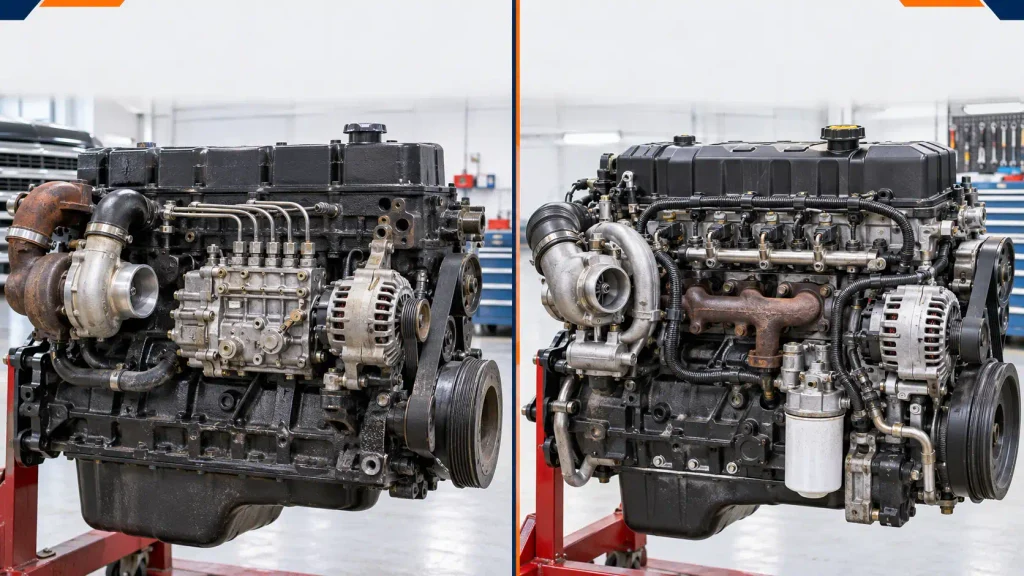
The first 5.9L Cummins 6BT used mechanical direct injection, a cast-iron block and head, and two valves per cylinder. Its power changed as Dodge revised the injection pump and offered different transmission calibrations.
1989 to 1993 Factory Ratings
From 1989 through 1993, the 12-valve engine produced 160 hp and 400 lb-ft. A Bosch VE rotary injection pump controlled fuel delivery. Dodge added an intercooler during the 1991 model year, but the published peak output remained unchanged.


1994 to 1995 Factory Ratings
The Bosch P7100 inline injection pump replaced the VE pump for 1994. Automatic-equipped trucks retained 160 hp and 400 lb-ft, while five-speed manual trucks received 175 hp and 420 lb-ft. The difference came from the factory engine specification, not simply the transmission’s mechanical advantage.
1996 to Early 1998 Factory Ratings


Output increased again to 180 hp and 420 lb-ft with the automatic and 215 hp and 440 lb-ft with federal-emissions manual configurations. Some California-emissions manual trucks carried the lower 180 hp rating, so buyers should check the actual engine calibration.
For a broader look at how mechanical-injection trucks fit into later Cummins models, see the Cummins engine generations chart.
How 1998.5 to 2002 Cummins Power Ratings Differ


The 1998.5 change replaced the 12-valve cylinder head with a 24-valve design. The Bosch VP44 electronically controlled rotary injection pump also replaced the mechanical P7100. This was still a 5.9L Cummins, but it was a substantially different fuel-system configuration.



1998.5 to 2000 Standard Output
For 1998.5 and 1999, the automatic rating was 215 hp and 420 lb-ft. The manual version produced 235 hp and 460 lb-ft. Dodge’s 2000 pickup specification continued to distinguish those automatic and manual ratings, although some retrospective summaries group the 2000 automatic with later 235 hp trucks.
The early 24-valve engines generally used the 47RE four-speed automatic or NV4500 five-speed manual. A six-speed NV5600 was also introduced during this generation, with its strongest application arriving alongside the HO engine.
2001 to 2002 High Output
Standard Output versions were rated at 235 hp and 460 lb-ft. The optional High Output version made 245 hp and 505 lb-ft, paired with the heavy-duty NV5600 six-speed manual. Its higher output involved different fueling and internal specifications, not just a different transmission.
SO and HO are factory engine ratings. A modified VP44 truck may produce more power, but aftermarket output does not change its original factory specification.
What Changed in 2003 to 2007 Cummins Engines



For the 2003 model year, Cummins switched Dodge pickup applications to Bosch high-pressure common-rail injection using the CP3 pump. The 24-valve inline-six layout remained, while electronic fuel delivery and engine calibrations changed.
2003 to Early 2004
The 2003 Standard Output engine included a 235 hp California-emissions version and a 250 hp federal-emissions version, both rated at 460 lb-ft. The federal High Output engine delivered 305 hp and 555 lb-ft. Later 2003 configurations also offered the stronger output with the 48RE automatic.
For early 2004, the federal-emissions configuration delivered 305 hp and 555 lb-ft, while the California-emissions configuration retained 235 hp and 460 lb-ft. These ratings should not be confused with the redesigned midyear engine.
2004.5 Cummins 600


The updated Cummins 600 arrived during the 2004 model year with 325 hp at 2,900 rpm and 600 lb-ft at 1,600 rpm. Revised engine components and calibration supported the increase. The name Cummins 600 refers to the 600 lb-ft torque rating, not to engine displacement or horsepower.
2005 to Early 2007
For 2005, torque increased to 610 lb-ft, while horsepower remained 325 hp. Those figures carried through the 2006 model year and the outgoing 5.9L trucks in early 2007. For truck-level details beyond engine output, the 2005 Dodge Ram 2500 diesel specifications cover the complete pickup configuration.
What Are the Core 5.9 Cummins Engine Specifications
All three Dodge pickup versions are turbocharged inline-six diesels with 359 cubic inches of displacement. The valve count, injection method, and compression configuration changed across generations.
| Specification | 12V 6BT | 24V VP44 ISB | 24V Common-Rail ISB |
|---|---|---|---|
| Pickup years | 1989–early 1998 | 1998.5–2002 | 2003–early 2007 |
| Cylinders | Inline six | Inline six | Inline six |
| Displacement | 5.9L / 359 cu in | 5.9L / 359 cu in | 5.9L / 359 cu in |
| Bore × stroke | 4.02 × 4.72 in | 4.02 × 4.72 in | 4.02 × 4.72 in |
| Valves | 12 | 24 | 24 |
| Fuel system | Bosch VE or P7100 | Electronic Bosch VP44 | Bosch CP3 common rail |
| Block and head | Cast iron | Cast iron | Cast iron |
| Compression ratio | 17.5:1 in later 12V specifications | 16.3:1 SO; HO configurations vary | 17.2:1 in 2006 factory specification |
| Turbocharging | Turbocharged; intercooled from mid-1991 | Turbocharged and intercooled | Turbocharged and intercooled |
Oil capacity should be checked against the correct engine and oil-pan service information, rather than treating every early 12-valve application as identical. The original 2006 Dodge Ram factory specification sheet specifies 12 US quarts (11.4 L) with filter, along with the 325 hp and 610 lb-ft ratings. The 2006 Ram 2500 5.9 Cummins guide covers that model’s transmission and truck-specific specifications in more detail.
Why Three Cummins Midyear Changes Affect Factory Specs
A midyear label can indicate a different engine system or power rating within the same advertised model year. Three transitions are especially important when matching a parts catalog or specification sheet.
The 1998.5 Valve Change
An early 1998 5.9L Cummins is a 12-valve engine with a mechanical P7100 pump. A 1998.5 engine is a 24-valve ISB with an electronically controlled VP44 pump. Those engines should not share a single row in a specifications chart.
The 2004.5 Output Change
Early 2004 common-rail trucks used lower factory ratings than the midyear Cummins 600. The updated 2004.5 version produced 325 hp and 600 lb-ft, not the 610 lb-ft rating introduced for 2005.
The 2007.5 Engine Replacement


The 6.7L Cummins replaced the 5.9L during the 2007 model year. Early 2007 5.9L trucks retain the 325 hp and 610 lb-ft rating; later 6.7L trucks belong to a different engine family. The 2007 Dodge Ram 2500 5.9 Cummins guide explains the outgoing engine’s truck-specific details.
How to Identify Your 5.9 Cummins Factory Configuration
A model-year label alone may not establish the engine’s exact factory output. Follow these checks before ordering calibration-specific parts or quoting a rating.
- Confirm the model year and production date. Check the vehicle certification label and original documentation, especially for 1998, 2004, and 2007 trucks.
- Identify the engine and transmission. Determine whether it has a 12-valve P7100, 24-valve VP44, or 24-valve common-rail system, then identify the original transmission.
- Find the Cummins engine data plate. Record the Engine Serial Number (ESN) and Control Parts List (CPL). The CPL connects the engine to its original parts and performance calibration.
- Confirm the applicable emissions configuration. Federal and California specifications differ in some years. A Cummins service source or original Dodge documentation can resolve the exact rating.
These checks matter even more when an older truck has undergone an engine or transmission swap. A modified truck’s measured horsepower should never be presented as its original factory rating.
What the 5.9 Cummins Yearly Specs Show
The 5.9 Cummins specs chart by year documents a long factory progression: 160 hp and 400 lb-ft in 1989, higher manual-transmission 12-valve ratings during the 1990s, a VP44 High Output option reaching 245 hp and 505 lb-ft, and common-rail engines ultimately rated at 325 hp and 610 lb-ft.
The exact number is not determined by displacement or model year alone. Transmission, emissions configuration, and midyear engine changes can alter the correct answer. For a factory-accurate comparison, start with the applicable chart row and use the engine’s serial number and CPL to confirm the original configuration.
5 Common Questions About 5.9 Cummins Specs
How Much Horsepower Does a Stock 5.9 Cummins Have?
Factory Dodge pickup versions range from 160 to 325 horsepower. The original 1989–1993 12-valve produced 160 hp, while the later common-rail 5.9L reached 325 hp. The exact rating depends on year, transmission, and emissions configuration.
Which Year Has the Most Powerful Factory 5.9 Cummins?
The 2005, 2006, and early 2007 pickup applications share the highest listed factory torque rating, 610 lb-ft, with 325 hp. The 2004.5 Cummins 600 also made 325 hp but was rated at 600 lb-ft. The 6.7L successor should not be counted as a 5.9L engine.
What Is the Difference Between 12V and 24V Cummins Engines?
The 12-valve 6BT uses two valves per cylinder and mechanically controlled Bosch VE or P7100 injection. The 24-valve ISB uses four valves per cylinder and electronically controlled fuel injection, first with the VP44 and then with CP3 common rail starting in 2003.
Did the 2004.5 Cummins Produce 600 or 610 lb-ft?
The updated 2004.5 Cummins 600 produced 600 lb-ft at the factory. The 610 lb-ft rating arrived for the 2005 model year, with horsepower remaining at 325. Treating 2004.5 and 2005 as identical can produce the wrong specification.
What Year Did Dodge Stop Using the 5.9 Cummins?
Dodge stopped installing the 5.9L Cummins in pickups during the 2007 model year, when the 6.7L engine replaced it. An early 2007 truck may have the 5.9L, while a later truck may have the 6.7L. Confirm the engine before ordering parts or citing specifications.